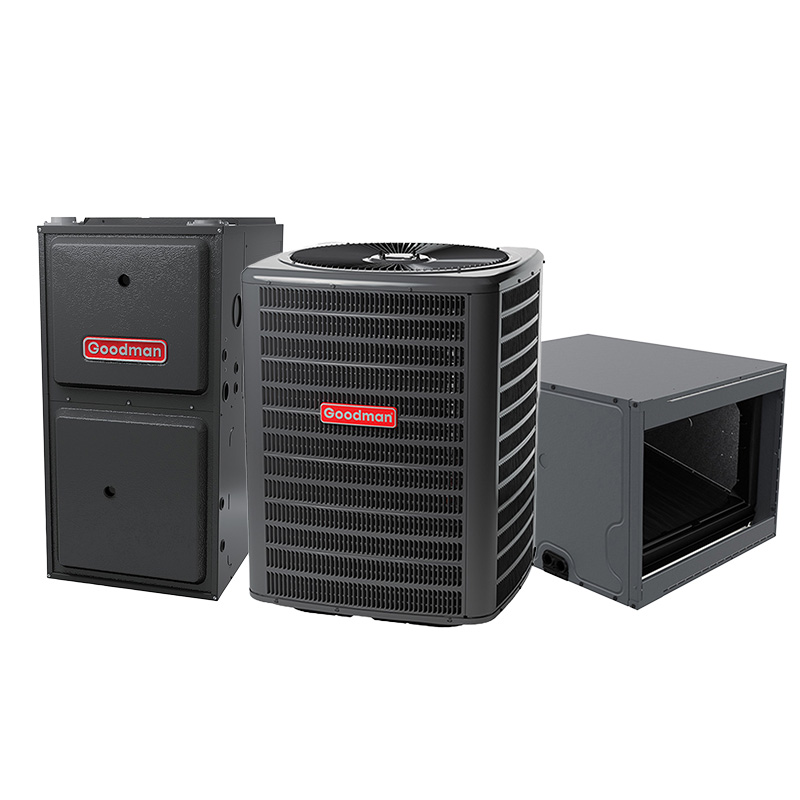
Goodman 3.5 Ton 15 SEER2 AC & Gas Furnace System – Two Stage Variable-Speed, 120000 BTU Gas Furnace, 96% AFUE, Horizontal, R32
View on AC Direct see your lowest price →Check current price on AC Direct →
Key features
- 3.5-ton two-stage cooling rated at 15 SEER2 for improved humidity control and quieter part-load operation
- 120,000 BTU gas furnace at 96% AFUE, qualifying for most utility efficiency rebates
- Variable-speed ECM blower motor for gradual airflow ramp-up and more consistent temperatures
- R-32 refrigerant with lower global warming potential than R-410A, forward-compatible with evolving regulations
- Horizontal configuration designed specifically for attic or crawlspace installations
- Factory-matched system tested as a pair, simplifying AHRI efficiency certification and warranty coverage
About this system
The Goodman GLXS4BA4210 pairs a 3.5-ton, 15 SEER2 two-stage air conditioner with a 120,000 BTU, 96% AFUE variable-speed gas furnace in a horizontal configuration, making it purpose-built for attic or crawlspace installations where upflow or downflow simply will not fit. The R-32 refrigerant charge is a forward-looking choice: R-32 has a lower global warming potential than the R-410A it replaces and is increasingly the industry standard, so sourcing refrigerant for future service should not become the headache it eventually will for older R-22 and transitional R-410A systems.
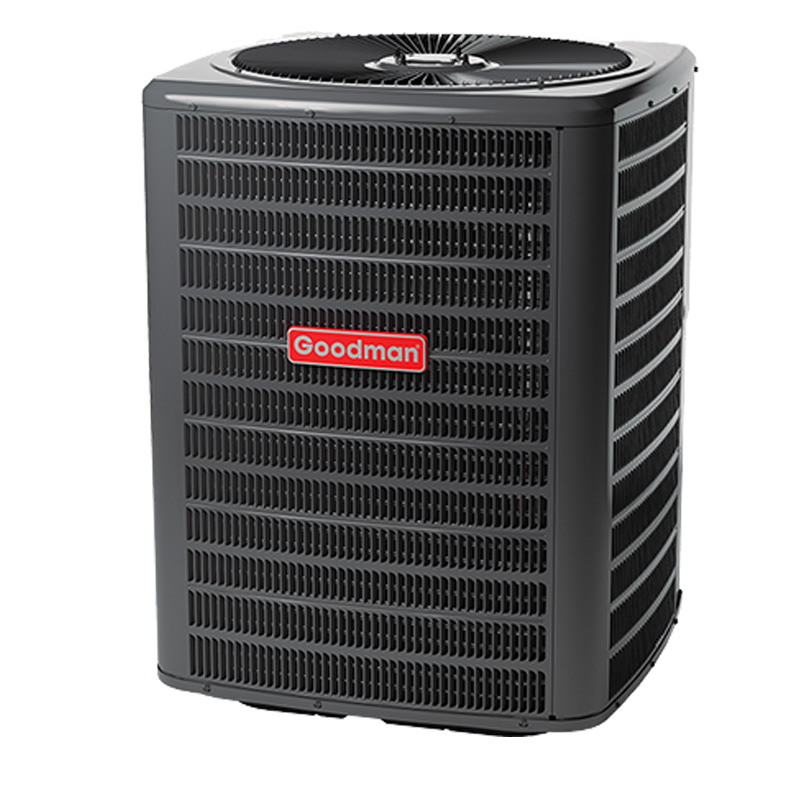
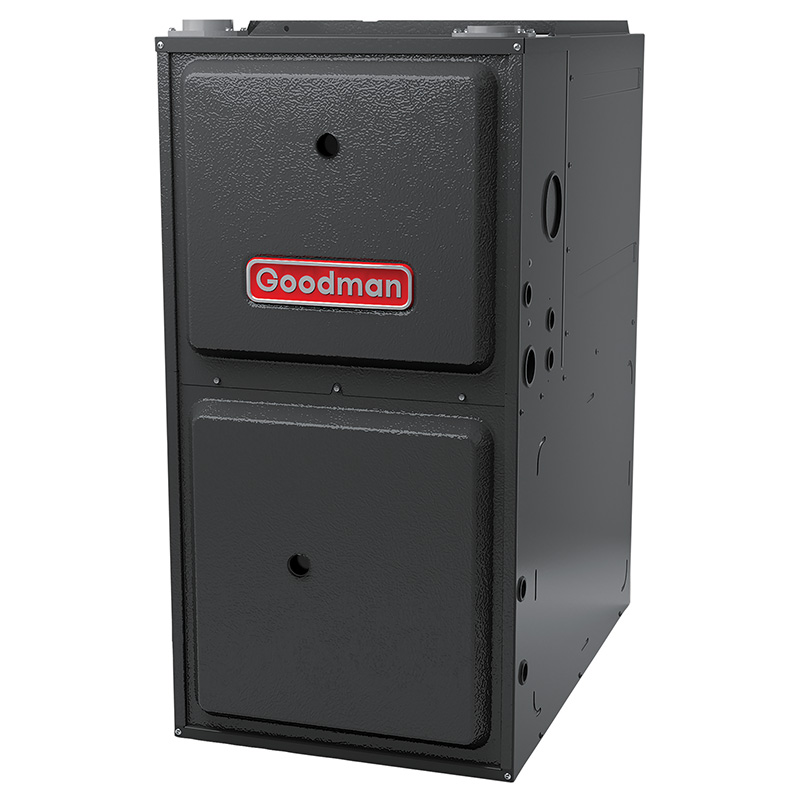
Two-stage cooling means the outdoor unit runs at a reduced capacity on moderate days and steps up only when conditions demand full output. That reduces short-cycling, keeps humidity under better control than a single-stage unit, and generally makes the system quieter during the long shoulder-season hours when it runs most. The variable-speed air handler pairs well with that approach, allowing the blower to ramp up gradually rather than slamming on at full speed, which smooths out temperature swings and helps filter air more effectively per hour. At 96% AFUE, the furnace converts 96 cents of every heating dollar into usable heat, which qualifies it for most utility rebate programs and sits at the practical ceiling of non-condensing-style efficiency in a single-stage heat exchanger design.
This system is sized for larger homes, roughly 1,800 to 2,800 square feet depending on climate zone, insulation, and window load. The horizontal configuration is a real constraint: this unit is not a straightforward swap-in for a standard closet or basement installation. Buyers should confirm their existing air handler location and ductwork orientation before purchasing, and should budget for a licensed installer who has specific experience with horizontal-in-attic setups, because access difficulty raises both labor time and the chance of installation errors that can affect long-term reliability.
The GLXS4BA4210 delivers a capable two-stage, high-efficiency heating and cooling package at a price point meaningfully below Carrier, Trane, and Lennox equivalents, which makes the upfront math attractive for budget-conscious buyers. The trade-off is a brand track record that shows higher-than-average repair activity after the seven-year mark and a compressor lifespan that historically trails premium competitors by several years. For buyers who choose a skilled installer and maintain the system regularly, this package represents solid value; for those who want to minimize service calls over a 15-plus-year horizon, premium brands deserve a genuine look.
Overall score is the average of the five ratings above.
What we like
- Priced 15 to 25 percent below comparable Carrier, Trane, and Lennox systems, leaving room in the budget for a quality install
- Two-stage compressor meaningfully improves humidity removal and comfort versus a single-stage unit at this efficiency tier
- 96% AFUE furnace qualifies for utility rebates in most regions, helping offset purchase cost
- R-32 refrigerant is a practical, lower-impact choice as the industry moves away from R-410A
- Variable-speed blower reduces noise, improves air circulation, and can extend filter life between changes
Trade-offs
- Compressor lifespan averages 10 to 14 years versus 15 to 20 years for premium brands, a real long-term cost factor on a large-tonnage system
- Dual-run capacitor failures are the most commonly documented issue; expect at least one replacement call within the first ten years
- A minority of owners have reported evaporator coil leaks and first-year refrigerant issues, outcomes that hinge heavily on installation quality
- Horizontal-only configuration limits where this unit can be installed and increases labor complexity, which raises install cost and the risk of workmanship errors
What homeowners and pros say about Goodman
Homeowners who review Goodman equipment on platforms like ConsumerAffairs give the brand roughly 2.5 out of 5 stars, and it is worth understanding what that number reflects. ConsumerAffairs skews toward people who had a problem and wanted to be heard, so it captures the frustration of repair bills climbing after roughly year seven more than it captures the experience of an owner whose unit ran quietly for a decade without incident. Google dealer reviews tell a somewhat different story, averaging around 3.8 out of 5 across hundreds of location-level reviews, where the most repeated theme is straightforward: the price was right and the system does what it is supposed to do. Neither number is wrong. They are measuring different parts of the ownership arc.
HVAC technicians who work on Goodman equipment regularly point to two consistent patterns with this brand. First, dual-run capacitors are the most common service call, and while that is a legitimate inconvenience, it is also a repair that usually costs between 300 and 600 dollars and takes less than an hour. Second, and more consequential for a 3.5-ton investment, evaporator coil leaks appear in a meaningful share of owner accounts, and compressor longevity on Goodman units has historically averaged 10 to 14 years rather than the 15 to 20 years documented for premium brands. Technicians also note that first-year refrigerant issues, while affecting only a minority of units, are nearly always traceable to installation rather than a factory defect, which underscores why the quality of whoever installs this system matters at least as much as the equipment itself.
Sources: ConsumerAffairs Goodman owner reviews, AHRI Directory of Certified Product Performance, U.S. DOE appliance and equipment efficiency standards, Goodman product specification sheets.
What it costs to run
At 15 SEER2, cooling this 3.5-ton system for a typical 1200-hour cooling season at the U.S. average electricity rate of $0.17/kWh works out to roughly $571 per year in cooling, about $68 less per year than a minimum-efficiency 13.4 SEER2 unit of the same size. Your real cost depends on your climate and local rate.
Method: (42,000 BTU/hr ÷ 15 SEER2) × 1200 hours ÷ 1000 × $0.17/kWh. Rate source: U.S. EIA average; cooling hours: moderate-climate estimate.
How it compares
| Brand | Comparable model | SEER2 | Stage | Price position |
|---|---|---|---|---|
| Goodman | GLXS4BA4210 | 15 | Two-stage | Value pick |
| Carrier | Performance 16 (24ACC6) with 96% AFUE Fan Coil | 15-16 | Two-stage | Typically 15 to 25 percent more than Goodman |
| Trane | XR15 (4TTR5) with S9X2 96% AFUE Furnace | 15 | Single-stage to two-stage depending on configuration | Typically 15 to 25 percent more than Goodman |
| Lennox | Merit 16ACX with ML96V 96% AFUE Furnace | 15-16 | Single-stage | Typically 15 to 25 percent more than Goodman |
Competitor rows are comparable single-stage units at similar efficiency; price is relative position, not a quote.
Questions about this system
Why does this system only come in a horizontal configuration, and can I install it vertically?
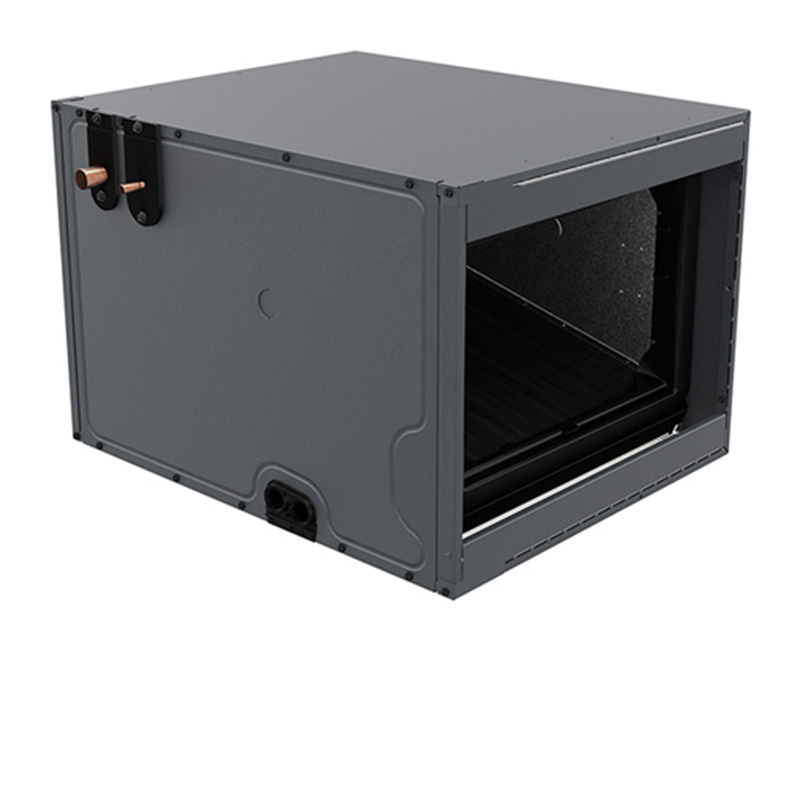
The GLXS4BA4210 air handler is engineered and factory-configured for horizontal airflow, meaning the coil, drain pan, and blower are oriented for attic or crawlspace installations where the unit lies on its side relative to the airflow path. Installing it in an upflow or downflow position would route condensate incorrectly and void the warranty. If your existing system is in a closet or basement, you need a different configuration model.
What does the two-stage compressor actually change about day-to-day comfort compared with the single-stage units I've seen at a lower price?
On mild days the unit runs at its lower stage for longer, continuous cycles rather than short blasts at full power. That extended runtime removes more humidity from the air, reduces temperature swings between thermostat cycles, and is noticeably quieter. The efficiency gain from two-stage operation is real, but the comfort improvement in humid climates is often what owners notice first.
What is the warranty on this system, and does it require registration?
Goodman typically offers a 10-year parts warranty on registered systems, which includes the compressor, heat exchanger, and other major components. Registration must be completed within a set window after installation, and the warranty generally requires installation by a licensed HVAC contractor. Failure to register usually drops coverage to a shorter base period, so registration should be treated as a required step, not optional paperwork.
I've read about dual-run capacitor failures in Goodman units. How serious is that, and what does it cost to fix?
Capacitor failure is the most commonly reported Goodman service call, but it is also one of the least expensive HVAC repairs, typically in the 300 to 600 dollar range including a service visit. The unit will stop cooling or starting properly, which makes it obvious, and most technicians can diagnose and replace a capacitor in under an hour. Keeping a service contract or scheduling annual maintenance can catch a weakening capacitor before it causes a no-cool day in midsummer.
Is R-32 refrigerant harder to find or more expensive to service than the R-410A in my old system?
R-32 is widely available and is now the refrigerant of choice for major manufacturers moving away from R-410A, so supply and technician familiarity are growing rather than shrinking. It does require equipment rated for slightly higher pressures than R-410A, and not every older recovery machine handles it, so confirming your service contractor has current R-32 equipment is worth a quick question before signing a maintenance agreement.
Specifications
| Cooling capacity | 3.5 Ton |
| Efficiency | 15 SEER2 |
| Furnace output | 120000 BTU |
| Furnace efficiency | 96% AFUE |
| Configuration | Horizontal |
| Refrigerant | R-32 |
| Model | GLXS4BA4210 |