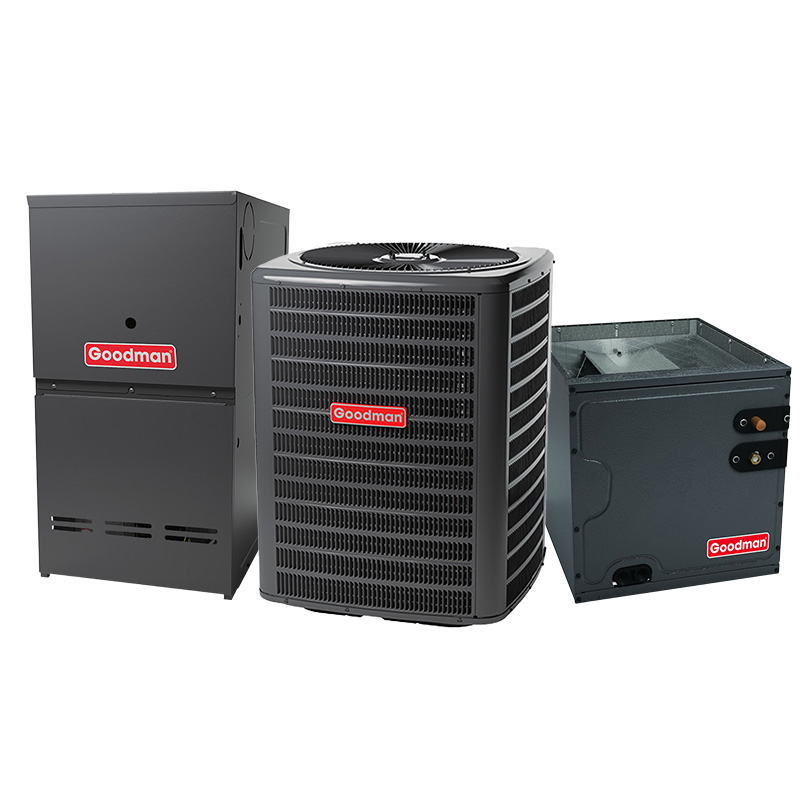
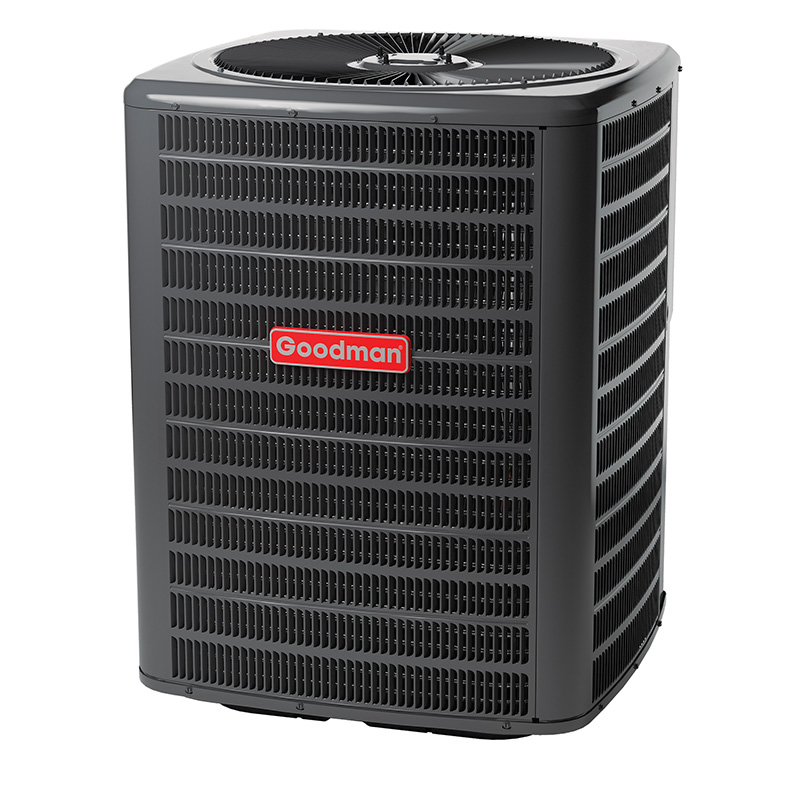
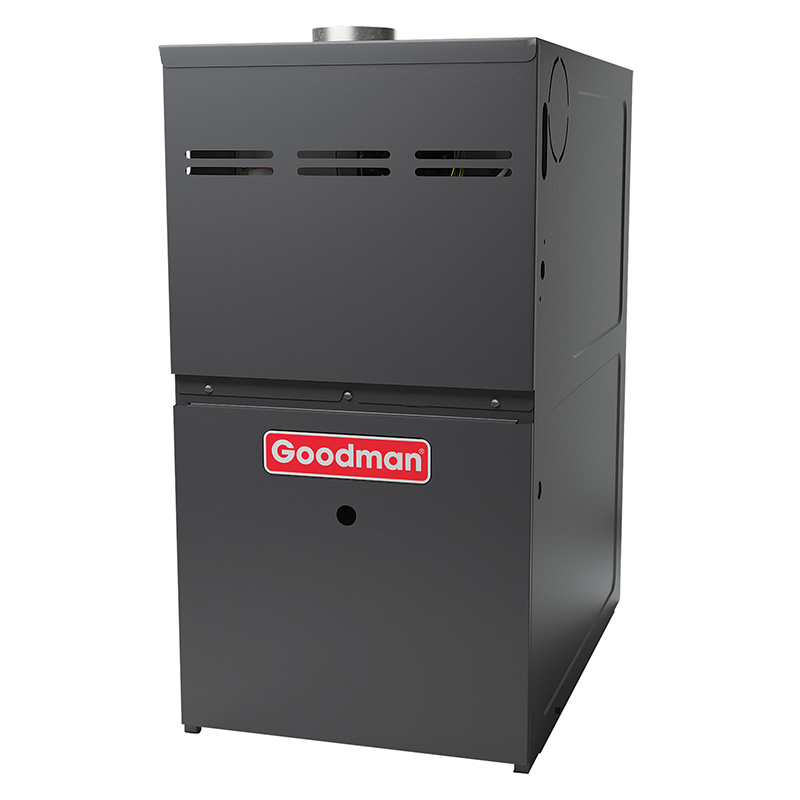
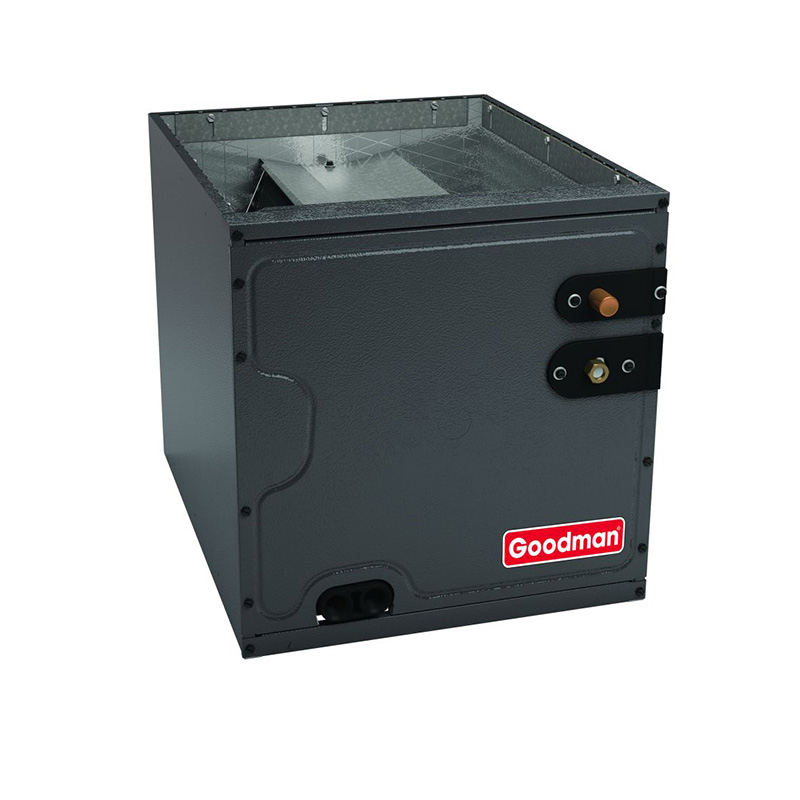
Goodman 3.5 Ton Dual Fuel Hybrid Heat Pump System – 80000 BTU California Low NOx Two Stage Gas Furnace, 80% AFUE, Downflow, 15 SEER2, R32
View on AC Direct see your lowest price →Check current price on AC Direct →
Key features
- Dual-fuel hybrid operation: heat pump handles mild weather, gas furnace covers deep-cold heating demand
- Two-stage 80,000 BTU furnace fires at reduced capacity first, cutting short-cycling and improving comfort
- California Low NOx certified furnace meets strict Southern California and Bay Area air-quality requirements
- Downflow air discharge suits closet or platform installations above conditioned living space
- R-32 refrigerant has a lower global-warming potential than R-410A and is now the industry-standard replacement
- 15 SEER2 / 80% AFUE rating meets current federal minimums and qualifies for standard utility rebates
About this system
The Goodman 3.5-ton dual-fuel hybrid system pairs a 15 SEER2 heat pump with an 80,000 BTU, 80% AFUE two-stage gas furnace in a downflow configuration, making it a practical choice for homeowners in mixed climates who want the efficiency of a heat pump during mild weather and the raw heating power of natural gas when temperatures drop hard. The dual-fuel setup means the system automatically shifts between electric heat pump operation and gas combustion based on outdoor conditions, which can lower monthly energy bills compared to a straight gas system in shoulder seasons while still delivering reliable heat during cold snaps that would strain a heat pump alone.
The downflow configuration sends conditioned air downward through the duct system, which suits homes where the furnace sits in an upper-floor closet or a platform installation above the living space. R-32 refrigerant carries a lower global-warming potential than the R-410A it replaces and runs at slightly lower pressures, though it does require technicians certified to handle mildly flammable refrigerants. At 15 SEER2 and 80% AFUE, the system sits at the regulatory minimum efficiency tier in most U.S. markets, meaning it qualifies for standard rebates in many utility programs but will not earn premium energy-star tier incentives that higher-AFUE or higher-SEER2 systems can unlock. It is a solid mid-entry system, not a high-efficiency showpiece.
This package is worth serious consideration for budget-conscious buyers replacing aging equipment in a 1,500 to 2,200 square foot home, especially in California markets where the Low NOx-certified furnace is required by air-quality regulations. The two-stage furnace fires at a lower capacity most of the time, which improves comfort and humidity control versus a single-stage model and reduces short-cycling. The trade-off is that this is a Goodman, so installation quality and the choosing of a competent contractor will shape the system’s long-term story more than the hardware itself will.
The Goodman 3.5-ton dual-fuel hybrid system delivers a competent, code-compliant heating and cooling solution at a price that undercuts Carrier, Trane, and Lennox by a meaningful margin. The two-stage furnace and hybrid logic are genuine comfort upgrades over basic single-stage alternatives, but the brand's documented track record of capacitor failures, occasional coil leaks, and compressors that tend to fall short of premium-brand lifespans means buyers should budget for maintenance and prioritize a skilled installer above all else. At 80% AFUE and 15 SEER2, operating costs sit at the acceptable end of the efficiency range, not the impressive end.
Overall score is the average of the five ratings above.
What we like
- Price lands 15 to 25 percent below Carrier, Trane, and Lennox systems with comparable specs
- Dual-fuel logic cuts heating costs during mild winters while gas backup handles extreme cold reliably
- Two-stage furnace operation reduces short-cycling and improves indoor humidity and temperature consistency
- California Low NOx certification removes a compliance barrier for buyers in regulated air districts
- R-32 refrigerant is increasingly serviceable as technicians across the country gain certification
Trade-offs
- Dual-run capacitor failures are the most commonly reported repair issue, typically appearing after the first several years of service
- Evaporator coil leaks show up in a meaningful share of owner reviews and can be a costly mid-life repair
- Compressor lifespan averages 10 to 14 years versus 15 to 20 years reported for premium-brand compressors
- 80% AFUE is the lowest efficiency tier available, so owners in cold climates will pay more in gas costs than with a 96% or 98% AFUE alternative
What homeowners and pros say about Goodman
Homeowners who post about Goodman equipment tend to split along a predictable line. On ConsumerAffairs, where the brand scores around 2.5 out of 5, the recurring complaint is repair bills that start stacking up after roughly year seven, with capacitor replacements and coil leaks cited most often. Those are real failure modes: dual-run capacitors are the single most commonly reported hardware issue in Goodman systems, usually a $300 to $600 fix that catches owners off guard if they have not planned for it. Evaporator coil leaks surface in a meaningful share of longer-term owner reports and represent a more serious mid-life expense. Compressor longevity, averaging 10 to 14 years in documented accounts, runs shorter than the 15 to 20 years owners of premium-brand systems report. That gap matters most to buyers who plan to stay in a home for 15-plus years.
On Google dealer review pages, Goodman sits closer to 3.8 out of 5 across aggregated dealer locations, and the most consistent praise is straightforward: these systems cost less to buy and they do the job when installed correctly. HVAC technicians frequently point out that installation quality is the largest single variable in how long any Goodman unit runs without trouble, and that framing is important for this specific dual-fuel hybrid configuration. A dual-fuel system adds a layer of commissioning complexity, including balance-point calibration and proper refrigerant charge of the R-32 circuit, where an inexperienced installer can create problems that look like hardware failures. The honest picture is that this system rewards buyers who vet their contractor as carefully as they vet the equipment itself.
Sources: ConsumerAffairs Goodman owner reviews, AHRI Directory of Certified Product Performance, U.S. DOE appliance and equipment efficiency standards, Goodman product specification sheets.
What it costs to run
At 15 SEER2, cooling this 3.5-ton system for a typical 1200-hour cooling season at the U.S. average electricity rate of $0.17/kWh works out to roughly $571 per year in cooling, about $68 less per year than a minimum-efficiency 13.4 SEER2 unit of the same size. Your real cost depends on your climate and local rate.
Method: (42,000 BTU/hr ÷ 15 SEER2) × 1200 hours ÷ 1000 × $0.17/kWh. Rate source: U.S. EIA average; cooling hours: moderate-climate estimate.
How it compares
| Brand | Comparable model | SEER2 | Stage | Price position |
|---|---|---|---|---|
| Goodman | 3.5-Ton Dual Fuel Hybrid / 80K BTU 80% AFUE Downflow Two-Stage (this system) | 15 | Two-stage | Value pick |
| Carrier | Performance Series Dual Fuel (58TP / 25VNA matching) | 15-16 | Single-stage | Typically 15 to 25 percent more than this Goodman system |
| Trane | S8X1 80% AFUE / XR15 Heat Pump Dual Fuel pairing | 15 | Single-stage | Typically 15 to 25 percent more than this Goodman system |
| Lennox | ML180 80% AFUE / XP15 Heat Pump Dual Fuel pairing | 15 | Single-stage | Typically 15 to 25 percent more than this Goodman system |
Competitor rows are comparable single-stage units at similar efficiency; price is relative position, not a quote.
Questions about this system
How does the dual-fuel system decide when to run the heat pump versus the gas furnace?
The system uses a balance-point setting, usually programmed by your installer, that tells it to switch from heat pump to gas when outdoor temperatures drop below a certain threshold, often between 30 and 40 degrees Fahrenheit. Below that point the heat pump loses efficiency and the gas furnace takes over. Getting this balance-point set correctly during commissioning is important for both comfort and operating costs.
Why does the furnace need to be California Low NOx certified, and does that matter outside California?
California air-quality regulations, primarily enforced by the South Coast and Bay Area AQMDs, require residential furnaces to meet stricter nitrogen oxide emission limits than federal standards demand. Outside of California and a handful of other regulated districts, a Low NOx certification has no practical impact on the buyer, though it does not hurt performance or efficiency in any way.
What is the most common repair I should plan for with this Goodman system?
Dual-run capacitors are the most frequently reported failure point in Goodman equipment, and a replacement typically costs between $300 and $600 including labor. Scheduling an annual tune-up where a technician checks capacitor health can catch this before it causes a no-cool or no-heat call. Evaporator coil leaks are a more expensive issue that some owners encounter in the middle years of the system's life.
Is R-32 refrigerant harder to service than the R-410A I am used to?
R-32 is mildly flammable, which requires technicians to have specific training and equipment to handle it safely, and not every local HVAC company is set up for it yet. That said, the industry is actively transitioning to R-32 and A2L refrigerants broadly, so service availability is improving steadily. When hiring a contractor, confirm upfront that they are A2L-certified before they work on this system.
Will this system work with my existing downflow ductwork, or do I need modifications?
A downflow furnace requires the supply plenum and ductwork to connect below the unit, which is a specific physical configuration. If your current system is also a downflow installation, the swap is generally straightforward. If your existing ductwork is set up for upflow or horizontal discharge, significant modifications or a different furnace orientation would be required, and that cost should be factored into your decision.
Specifications
| Cooling capacity | 3.5 Ton |
| Efficiency | 15 SEER2 |
| Furnace output | 80000 BTU |
| Furnace efficiency | 80% AFUE |
| Configuration | Downflow |
| Refrigerant | R-32 |