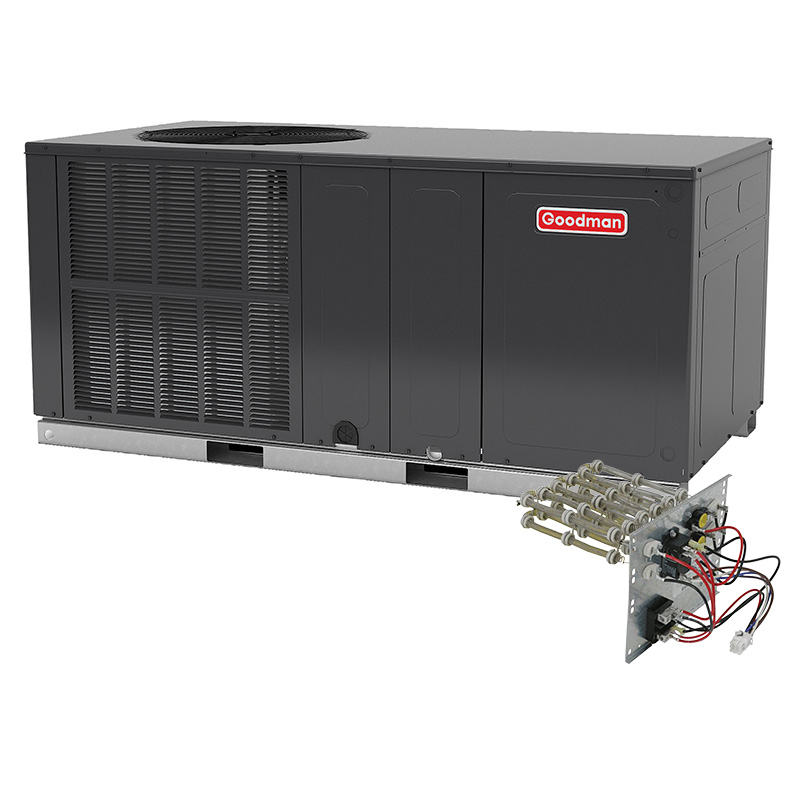
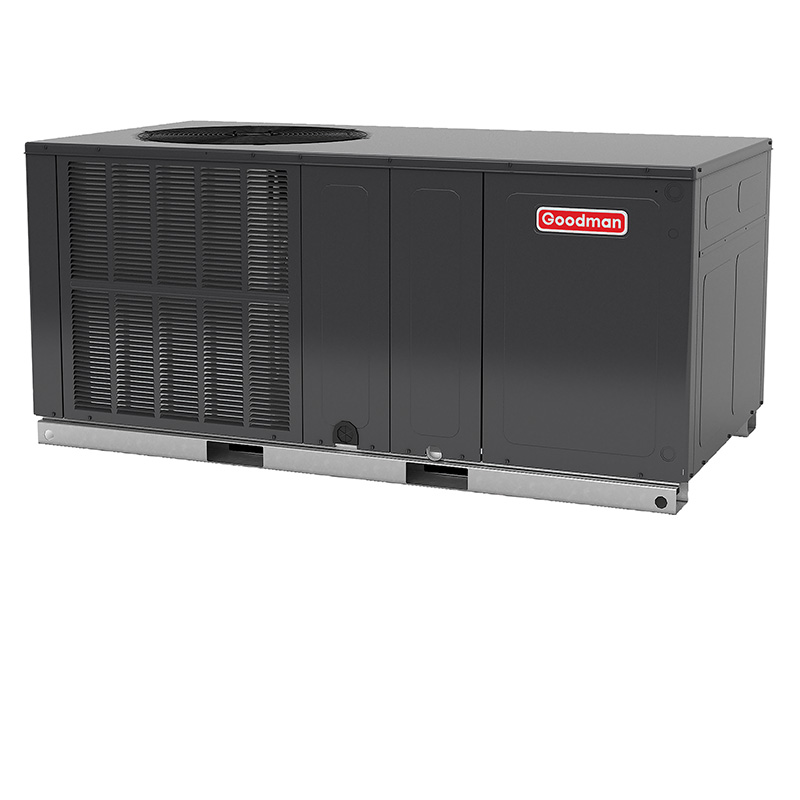
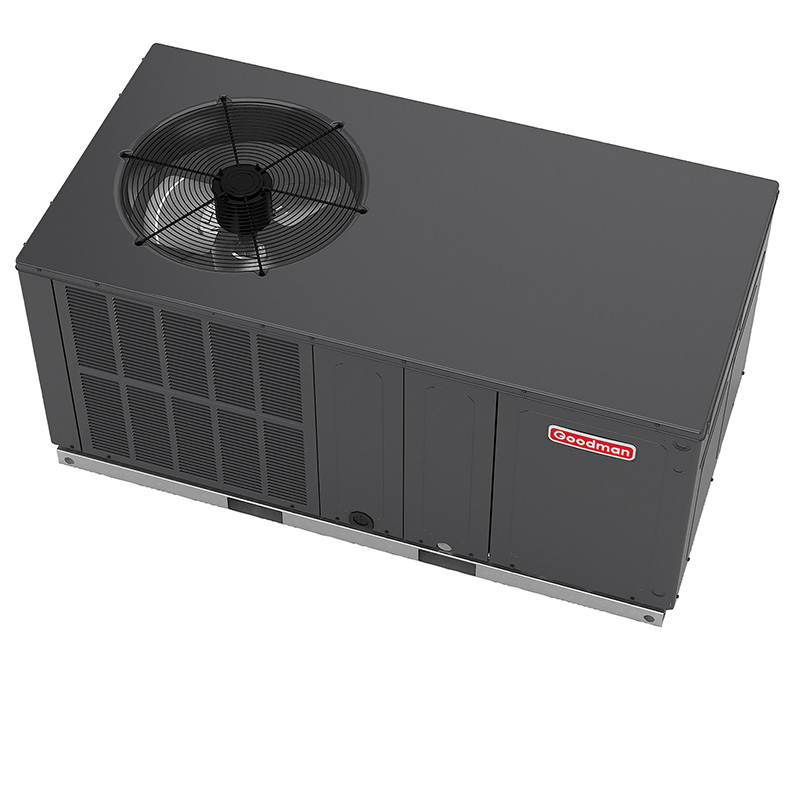
Goodman 3.5 Ton Heat Pump Package Unit – 15.2 SEER2, Horizontal Discharge, R32
View on AC Direct see your lowest price →Check current price on AC Direct →
Key features
- 15.2 SEER2 efficiency rating, exceeding federal minimums for most U.S. climate regions
- Horizontal-discharge, all-in-one package unit design for under-floor or rooftop installations
- R-32 refrigerant with lower global warming potential than legacy R-410A systems
- 3.5-ton capacity sized for approximately 1,600 to 2,200 square feet depending on load
- Single-stage scroll compressor providing straightforward operation and serviceability
- Factory-tested, pre-charged unit reduces field assembly compared to split-system installations
About this system
The Goodman 3.5-ton heat pump package unit delivers 15.2 SEER2 efficiency in a self-contained horizontal-discharge cabinet, meaning the entire heating and cooling system ships as one unit rather than two separate indoor and outdoor pieces. That configuration makes it a natural fit for manufactured homes, mobile homes, crawlspace installations, and any structure where a horizontal rooftop or under-floor mount is the only practical option. At 3.5 tons of capacity, it is sized for roughly 1,600 to 2,200 square feet depending on climate zone, insulation, and duct condition.
The switch to R-32 refrigerant is a meaningful spec detail for buyers planning ahead. R-32 has a lower global warming potential than the R-410A found in older inventory, and it is the direction the HVAC industry is moving as EPA phase-down rules tighten. Parts availability for R-32 systems is growing, though technicians in some rural markets may have less hands-on experience with it right now. The 15.2 SEER2 rating clears the federal minimum efficiency threshold for most U.S. regions by a meaningful margin without reaching the higher-cost variable-speed territory, which is a reasonable compromise for homeowners who want compliant efficiency without paying a premium for technology they may not fully utilize in a moderate climate.
This Goodman package unit is a competent, code-compliant heat pump for buyers who need a horizontal-discharge configuration and want to keep upfront costs down. The 15.2 SEER2 rating is honest mid-tier efficiency, and the R-32 refrigerant future-proofs the system against near-term regulatory changes. The trade-off is a brand track record that shows shorter average compressor life and a higher rate of component issues after year seven compared to premium-tier competitors.
Overall score is the average of the five ratings above.
What we like
- Priced 15 to 25 percent below comparable Carrier, Trane, and Lennox package units
- Horizontal-discharge cabinet opens installation options unavailable with vertical split systems
- R-32 refrigerant aligns with upcoming EPA phase-down regulations, protecting future serviceability
- 15.2 SEER2 clears regional efficiency minimums and delivers meaningful operating cost savings over older R-22 or low-SEER systems it typically replaces
- Self-contained package unit simplifies the installation footprint and reduces leak points versus a split system
Trade-offs
- Dual-run capacitors are the most commonly reported failure point, typically adding a repair call in the $300 to $600 range sometime during the unit's life
- Evaporator coil leaks appear in a notable share of owner reports, a failure mode that can be costly and time-consuming to address
- Compressor lifespan averages 10 to 14 years in owner data, roughly 3 to 6 years shorter than premium-brand compressors tend to last
- A minority of owners have reported refrigerant leaks within the first year, most often traced to install or charge quality rather than the unit itself
What homeowners and pros say about Goodman
Homeowners who follow up on their Goodman package unit purchases tend to fall into two distinct camps. Those who had a meticulous installation and who schedule annual maintenance often report years of dependable, low-drama operation, which aligns with the roughly 3.8 out of 5 score Goodman earns in Google dealer reviews, where affordability and straightforward performance are the most repeated positives. The other camp, more visible on complaint-oriented channels like ConsumerAffairs where Goodman scores around 2.5 out of 5, reports frustration with repair bills that begin climbing after year seven, particularly around evaporator coil leaks and compressor wear. The gap between those two groups tends to narrow when you look closely at install quality and maintenance history.
HVAC technicians are generally candid about Goodman: it is a brand that rewards a careful startup and punishes a sloppy one. The dual-run capacitor is widely cited among service professionals as the first component to watch, a known weak point that can be addressed cheaply if caught early but that can shorten compressor life if it fails quietly and causes hard-start stress over time. Coil leaks and refrigerant loss within the first year are also documented in owner feedback, and pros consistently flag these as installation or charge-quality issues rather than manufacturing defects. The compressor lifespan averaging 10 to 14 years versus the 15 to 20 years reported for premium-brand compressors is the most honest long-term trade-off, and it is the number serious buyers should factor into their total cost of ownership calculation before choosing on upfront price alone.
Sources: ConsumerAffairs Goodman owner reviews, AHRI Directory of Certified Product Performance, U.S. DOE appliance and equipment efficiency standards, Goodman product specification sheets.
What it costs to run
At 15.2 SEER2, cooling this 3.5-ton system for a typical 1200-hour cooling season at the U.S. average electricity rate of $0.17/kWh works out to roughly $564 per year in cooling, about $75 less per year than a minimum-efficiency 13.4 SEER2 unit of the same size. Your real cost depends on your climate and local rate.
Method: (42,000 BTU/hr ÷ 15.2 SEER2) × 1200 hours ÷ 1000 × $0.17/kWh. Rate source: U.S. EIA average; cooling hours: moderate-climate estimate.
How it compares
| Brand | Comparable model | SEER2 | Stage | Price position |
|---|---|---|---|---|
| Goodman | 3.5-Ton Heat Pump Package Unit, 15.2 SEER2, R-32, Horizontal | 15.2 | Single-stage | Value pick |
| Carrier | WeatherMaster 50XC Series Package Heat Pump | 15.2 | Single-stage | Typically 15 to 25 percent more than Goodman |
| Trane | Precedent Series Package Heat Pump | 15.0-16.0 | Single-stage | Typically 15 to 25 percent more than Goodman |
| Lennox | HP/HC Series Package Heat Pump | 15.2 | Single-stage | Typically 15 to 25 percent more than Goodman |
Competitor rows are comparable single-stage units at similar efficiency; price is relative position, not a quote.
Questions about this system
Will HVAC technicians in my area know how to service an R-32 system?
R-32 is becoming more common, and most licensed technicians can handle it, but familiarity varies by region. Before buying, it is worth calling two or three local HVAC companies to confirm they stock R-32 and have experience with it, especially if you are in a rural area.
Is a horizontal package unit harder to install than a standard split system?
For the right application, a horizontal package unit is actually simpler because refrigerant lines, electrical, and ductwork all connect at one cabinet. The complexity comes from ensuring the mounting platform or curb is level and properly supported, and that horizontal duct connections are sealed correctly. A technician experienced with manufactured homes or rooftop package units will handle this routinely.
What is the most likely repair this unit will need, and how much does it cost?
Dual-run capacitors are the most frequently reported failure on Goodman units. They are a relatively straightforward repair, typically running $300 to $600 including labor, and most technicians can complete the job in under an hour. Keeping a service contract or having your installer note the capacitor spec at startup can help you catch a weakening capacitor before it causes a compressor hard-start situation.
How does 15.2 SEER2 compare to what I might already have, and will I see lower electric bills?
If you are replacing a unit from the early 2000s or older, which was likely rated at 10 to 13 SEER under the old testing standard, you will likely see a noticeable reduction in cooling and heating electricity use. The exact savings depend on your climate, utility rates, and how well your duct system is sealed, so an energy savings calculator using your actual billing data will give you a better estimate than any general figure.
Does Goodman's warranty cover both parts and labor on this unit?
Goodman's standard limited warranty covers parts for 10 years when registered within 60 days of installation, but it does not include labor costs. Labor warranties, if any, come from the installing contractor rather than the manufacturer. Before signing an installation contract, confirm whether the installer offers a separate labor warranty and for how long, since labor can represent the majority of a repair bill.
Specifications
| Cooling capacity | 3.5 Ton |
| Efficiency | 15.2 SEER2 |
| Configuration | Horizontal |
| Refrigerant | R-32 |