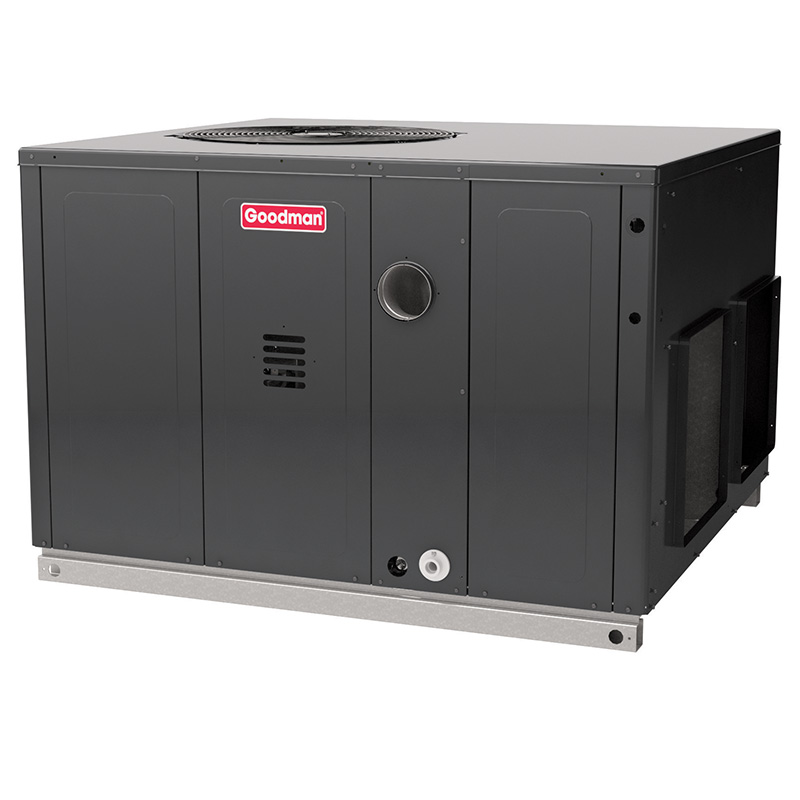
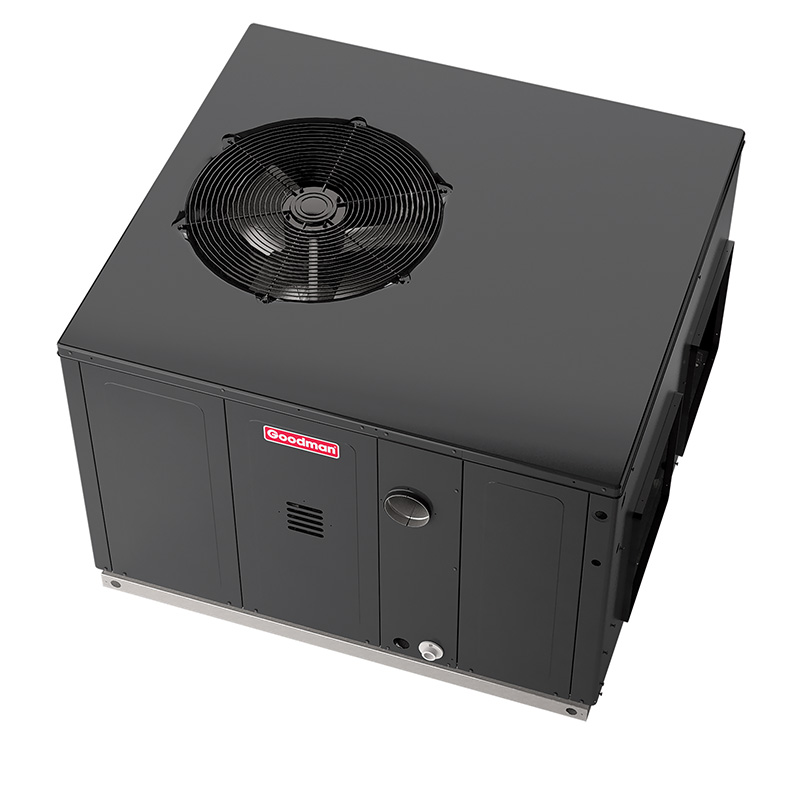
Goodman 3.5 Ton Package Unit Gas / Electric AC – 81% Efficiency 100000 BTU | 15.2 SEER2 Multi-Positional | R32
View on AC Direct see your lowest price →Check current price on AC Direct →
Key features
- 15.2 SEER2 cooling efficiency meets current federal minimums for most regions
- 100,000 BTU gas heat at 81% AFUE in a single outdoor cabinet
- Multi-positional cabinet supports rooftop downflow or ground-level horizontal install
- R-32 refrigerant with lower global warming potential than R-410A
- 3.5-ton capacity sized for approximately 1,600 to 2,200 square feet
- All-in-one package design eliminates the need for indoor air handling equipment
About this system
The Goodman GPGM54210031 is a 3.5-ton self-contained package unit that combines a gas furnace and central air conditioner in a single outdoor cabinet. At 100,000 BTU of heating output and 15.2 SEER2 cooling efficiency, it sits at the entry point of the mid-efficiency tier, meeting the federally mandated minimums for most U.S. climate regions while offering a meaningful step above older baseline equipment. The multi-positional design means it can be installed in a downflow rooftop configuration or a horizontal ground-level setup, which gives contractors flexibility on commercial buildings, mobile homes, and slab-built residences where a split system is not practical. R-32 refrigerant, now standard across Goodman’s newer lineup, carries a lower global warming potential than the R-410A it replaces and is slightly more efficient in heat transfer.
Package units appeal to a specific buyer: someone who needs the entire heating and cooling system outside the conditioned space, either because interior mechanical room square footage is limited or because the structure was originally built around this configuration. The 3.5-ton capacity targets homes roughly in the 1,600 to 2,200 square foot range, though actual sizing depends on insulation levels, window area, and local design temperatures. The 81 percent AFUE furnace section is a standard-efficiency heat exchanger, not a condensing unit, so it does not require a dedicated condensate drain line and vents with conventional B-vent or direct flue. Buyers in colder climates who run the furnace heavily for six or more months a year should weigh whether the fuel cost difference between 81 percent and a 95-plus percent alternative justifies the price gap before committing.
The GPGM54210031 is a sensible choice when budget and configuration requirements point toward a package unit and top-tier efficiency is not the priority. It delivers adequate cooling and heating performance for a price that typically runs 15 to 25 percent below comparable Carrier, Trane, or Lennox units, but buyers should budget for potential capacitor replacement after year five to seven and vet installer credentials carefully, since Goodman's real-world longevity is more install-dependent than most premium brands.
Overall score is the average of the five ratings above.
What we like
- Lower upfront cost versus comparable Carrier, Trane, and Lennox package units
- R-32 refrigerant is more environmentally responsible than R-410A and increasingly serviceable
- Multi-positional cabinet simplifies replacement installs where rooftop or horizontal mounting is already in place
- 15.2 SEER2 clears federal efficiency standards without an inflated price premium
- Single outdoor cabinet reduces the number of refrigerant connections and potential leak points compared to a split system
Trade-offs
- 81% AFUE is the low end of current gas efficiency; heavy heating users will see higher annual fuel costs than with a condensing alternative
- Compressor lifespan averages 10 to 14 years versus 15 to 20 years documented in premium brands, meaning a mid-life replacement is a realistic budget item
- Dual-run capacitors are the most reported failure component and, while relatively inexpensive to fix, can strand occupants without heat or cooling if not caught early
- Evaporator coil leaks appear in a meaningful share of owner reports and can be a costly repair outside the warranty period
What homeowners and pros say about Goodman
Owners who praise this Goodman package unit most often point to the upfront price as the deciding factor, and that sentiment shows up consistently in Google dealer reviews where Goodman locations average around 3.8 out of 5. In the package unit category specifically, the all-in-one configuration is cited as a straightforward swap for contractors familiar with rooftop or slab installs, and first-year performance complaints are relatively rare when a qualified technician commissions the system properly. The R-32 refrigerant is a newer addition that some HVAC pros note requires updated recovery equipment, but most shops serving commercial or multi-unit residential markets are already equipped.
The less encouraging picture emerges on ConsumerAffairs, where Goodman sits at roughly 2.5 out of 5 across its product line, a channel that skews toward frustrated owners rather than satisfied ones. The recurring themes are repair bills that accelerate after year seven and, in a smaller share of reports, refrigerant leaks that appear early and point back to install quality. For this specific unit, the documented failure modes to watch are dual-run capacitor failures (typically a manageable $300 to $600 fix), evaporator coil leaks that can be more costly outside the warranty window, and a compressor lifespan that averages 10 to 14 years rather than the 15 to 20 years that Trane, Carrier, and Lennox owners more often report. HVAC technicians consistently note that the gap between a trouble-free Goodman and a problematic one often comes down to who installed it, making contractor selection as important as the equipment choice itself.
Sources: ConsumerAffairs Goodman owner reviews, AHRI Directory of Certified Product Performance, U.S. DOE appliance and equipment efficiency standards, Goodman product specification sheets.
What it costs to run
At 15.2 SEER2, cooling this 3.5-ton system for a typical 1200-hour cooling season at the U.S. average electricity rate of $0.17/kWh works out to roughly $564 per year in cooling, about $75 less per year than a minimum-efficiency 13.4 SEER2 unit of the same size. Your real cost depends on your climate and local rate.
Method: (42,000 BTU/hr ÷ 15.2 SEER2) × 1200 hours ÷ 1000 × $0.17/kWh. Rate source: U.S. EIA average; cooling hours: moderate-climate estimate.
How it compares
| Brand | Comparable model | SEER2 | Stage | Price position |
|---|---|---|---|---|
| Goodman | GPGM54210031 | 15.2 | Single-stage | Value pick |
| Carrier | WeatherMaster 50XC Series | 15.2 | Single-stage | Typically 15 to 25 percent more than Goodman |
| Trane | YSC060 Series | 15.2 | Single-stage | Typically 15 to 25 percent more than Goodman |
| Lennox | LRP16GE Series | 16.0 | Single-stage | Typically 15 to 25 percent more than Goodman |
Competitor rows are comparable single-stage units at similar efficiency; price is relative position, not a quote.
Questions about this system
Can this package unit be installed on a rooftop as well as at ground level?
Yes. The multi-positional cabinet is designed for both downflow rooftop and horizontal ground-level installations. Your contractor will need to confirm that the curb dimensions or pad configuration match and that local codes allow the venting arrangement for the gas section in your specific setup.
How does R-32 refrigerant affect service costs compared to the R-410A systems I am replacing?
R-32 is gradually becoming more widely stocked by distributors and HVAC supply houses, so availability is improving, though it is not yet as universally on hand as R-410A was. It is mildly flammable (A2L classification), which requires technicians to use compatible recovery equipment and follow updated handling procedures. In most markets this does not meaningfully increase service call costs today, but confirm your local technicians carry the right equipment before signing a maintenance contract.
What does the 81% AFUE rating mean for my monthly gas bill compared to a 95% unit?
An 81% AFUE furnace converts 81 cents of every dollar of gas into usable heat, versus 95 cents for a condensing unit. On a $1,200 annual gas heating bill that gap is roughly $168 per year. If the price difference between an 81% and a 95% package unit is $800 to $1,200, the payback period runs five to seven years, which matters more in colder climates where the furnace runs frequently.
How concerned should I be about the refrigerant leaks some owners report in the first year?
First-year refrigerant leaks in Goodman equipment are most often traced to installation issues, including improper line connections or an incorrect charge, rather than factory defects. Choosing a licensed contractor with documented Goodman or package unit experience and verifying the system is commissioned with a proper charge and leak test significantly reduces this risk. If a leak does appear in year one, it is typically covered under warranty, but diagnosing and re-charging still requires a service visit.
What is the realistic service life of this unit, and what maintenance items should I plan for?
Based on documented owner experience, Goodman compressors tend to average 10 to 14 years rather than the 15 to 20 years seen in premium brands. Dual-run capacitors are the most commonly replaced component, often around year five to seven, and typically cost $300 to $600 to replace including labor. Annual filter changes, coil cleaning, and a seasonal tune-up that includes capacitor testing are the best ways to get the most service years out of this unit.
Specifications
| Cooling capacity | 3.5 Ton |
| Efficiency | 15.2 SEER2 |
| Furnace output | 100000 BTU |
| Configuration | Multi-Position |
| Refrigerant | R-32 |
| Model | GPGM54210031 |