Goodman 3.5 Ton Package Unit Heat Pump & AC | 13.4 SEER2 Horizontal Discharge | R32
View on AC Direct see your lowest price →Check current price on AC Direct →
Key features
- 3.5-ton capacity in a self-contained horizontal-discharge package unit
- 13.4 SEER2 efficiency rating, meeting current federal minimums
- R-32 refrigerant with lower global warming potential than R-410A
- Single-stage compressor operation for straightforward, proven control
- Combined heat pump and AC function in one outdoor cabinet
- Horizontal airflow discharge suited to mobile home and crawl-space installs
About this system
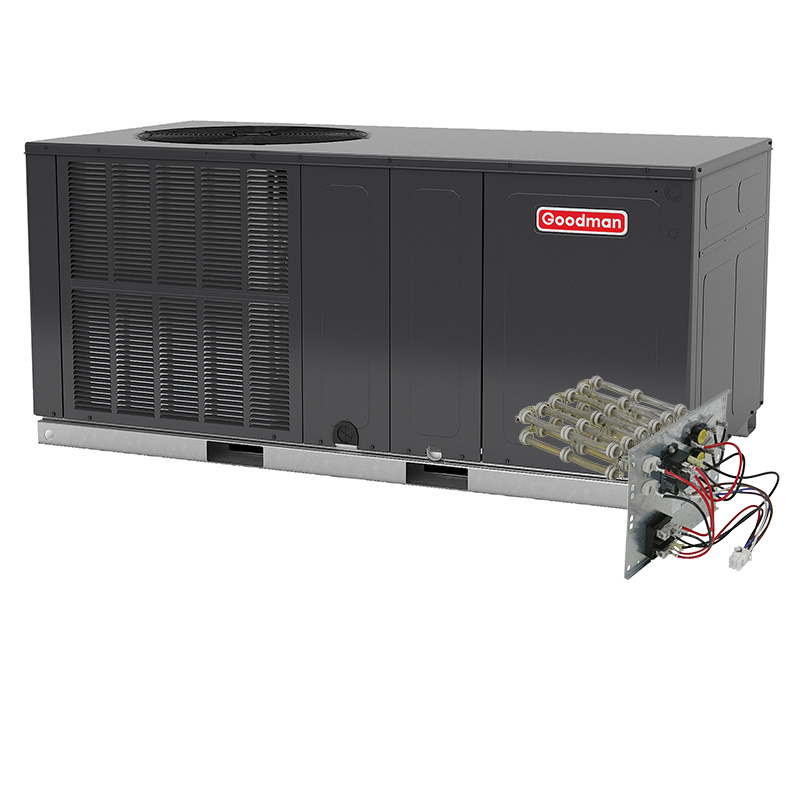
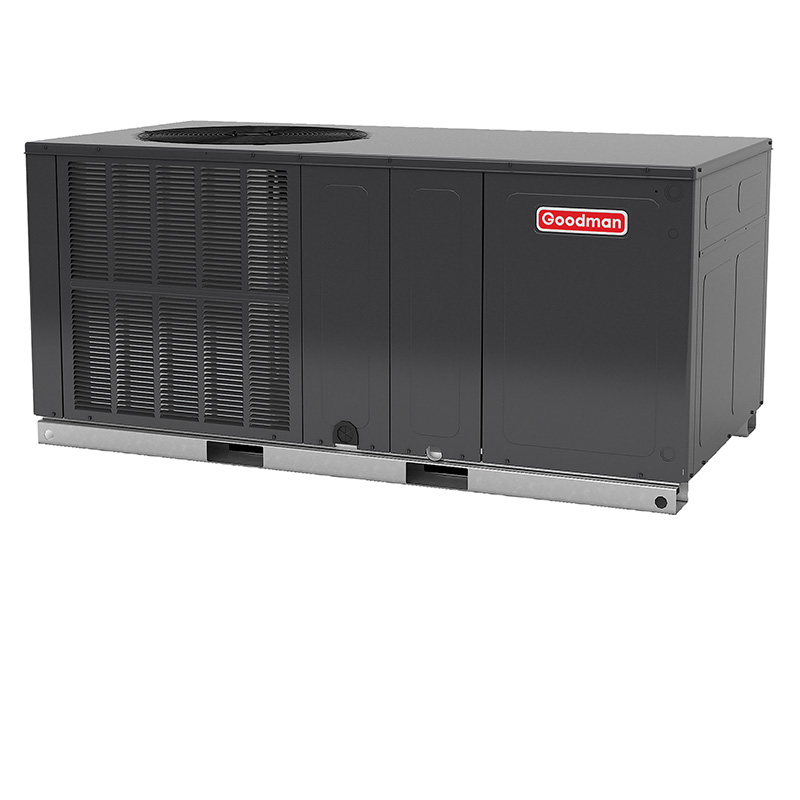
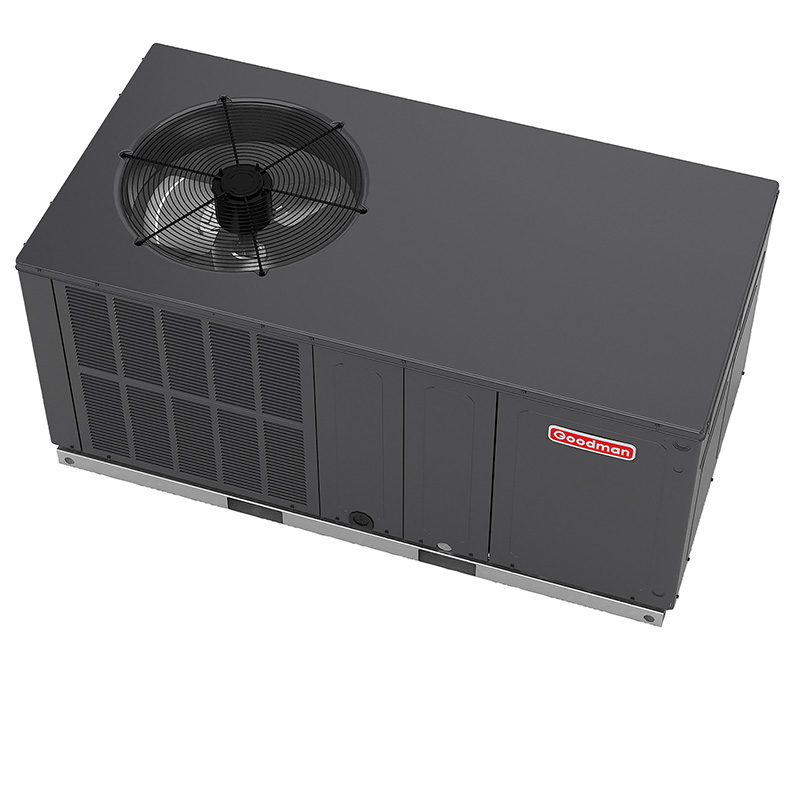
The Goodman 3.5-ton horizontal-discharge package unit combines a heat pump and air conditioner in a single outdoor cabinet, making it a practical choice for mobile homes, manufactured housing, and crawl-space or utility-closet installations where a side-discharge configuration is required. At 13.4 SEER2, it meets the current federal minimum efficiency standard for most U.S. climate zones and will run meaningfully more efficiently than older equipment being replaced, though it sits at the entry tier rather than the mid or high tier of today’s market.
The use of R-32 refrigerant is a genuine forward-looking specification. R-32 has a lower global warming potential than the R-410A it replaces and is already the dominant refrigerant across commercial markets globally. It also operates at slightly higher efficiency by nature, which is part of how Goodman hits 13.4 SEER2 at this price point. On the practical side, R-32 requires technicians who are current on handling procedures, so confirming your installer is familiar with it before scheduling is worthwhile. As a single-stage unit, the compressor runs at full capacity whenever it cycles on, which is fine for most climates but means it will short-cycle on mild days rather than modulating down the way a two-stage or variable-speed unit would.
This system suits homeowners who need a dependable, budget-conscious replacement in a horizontal-discharge application and who understand that long-term satisfaction with Goodman equipment correlates closely with a careful install and a maintenance plan. It is not the right fit for buyers prioritizing the lowest possible utility bills or the longest expected compressor lifespan without periodic repair costs factored in.
The Goodman 3.5-ton horizontal package heat pump is a cost-accessible entry-tier unit that does its job when installed correctly, but buyers should budget for the realistic possibility of a capacitor replacement or coil inspection somewhere in the 7-to-10-year range. It is priced meaningfully below comparable Carrier, Trane, and Lennox equipment, and that gap is real, but so are the trade-offs in expected compressor longevity and long-term repair frequency. If budget is the primary constraint and you pair it with a qualified installer, it represents a reasonable value; if you plan to own the home for 15-plus years and want to minimize service calls, stepping up to a premium brand deserves serious consideration.
Overall score is the average of the five ratings above.
What we like
- Priced roughly 15 to 25 percent below comparable Carrier, Trane, and Lennox units
- R-32 refrigerant is a forward-looking, lower-GWP choice
- Horizontal discharge configuration covers mobile home and specialty installs that vertical units cannot
- 13.4 SEER2 is a measurable efficiency improvement over aging R-22 or early R-410A equipment
- All-in-one package design simplifies the installation footprint and reduces refrigerant line complexity
Trade-offs
- Compressor lifespan averages 10 to 14 years, compared to 15 to 20 years reported for premium brands
- Dual-run capacitor failures are a documented and recurring maintenance cost, typically in the $300 to $600 range
- Evaporator coil leaks appear in a meaningful share of owner reviews, particularly past year seven
- Single-stage operation means full-capacity cycling on mild days, reducing comfort precision and efficiency in moderate weather
What homeowners and pros say about Goodman
On ConsumerAffairs, Goodman holds around 2.5 out of 5 stars, a score shaped by that platform’s tendency to attract complaint-driven reviews. The recurring pattern in those reviews is not early catastrophic failure but rather escalating repair costs after roughly year seven, with dual-run capacitor failures and evaporator coil leaks mentioned most often. Google dealer reviews land in a more favorable range, around 3.8 out of 5 across multiple dealer locations, where affordability is consistently the most cited reason for choosing the brand. HVAC technicians tend to describe Goodman as workable equipment whose longevity depends heavily on the quality of the original installation, with a compressor lifespan that averages 10 to 14 years versus the 15 to 20 years commonly reported for Trane, Carrier, and Lennox compressors.
For this specific 3.5-ton horizontal package heat pump, the R-32 refrigerant is a detail that comes up in installer conversations, since it requires current A2L certification and compatible service equipment. Owners who report satisfaction with Goodman units in this configuration tend to be in manufactured housing, where the horizontal discharge is a practical necessity rather than a preference, and where the lower purchase price matters more than it might in a standard site-built home with more installation options. The documented failure modes to watch for are consistent with the broader Goodman product line: budget for a capacitor replacement at some point in the service life, have the coils inspected during annual maintenance, and verify that refrigerant charge was set correctly at install, since a minority of early refrigerant leak reports trace back to installation rather than the equipment itself.
Sources: ConsumerAffairs Goodman owner reviews, AHRI Directory of Certified Product Performance, U.S. DOE appliance and equipment efficiency standards, Goodman product specification sheets.
What it costs to run
At 13.4 SEER2, cooling this 3.5-ton system for a typical 1200-hour cooling season at the U.S. average electricity rate of $0.17/kWh works out to roughly $639 per year in cooling, about $0 less per year than a minimum-efficiency 13.4 SEER2 unit of the same size. Your real cost depends on your climate and local rate.
Method: (42,000 BTU/hr ÷ 13.4 SEER2) × 1200 hours ÷ 1000 × $0.17/kWh. Rate source: U.S. EIA average; cooling hours: moderate-climate estimate.
How it compares
| Brand | Comparable model | SEER2 | Stage | Price position |
|---|---|---|---|---|
| Goodman | 3.5-Ton Horizontal Package Heat Pump | 13.4 | Single-stage | Value pick |
| Carrier | Comfort Series Package Heat Pump (50XC) | 14.0 | Single-stage | Typically 15 to 25 percent more than Goodman |
| Trane | Precedent Series Package Heat Pump (TWE/TWH) | 14.0 | Single-stage | Typically 15 to 25 percent more than Goodman |
| Lennox | Merit Series Package Heat Pump (LRP14HP) | 14.0 | Single-stage | Typically 15 to 25 percent more than Goodman |
Competitor rows are comparable single-stage units at similar efficiency; price is relative position, not a quote.
Questions about this system
Is R-32 refrigerant safe, and can my current HVAC technician handle it?
R-32 is mildly flammable (A2L classification) and requires technicians to follow updated handling procedures, including using compatible tools and ensuring adequate ventilation during service. Most established HVAC companies have trained their technicians on A2L refrigerants ahead of the industry-wide transition, but it is worth confirming before booking installation or future service calls.
What does horizontal discharge mean, and is this unit right for my mobile home?
Horizontal discharge means conditioned air exits the cabinet from the side rather than the top, which is specifically designed for installations where ductwork connects laterally, as is common in manufactured and mobile homes or utility closets with low clearance above. If your existing package unit has horizontal connections at the side of the cabinet, this unit is likely the correct configuration.
How often should I expect to service or repair a Goodman package unit, based on real owner experience?
Dual-run capacitor replacements are the most frequently reported repair, often showing up somewhere in years five through ten and typically costing $300 to $600 with a service call included. Evaporator coil leaks are a secondary concern that tends to appear in later years. Keeping up with annual maintenance, including cleaning coils and checking refrigerant charge, is the most effective way to extend the interval between unplanned repairs.
Is 13.4 SEER2 going to save me money compared to my old system?
If you are replacing equipment from the early 2000s or older, which may have been rated at 10 SEER or below under the older testing standard, yes, you will see a noticeable reduction in cooling and heating energy use. If you are replacing a relatively recent 16 or 18 SEER system, the savings will be smaller or negligible, and a higher-efficiency unit would be a better investment.
Does the single-stage compressor affect comfort, and should I pay more for two-stage?
A single-stage compressor runs at 100 percent capacity every time it cycles on, which means it cools the space quickly but then shuts off rather than running at a lower, steadier output on mild days. In very hot climates where the system runs at or near full load most of the cooling season, this is rarely noticeable. In moderate climates with many swing days in spring and fall, a two-stage unit will maintain more consistent temperatures and humidity control, though it will cost more upfront.
Specifications
| Cooling capacity | 3.5 Ton |
| Efficiency | 13.4 SEER2 |
| Configuration | Horizontal |
| Refrigerant | R-32 |