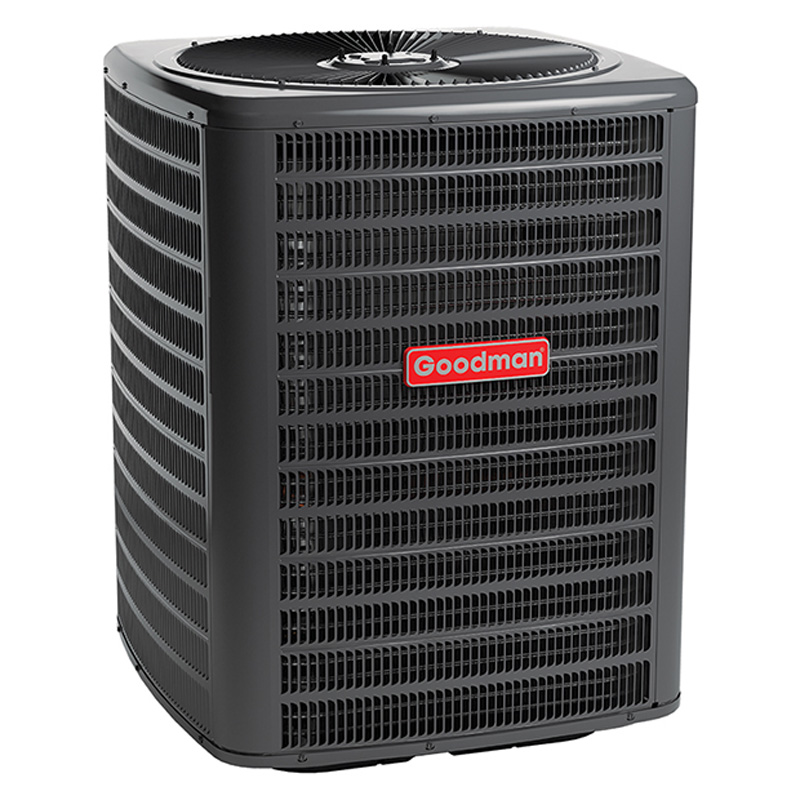
Goodman 3 Ton 13.4 SEER2 R32 Cooling Only Condenser (GLXS3BN3610)
View on AC Direct see your lowest price →Check current price on AC Direct →
Key features
- 3-ton capacity, suited for approximately 1,400 to 1,800 sq ft depending on load calculation
- 13.4 SEER2 efficiency rating, meeting current federal minimum standards
- R-32 refrigerant, lower global warming potential than R-410A
- Single-stage scroll compressor, full capacity or off operation
- Cooling-only condenser, requires separate air handler and evaporator coil
- 10-year parts warranty when registered within 60 days of installation
About this system
The Goodman GLXS3BN3610 is a 3-ton, single-stage cooling-only condenser built around R-32 refrigerant and rated at 13.4 SEER2. That efficiency rating sits right at the federal minimum for most U.S. climate zones, which keeps the purchase price low but means operating costs will run higher than a 16 or 18 SEER2 unit over the life of the system. R-32 is a lower-GWP refrigerant replacing the older R-410A, so this unit is positioned for the near-term regulatory environment and should be serviceable for the foreseeable future without the phase-out concerns that now shadow R-22 systems.
This condenser is a cooling-only unit, meaning it pairs with a separate air handler and evaporator coil rather than a heat pump, making it a straightforward replacement or new-install option for homes in warm climates that use gas or electric strip heat separately. The 3-ton capacity covers roughly 1,400 to 1,800 square feet in a typical single-story home, though a proper Manual J load calculation is the only reliable way to confirm sizing. Single-stage operation means the compressor runs at full capacity or not at all, which is less efficient at part-load conditions than two-stage or variable-speed alternatives but is simpler and less expensive to service.
The GLXS3BN3610 is a no-frills, budget-accessible condenser that gets the cooling job done at entry-level efficiency. It suits budget-conscious buyers who want a straightforward replacement and are comfortable with higher long-term operating costs and a repair profile that becomes more active after year 7. Buyers willing to spend more upfront can get meaningfully longer compressor life and better efficiency from competing brands.
Overall score is the average of the five ratings above.
What we like
- Purchase price typically 15 to 25 percent below comparable Trane, Lennox, and Carrier units
- R-32 refrigerant keeps this unit current with evolving industry standards
- 10-year parts warranty (registered) offers reasonable coverage for the price tier
- Single-stage design is straightforward for any qualified technician to service
- Wide installer network means parts and service are rarely hard to source
Trade-offs
- 13.4 SEER2 is minimum-tier efficiency; monthly cooling bills will be higher than mid- or high-efficiency alternatives
- Compressor lifespan averages 10 to 14 years, shorter than the 15 to 20 years typical of premium brands
- Dual-run capacitor failures are the most commonly reported issue, typically appearing after year 5 to 7
- Evaporator coil leaks and first-year refrigerant charge problems appear in a meaningful share of owner reports, often tied to install quality
What homeowners and pros say about Goodman
Homeowners who review Goodman equipment tend to split sharply. On Google dealer review pages, the brand averages around 3.8 out of 5, and the most consistent praise is straightforward: it cools the house and the upfront price was far lower than competing bids. The criticism that surfaces on those same pages, and more heavily on ConsumerAffairs where the brand sits at roughly 2.5 out of 5, centers on repair costs that accumulate after roughly year 7. The ConsumerAffairs channel skews toward frustrated owners, so the gap between those two scores partly reflects who bothers to write a review, but the pattern of mid-life repair activity is consistent enough to take seriously.
HVAC technicians tend to view Goodman pragmatically. They point to the dual-run capacitor as the unit’s most predictable weak point, a repair they perform routinely and one that typically runs 300 to 600 dollars. Evaporator coil leaks show up in enough service calls that experienced installers consider them a known risk, and the compressor lifespan averaging 10 to 14 years versus 15 to 20 for premium brands is a widely cited trade-off. Techs are consistent on one point: installation quality matters more with Goodman than with pricier equipment. A careful startup procedure and accurate refrigerant charge reduce the risk of the first-year refrigerant issues that appear in a minority of owner reports. For the GLXS3BN3610 specifically, pairing it with a matched R-32 indoor system and a thorough commissioning process is the most direct way to get the most out of what this unit offers.
Sources: ConsumerAffairs Goodman owner reviews, AHRI Directory of Certified Product Performance, U.S. DOE appliance and equipment efficiency standards, Goodman product specification sheets.
What it costs to run
At 13.4 SEER2, cooling this 3-ton system for a typical 1200-hour cooling season at the U.S. average electricity rate of $0.17/kWh works out to roughly $548 per year in cooling, about $0 less per year than a minimum-efficiency 13.4 SEER2 unit of the same size. Your real cost depends on your climate and local rate.
Method: (36,000 BTU/hr ÷ 13.4 SEER2) × 1200 hours ÷ 1000 × $0.17/kWh. Rate source: U.S. EIA average; cooling hours: moderate-climate estimate.
How it compares
| Brand | Comparable model | SEER2 | Stage | Price position |
|---|---|---|---|---|
| Goodman | GLXS3BN3610 | 13.4 | Single-stage | Value pick |
| Carrier | Comfort 13 (24ACC3) | 13.4 | Single-stage | Roughly 15 to 20 percent more than this Goodman |
| Trane | XR13c | 13.4 | Single-stage | Roughly 20 to 25 percent more than this Goodman |
| Lennox | Merit 13ACX | 13.4 | Single-stage | Roughly 15 to 25 percent more than this Goodman |
Competitor rows are comparable single-stage units at similar efficiency; price is relative position, not a quote.
Questions about this system
Does this condenser work with my existing R-410A air handler and coil?
No, not directly. R-32 and R-410A are not interchangeable, and the line sets, coil, and air handler must all be compatible with R-32. You will need to confirm with your installer that all indoor components are rated for R-32 before pairing this unit with existing equipment.
What air handler and evaporator coil should I pair with this condenser?
Goodman makes matched R-32 air handlers and cased coils designed for this unit. Using a matched Goodman system is the simplest path to maintaining the rated SEER2 and warranty coverage. Your installer can pull a matched-system combination report to confirm rated efficiency before committing.
Is 13.4 SEER2 going to cost me a lot more to run than a higher-efficiency unit?
Compared to a 16 SEER2 system, you can expect roughly 15 to 20 percent higher cooling energy use for the same output. In a climate with heavy cooling loads, that difference compounds over the system's life. For moderate-cooling climates or shorter seasons, the gap is smaller and the lower purchase price can offset it.
What is the most likely repair this condenser will need, and how much does it cost?
Dual-run capacitor failure is the most commonly documented issue with Goodman condensers. It typically shows up after several years of use and usually costs between 300 and 600 dollars to fix. It is a relatively quick repair for any technician and is covered under the parts warranty if it occurs within the warranty period.
How important is the installer for a unit like this?
Critically important. Technicians consistently cite installation quality as the single biggest factor in how long a Goodman unit lasts. Refrigerant charge errors in particular account for a meaningful share of first-year issues. Using an experienced, licensed installer who performs a proper startup procedure is not optional if you want to reach the full expected service life.
Specifications
| Cooling capacity | 3 Ton |
| Efficiency | 13.4 SEER2 |
| Refrigerant | R-32 |
| Model | GLXS3BN3610 |