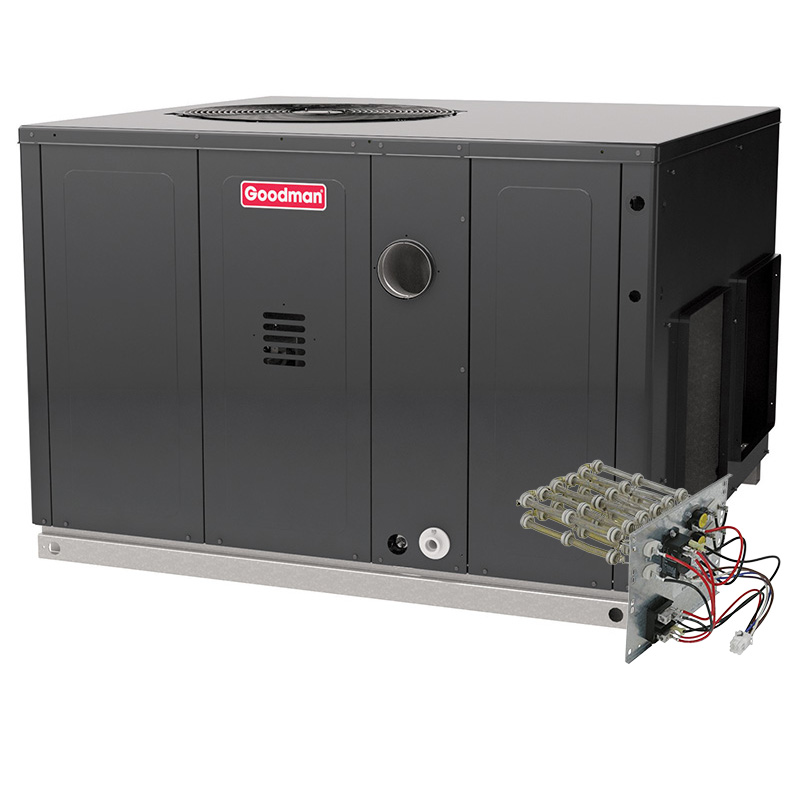
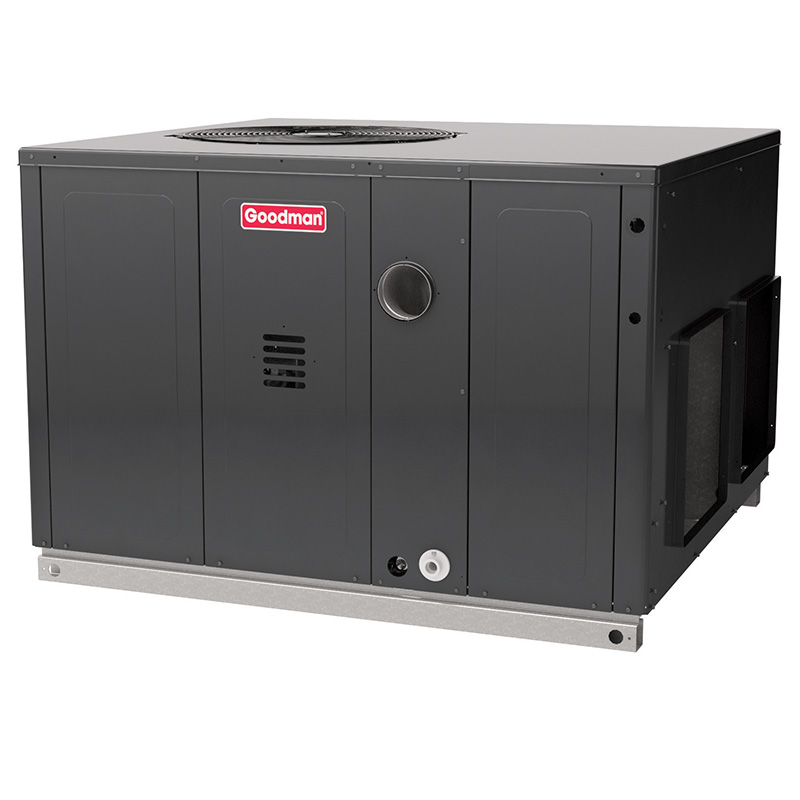
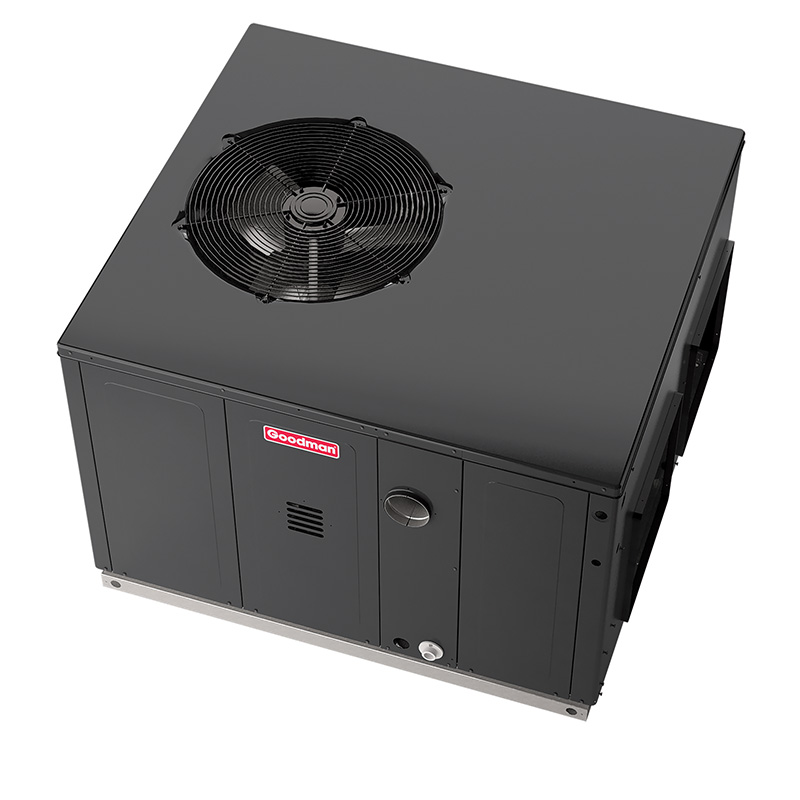
Goodman 3 Ton Package Unit Heat Pump & AC | 13.4 SEER2 Multi-Positional | R32
View on AC Direct see your lowest price →Check current price on AC Direct →
Key features
- 13.4 SEER2 efficiency meets current federal minimum standards for most U.S. climate zones
- All-in-one package unit design houses heating and cooling in a single outdoor cabinet
- Horizontal configuration for ground-pad, rooftop, or side-mount installations
- R-32 refrigerant with lower global warming potential than legacy R-410A systems
- 3-ton capacity suited for approximately 1,500 to 2,100 square feet depending on load factors
- Heat pump operation provides both heating and cooling from a single piece of equipment
About this system
The Goodman 3-Ton Package Unit Heat Pump combines heating and cooling into a single cabinet, which means all of the mechanical components live outdoors and nothing needs to be installed in a basement, crawl space, or utility closet. That self-contained design makes it a common choice for manufactured homes, slab-on-grade construction, and commercial applications where rooftop mounting or side-yard horizontal installation is the practical option. The horizontal configuration here means the unit is oriented to sit on a pad or mount flat, so confirming that orientation matches your specific installation site before ordering is essential.
At 13.4 SEER2, this unit sits right at the federal minimum efficiency threshold for most U.S. climate zones, which is not a criticism so much as a description. You get reliable, code-compliant performance without paying for efficiency tiers you may not need in a mild climate or a structure you plan to sell in the near term. The R-32 refrigerant is a meaningful forward-looking detail: R-32 has a lower global warming potential than the older R-410A it replaces, and its adoption signals this unit is positioned for regulatory compliance well into the 2030s. Three tons of capacity handles roughly 1,500 to 2,100 square feet depending on insulation quality, ceiling height, and local climate, though a proper Manual J load calculation should always drive that decision.
This unit delivers solid baseline performance at a price point that undercuts major premium brands by 15 to 25 percent, making it a reasonable fit for budget-conscious buyers who prioritize upfront cost. The trade-off is a documented history of mid-life component failures and a compressor lifespan that runs shorter on average than Trane, Carrier, or Lennox equivalents. Invest in a quality installation and a service agreement, and this unit can perform reliably for a decade or more.
Overall score is the average of the five ratings above.
What we like
- Priced 15 to 25 percent below comparable Trane, Lennox, and Carrier package units
- R-32 refrigerant positions the unit for long-term regulatory compliance
- All-in-one package design simplifies installation on slab foundations and manufactured homes
- Horizontal configuration covers a wide range of practical mounting scenarios
- Replacement parts, including the commonly needed dual-run capacitors, are widely available and relatively inexpensive
Trade-offs
- Compressor lifespan averages 10 to 14 years versus 15 to 20 years reported for premium-brand competitors
- Evaporator coil leaks appear in a meaningful share of owner feedback, representing a potentially costly mid-life repair
- ConsumerAffairs score of roughly 2.5 out of 5 reflects recurring complaints about repair costs after year seven
- A minority of owners report refrigerant leaks within the first year, typically traced to installation or factory charge issues rather than design
What homeowners and pros say about Goodman
Homeowners who choose Goodman package units tend to land in one of two camps. The larger group appreciates the straightforward value: the units cost noticeably less than Carrier, Trane, or Lennox equivalents, parts are easy to source, and when something breaks it rarely requires a specialty technician. Goodman earns around 3.8 out of 5 across Google dealer reviews, with affordability cited most often as the reason buyers are satisfied. The smaller but vocal group tells a different story on complaint-heavy channels like ConsumerAffairs, where Goodman scores closer to 2.5 out of 5, and the recurring frustration is repair costs that start stacking up somewhere after year seven.
HVAC technicians who work on Goodman equipment regularly point to installation quality as the decisive variable. A properly charged system with clean electrical connections tends to run without drama for a decade. The documented weak points are specific: dual-run capacitors fail with enough frequency that many service pros carry them as a standard truck stock item, and the repair typically runs 300 to 600 dollars when it happens. Evaporator coil leaks show up in a meaningful portion of long-term owner reports and represent a more expensive repair. Compressor longevity averaging 10 to 14 years puts this unit a step behind what premium brands routinely deliver, and a small share of owners trace refrigerant leaks in the first year back to installation or factory charge problems rather than anything inherent to the unit itself. For a package heat pump in a budget-conscious application, the calculus often works out in Goodman’s favor as long as buyers go in with realistic expectations about long-term maintenance costs.
Sources: ConsumerAffairs Goodman owner reviews, AHRI Directory of Certified Product Performance, U.S. DOE appliance and equipment efficiency standards, Goodman product specification sheets.
What it costs to run
At 13.4 SEER2, cooling this 3-ton system for a typical 1200-hour cooling season at the U.S. average electricity rate of $0.17/kWh works out to roughly $548 per year in cooling, about $0 less per year than a minimum-efficiency 13.4 SEER2 unit of the same size. Your real cost depends on your climate and local rate.
Method: (36,000 BTU/hr ÷ 13.4 SEER2) × 1200 hours ÷ 1000 × $0.17/kWh. Rate source: U.S. EIA average; cooling hours: moderate-climate estimate.
How it compares
| Brand | Comparable model | SEER2 | Stage | Price position |
|---|---|---|---|---|
| Goodman | 3-Ton R-32 Package Heat Pump | 13.4 | Single-stage | Value pick |
| Carrier | WeatherMaster 50XC Series | 14.0 | Single-stage | Approximately 20 to 25 percent more than this Goodman |
| Trane | YCC 4YCC3 Series | 14.0 | Single-stage | Approximately 20 to 25 percent more than this Goodman |
| Lennox | XP13 Packaged Heat Pump | 13.4 | Single-stage | Approximately 15 to 20 percent more than this Goodman |
Competitor rows are comparable single-stage units at similar efficiency; price is relative position, not a quote.
Questions about this system
Is a horizontal package unit the right configuration for my home?
Horizontal package units are designed for installations where the unit sits on a ground pad alongside the structure or mounts on a rooftop with the duct connections oriented horizontally. If your ductwork exits vertically through a floor or crawl space, you would need a vertical configuration instead. Confirm the duct connection orientation at your installation site before ordering.
What does the R-32 refrigerant change about service and maintenance?
R-32 requires technicians who are certified to handle it and recovery equipment rated for the refrigerant. Most current HVAC service companies are already equipped for R-32, but it is worth confirming with your service provider. On the positive side, R-32 systems are expected to remain fully serviceable and compliant with upcoming EPA regulations longer than older R-410A equipment.
How often do the dual-run capacitors actually fail, and what does it cost to fix?
Dual-run capacitor failure is the most commonly reported repair issue on Goodman equipment across owner reviews. The part itself is inexpensive and the repair typically runs between 300 and 600 dollars including labor. Having a capacitor replaced at the first sign of hard-starting or sluggish operation prevents the cascading compressor stress that leads to much larger repair bills.
What is the realistic lifespan I should plan around for this unit?
With a quality installation and regular maintenance, a Goodman compressor tends to average 10 to 14 years, which is somewhat shorter than the 15 to 20 years commonly associated with premium-brand compressors. Total unit lifespan can extend beyond that if the compressor is replaced or if ancillary components like coils and capacitors are serviced promptly when problems arise.
Does a 3-ton unit cover my house, and do I need a load calculation?
Three tons of capacity is a common fit for homes between roughly 1,500 and 2,100 square feet, but square footage alone is not a reliable sizing method. Ceiling height, insulation levels, window area, local climate, and duct condition all affect the right size. Oversizing a heat pump package unit causes short-cycling that accelerates wear and increases humidity problems, so a Manual J load calculation performed by your installer is strongly recommended.
Specifications
| Cooling capacity | 3 Ton |
| Efficiency | 13.4 SEER2 |
| Configuration | Horizontal |
| Refrigerant | R-32 |