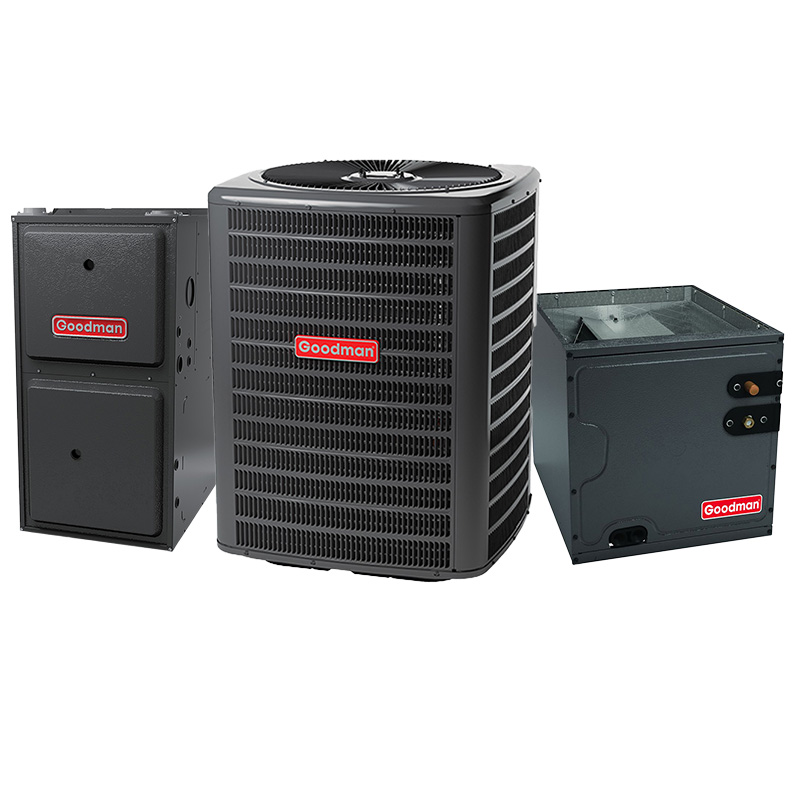
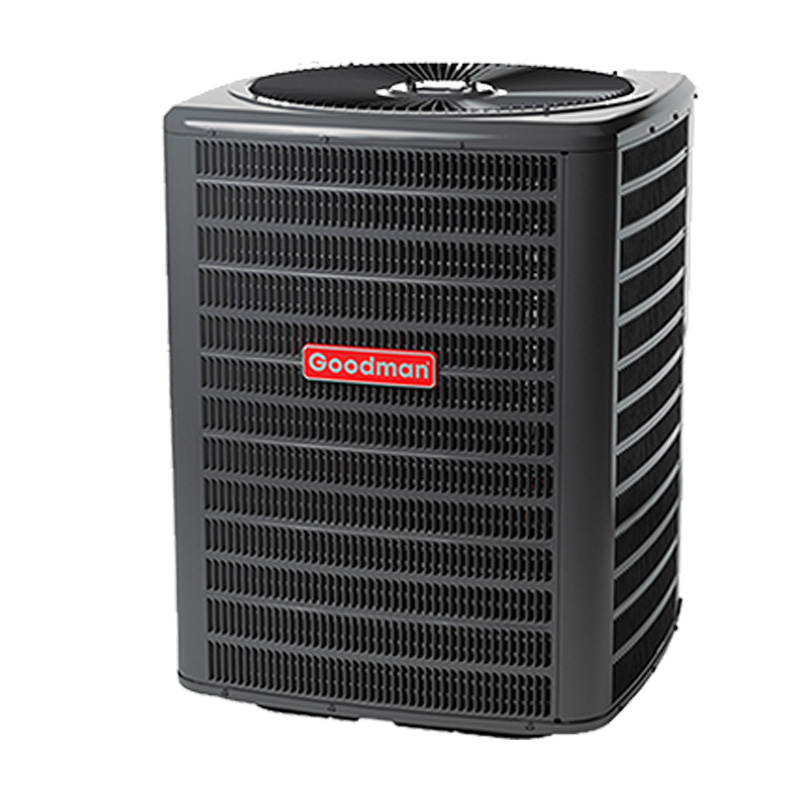
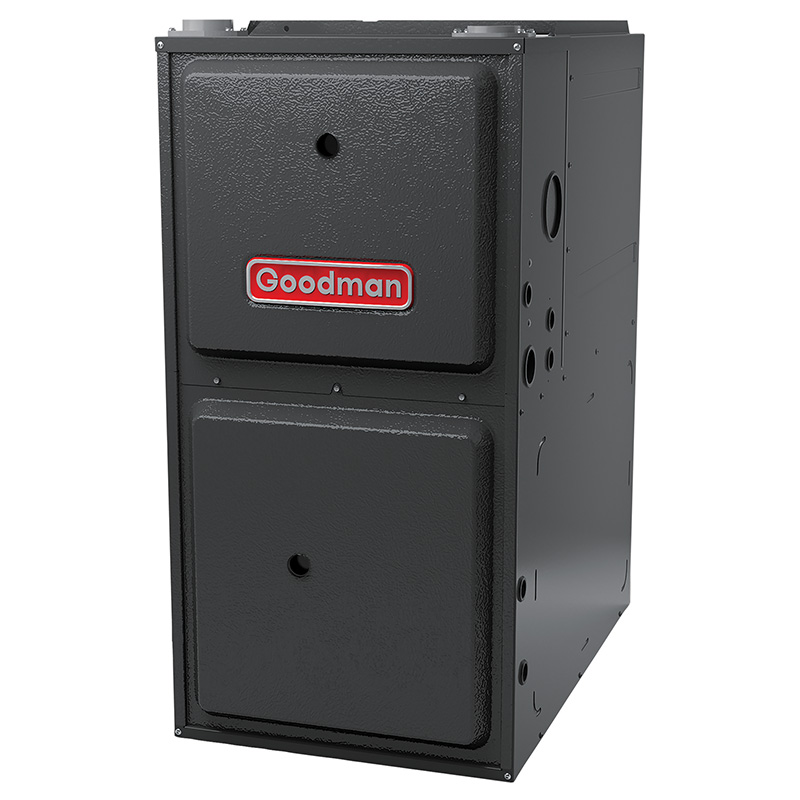
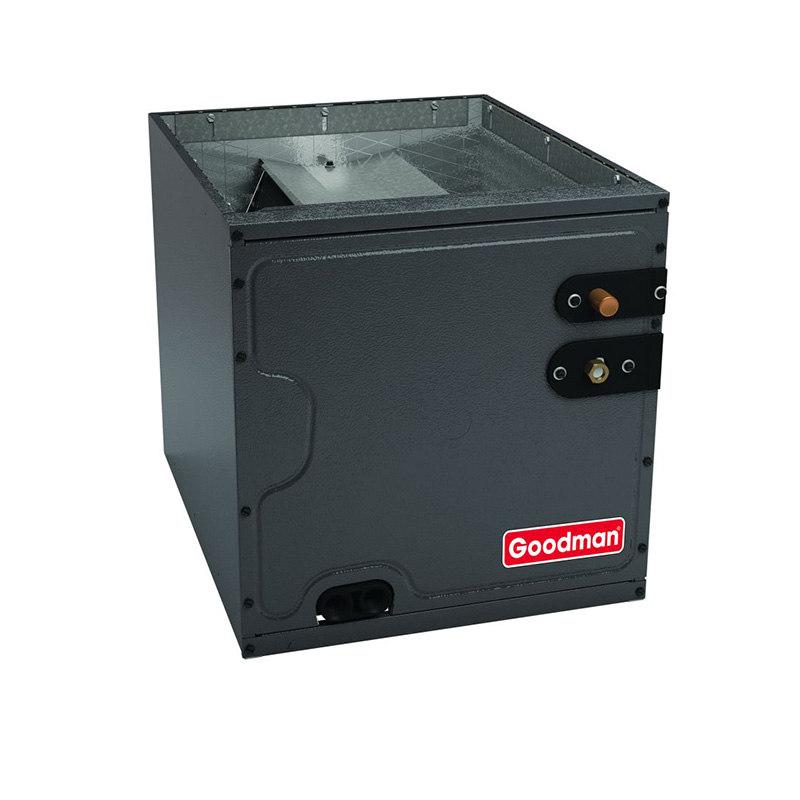
Goodman 3 Ton 14.5 SEER2 AC With 80000 BTU 96% AFUE 2-Stage Variable-Speed ECM Gas Furnace System – Upflow | R32
View on AC Direct see your lowest price →Check current price on AC Direct →
Key features
- 3-ton cooling capacity rated at 14.5 SEER2, meeting current federal efficiency minimums
- 80,000 BTU gas furnace at 96% AFUE for high-efficiency heating with minimal exhaust waste
- Two-stage furnace burner reduces frequent on/off cycling and improves temperature consistency
- Variable-speed ECM blower motor lowers electricity use and supports better humidity control
- R-32 refrigerant with lower global warming potential, replacing the phased-out R-410A standard
- Upflow configuration designed for basement or closet installs with overhead duct delivery
About this system
This Goodman bundle pairs a 3-ton, 14.5 SEER2 air conditioner with an 80,000 BTU, 96% AFUE two-stage, variable-speed ECM gas furnace in an upflow configuration. The 14.5 SEER2 rating sits at the entry point of the current federal efficiency tier, which keeps the purchase price accessible while still meeting 2023 regional standards. The 96% AFUE furnace is a meaningful upgrade over the older 80% units that still populate many homes: for every dollar spent on gas, 96 cents goes toward heat rather than exhaust, which adds up noticeably on monthly bills in cold climates.
The two-stage furnace operation and variable-speed ECM blower motor are the real story here. Two-stage firing means the furnace runs on a lower flame most of the time, cycling less aggressively and holding room temperatures more evenly than a single-stage unit. The ECM blower adjusts airflow continuously, which lowers electricity consumption during heating and cooling and helps with humidity management in shoulder seasons. The system uses R-32 refrigerant, a lower global-warming-potential refrigerant that is becoming the new standard as R-410A phases out. Upflow configuration suits the majority of homes where the furnace sits in a basement or closet and air is delivered upward through supply ducts above.
This system is well suited to homeowners who want meaningful heating efficiency and comfort features at a price well below what Trane, Lennox, or Carrier charge for equivalent specs. The trade-off is that Goodman’s long-term reliability leans heavily on who installs it and how well it is maintained, so pairing this equipment with an experienced, licensed HVAC contractor is not optional, it is essential.
This Goodman system delivers a genuinely capable combination of high-efficiency heating and adequate cooling at a price point that meaningfully undercuts premium brands. The two-stage furnace and ECM blower are real comfort upgrades over entry-level equipment, and the 96% AFUE is hard to argue with on fuel cost grounds. The honest caveat is that Goodman's track record shows more owner complaints after year seven than premium competitors, and install quality will shape how long this system performs.
Overall score is the average of the five ratings above.
What we like
- 96% AFUE furnace is among the most efficient gas heating tiers available, reducing monthly fuel costs noticeably
- Two-stage firing and variable-speed ECM blower provide more even temperatures and better dehumidification than single-stage systems
- R-32 refrigerant is future-ready as R-410A production ends, reducing refrigerant availability concerns long term
- Priced roughly 15 to 25 percent below comparable Trane, Lennox, and Carrier systems, making a higher-spec combo more accessible
- Upflow design covers the most common residential duct layout, and parts availability through Goodman's wide dealer network is generally strong
Trade-offs
- Compressor lifespan averages 10 to 14 years based on documented owner experience, shorter than the 15 to 20 years reported for premium brands
- Dual-run capacitor failures are the most frequently reported repair issue, and while the fix is typically inexpensive, it adds to long-term ownership cost
- A share of owners report evaporator coil leaks, and a smaller group sees refrigerant issues within the first year, often tied to install or initial charge problems
- ConsumerAffairs scores average around 2.5 out of 5 on that complaint-skewed platform, with rising repair costs after roughly year seven as a recurring theme
What homeowners and pros say about Goodman
Homeowners who have installed Goodman equipment tend to land in two camps. Those who had experienced contractors handle the job and stayed current on maintenance often report solid performance for the first several years, and they point to the lower purchase price as a win. The affordability praise shows up consistently in Google dealer reviews, where Goodman averages around 3.8 out of 5 across hundreds of reviews per location. The other camp, more visible on ConsumerAffairs where the platform skews toward complaints and the brand averages about 2.5 out of 5, reports repair costs climbing noticeably after roughly year seven. The specific failure modes that show up repeatedly are dual-run capacitor replacements, evaporator coil leaks, and compressors that tend to average 10 to 14 years rather than the 15 to 20 years some premium competitors achieve.
HVAC technicians generally describe Goodman as workable equipment that rewards a careful install and penalizes a rushed one more than premium brands do. For this specific system, the two-stage furnace and ECM blower add mechanical complexity compared to a basic single-stage unit, which means the quality of commissioning matters even more. Pros who work on these systems regularly note that the capacitor issue is a nuisance rather than a catastrophe since the repair is straightforward and parts are widely available. The R-32 refrigerant is new enough that technicians flag the importance of confirming your service contractor has the right equipment and certification for it. The consensus is that this bundle represents a reasonable bet for buyers who prioritize upfront cost savings and are willing to budget for the occasional service call, as long as they do not cut corners on the installer they choose.
Sources: ConsumerAffairs Goodman owner reviews, AHRI Directory of Certified Product Performance, U.S. DOE appliance and equipment efficiency standards, Goodman product specification sheets.
What it costs to run
At 14.5 SEER2, cooling this 3-ton system for a typical 1200-hour cooling season at the U.S. average electricity rate of $0.17/kWh works out to roughly $506 per year in cooling, about $42 less per year than a minimum-efficiency 13.4 SEER2 unit of the same size. Your real cost depends on your climate and local rate.
Method: (36,000 BTU/hr ÷ 14.5 SEER2) × 1200 hours ÷ 1000 × $0.17/kWh. Rate source: U.S. EIA average; cooling hours: moderate-climate estimate.
How it compares
| Brand | Comparable model | SEER2 | Stage | Price position |
|---|---|---|---|---|
| Goodman | GSX-GMVC96 Bundle (this system) | 14.5 | Two-stage furnace / single-stage AC | Value pick |
| Carrier | Comfort 14 (CA14NA) with 96% AFUE 58MVC furnace | 14 to 15 | Single-stage AC, two-stage furnace | Typically 15 to 25 percent more than this Goodman bundle |
| Trane | XR14c with S9V2 96% AFUE furnace | 14 to 15 | Single-stage AC, two-stage furnace | Typically 15 to 25 percent more than this Goodman bundle |
| Lennox | Merit 14ACX with ML96V furnace | 14 to 15 | Single-stage AC, variable-capacity furnace | Typically 15 to 25 percent more than this Goodman bundle |
Competitor rows are comparable single-stage units at similar efficiency; price is relative position, not a quote.
Questions about this system
Is 14.5 SEER2 going to cost me more on my electric bill compared to a higher-SEER2 unit?
Yes, a 16 or 17 SEER2 system will use less electricity per cooling hour. That said, for a 3-ton unit in a typical climate, the annual savings difference between 14.5 and 16 SEER2 is relatively modest, and the lower purchase price of this unit can offset years of that gap. If you live in an extremely hot climate with long cooling seasons, stepping up to a higher SEER2 rating becomes a stronger financial argument.
What does two-stage mean for the furnace, and will I actually notice it?
Two-stage means the furnace burns at a lower rate most of the time and only fires at full capacity during the coldest conditions. Most homeowners do notice less dramatic temperature swings, quieter operation during normal cycles, and somewhat better humidity control compared to single-stage furnaces. The ECM blower on this system amplifies those benefits by adjusting airflow rather than simply running at one fixed speed.
What are the most common repairs I should budget for on a Goodman system like this?
The dual-run capacitor is the most frequently reported failure point on Goodman AC equipment, and replacement typically runs in the 300 to 600 dollar range including labor. Evaporator coil leaks show up in a meaningful share of long-term owner reviews as well. Planning for one or two service calls in the 7-to-10 year range is a reasonable expectation based on documented owner experience.
Why does this system use R-32 instead of R-410A, and does that affect servicing?
R-32 is replacing R-410A industry-wide due to lower global warming potential and more efficient heat transfer properties. R-32 does require technicians to use R-32-rated tools and follow slightly different handling procedures because it is mildly flammable, so confirm your service contractor is certified and equipped to work with it before signing any maintenance agreement.
How important is it to use a specific contractor for this install, and will it affect my warranty?
Install quality is the single biggest factor in how long a Goodman system lasts, according to technicians who work on these units regularly. Improper refrigerant charge, duct mismatch, or poor electrical connections can shorten component life regardless of equipment quality. Goodman's warranty registration typically requires installation by a licensed HVAC professional, and warranty claims can be complicated if there is evidence of improper installation, so choosing an experienced, licensed contractor is both a performance and a warranty issue.
Specifications
| Cooling capacity | 3 Ton |
| Efficiency | 14.5 SEER2 |
| Furnace output | 80000 BTU |
| Furnace efficiency | 96% AFUE |
| Configuration | Upflow |
| Refrigerant | R-32 |