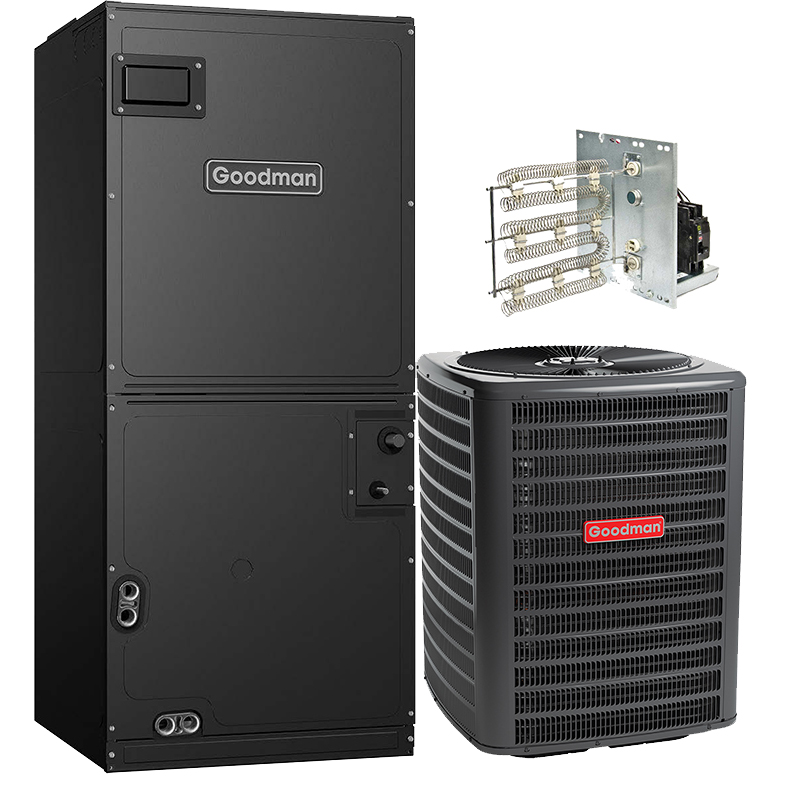
Goodman 3 Ton 14.5 SEER2 Split System with Electric Heat w/3 Ton A/H 49"
View on AC Direct see your lowest price →Check current price on AC Direct →
Key features
- 3-ton cooling capacity suited to roughly 1,400 to 1,800 sq ft in average climates
- 14.5 SEER2 efficiency rating meets current federal minimum standards
- Single-stage compressor operation for straightforward, low-complexity cycling
- Electric resistance heat strips in the air handler for supplemental warmth
- 49-inch air handler cabinet fits standard residential utility closet and attic installations
- Daikin-owned manufacturing with broad domestic parts availability
About this system
The Goodman GSXN403610 pairs a 3-ton, 14.5 SEER2 single-stage condensing unit with a matched 3-ton air handler in a 49-inch cabinet configuration. At 14.5 SEER2, this system sits at the current federal minimum efficiency tier for most U.S. climate zones, which means it meets the bar but does not exceed it. For a home roughly 1,400 to 1,800 square feet with average insulation and duct work in reasonable shape, that efficiency level translates to acceptable utility costs without the upfront premium of a two-stage or variable-speed system.
The electric heat designation means this package relies on electric resistance strips in the air handler for heating rather than a heat pump or gas furnace. That setup works well in mild-winter climates where supplemental heat is needed only occasionally, but it becomes expensive to operate in regions where temperatures drop consistently below 40 degrees Fahrenheit. Buyers in the Deep South, parts of the Southwest, or coastal areas with short winters will get more out of this configuration than homeowners in the Midwest or Northeast who heat frequently.
Goodman is owned by Daikin and assembles its equipment in the United States, which supports a broad parts supply network. The brand is positioned as a cost-conscious option, typically priced 15 to 25 percent below Trane, Carrier, and Lennox equivalents. For a homeowner replacing an aging system on a defined budget, or a landlord managing a rental property, that price gap is meaningful. Those willing to spend more for a longer compressor lifespan or better factory tolerances should weigh the trade-offs carefully before purchasing.
The Goodman GSXN403610 is a competent, budget-friendly cooling and light-heating solution for homeowners who need a functional system without the upfront cost of a premium brand. It delivers baseline efficiency and will perform reliably over the near term if installed correctly, but documented patterns of capacitor failures, evaporator coil leaks, and a shorter average compressor lifespan mean total ownership costs can close the gap with pricier brands over a 10-to-15-year horizon. It is a reasonable buy when the budget is real and expectations are calibrated.
Overall score is the average of the five ratings above.
What we like
- Purchase price typically 15 to 25 percent below comparable Carrier, Trane, and Lennox units
- 14.5 SEER2 meets federal minimums, keeping operating costs reasonable in mild-to-moderate climates
- Daikin ownership means parts are widely stocked and not hard to source
- Simple single-stage design keeps service diagnostics and repair labor straightforward
- Matched air handler and condenser pairing is pre-verified for capacity and coil compatibility
Trade-offs
- Dual-run capacitors are a documented common failure point, often surfacing within the first several years of use
- Evaporator coil leaks appear in a meaningful share of owner reports, a recurring warranty and repair concern
- Compressor lifespan averages 10 to 14 years versus 15 to 20 years reported for premium brands, affecting long-run economics
- Electric resistance heat is costly to operate in colder climates, limiting this configuration to mild-winter regions for practical use
What homeowners and pros say about Goodman
Homeowners who have gone the Goodman route with units in this efficiency class tend to split into two camps. The first group, particularly those in warm-weather states, reports years of uneventful service and credits the lower upfront cost as the right call for their situation. The Google dealer review average of around 3.8 out of 5 across hundreds of reviews reflects that experience, with affordability and straightforward service the most common points of praise. The second camp, more visible on complaint-skewed channels like ConsumerAffairs where Goodman scores about 2.5 out of 5, runs into trouble around the seven-year mark, when repair costs begin accumulating on capacitors and, in some cases, refrigerant-side components. Dual-run capacitor failures are the most frequently documented issue, typically a quick repair in the 300 to 600 dollar range, but evaporator coil leaks also surface in a notable share of owner accounts and are a more involved fix.
HVAC technicians who work on Goodman equipment regularly tend to hold a pragmatic view. They note that installation quality is the single biggest variable in how any Goodman unit performs long-term, which makes choosing an experienced, thorough installer more important here than it might be with a brand that has tighter factory tolerances. They also point out that parts availability is genuinely good thanks to Daikin ownership, so a service call is rarely held up by a back-ordered component. The honest professional concern is compressor longevity: documented averages of 10 to 14 years versus 15 to 20 for Trane, Carrier, or Lennox units mean that for a homeowner planning to stay in a house long-term, the initial savings can erode. For a rental property, a shorter ownership horizon, or a household working within a firm budget, the math often still favors Goodman when all of those factors are weighed honestly.
Sources: ConsumerAffairs Goodman owner reviews, AHRI Directory of Certified Product Performance, U.S. DOE appliance and equipment efficiency standards, Goodman product specification sheets.
What it costs to run
At 14.5 SEER2, cooling this 3-ton system for a typical 1200-hour cooling season at the U.S. average electricity rate of $0.17/kWh works out to roughly $506 per year in cooling, about $42 less per year than a minimum-efficiency 13.4 SEER2 unit of the same size. Your real cost depends on your climate and local rate.
Method: (36,000 BTU/hr ÷ 14.5 SEER2) × 1200 hours ÷ 1000 × $0.17/kWh. Rate source: U.S. EIA average; cooling hours: moderate-climate estimate.
How it compares
| Brand | Comparable model | SEER2 | Stage | Price position |
|---|---|---|---|---|
| Goodman | GSXN403610 with matched air handler | 14.5 | Single-stage | Value pick |
| Carrier | Comfort Series (24ACC636A003) | 14.3 to 15.2 | Single-stage | Typically 15 to 25 percent more than Goodman |
| Trane | XR14 Series (4TTR4036J) | 14.3 to 15.0 | Single-stage | Typically 15 to 25 percent more than Goodman |
| Lennox | Merit Series (13ACX-036) | 14.3 to 15.5 | Single-stage | Typically 15 to 25 percent more than Goodman |
Competitor rows are comparable single-stage units at similar efficiency; price is relative position, not a quote.
Questions about this system
What size home will a 3-ton Goodman GSXN403610 cool effectively?
A 3-ton unit is generally sized for homes between roughly 1,400 and 1,800 square feet under average insulation and ceiling height conditions, though the right size depends on a proper Manual J load calculation for your specific home. Oversizing or undersizing both hurt comfort and efficiency, so an on-site assessment by your installer matters more than square footage rules of thumb.
Is 14.5 SEER2 efficient enough, or should I pay more for a higher-rated unit?
14.5 SEER2 is the federal minimum for most regions and will keep your electricity bills at a baseline acceptable level, but it will cost more to operate annually than a 16 or 18 SEER2 system. If your cooling season is long or electricity rates in your area are high, a higher-efficiency unit may pay back the cost difference within several years. For short cooling seasons or lower utility rates, the payback period stretches out and the basic unit often makes financial sense.
How reliable is Goodman compared to Carrier or Trane at this price point?
Goodman carries a ConsumerAffairs rating of about 2.5 out of 5, a channel that skews toward complaints, with repair costs climbing after roughly year 7 as a recurring theme. Dealer-facing Google reviews average around 3.8 out of 5, where affordability is the most cited positive. Documented issues include dual-run capacitor failures, evaporator coil leaks, and a compressor lifespan that averages 10 to 14 years versus 15 to 20 for premium brands, so long-term reliability is a real trade-off for the lower initial price.
What does the warranty cover, and are there conditions I need to meet?
Goodman typically offers a 10-year parts limited warranty when the equipment is registered within a specific window after installation, along with a compressor warranty and a unit replacement limited warranty on the condenser coil. Registration is usually required within 60 days of installation to secure the full 10-year coverage; missing that window can shorten coverage significantly. Always confirm current warranty terms directly with Goodman, as specifics can change by model year.
Can I use this system for primary heating, or is the electric heat only for backup?
The electric resistance heat strips in this air handler can technically serve as primary heat, but they are among the most expensive forms of electric heating to operate. In a climate where temperatures rarely drop below 40 degrees Fahrenheit and heat is needed only a few weeks per year, that cost is manageable. In colder climates with extended heating seasons, running electric strips as the primary heat source will produce significantly higher utility bills than a heat pump or gas furnace alternative.
Specifications
| Cooling capacity | 3 Ton |
| Efficiency | 14.5 SEER2 |
| Model | GSXN403610 |