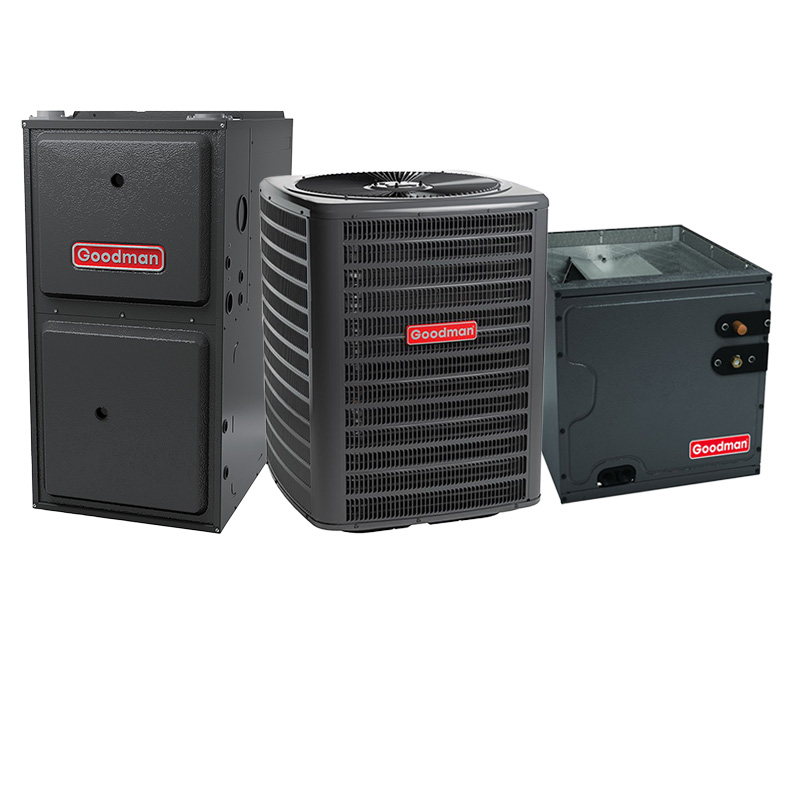
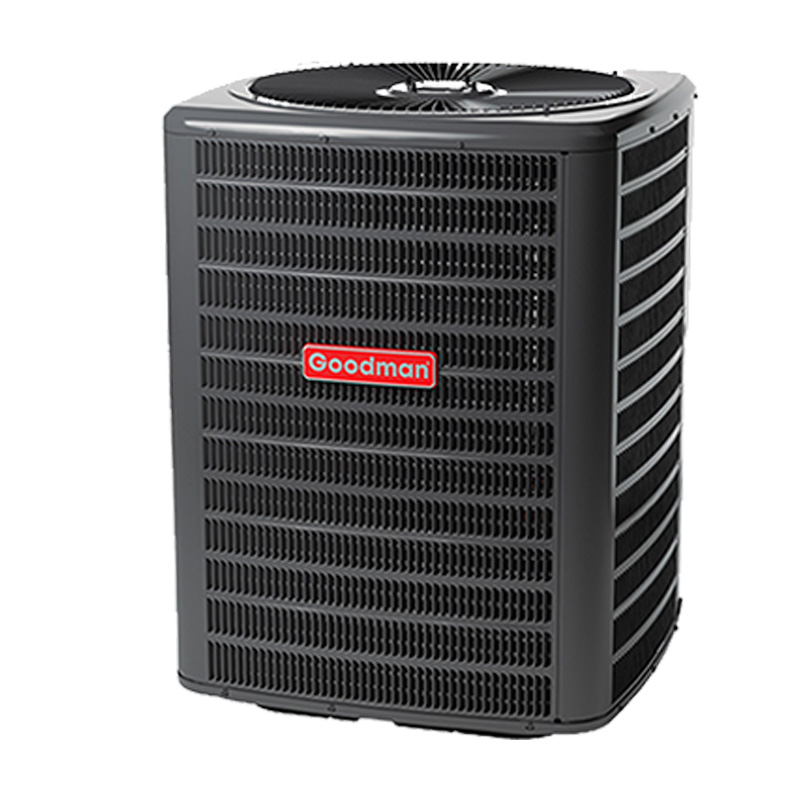
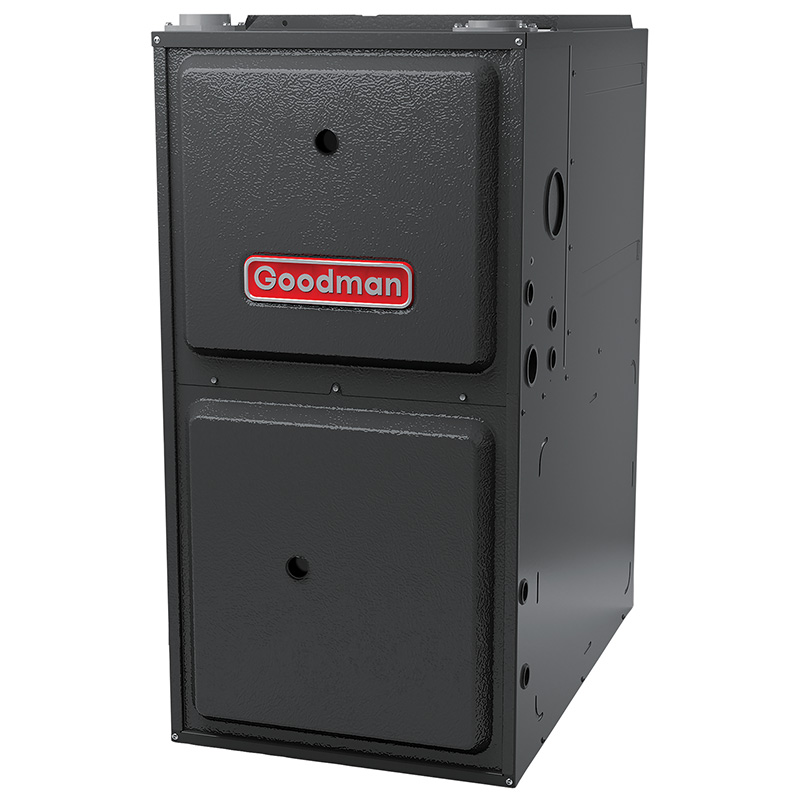
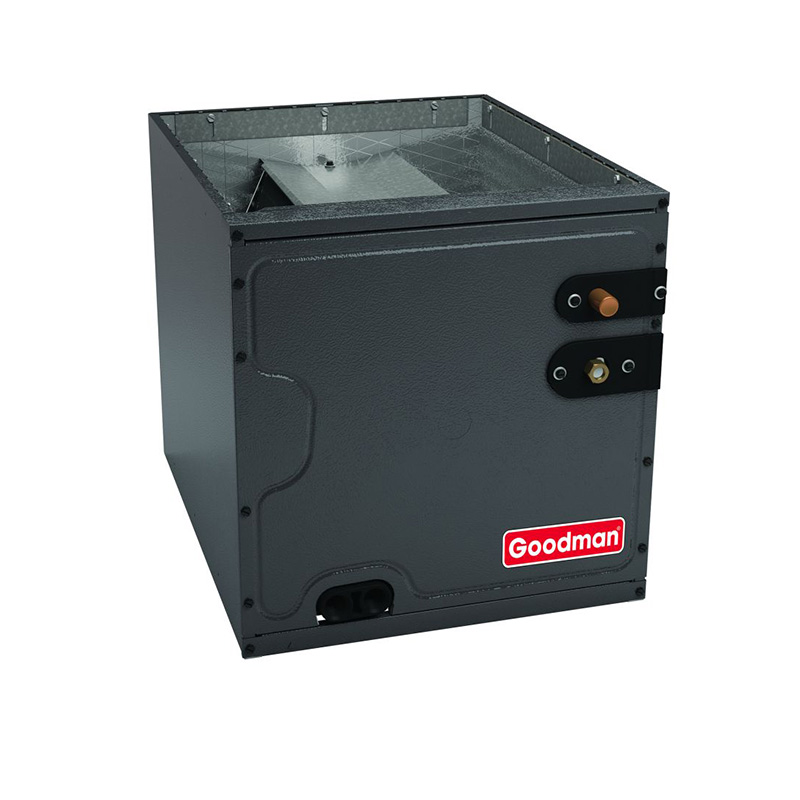
Goodman 3 Ton 14 SEER2 80000 BTU 96% AFUE Two Stage Multi-Speed ECM Gas Furnace System – Upflow | R32
View on AC Direct see your lowest price →Check current price on AC Direct →
Key features
- 96% AFUE two-stage gas furnace reduces fuel waste to roughly 4% exhaust loss
- Multi-speed ECM blower motor lowers electricity consumption versus standard PSC motors
- 14 SEER2 cooling efficiency meets current federal minimum standards with modest energy savings
- R-32 refrigerant offers a lower global warming potential than R-410A and aligns with upcoming regulations
- Upflow configuration suits homes with the air handler in a basement or closet with ductwork above
- Two-stage operation supports longer, steadier run cycles that improve humidity control
About this system
This Goodman bundle pairs a 3-ton, 14 SEER2 R-32 air conditioner with an 80,000 BTU, 96% AFUE two-stage, multi-speed ECM gas furnace in an upflow configuration. The combination is aimed at homeowners who want meaningful efficiency gains over a basic 80% furnace and a code-compliant, future-oriented refrigerant without paying premium-brand prices. R-32 has a lower global warming potential than the R-410A it replaces and is increasingly required under evolving EPA refrigerant rules, so this system avoids the near-term obsolescence risk of older refrigerant platforms.
The two-stage furnace and ECM blower motor are the standout specs here. Two-stage heating means the furnace runs on a lower firing rate most of the time, cycling on high only during the coldest stretches. That translates to more even temperatures, longer run cycles that better control humidity, and quieter operation compared to single-stage units. The ECM motor adjusts airflow continuously and uses significantly less electricity than a standard PSC motor, which helps offset operating costs over the system’s life. The 96% AFUE rating means only about four cents of every dollar spent on gas is lost as exhaust, which places this furnace solidly in the high-efficiency tier. For a 3-ton load in a mid-size home, this is a well-matched, capable package.
This Goodman system delivers genuinely good specs for the price, particularly the 96% AFUE furnace and ECM motor, which punch above the value-brand tier in features. The trade-off is a brand with a mixed long-term reliability record and a compressor lifespan that tends to fall short of premium competitors, so buyers should weigh upfront savings against the possibility of earlier-than-average component replacement. If the install is done right by a qualified technician, this system is a reasonable choice for budget-conscious homeowners who want more than a bare-minimum setup.
Overall score is the average of the five ratings above.
What we like
- 96% AFUE and two-stage operation are legitimate high-efficiency furnace features, not just entry-level specs
- ECM blower motor meaningfully reduces ongoing electricity costs compared to standard motors
- R-32 refrigerant provides a degree of regulatory future-proofing as R-410A is phased down
- Priced roughly 15 to 25 percent below comparable Trane, Lennox, and Carrier bundles
- Two-stage heating produces more consistent indoor temperatures and better humidity management than single-stage units
Trade-offs
- Compressors on Goodman units average 10 to 14 years, a shorter window than the 15 to 20 years typical of premium brands
- Dual-run capacitor failures are the most commonly reported repair, usually appearing after year 7 and costing $300 to $600
- A minority of owners have reported refrigerant leaks within the first year, often tied to install or charge quality rather than the unit itself
- Evaporator coil leaks appear in a meaningful share of owner reviews and can be costly to address out of warranty
What homeowners and pros say about Goodman
Homeowners who research Goodman before buying tend to land in two camps. Those who had a smooth installation and chose a competent contractor often report years of solid, unremarkable service and point to the upfront savings as a win. The dissatisfied group, which is over-represented on complaint-skewed channels like ConsumerAffairs (where Goodman sits at around 2.5 out of 5), tends to trace frustration back to repair bills that start climbing after roughly year 7, with dual-run capacitor failures being the most commonly named culprit at $300 to $600 a fix. Google dealer reviews, a more balanced sample across a broader range of experiences, put Goodman-sold systems at around 3.8 out of 5, with affordability cited most often as the reason for satisfaction.
HVAC technicians who work on Goodman equipment regularly tend to have a pragmatic view. They acknowledge the brand delivers real value on paper, especially at the 96% AFUE and two-stage level this system represents, but they are consistent in noting that the brand’s documented weak points require attention. Evaporator coil leaks appear in enough owner accounts to be a genuine consideration, and compressor longevity averaging 10 to 14 years falls measurably short of the 15 to 20 years seen more often in Trane, Carrier, and Lennox equipment. Early refrigerant leaks, while affecting a minority of owners, are almost always tied to charging or connection issues at install rather than a factory defect, which is why technicians stress that who puts this system in matters at least as much as what the system is.
Sources: ConsumerAffairs Goodman owner reviews, AHRI Directory of Certified Product Performance, U.S. DOE appliance and equipment efficiency standards, Goodman product specification sheets.
What it costs to run
At 14 SEER2, cooling this 3-ton system for a typical 1200-hour cooling season at the U.S. average electricity rate of $0.17/kWh works out to roughly $525 per year in cooling, about $23 less per year than a minimum-efficiency 13.4 SEER2 unit of the same size. Your real cost depends on your climate and local rate.
Method: (36,000 BTU/hr ÷ 14 SEER2) × 1200 hours ÷ 1000 × $0.17/kWh. Rate source: U.S. EIA average; cooling hours: moderate-climate estimate.
How it compares
| Brand | Comparable model | SEER2 | Stage | Price position |
|---|---|---|---|---|
| Goodman | 3 Ton 14 SEER2 / 80K BTU 96% AFUE Two-Stage ECM (this system) | 14 | Two-stage | Value pick |
| Carrier | Performance 14 / 58MVC 96% AFUE | 14 | Two-stage | Typically 15 to 25 percent more than this Goodman bundle |
| Trane | XR14c / S9V2 96% AFUE | 14 | Two-stage | Typically 15 to 25 percent more than this Goodman bundle |
| Lennox | Merit 14ACX / ML96V 96% AFUE | 14 | Two-stage | Typically 15 to 25 percent more than this Goodman bundle |
Competitor rows are comparable single-stage units at similar efficiency; price is relative position, not a quote.
Questions about this system
Is R-32 refrigerant going to be hard to service or recharge in a few years?
R-32 is actually one of the refrigerants being positioned as a long-term replacement for R-410A as the EPA phases down high-GWP refrigerants, so availability should improve rather than shrink. Technicians do need specific training and equipment to handle it safely since it is mildly flammable, so confirm your service contractor is certified to work with A2L refrigerants before booking.
What does two-stage heating actually mean for my home day to day?
Most of the time the furnace runs at a lower firing rate, which means longer, quieter cycles that distribute heat more evenly and pull more moisture out of the air. It only kicks up to full capacity when outdoor temperatures are at their coldest, which is a relatively small portion of the heating season for most climates.
How important is the installer for this Goodman system specifically?
Critically important. Goodman's own performance and longevity lean heavily on installation quality, and the documented early refrigerant leak issues in owner reports are most often traced back to improper charging or line-set connections rather than the equipment itself. Choosing a licensed, experienced HVAC contractor and not the lowest bidder is arguably the single most impactful decision you can make with this purchase.
What should I budget for likely repairs over the life of this system?
The most common documented repair on Goodman equipment is the dual-run capacitor, which typically costs $300 to $600 and tends to show up after roughly year 7. Evaporator coil leaks and compressor replacement are less frequent but more expensive events to plan for, particularly as the system ages past the 10-year mark. Setting aside a small annual service reserve is a practical step.
Will this upflow furnace work in my home if my air handler is in a crawl space or attic?
No, upflow means the furnace draws return air from the bottom and discharges conditioned air from the top, which requires the ductwork to run above the unit. A crawl space installation typically calls for a downflow or horizontal configuration, and an attic installation may need a different orientation as well. Confirm your home's duct layout with your contractor before ordering.
Specifications
| Cooling capacity | 3 Ton |
| Efficiency | 14 SEER2 |
| Furnace output | 80000 BTU |
| Furnace efficiency | 96% AFUE |
| Configuration | Upflow |
| Refrigerant | R-32 |