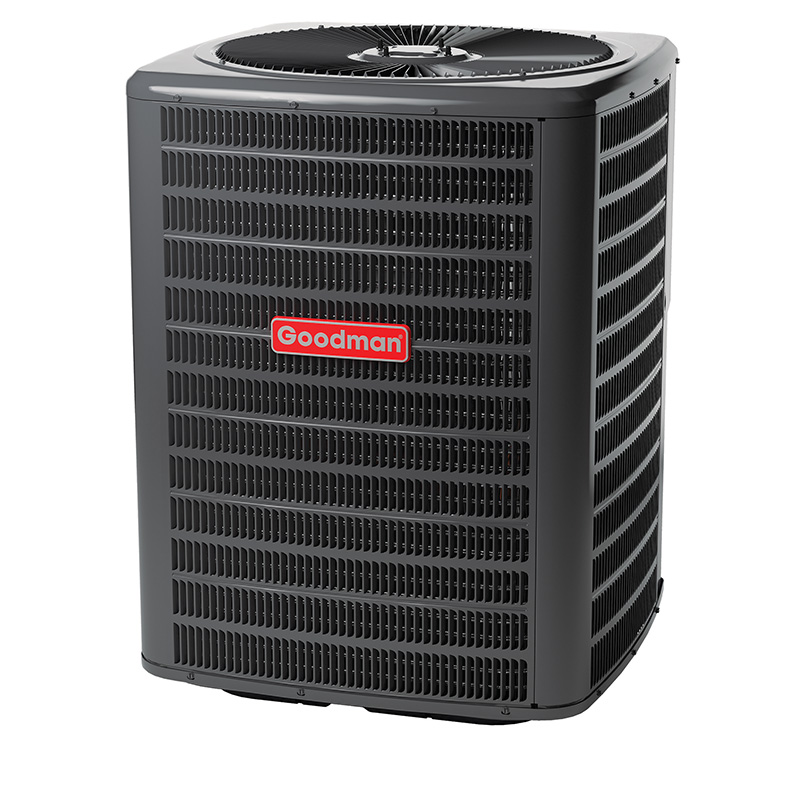
Goodman 3 Ton 17.2 SEER2 R32 High-Efficiency Two Stage Cooling Only Condenser (GLXT7CA3610)
View on AC Direct see your lowest price →Check current price on AC Direct →
Key features
- 3-ton capacity, suited for roughly 1,400 to 1,900 sq ft depending on climate and insulation
- 17.2 SEER2 two-stage compressor for improved humidity control and part-load efficiency
- R-32 refrigerant with lower global warming potential than R-410A
- Cooling-only condenser, requires a separate air handler or furnace for heating
- Factory-installed filter drier to reduce moisture-related system contamination
- Louvered steel cabinet with baked-on powder coat finish for corrosion resistance
About this system
The Goodman GLXT7CA3610 is a 3-ton, two-stage cooling-only condenser rated at 17.2 SEER2 and designed for use with R-32 refrigerant. Two-stage operation means the compressor can run at a reduced capacity on milder days, cycling on and off less frequently, which tends to improve humidity control and reduce temperature swings compared to a single-stage unit. R-32 has a lower global warming potential than the R-410A it largely replaces, and its higher energy density can support slightly smaller refrigerant charges, though it does require technicians certified to handle it.
At 17.2 SEER2, this condenser sits in a meaningful efficiency tier, well above the federal minimums for most U.S. climate zones and capable of qualifying for utility rebates in many markets. It pairs best with a matching Goodman air handler and coil to achieve rated efficiency; mismatching components can pull that number down and complicate warranty claims. This unit is a practical choice for homeowners replacing an aging system in a home with existing ductwork who want a tangible efficiency step up without paying the premium-brand price premium.
Keep in mind this is a cooling-only condenser, so it needs a separate furnace or air handler for heating. It is not a heat pump. Buyers in climates with significant heating loads will need to budget for that complementary equipment separately.
The GLXT7CA3610 delivers a genuine efficiency upgrade at a price point that undercuts Trane, Carrier, and Lennox by a meaningful margin, making it a solid choice for budget-conscious buyers who prioritize upfront savings. Two-stage operation adds real comfort value over entry-level single-stage units. The trade-off is a documented history of component failures around year 7 and beyond, and long-term durability that typically trails premium brands.
Overall score is the average of the five ratings above.
What we like
- 17.2 SEER2 is a competitive efficiency rating that can meaningfully reduce summer cooling bills
- Two-stage compressor improves humidity removal and reduces short-cycling compared to single-stage units
- R-32 refrigerant is more environmentally friendly and widely available going forward
- Typical street price runs 15 to 25 percent below comparable Carrier, Trane, and Lennox equipment
- Broad dealer network means parts and service are generally accessible in most U.S. markets
Trade-offs
- Dual-run capacitors are a well-documented early failure point, often requiring a 300 to 600 dollar repair
- Compressor lifespan averages 10 to 14 years versus 15 to 20 years for premium-brand compressors
- A minority of owners report refrigerant leaks within the first year, typically linked to install quality or charge errors
- Evaporator coil leaks appear in a meaningful share of long-term owner reviews, a potentially costly repair
What homeowners and pros say about Goodman
Homeowners who have lived with a Goodman system tend to split along predictable lines. In the first several years, the most common feedback echoes the Google dealer review average of around 3.8 out of 5, with affordability and solid early performance cited most often. The two-stage operation on a unit like the GLXT7CA3610 draws specific praise for humidity control in humid climates, where a single-stage unit running at full blast tends to cool quickly without running long enough to wring moisture out of the air. That comfort difference is real and measurable, not just marketing language.
The more skeptical picture comes from channels like ConsumerAffairs, where Goodman sits around 2.5 out of 5, weighted toward owners who encountered problems. The recurring story there is a system that performs adequately for several years and then starts accumulating repair bills after roughly year 7. The specific failure modes that appear most often in owner accounts and contractor reports are dual-run capacitor failures (a relatively affordable fix, typically 300 to 600 dollars, but an indicator of component quality), evaporator coil leaks that can be considerably more expensive to address, and compressor longevity that industry technicians peg at an average of 10 to 14 years, compared to 15 to 20 years for premium-brand compressors. A small but notable share of owners also report refrigerant leaks in the first year, which contractors generally attribute to install or charge quality rather than the equipment itself, underscoring how much the long-term outcome of any Goodman installation depends on the technician doing the work.
Sources: ConsumerAffairs Goodman owner reviews, AHRI Directory of Certified Product Performance, U.S. DOE appliance and equipment efficiency standards, Goodman product specification sheets.
What it costs to run
At 17.2 SEER2, cooling this 3-ton system for a typical 1200-hour cooling season at the U.S. average electricity rate of $0.17/kWh works out to roughly $427 per year in cooling, about $121 less per year than a minimum-efficiency 13.4 SEER2 unit of the same size. Your real cost depends on your climate and local rate.
Method: (36,000 BTU/hr ÷ 17.2 SEER2) × 1200 hours ÷ 1000 × $0.17/kWh. Rate source: U.S. EIA average; cooling hours: moderate-climate estimate.
How it compares
| Brand | Comparable model | SEER2 | Stage | Price position |
|---|---|---|---|---|
| Goodman | GLXT7CA3610 | 17.2 | two-stage | Value pick |
| Carrier | Comfort 24ACC636A003 | 17 | two-stage | Typically 20 to 25 percent more than this Goodman |
| Trane | XR17 4TTR7036 | 17 | two-stage | Typically 20 to 30 percent more than this Goodman |
| Lennox | Merit ML17XC1-036 | 17 | two-stage | Typically 15 to 25 percent more than this Goodman |
Competitor rows are comparable single-stage units at similar efficiency; price is relative position, not a quote.
Questions about this system
Does this unit work as a heat pump, or is it cooling only?
This is a cooling-only condenser. It does not provide heating. You will need a separate furnace or electric air handler for heating, and you should confirm any air handler or coil you pair it with is rated for R-32 refrigerant.
What air handler or coil should I pair with this to hit the 17.2 SEER2 rating?
You need a matched Goodman air handler and indoor coil from a tested combination listed in Goodman's AHRI directory. Using an unmatched coil or air handler typically lowers the realized efficiency and can void the equipment warranty, so confirm the AHRI certificate number before purchasing.
How does R-32 refrigerant affect installation and service costs?
R-32 requires technicians with specific handling certification because it is mildly flammable (A2L classification). Most established HVAC companies are already certified or in the process of becoming so, but it is worth confirming your installer is R-32 qualified before booking the job.
What is the Goodman warranty on this condenser, and what do I need to do to activate it?
Goodman typically offers a 10-year parts warranty when registered within 60 days of installation by a licensed contractor. Without registration, coverage usually drops to 5 years. The compressor warranty terms are important to review separately, as compressor replacement is the most expensive potential repair on any system.
Are there common repairs I should budget for over the life of this unit?
The most frequently reported issue on Goodman systems is dual-run capacitor failure, which typically runs 300 to 600 dollars and is considered a routine repair. Evaporator coil leaks and refrigerant issues have also shown up in long-term owner reviews, and compressor longevity tends to average 10 to 14 years, so factoring in a possible compressor replacement or system replacement before year 15 is reasonable financial planning.
Specifications
| Cooling capacity | 3 Ton |
| Efficiency | 17.2 SEER2 |
| Refrigerant | R-32 |
| Model | GLXT7CA3610 |