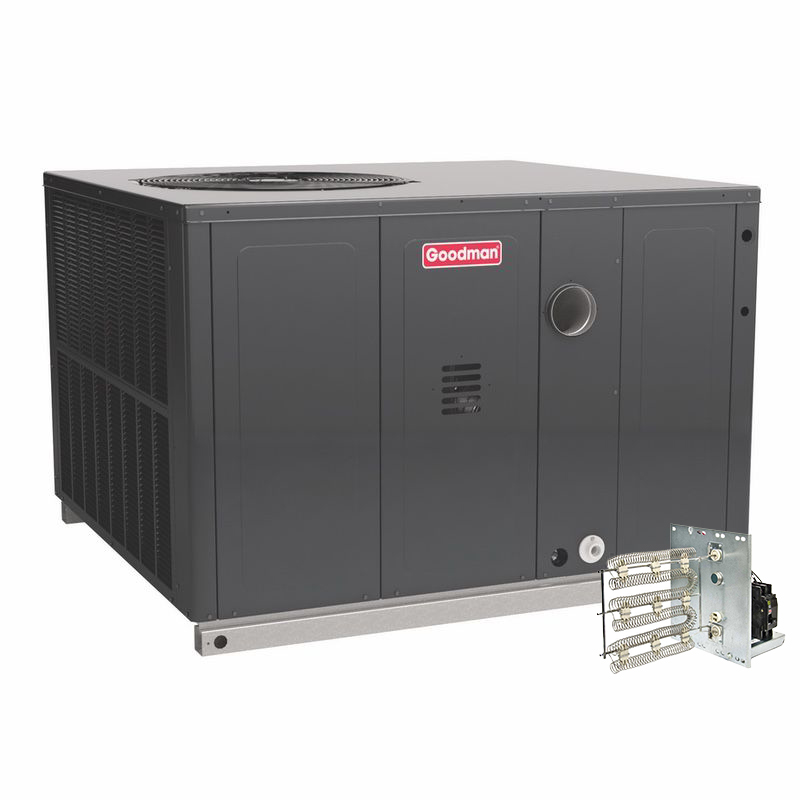
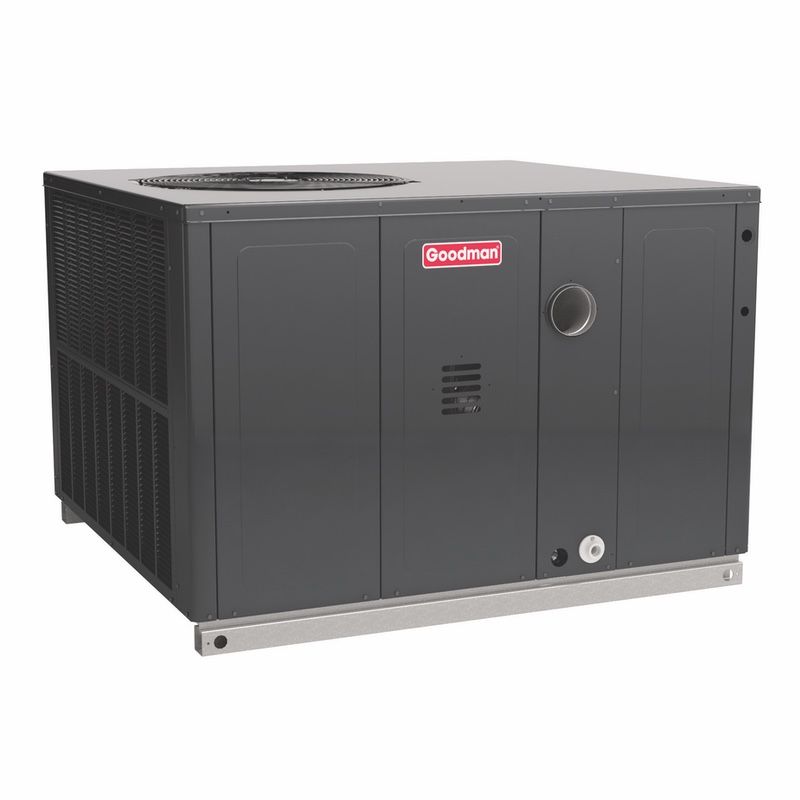
Goodman 3 Ton 60000 BTU 13.4 SEER2 Gas/Electric Package Unit Ultra-Low NOx
View on AC Direct see your lowest price →Check current price on AC Direct →
Key features
- 3-ton cooling capacity (36,000 BTU/hr) in a self-contained package unit cabinet
- 13.4 SEER2 efficiency rating meets current federal minimums for most U.S. regions
- 60,000 BTU gas furnace section for combined heating and cooling in one unit
- Ultra-Low NOx burner assembly meets CARB standards for regulated air districts
- Single-stage compressor and single-speed blower motor operation
- Compatible with standard rooftop curb and ground-mount pad installations
About this system
The Goodman GPUM33606041 is a 3-ton, 60,000 BTU gas/electric packaged unit designed for homes and light commercial spaces where the air handler, furnace heat exchanger, and cooling coil all live in a single cabinet mounted on a rooftop curb or ground pad. That all-in-one design is common in the Sun Belt, Southwest, and parts of the Southeast where slab foundations and flat or low-slope roofs make split systems impractical. If your home already uses a package unit, this is a like-for-like swap that avoids the cost of converting to a split system.
At 13.4 SEER2, this unit clears the federal minimum efficiency standard in effect for most regions but sits at the lower end of what the market offers. That means lower up-front cost and widely available parts, but higher monthly energy bills compared to 15 SEER2 or higher equipment over a 10-plus-year ownership window. The Ultra-Low NOx designation is a California Air Resources Board (CARB) requirement for certain air districts, so if you are not in a NOx-regulated area, you are paying for a compliance feature you may not need. If you are in one of those districts, this unit keeps you legal without a separate combustion upgrade.
Gas/electric configuration means cooling is handled by the refrigerant circuit while heating comes from a gas furnace section in the same cabinet, sharing one set of ductwork. This suits climates with cold winters and hot summers where both heating and cooling loads are real demands rather than seasonal afterthoughts. At 60,000 BTU on the heating side, output is adequate for most 1,200 to 1,800 square foot homes in moderate climates, though a proper Manual J load calculation should always confirm sizing before purchase.
The GPUM33606041 is a straightforward, budget-conscious package unit that delivers reliable basic comfort when properly installed and maintained. It will not win on efficiency or expected compressor lifespan versus premium brands, but its lower price point and widely available parts make it a defensible choice for owners who want to control up-front costs. Long-term value depends heavily on installer quality and a commitment to annual maintenance.
Overall score is the average of the five ratings above.
What we like
- Priced 15 to 25 percent below comparable Carrier, Trane, and Lennox package units
- All-in-one cabinet simplifies replacement of an existing package unit without ductwork changes
- Ultra-Low NOx compliance built in for California and other regulated air districts
- Parts, including the commonly replaced dual-run capacitor, are widely stocked and inexpensive
- 13.4 SEER2 meets federal efficiency minimums, keeping the purchase price accessible
Trade-offs
- Single-stage operation delivers full capacity or nothing, which can cause humidity and comfort issues in mild weather
- 13.4 SEER2 is the lowest efficiency tier available and will cost more to operate than 15 SEER2 or higher alternatives over a long ownership period
- Compressor lifespan averages 10 to 14 years, shorter than the 15 to 20 years typical of premium-brand compressors
- Evaporator coil leaks and early refrigerant loss are documented failure modes, making installation quality and a thorough startup check critically important
What homeowners and pros say about Goodman
Homeowners who have lived with Goodman package units tend to split into two camps. Those who had a qualified technician install the unit, verify the refrigerant charge, and return annually for tune-ups often report years of uneventful service and appreciate the low purchase price. The recurring complaint on review channels like ConsumerAffairs, where Goodman scores around 2.5 out of 5, centers on repair bills that climb after roughly year seven, particularly from dual-run capacitor failures and, in a meaningful share of cases, evaporator coil leaks. Google dealer reviews average around 3.8 out of 5 across dealer locations, where affordability is consistently the top compliment. The gap between those two scores reflects a real pattern: satisfaction correlates strongly with installer quality and maintenance habits rather than with the unit alone.
HVAC technicians tend to hold a more pragmatic view of Goodman. They note that the parts ecosystem is wide and inexpensive, that capacitor replacements on these units are routine and quick, and that a well-maintained unit can reach 12 or more years without major incident. The concern they raise most consistently is the compressor lifespan differential: Goodman compressors in package units typically average 10 to 14 years, compared to 15 to 20 years in premium-brand equipment, which matters if the homeowner expects to keep the unit through a second decade. Technicians also flag that a minority of new Goodman installs present with refrigerant leaks in the first year, almost always traceable to installation or charge issues rather than a factory defect. For this particular model, the Ultra-Low NOx burner adds a layer of complexity that makes a licensed, experienced installer even more important than usual.
Sources: ConsumerAffairs Goodman owner reviews, AHRI Directory of Certified Product Performance, U.S. DOE appliance and equipment efficiency standards, Goodman product specification sheets.
What it costs to run
At 13.4 SEER2, cooling this 3-ton system for a typical 1200-hour cooling season at the U.S. average electricity rate of $0.17/kWh works out to roughly $548 per year in cooling, about $0 less per year than a minimum-efficiency 13.4 SEER2 unit of the same size. Your real cost depends on your climate and local rate.
Method: (36,000 BTU/hr ÷ 13.4 SEER2) × 1200 hours ÷ 1000 × $0.17/kWh. Rate source: U.S. EIA average; cooling hours: moderate-climate estimate.
How it compares
| Brand | Comparable model | SEER2 | Stage | Price position |
|---|---|---|---|---|
| Goodman | GPUM33606041 | 13.4 | Single-stage | Value pick |
| Carrier | WeatherMaster 50XC (base tier) | 13.4 | Single-stage | Typically 15 to 25 percent more than Goodman |
| Trane | Precedent (base series, YSC/YHC) | 13.4 | Single-stage | Typically 15 to 25 percent more than Goodman |
| Lennox | LRP14GE (14 SEER2 package series) | 13.4-14 | Single-stage | Typically 15 to 25 percent more than Goodman |
Competitor rows are comparable single-stage units at similar efficiency; price is relative position, not a quote.
Questions about this system
Is the Ultra-Low NOx version required where I live, and does it cost more to operate?
Ultra-Low NOx burners are required in California South Coast AQMD, San Joaquin Valley APCD, and a handful of other regulated districts. If you are outside those areas, the NOx designation does not affect your permit or rebates but also adds no efficiency benefit. Operating costs are the same as a standard-NOx unit at equivalent SEER2 and BTU ratings.
What maintenance does this unit need to avoid the capacitor and coil leak problems Goodman owners report?
Annual professional tune-ups that include capacitor testing, coil cleaning, and refrigerant charge verification address all three of the most commonly reported failure points. Dual-run capacitors on Goodman units are a known wear item; catching a weakening capacitor early costs roughly 300 to 600 dollars and prevents compressor stress. Keeping coils clean and charge correct significantly reduces the conditions that allow coil leaks to develop or go unnoticed.
Will a 3-ton 60,000 BTU unit be the right size for my home?
Tonnage rules of thumb are unreliable. The only accurate method is a Manual J load calculation that accounts for your home's square footage, insulation levels, window area, local climate, and duct condition. An oversized unit will short-cycle, leave humidity uncontrolled, and accelerate wear on the single-stage compressor; an undersized unit will run continuously on peak days and still not reach setpoint.
How does the expected compressor life compare to what I had before with a premium brand?
Goodman compressors in package units average 10 to 14 years of service life based on documented owner experience, compared to roughly 15 to 20 years for premium brands such as Trane or Carrier at similar usage. That gap matters most if you plan to stay in the home long-term; if you expect to sell within a decade, the difference is less significant, especially given the lower purchase price.
Can I install this myself to save money on labor?
In most jurisdictions, connecting gas lines and refrigerant circuits requires licensed contractor work and a mechanical permit. Even where DIY is technically legal, improper gas connections, refrigerant charge errors, and poor electrical work are the primary causes of the early refrigerant leaks and reliability problems that appear in Goodman owner complaints. Professional installation with a documented startup checklist is strongly recommended.
Specifications
| Cooling capacity | 3 Ton |
| Efficiency | 13.4 SEER2 |
| Furnace output | 60000 BTU |
| Model | GPUM33606041 |