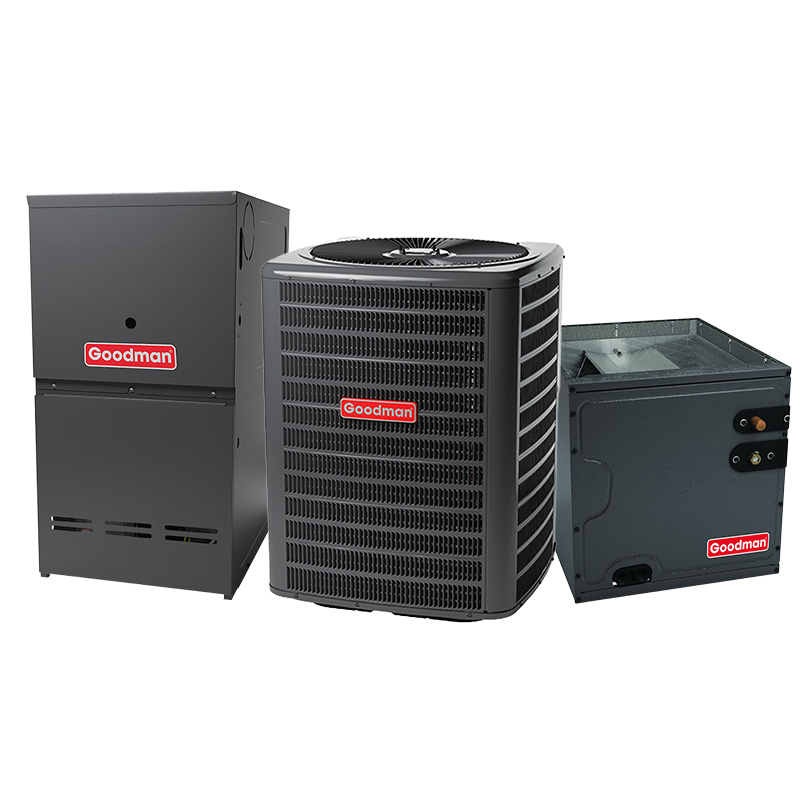
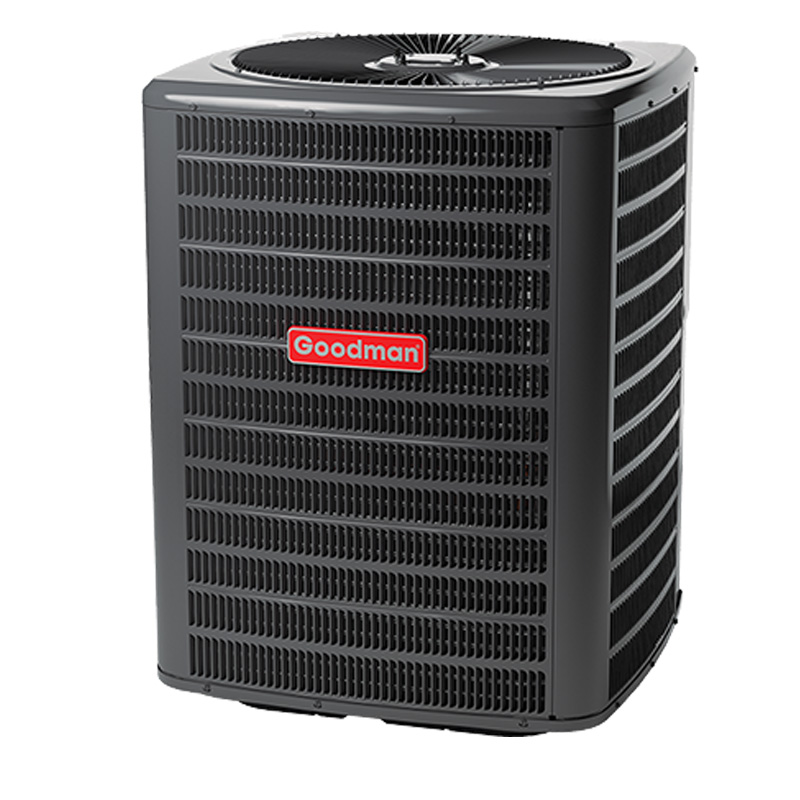
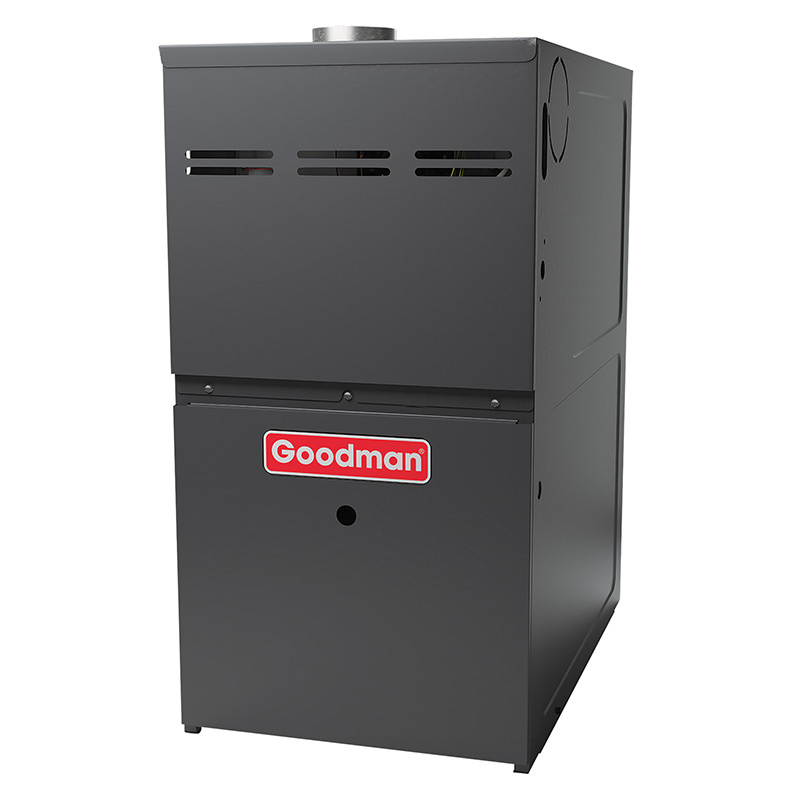
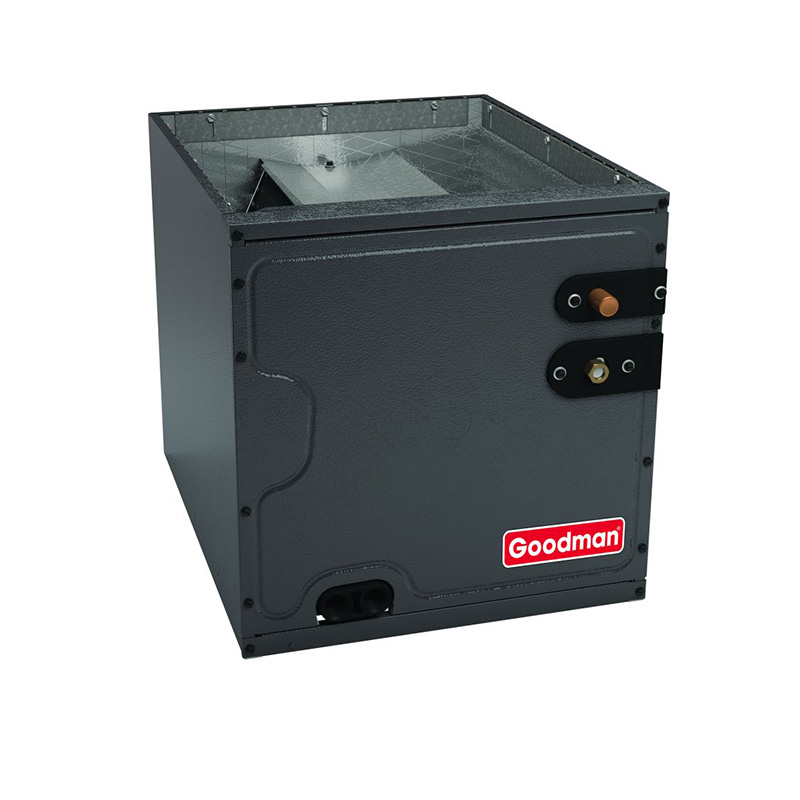
Goodman 3 Ton Dual Fuel Hybrid Heat Pump System – 80000 BTU Gas Furnace, 80% AFUE, 14.5 SEER2, Downflow, R32
View on AC Direct see your lowest price →Check current price on AC Direct →
Key features
- Dual fuel hybrid design: heat pump runs until gas becomes the more cost-effective option, then furnace takes over automatically
- 14.5 SEER2 rated cooling efficiency, meeting current federal minimums for most U.S. regions
- 80,000 BTU gas furnace at 80% AFUE, downflow cabinet for below-unit duct connections
- R-32 refrigerant: lower global warming potential than R-410A and increasingly supported by service technicians
- 3-ton (36,000 BTU/h) cooling capacity suits homes roughly in the 1,400 to 2,000 square-foot range depending on climate and insulation
- Goodman factory 10-year parts warranty when registered within 60 days of install
About this system
The Goodman 3-Ton Dual Fuel Hybrid Heat Pump System pairs a 14.5 SEER2 heat pump with an 80,000 BTU, 80% AFUE gas furnace in a downflow configuration, giving you two heating sources that switch automatically based on outdoor temperature and operating cost. When the heat pump can handle the load efficiently, it runs; when temps drop far enough that gas becomes cheaper or more effective, the furnace takes over. That switchover logic is what makes dual fuel worth the added complexity, and it works best in climates with cold but not extreme winters, where electricity prices and gas prices are reasonably competitive.
At 14.5 SEER2 the cooling efficiency is at the low end of what qualifies as mid-efficiency today, clearing the federal minimums for most U.S. regions but leaving room above it. The 80% AFUE furnace is similarly entry-level on the heating side: one in five BTUs of gas goes up the flue. Homeowners in mild-to-moderate climates who run the heat pump for most of the heating season will see this furnace relatively rarely, which limits the real-world cost of the 80% rating. The R-32 refrigerant charge is a forward-looking choice: R-32 has a lower global warming potential than the R-410A it replaces and is increasingly the industry standard going forward. The downflow cabinet orientation means warm air exits the bottom of the furnace, a layout used in homes where ductwork runs below the unit, such as crawl spaces or raised platforms.
This system is a cost-conscious entry point into dual fuel hybrid heating, and it delivers the core switchover benefit at a noticeably lower purchase price than comparable Carrier, Trane, or Lennox configurations. The 80% AFUE and 14.5 SEER2 ratings are functional rather than impressive, and long-term ownership costs depend heavily on install quality and whether a few documented weak points, especially capacitors and evaporator coils, surface on your unit.
Overall score is the average of the five ratings above.
What we like
- Purchase price typically 15 to 25 percent below comparable dual fuel systems from Carrier, Trane, and Lennox
- Automatic fuel switching reduces heating bills in climates with cold but not extreme winters
- R-32 refrigerant is lower-GWP and increasingly well-supported by technicians
- Downflow configuration suits crawl-space and raised-platform duct layouts that other orientations cannot accommodate
- 10-year parts warranty (registered) is competitive at this price tier
Trade-offs
- 80% AFUE is the lowest efficiency tier available; a two-stage or modulating 95%+ furnace would cut gas bills meaningfully in cold climates
- 14.5 SEER2 cooling efficiency sits at the entry level; higher-SEER2 heat pumps are available for a modest price step up
- Dual capacitor failures and evaporator coil leaks are documented recurring issues in owner reviews; budget for possible service calls after year 7
- Compressor lifespan averages 10 to 14 years versus 15 to 20 for premium-brand compressors, which matters for a system you expect to run for 15-plus years
What homeowners and pros say about Goodman
Owners and HVAC technicians who follow Goodman systems closely tend to land in a similar place: the value proposition is real, but it comes with conditions. On Google dealer reviews Goodman averages around 3.8 out of 5 across hundreds of reviews per location, and affordability is the single most common reason people are satisfied. On ConsumerAffairs the score drops to roughly 2.5 out of 5, a platform that skews toward people who had a bad enough experience to write about it, and the recurring complaint there is repair costs that start climbing after year seven or so. Neither number tells the whole story on its own, but together they suggest a brand that performs adequately when installed well and maintained, and struggles more than premium brands when it is not.
For a dual fuel hybrid system specifically, the technician feedback worth taking seriously centers on a few documented failure patterns. Dual-run capacitors are the most commonly cited repair on Goodman heat pump equipment and are usually a low-cost fix in the $300 to $600 range, but they do show up with some regularity. Evaporator coil leaks appear in a meaningful share of owner accounts and represent a more serious and expensive repair. Compressor longevity averages 10 to 14 years across Goodman systems, shorter than the 15 to 20 years typical of Trane, Carrier, and Lennox compressors, which is worth factoring in if you are planning to stay in the home long-term. A small number of owners also report refrigerant leaks within the first year, which technicians generally attribute to installation or initial charging errors rather than factory defects. The bottom line from the field is consistent: a Goodman system installed carefully by an experienced technician, with annual maintenance, will serve most homeowners reasonably well; skipping corners on either front shortens that outcome noticeably.
Sources: ConsumerAffairs Goodman owner reviews, AHRI Directory of Certified Product Performance, U.S. DOE appliance and equipment efficiency standards, Goodman product specification sheets.
What it costs to run
At 14.5 SEER2, cooling this 3-ton system for a typical 1200-hour cooling season at the U.S. average electricity rate of $0.17/kWh works out to roughly $506 per year in cooling, about $42 less per year than a minimum-efficiency 13.4 SEER2 unit of the same size. Your real cost depends on your climate and local rate.
Method: (36,000 BTU/hr ÷ 14.5 SEER2) × 1200 hours ÷ 1000 × $0.17/kWh. Rate source: U.S. EIA average; cooling hours: moderate-climate estimate.
How it compares
| Brand | Comparable model | SEER2 | Stage | Price position |
|---|---|---|---|---|
| Goodman | 3-Ton Dual Fuel Hybrid System (GSZTO / GCVC80 or equivalent 80% downflow pairing) | 14.5 | Single-stage | Value pick |
| Carrier | Performance Series Dual Fuel (25HCB3 heat pump paired with 58SB 80% furnace) | 15.2 | Single-stage | Typically 15 to 25 percent more than Goodman |
| Trane | XR15 Dual Fuel System (XR15 heat pump paired with S8B1 80% furnace) | 15.0 | Single-stage | Typically 15 to 25 percent more than Goodman |
| Lennox | Merit Series Dual Fuel (14HPX heat pump paired with ML180 80% furnace) | 15.0 | Single-stage | Typically 15 to 25 percent more than Goodman |
Competitor rows are comparable single-stage units at similar efficiency; price is relative position, not a quote.
Questions about this system
At what outdoor temperature does the system switch from heat pump to gas furnace, and can I change that setpoint?
The switchover temperature, often called the balance point, is typically set during installation by your HVAC technician using the thermostat or control board settings. A common starting point is around 35 to 40 degrees Fahrenheit, but the right number for your home depends on your local electricity and gas rates as well as your home's heat load. A qualified installer will size and set this correctly; ask them to walk you through it before they leave.
Why does this system use R-32 instead of R-410A, and does that affect service costs?
R-32 is being adopted industry-wide because its global warming potential is roughly 68 percent lower than R-410A, in line with updated EPA regulations phasing down high-GWP refrigerants. Most HVAC service companies are now equipped to handle R-32, though if you live in a rural area you should confirm your local technician is certified for it before purchasing.
What does 80% AFUE actually mean for my gas bill compared to a 96% furnace?
AFUE is the share of fuel that becomes usable heat; at 80% AFUE, 20 cents of every dollar spent on gas goes up the flue. A 96% AFUE furnace wastes only 4 cents per dollar, so the gap is real, roughly 16 percent lower gas consumption per hour of furnace run time. In a dual fuel system where the furnace mostly runs as a backup, this gap matters less than it would in a straight gas-only system, but in colder climates where the furnace runs often it adds up.
What are the most common repairs owners deal with on this Goodman system, and what do they cost?
The most frequently reported failure on Goodman heat pump and air conditioning systems is the dual-run capacitor, a relatively inexpensive fix typically in the $300 to $600 range including labor. Evaporator coil leaks show up in a meaningful share of longer-term owner reviews and are more expensive to address. Compressor failures become more likely after the 10- to 14-year mark, which is shorter than the 15- to 20-year lifespan seen with premium brands. A refrigerant leak in the first year is usually a sign of an installation or initial charge issue rather than a manufacturing defect.
Is downflow the right configuration for my home, and what happens if I need a different orientation?
Downflow means heated or cooled air exits through the bottom of the furnace cabinet and feeds into ductwork below, common in homes with crawl spaces or where the air handler sits on a raised platform. If your ducts run in an attic above the unit, you need an upflow configuration, and if ducts connect from the side, a horizontal unit may be needed. Installing the wrong orientation is not a minor issue; confirm your existing duct connection point before purchasing this specific cabinet.
Specifications
| Cooling capacity | 3 Ton |
| Efficiency | 14.5 SEER2 |
| Furnace output | 80000 BTU |
| Furnace efficiency | 80% AFUE |
| Configuration | Downflow |
| Refrigerant | R-32 |