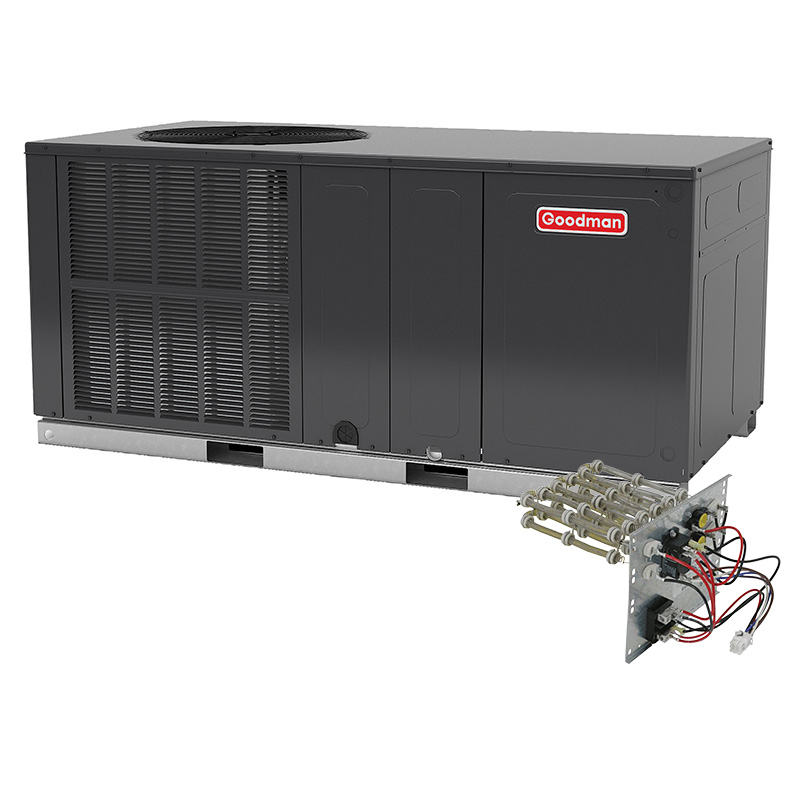
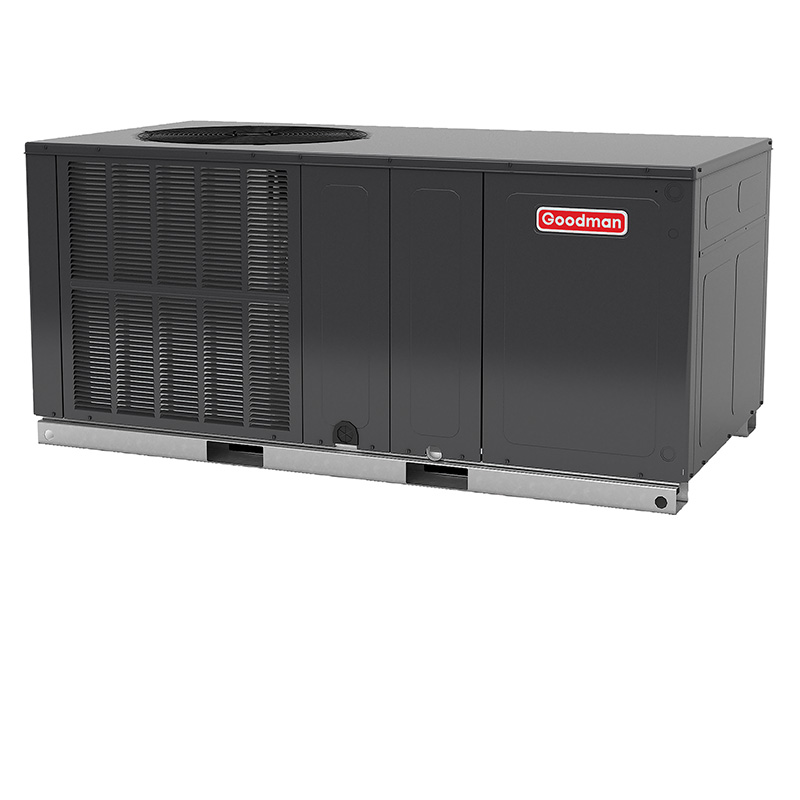
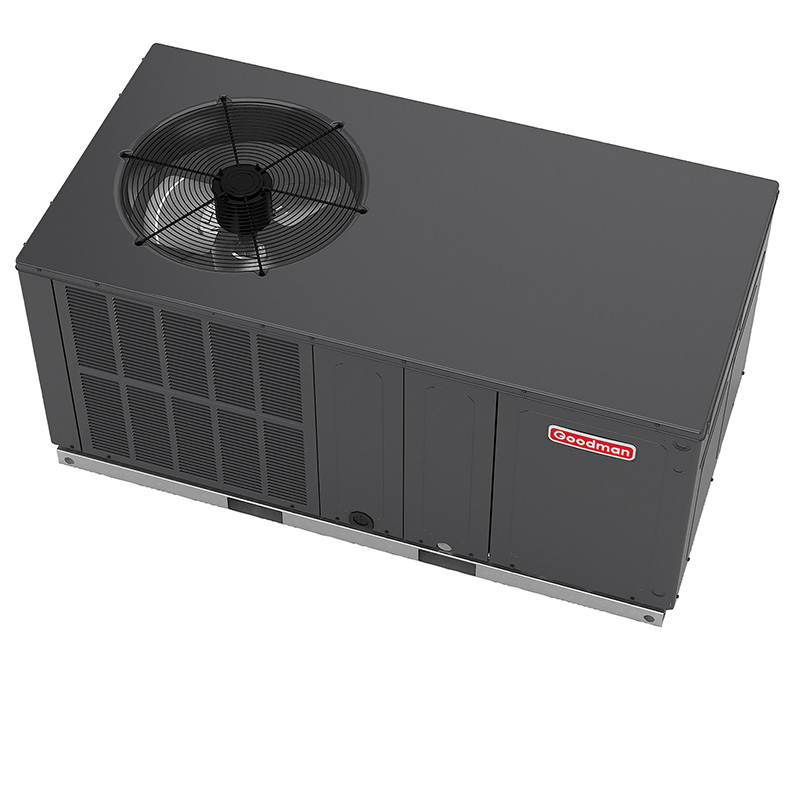
Goodman 3 Ton Heat Pump Package Unit – 15.2 SEER2, Horizontal Discharge, R32
View on AC Direct see your lowest price →Check current price on AC Direct →
Key features
- 15.2 SEER2 efficiency rating, above current federal minimum for most U.S. regions
- 3-ton (approximately 36,000 BTU) capacity suited for roughly 1,200 to 1,800 sq ft
- Horizontal discharge airflow for low-clearance rooftop or side-discharge applications
- R-32 refrigerant with lower global warming potential than R-410A
- All-in-one package unit design: compressor, coil, and air handler in one outdoor cabinet
- 10-year parts warranty when registered within 60 days of installation
About this system
The Goodman 3-ton heat pump package unit is a self-contained, all-in-one system that houses the compressor, coil, and air handler inside a single outdoor cabinet. The horizontal discharge configuration directs airflow sideways rather than upward, which makes it well suited for installations under low overhangs, in tight utility alcoves, or on rooftop curbs where vertical clearance is limited. At 3 tons, this unit is sized for homes roughly in the 1,200 to 1,800 square foot range, though actual sizing depends heavily on insulation levels, climate zone, and local load calculations.
The 15.2 SEER2 rating reflects the updated DOE testing protocol introduced in 2023, which runs equipment harder than the older SEER standard. In practical terms, 15.2 SEER2 sits comfortably above the current federal minimum for most U.S. regions and will deliver meaningful savings compared to older equipment, but it is not a premium-tier efficiency unit. Homeowners in moderate climates or those replacing a system rated below 14 SEER will notice a real drop in monthly energy costs. The switch to R-32 refrigerant is a forward-looking move: R-32 has a lower global warming potential than the R-410A it replaces and is increasingly the industry standard, which should help with long-term service availability and technician familiarity.
As a package unit, this system is especially common in sunbelt states and manufactured or modular homes where a split system is not practical. Because everything is outside, interior space requirements are minimal and ductwork connections are straightforward. The trade-off is that every major component is exposed to outdoor conditions, so unit placement, weatherproofing, and proper pad or curb installation matter more than they might with a split system.
This Goodman package unit offers a practical entry point into heat pump comfort with above-minimum efficiency and a modern refrigerant, at a price point that is hard to argue with on a tight budget. The hardware is serviceable, but its long-term performance depends more on who installs and maintains it than on the unit itself. Buyers who want a worry-free decade or more should weigh the lower upfront cost against Goodman's documented mid-life repair history before committing.
Overall score is the average of the five ratings above.
What we like
- Priced 15 to 25 percent below comparable Carrier, Trane, and Lennox package units
- 15.2 SEER2 clears federal minimums and delivers real savings over older low-efficiency systems
- R-32 refrigerant is increasingly available and has a lower environmental impact than R-410A
- Horizontal discharge design opens up installation options where vertical clearance is restricted
- Single outdoor cabinet keeps the installation footprint compact and interior spaces free of equipment
Trade-offs
- Dual-run capacitors are the most commonly reported failure, adding repair costs typically in the $300 to $600 range after the early years
- Evaporator coil leaks appear in a meaningful share of owner reports, a potentially expensive fix
- Compressor lifespan averages 10 to 14 years versus 15 to 20 years seen in premium-brand units
- A minority of owners report refrigerant leaks within the first year, most often tied to installation or initial charge quality
What homeowners and pros say about Goodman
Owners and HVAC professionals tend to describe Goodman package units in the same breath as their price tag. On Google dealer reviews, Goodman equipment averages around 3.8 out of 5 stars across locations, and the most consistent praise is straightforward: it costs less than the competition and, when installed correctly, it runs. Technicians are quick to add that qualifier about installation. Because Goodman’s margins are thinner, the brand attracts a wider range of installing contractors, and poor workmanship is widely cited in the field as the single biggest predictor of early trouble. The R-32 refrigerant and horizontal discharge configuration on this particular unit are not points of controversy; the real question technicians raise is whether the installer sized it properly, charged it accurately, and sealed the cabinet connections before walking away.
The less flattering picture comes from longer-term ownership. On ConsumerAffairs, Goodman sits at roughly 2.5 out of 5 stars, a score that reflects a platform where frustrated owners are far more likely to write reviews than satisfied ones, but the recurring theme is still worth noting: repair costs start climbing around year seven. The specific failure modes that show up most consistently are dual-run capacitor failures (a low-stakes, relatively affordable repair), evaporator coil leaks (a more serious and costly problem), and compressor wear that tends to peak between 10 and 14 years rather than the 15 to 20 years more commonly seen in Trane, Carrier, or Lennox equipment. A small but notable share of owners also report refrigerant leaks in the first year, which technicians almost universally attribute to installation or initial charging errors rather than a factory defect. The honest read is that this unit can deliver solid value with attentive installation and regular maintenance, but it rewards owners who budget for upkeep and stay on top of service calls.
Sources: ConsumerAffairs Goodman owner reviews, AHRI Directory of Certified Product Performance, U.S. DOE appliance and equipment efficiency standards, Goodman product specification sheets.
What it costs to run
At 15.2 SEER2, cooling this 3-ton system for a typical 1200-hour cooling season at the U.S. average electricity rate of $0.17/kWh works out to roughly $483 per year in cooling, about $65 less per year than a minimum-efficiency 13.4 SEER2 unit of the same size. Your real cost depends on your climate and local rate.
Method: (36,000 BTU/hr ÷ 15.2 SEER2) × 1200 hours ÷ 1000 × $0.17/kWh. Rate source: U.S. EIA average; cooling hours: moderate-climate estimate.
How it compares
| Brand | Comparable model | SEER2 | Stage | Price position |
|---|---|---|---|---|
| Goodman | 3-Ton Heat Pump Package Unit (this unit) | 15.2 | Single-stage | Value pick |
| Carrier | WeatherMaster 50XC series | 15.2 | Single-stage | Typically 15 to 25 percent more than this Goodman |
| Trane | Precedent TWE/TWA series | 15.2 | Single-stage | Typically 15 to 25 percent more than this Goodman |
| Lennox | LRP16HP series | 16.0 | Single-stage | Typically 15 to 25 percent more than this Goodman |
Competitor rows are comparable single-stage units at similar efficiency; price is relative position, not a quote.
Questions about this system
Will the horizontal discharge work on a rooftop curb, or is it only for ground-level side discharge?
Horizontal discharge package units are designed for both applications. They are commonly mounted on rooftop curbs in light commercial and manufactured-home settings, as well as at ground level where vertical discharge would hit an overhang. Confirm with your installer that the curb dimensions match the unit's footprint before ordering.
R-32 is new to me. Can local HVAC technicians actually service it?
R-32 is rapidly becoming the industry standard and is already widely used in residential equipment across the country. Most licensed HVAC technicians are or will soon be equipped to handle it, but it is worth confirming that your service contractor has R-32 recovery equipment before the warranty period ends.
How do I make sure the warranty stays valid?
Goodman requires product registration within 60 days of installation to activate the 10-year parts warranty. Installation must be performed by a licensed contractor, and you should keep the original invoice. Without registration, coverage typically drops to a shorter base period.
The reviews mention capacitor failures. How worried should I be about that?
Dual-run capacitor failure is the most frequently reported issue across Goodman units and is essentially an industry-wide weak point on value-tier equipment. The good news is that it is usually a quick repair in the $300 to $600 range. Enrolling in an annual maintenance plan that includes a capacitor check is a practical way to catch a weakening capacitor before it causes a compressor start failure on the hottest day of summer.
Is 15.2 SEER2 efficient enough to qualify for a federal tax credit?
The Inflation Reduction Act's 25C tax credit for heat pumps requires a minimum of 15.2 SEER2 for package units in most regions, so this unit sits right at the qualifying threshold. Verify current IRS guidance and consult a tax professional, as credit amounts and requirements can change, and regional minimum efficiency standards may vary.
Specifications
| Cooling capacity | 3 Ton |
| Efficiency | 15.2 SEER2 |
| Configuration | Horizontal |
| Refrigerant | R-32 |