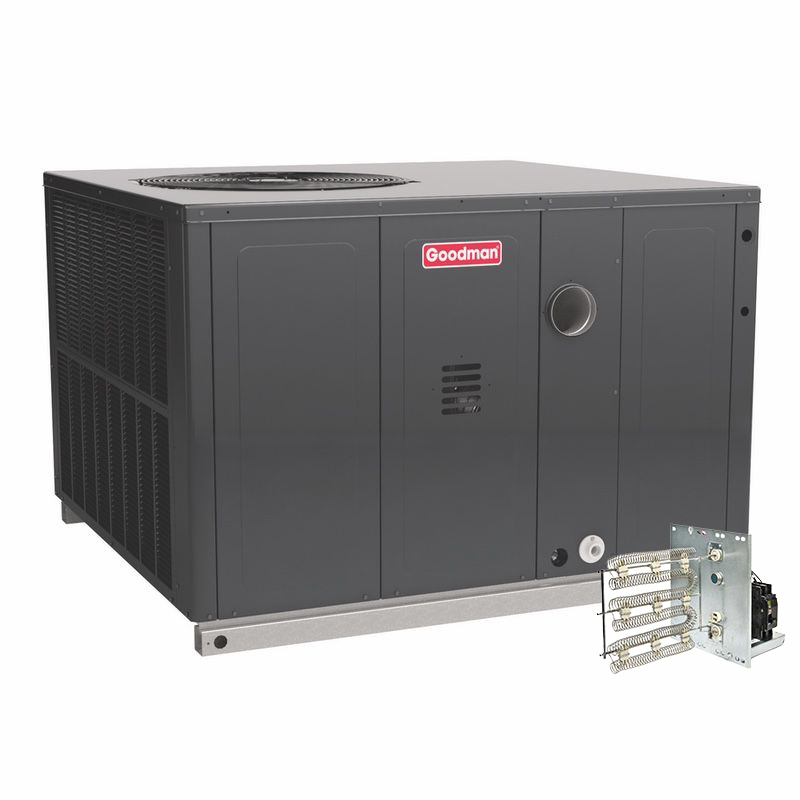
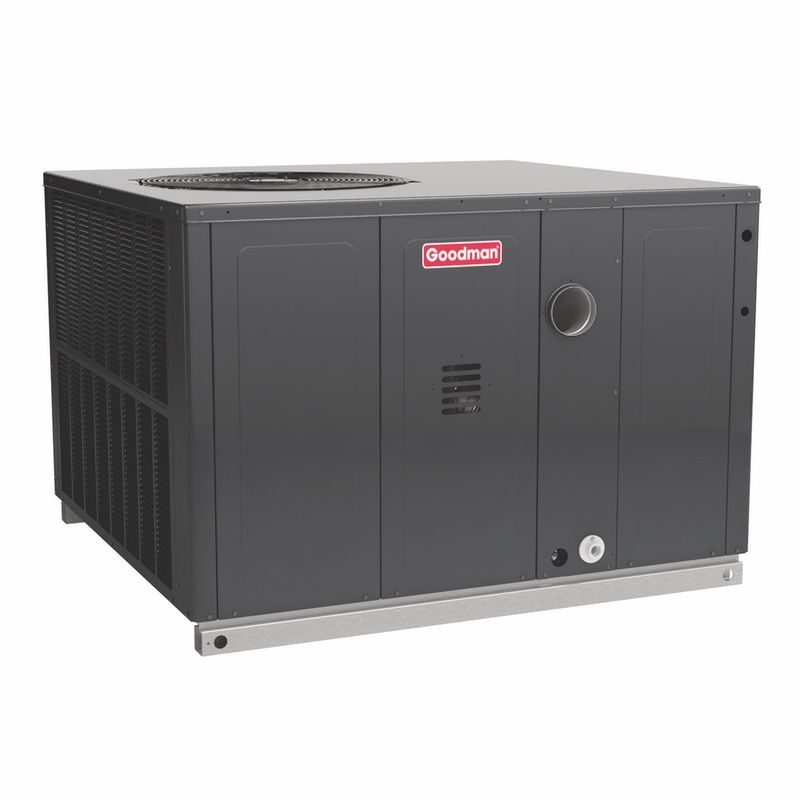
Goodman 3 Ton 60000 BTU 13.4 SEER2 Gas/Electric Package Unit Multiposition
View on AC Direct see your lowest price →Check current price on AC Direct →
Key features
- 3-ton cooling capacity with 60,000 BTU gas heat in a single packaged cabinet
- 13.4 SEER2 efficiency rating meets 2023 federal minimum standards
- Multiposition design supports horizontal or vertical duct connections
- Single-stage operation keeps controls and service procedures straightforward
- All-in-one configuration eliminates the need for a separate indoor air handler
- Goodman factory warranty covers parts; compressor and heat exchanger terms vary by registration
About this system
The Goodman GPGM33606041 is a 3-ton, 60,000 BTU gas/electric packaged unit designed for homes where space or installation constraints make a single outdoor cabinet more practical than separate indoor and outdoor components. Everything ships in one self-contained box: the cooling coil, compressor, gas furnace section, and air handler all live together, which is common in slab-foundation homes, mobile homes, rooftop applications, and tight utility closets. The multiposition design means installers can orient the unit horizontally or vertically to fit the available ductwork layout, adding flexibility to the install.
At 13.4 SEER2, this unit meets the 2023 federal minimum efficiency standards for most U.S. climate regions and nothing more. It will cool and heat reliably, but it sits at the entry tier of efficiency, so homeowners in hot climates running the system heavily will pay more in monthly utility costs compared to a 16 or 17 SEER2 system over time. The gas heating section is rated at 60,000 BTU output, suitable for moderate heating loads in mild to moderate climates. There is no published AFUE for this unit in the available specs, so buyers should confirm the heating efficiency rating with the dealer before purchase. This is a single-stage system, meaning the compressor and burner run at full capacity or not at all, which is straightforward to service but less precise at humidity control than two-stage or variable-capacity equipment.
The GPGM33606041 is a no-frills packaged unit that delivers entry-level efficiency at a price point noticeably below comparable Carrier, Trane, and Lennox equipment. It suits buyers who need a replacement or new install on a defined budget and are less concerned with long-term energy savings or premium longevity. The trade-off is a compressor lifespan that typically runs shorter than premium brands and repair costs that tend to rise after year seven.
Overall score is the average of the five ratings above.
What we like
- Purchase price typically 15 to 25 percent below comparable Carrier, Trane, and Lennox packaged units
- Multiposition capability makes it adaptable to a wider range of ductwork configurations
- Single-stage design means fewer components to troubleshoot and lower diagnostic complexity
- Replacement parts, including the commonly needed dual-run capacitor, are widely stocked by distributors nationwide
- All-in-one cabinet simplifies rooftop and slab installations where separate components are impractical
Trade-offs
- 13.4 SEER2 is the regulatory floor, not a competitive efficiency rating, leading to higher operating costs versus mid- or high-efficiency alternatives
- Compressor lifespan averages 10 to 14 years in real-world reports, versus 15 to 20 years for premium brands under similar conditions
- Evaporator coil leaks are a documented recurring complaint and can be a significant repair expense outside the warranty period
- A minority of owners report refrigerant leaks within the first year, typically traced to install or factory charge issues rather than a systemic defect, but quality control is less consistent than top-tier brands
What homeowners and pros say about Goodman
On review platforms that attract frustrated owners, Goodman scores around 2.5 out of 5 on ConsumerAffairs, where the recurring story is a system that runs fine for the first several years and then starts generating repair bills around year seven or eight. The specific failure modes most cited align with what technicians report independently: dual-run capacitor failures are common but inexpensive, evaporator coil leaks are more disruptive and costly, and a small share of owners describe refrigerant issues in the first year that most technicians attribute to installation or factory charge problems rather than a manufacturing defect. On Google dealer reviews, Goodman averages closer to 3.8 out of 5, where the tone shifts and affordability is consistently the most praised attribute, suggesting that buyers who understand what they are getting from a value brand tend to be satisfied with the proposition.
HVAC technicians tend to hold a nuanced view of Goodman equipment specifically on the packaged unit side. They point out that install quality drives more of the outcome than the brand nameplate, and a well-commissioned Goodman unit in a simple application will often outlast a poorly installed premium unit. That said, pros who work on aging Goodman systems frequently note that the compressor lifespan, typically 10 to 14 years in real-world conditions, falls short of the 15 to 20 years seen in top-tier brands. For a homeowner planning to sell within a decade, that gap may not matter. For someone staying put, it is worth factoring a potential compressor replacement into the long-term cost picture before deciding that the lower upfront price is the better deal.
Sources: ConsumerAffairs Goodman owner reviews, AHRI Directory of Certified Product Performance, U.S. DOE appliance and equipment efficiency standards, Goodman product specification sheets.
What it costs to run
At 13.4 SEER2, cooling this 3-ton system for a typical 1200-hour cooling season at the U.S. average electricity rate of $0.17/kWh works out to roughly $548 per year in cooling, about $0 less per year than a minimum-efficiency 13.4 SEER2 unit of the same size. Your real cost depends on your climate and local rate.
Method: (36,000 BTU/hr ÷ 13.4 SEER2) × 1200 hours ÷ 1000 × $0.17/kWh. Rate source: U.S. EIA average; cooling hours: moderate-climate estimate.
How it compares
| Brand | Comparable model | SEER2 | Stage | Price position |
|---|---|---|---|---|
| Goodman | GPGM33606041 | 13.4 | Single-stage | Value pick |
| Carrier | WeatherMaster 50XC series | 14.0 | Single-stage | Typically 15 to 25 percent more than Goodman |
| Trane | Precedent XR13 packaged series | 13.4 | Single-stage | Typically 15 to 25 percent more than Goodman |
| Lennox | LRP14GE packaged series | 14.0 | Single-stage | Typically 15 to 25 percent more than Goodman |
Competitor rows are comparable single-stage units at similar efficiency; price is relative position, not a quote.
Questions about this system
What does multiposition mean on this packaged unit, and does it affect what my installer needs to do?
Multiposition means the supply and return air connections can be configured for either a horizontal or vertical duct layout, which matters on rooftop curb mounts versus side-discharge slab applications. Your installer will need to verify the orientation before ordering any transition or curb adapter hardware. It does not mean the unit itself is repositioned; only the air-flow direction through the cabinet changes.
Is 13.4 SEER2 going to cost me noticeably more to run than a higher-efficiency unit?
Compared to a 16 SEER2 system, a 13.4 SEER2 unit uses roughly 16 to 20 percent more electricity per hour of cooling, which adds up meaningfully in climates where the unit runs four to six months a year. In moderate climates with shorter cooling seasons, the payback period for upgrading to higher efficiency stretches out and the savings are smaller. Run a simple annual cost estimate using your local utility rate and estimated run hours before deciding.
What is the most common repair I should budget for on this Goodman unit?
The dual-run capacitor is the most frequently reported failure on Goodman equipment and is generally a low-stakes fix in the 300 to 600 dollar range including labor. Evaporator coil leaks are a more serious documented failure mode and can run significantly higher depending on whether a repair or coil replacement is needed. Setting aside a small annual service budget and scheduling a spring tune-up each year is the most practical way to catch capacitor wear before it causes a compressor strain event.
Does this unit come with a warranty, and do I need to register it?
Goodman typically requires product registration within a set window after installation to activate the full limited warranty, which generally includes a longer term on the compressor and heat exchanger than on other parts. Without registration, coverage usually defaults to a shorter base warranty. Confirm the exact terms for model GPGM33606041 with your dealer at the time of purchase, since warranty specifics can vary by product generation.
Can this packaged unit be installed on a rooftop curb, or is it only for ground-level slab installs?
Packaged units like this one are commonly installed on rooftop curbs, which is one of the primary reasons homeowners choose them over split systems. Your installer will need a matching roof curb adapter sized for this unit's footprint and a code-compliant electrical and gas connection routed to the rooftop location. Confirm the curb dimensions with your installer before the equipment arrives on site to avoid delays.
Specifications
| Cooling capacity | 3 Ton |
| Efficiency | 13.4 SEER2 |
| Furnace output | 60000 BTU |
| Model | GPGM33606041 |