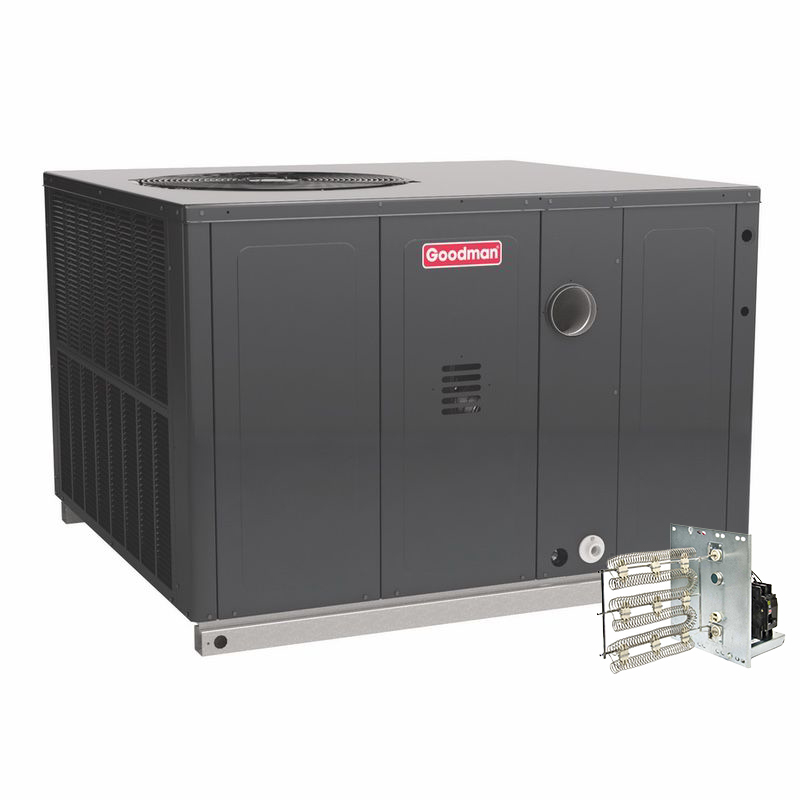
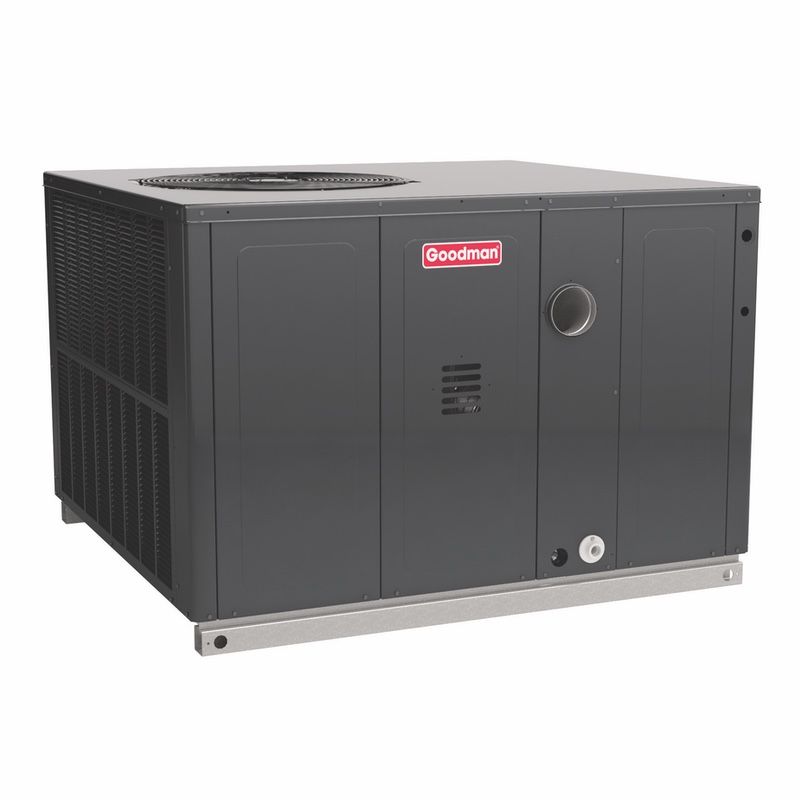
Goodman 3 Ton 80000 BTU 15.2 SEER2 Gas/Electric Package Unit
View on AC Direct see your lowest price →Check current price on AC Direct →
Key features
- 3-ton cooling capacity with 15.2 SEER2 efficiency rating, meeting 2023 federal minimums
- 80,000 BTU gas heating section in a single packaged cabinet for rooftop or ground-mount installations
- All-in-one gas/electric package eliminates the need for a separate indoor air handler
- Single-stage compressor and blower operation for straightforward, low-complexity control
- Factory-matched refrigerant circuit reduces field assembly points versus a split system
- Goodman 10-year parts limited warranty when registered within 60 days of installation
About this system
The Goodman GPGM53608041 is a 3-ton, 80,000 BTU gas/electric packaged unit designed for homes where the furnace, air handler, and condenser are all housed in a single cabinet, typically installed on a rooftop or a ground-level slab beside the structure. This configuration is common in sunbelt and southwestern climates, manufactured housing, and light commercial applications where mechanical closets are not available or practical. Everything ships in one box, which simplifies the installation footprint and reduces the number of refrigerant line connections compared to a split system.
At 15.2 SEER2, this unit clears the federal minimum efficiency threshold that took effect in 2023 for most regions, but it sits at the lower end of mid-efficiency territory rather than at the top. That means operating costs will be meaningfully lower than an older 10 or 13 SEER system it might replace, but noticeably higher than a 17 or 18 SEER2 premium unit over the same cooling season. The gas heating section is rated at 80,000 BTU input, which is appropriate for moderate-to-large homes in mild-to-moderate heating climates. Buyers in regions with harsh winters should confirm that output and AFUE align with their load calculation before purchasing.
This unit is best suited to cost-conscious homeowners or property managers who need a reliable, code-compliant replacement or new installation without the upfront premium of a Trane, Carrier, or Lennox equivalent. Goodman’s value proposition is straightforward: the hardware typically costs 15 to 25 percent less than those brands at comparable efficiency, and it carries a competitive warranty, but long-term performance depends heavily on installation quality and a willingness to budget for component-level repairs after the first decade.
The GPGM53608041 delivers a code-compliant, competitively priced packaged unit that makes practical sense for budget-focused replacements and rental properties in package-unit climates. The 15.2 SEER2 rating offers a real efficiency step up from older equipment, though it is not a high-efficiency unit by today's standards. Owners should factor in a modest repair budget for years 7 through 14, particularly for capacitor and potential coil service, and should prioritize hiring an experienced installer since Goodman's track record is closely tied to install quality.
Overall score is the average of the five ratings above.
What we like
- Priced 15 to 25 percent below comparable Trane, Carrier, and Lennox package units, lowering the initial capital outlay
- All-in-one cabinet simplifies installation and is ideal where split-system placement is not feasible
- 15.2 SEER2 represents a meaningful efficiency improvement over pre-2023 low-efficiency equipment
- 10-year parts warranty (registered) is competitive with premium brands at this efficiency tier
- Single-stage operation keeps the control system simple and service-friendly for most HVAC technicians
Trade-offs
- Compressor lifespan averages 10 to 14 years, shorter than the 15 to 20 years documented for premium-brand compressors
- Dual-run capacitor failures are the most commonly reported issue, typically appearing in years 5 through 10
- Evaporator coil leaks appear in a meaningful share of owner reviews, which can be a costly mid-life repair
- 15.2 SEER2 is at the low end of mid-efficiency; homeowners in hot climates with long cooling seasons will see higher utility costs than with a 17-plus SEER2 unit
What homeowners and pros say about Goodman
Homeowners who have lived with Goodman package units often echo a consistent pattern: satisfaction in the first five to seven years followed by more mixed feelings as repair bills start to appear. On ConsumerAffairs, Goodman carries roughly 2.5 out of 5 stars, a score that reflects the platform’s complaint-heavy nature but also a real cluster of owners frustrated by repair costs that begin climbing after year seven. Google dealer reviews tell a more balanced story, averaging around 3.8 out of 5 across hundreds of reviews per location, where the most common praise centers on affordability and the most common frustration is responsiveness when something goes wrong mid-warranty. For the GPGM53608041 specifically, prospective buyers should understand that these aggregate scores reflect the full Goodman line, including equipment that was improperly installed or poorly maintained.
HVAC technicians who service Goodman equipment regularly point to dual-run capacitor failure as the brand’s most predictable and luckily most affordable recurring issue, with typical repair costs in the 300 to 600 dollar range. More consequential are the evaporator coil leaks that appear in a meaningful share of owner reviews, which can require refrigerant recovery, coil replacement, and recharge at significantly higher cost. On compressor lifespan, technicians note that Goodman compressors tend to average 10 to 14 years in real-world conditions, compared to 15 to 20 years for premium-brand compressors under similar loads. A small percentage of owners also report refrigerant leaks within the first year, which technicians consistently attribute to installation or initial charge issues rather than a manufacturing defect. The takeaway from both camps is that Goodman’s value proposition holds when the install is done right and the unit receives annual preventive maintenance, but the margin for error is thinner than with a premium brand.
Sources: ConsumerAffairs Goodman owner reviews, AHRI Directory of Certified Product Performance, U.S. DOE appliance and equipment efficiency standards, Goodman product specification sheets.
What it costs to run
At 15.2 SEER2, cooling this 3-ton system for a typical 1200-hour cooling season at the U.S. average electricity rate of $0.17/kWh works out to roughly $483 per year in cooling, about $65 less per year than a minimum-efficiency 13.4 SEER2 unit of the same size. Your real cost depends on your climate and local rate.
Method: (36,000 BTU/hr ÷ 15.2 SEER2) × 1200 hours ÷ 1000 × $0.17/kWh. Rate source: U.S. EIA average; cooling hours: moderate-climate estimate.
How it compares
| Brand | Comparable model | SEER2 | Stage | Price position |
|---|---|---|---|---|
| Goodman | GPGM53608041 | 15.2 | Single-stage | Value pick |
| Carrier | WeatherMaster 50XC series (single-stage gas/electric package) | 15.2 | Single-stage | Typically 15 to 25 percent more than Goodman |
| Trane | YCD/YCC Precedent series (single-stage gas/electric package) | 15.2 | Single-stage | Typically 15 to 25 percent more than Goodman |
| Lennox | LRP16GE series (single-stage gas/electric package) | 16.0 | Single-stage | Typically 15 to 25 percent more than Goodman |
Competitor rows are comparable single-stage units at similar efficiency; price is relative position, not a quote.
Questions about this system
Does this unit work as a straight replacement for an existing rooftop package unit, or does ductwork usually need to be modified?
In many cases it can be a direct replacement if the existing curb dimensions and duct connections match Goodman's specifications for this model. However, curb adapters are often needed when swapping from a different brand or an older unit with different footprint dimensions, so your installer should verify curb compatibility and duct sizing before the old unit is removed.
What is the most likely repair I should budget for, and roughly when?
The dual-run capacitor is the most commonly reported failure point on Goodman equipment and typically runs 300 to 600 dollars to diagnose and replace. This part tends to show wear in years 5 through 10, particularly in hot climates where the unit runs frequently. Keeping a maintenance contract that includes an annual capacitor check is a practical way to catch it before it causes a full system shutdown.
How important is it to register the warranty, and what does the 10-year parts coverage actually include?
Registration within 60 days of installation is required to receive the full 10-year parts limited warranty; without registration the coverage drops to 5 years on most components. The parts warranty covers listed components against defects but does not cover labor, refrigerant, or diagnostic charges, so a service call can still cost several hundred dollars even on a warranted part.
Is 15.2 SEER2 efficient enough to qualify for federal tax credits or utility rebates?
As of the current Inflation Reduction Act guidelines, central air equipment generally needs to meet a higher efficiency threshold (typically 15.2 SEER2 is the minimum for split systems in northern regions, but package units may have different thresholds) to qualify for the 25C tax credit. You should verify current IRS guidance and check with your local utility, because rebate programs vary significantly by state and provider.
Can this unit be used in a climate with very cold winters, or is 80,000 BTU gas heat adequate?
The 80,000 BTU gas heating section is appropriate for moderate heating climates and average-to-large homes in mild-winter regions, but the adequacy depends entirely on a proper Manual J load calculation for your specific home and location. In climates with extended periods below 20 degrees Fahrenheit, a higher BTU input or supplemental heat may be needed, and a qualified technician should confirm sizing before purchase.
Specifications
| Cooling capacity | 3 Ton |
| Efficiency | 15.2 SEER2 |
| Furnace output | 80000 BTU |
| Model | GPGM53608041 |