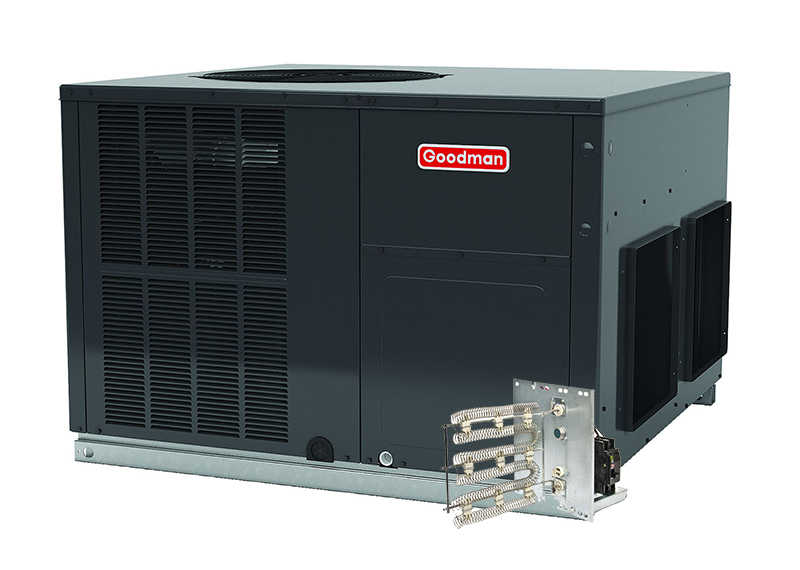
Goodman 3 Ton 13.4 SEER2 Heat Pump Package Unit Multiposition
View on AC Direct see your lowest price →Check current price on AC Direct →
Key features
- 3-ton capacity, suited for approximately 1,400 to 1,800 square feet depending on climate and load
- 13.4 SEER2 efficiency rating, meeting current federal minimum standards for most U.S. regions
- All-in-one package unit design houses coil, refrigerant circuit, and blower in a single outdoor cabinet
- Multiposition configuration supports horizontal and downflow duct connections
- Heat pump operation provides both summer cooling and winter heating from one system
- Goodman factory warranty covers compressor and parts, with registration typically required for extended coverage
About this system
The Goodman 3-ton 13.4 SEER2 heat pump package unit is an all-in-one outdoor cabinet that handles both heating and cooling from a single rooftop or ground-level installation. Because the air handler, coil, and refrigerant circuit are all contained in one chassis, it is a common choice for mobile homes, light commercial spaces, and homes where ductwork connects directly to a rooftop unit rather than running to a split system indoors. The multiposition design means the unit can be installed in a horizontal or downflow configuration, giving installers some flexibility to match existing duct layouts.
At 3 tons, this unit is suited to conditioned spaces roughly in the 1,400 to 1,800 square foot range, though actual sizing depends heavily on local climate, insulation, and ceiling height. The 13.4 SEER2 rating sits at the baseline of current federal minimum efficiency standards for most U.S. climate regions, so you are getting code-compliant performance without the added cost of a high-efficiency upgrade. Heat pump operation means the system moves heat rather than generating it, which typically delivers more heating output per dollar of electricity than straight electric resistance heat, though efficiency drops in very cold climates and a backup heat strip is often added for those conditions.
This Goodman package unit is a straightforward, budget-accessible entry point for homeowners or property managers who need an all-in-one heat pump without paying premium-brand prices. It delivers code-minimum efficiency and functional performance, but its long-term reliability leans on installation quality and carries the same documented weak points seen across the Goodman line. It is a reasonable choice when upfront cost is the primary constraint and you have access to a qualified installer.
Overall score is the average of the five ratings above.
What we like
- Priced 15 to 25 percent below comparable Carrier, Trane, and Lennox package units
- All-in-one cabinet simplifies installation where a split system is not practical
- Multiposition design offers some flexibility for existing duct layouts
- 13.4 SEER2 meets current federal efficiency minimums, so no penalty on utility bills versus a code-minimum competitor
- Dual-run capacitor failures, the most common documented issue, are generally a low-cost repair in the 300 to 600 dollar range
Trade-offs
- Compressor lifespan averages 10 to 14 years, shorter than the 15 to 20 years typical of premium brands
- Evaporator coil leaks appear in a meaningful share of owner reports and can be a costly mid-life repair
- A minority of owners report refrigerant leaks in the first year, most often traced to installation or factory charge issues
- ConsumerAffairs scores average around 2.5 out of 5, with repair cost escalation commonly cited after year 7
What homeowners and pros say about Goodman
Homeowners who purchased Goodman equipment cite affordability as the most consistent positive, and that sentiment shows up in Google dealer reviews, which average around 3.8 out of 5 stars across hundreds of location-level ratings. Buyers of this package unit will likely find similar feedback: the system works as advertised when properly installed, and the initial savings over Trane, Carrier, or Lennox are real and meaningful. HVAC technicians, however, are quick to add a qualification that installation quality is the single biggest factor in how long a Goodman unit performs reliably, which places more responsibility on the contractor than is the case with some premium brands.
The ConsumerAffairs score for Goodman sits at roughly 2.5 out of 5, a number worth understanding in context. That platform skews toward owners who experienced problems, but the recurring theme in those complaints is repair costs climbing after roughly year 7, which aligns with documented failure patterns across the product line. For this package unit specifically, the failure modes buyers should know about going in are dual-run capacitor failures (frequent but relatively inexpensive to fix), evaporator coil leaks (less common but more costly), and a compressor lifespan that tends to land in the 10 to 14 year range rather than the 15 to 20 years more common in premium equipment. A minority of owners also report refrigerant issues in the first year, most often linked to installation or factory charge rather than a manufacturing defect in the unit itself.
Sources: ConsumerAffairs Goodman owner reviews, AHRI Directory of Certified Product Performance, U.S. DOE appliance and equipment efficiency standards, Goodman product specification sheets.
What it costs to run
At 13.4 SEER2, cooling this 3-ton system for a typical 1200-hour cooling season at the U.S. average electricity rate of $0.17/kWh works out to roughly $548 per year in cooling, about $0 less per year than a minimum-efficiency 13.4 SEER2 unit of the same size. Your real cost depends on your climate and local rate.
Method: (36,000 BTU/hr ÷ 13.4 SEER2) × 1200 hours ÷ 1000 × $0.17/kWh. Rate source: U.S. EIA average; cooling hours: moderate-climate estimate.
How it compares
| Brand | Comparable model | SEER2 | Stage | Price position |
|---|---|---|---|---|
| Goodman | 3-Ton 13.4 SEER2 Heat Pump Package Unit Multiposition | 13.4 | Single-stage | Value pick |
| Carrier | WeatherMaster 50XC Series | 14.0 | Single-stage | Typically 15 to 25 percent more than Goodman |
| Trane | Precedent WCD/WHD Series | 14.0 | Single-stage | Typically 15 to 25 percent more than Goodman |
| Lennox | LRP14HP Series | 14.0 | Single-stage | Typically 15 to 25 percent more than Goodman |
Competitor rows are comparable single-stage units at similar efficiency; price is relative position, not a quote.
Questions about this system
Does this package unit include electric heat strips, or do I need to add them separately?
Heat strips are typically not included in the base package unit and must be ordered or installed separately. In climates where outdoor temperatures regularly drop below about 35 degrees Fahrenheit, a heat strip kit is strongly recommended as a backup when the heat pump's efficiency drops. Confirm with your installer what strip heat capacity is appropriate for your climate.
What does 'multiposition' actually mean for installation, and does my existing ductwork need to be modified?
Multiposition means the unit can be installed in a horizontal orientation (common for rooftop applications) or a downflow orientation where supply air goes straight down into the duct. Whether your existing ductwork needs modification depends on its current configuration and connection point. A qualified HVAC contractor should assess your duct layout before purchase.
How does the 13.4 SEER2 rating affect my monthly electricity bill compared to a higher-efficiency unit?
13.4 SEER2 is the code-minimum tier, so you will not see the utility bill savings that a 16 or 18 SEER2 unit could provide. The efficiency gap is more noticeable in climates with long, hot cooling seasons or very cold winters that require extended heat pump run times. For moderate climates or rental properties with lower occupancy, the upfront savings of a baseline-efficiency unit often outweigh the long-term energy cost difference.
What are the most common repairs I should budget for over the life of this unit?
Dual-run capacitor replacement is the most frequently reported issue across the Goodman line and typically costs 300 to 600 dollars including labor. Evaporator coil leaks appear in a meaningful share of owner reports and carry a higher repair cost. Compressor lifespan on Goodman units tends to average 10 to 14 years, so budgeting for a potential compressor replacement or full unit swap before the 15-year mark is prudent.
Does Goodman's warranty require registration, and what does it actually cover on this model?
Yes, Goodman's extended warranty coverage on compressor and parts generally requires product registration within a set window after installation, typically 60 days. Without registration, coverage typically reverts to a shorter base period. Read the warranty certificate for this specific model carefully before installation, and confirm registration with your contractor to avoid losing coverage.
Specifications
| Cooling capacity | 3 Ton |
| Efficiency | 13.4 SEER2 |