Goodman 3 Ton Up To 16.5 SEER2 R32 High-Efficiency Cooling Only Condenser (GLXS5BA3610)
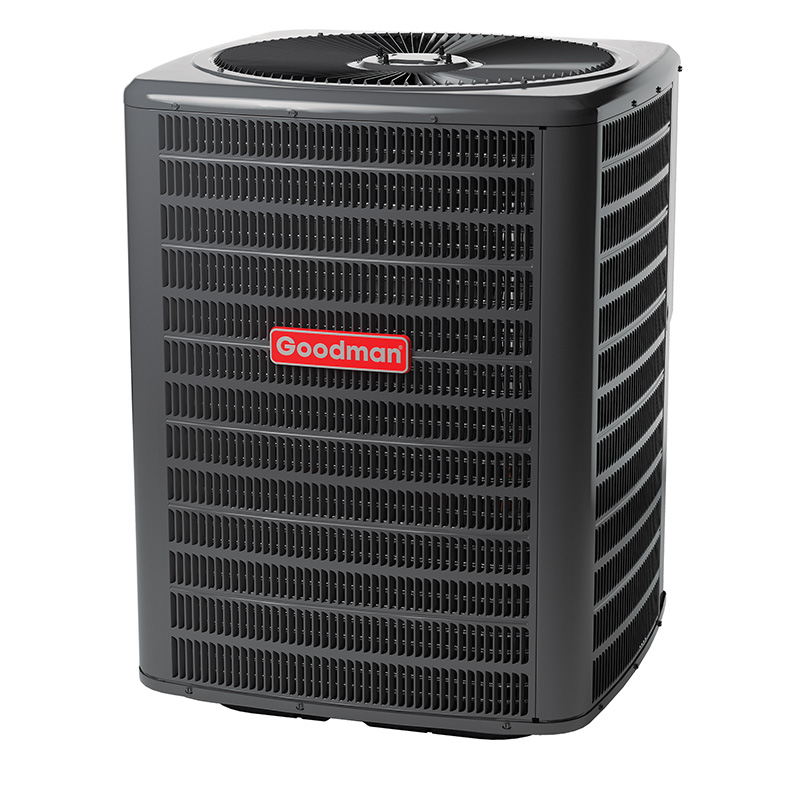
View on AC Direct see your lowest price →Check current price on AC Direct →
Key features
- 3-ton capacity rated up to 16.5 SEER2 under current DOE test standards
- R-32 refrigerant with lower global-warming potential than R-410A
- Single-stage scroll compressor for straightforward, serviceable operation
- Cooling-only configuration pairs with a separate air handler or coil-equipped furnace
- Factory-charged and tested before shipment from Goodman's U.S. manufacturing facility
- 10-year parts warranty and lifetime compressor warranty when registered within 60 days of install
About this system
The Goodman GLXS5BA3610 is a 3-ton, cooling-only condenser rated up to 16.5 SEER2 and designed to work as part of a split system alongside a separately purchased air handler or furnace with coil. It runs on R-32 refrigerant, a lower-global-warming-potential refrigerant that is increasingly common as the industry moves away from R-410A. At 16.5 SEER2, this unit sits in the upper-mid efficiency band, meaningfully above the federal minimum but below the 18-plus SEER2 territory of premium variable-speed equipment. Homeowners in moderately hot climates who want a legitimate efficiency step up without paying for top-tier hardware will find the spec sheet reasonable.
This condenser is a single-stage unit, meaning the compressor runs at full capacity whenever it is on. That design keeps the purchase price down and simplifies service calls, but it cannot match the humidity control or quiet part-load operation of two-stage or variable-speed systems. It suits homes with good duct systems, owners who prioritize upfront cost over long-run operating expense, and buyers who already have a compatible air handler in place and simply need to replace the outdoor unit. Because it is cooling-only, it pairs with a gas furnace or electric air handler for heating, making it the right fit in mild-winter markets or situations where heating is handled separately.
The GLXS5BA3610 delivers a reasonable 16.5 SEER2 efficiency rating at a price point that undercuts Carrier, Trane, and Lennox by a noticeable margin, making it a practical choice for budget-conscious buyers who are not chasing the lowest possible utility bills. The trade-off is a documented history of capacitor failures, a compressor lifespan that tends to run shorter than premium brands, and performance that depends heavily on the quality of the installation. Buyers who hire a skilled, licensed contractor and register the warranty promptly will get the most out of this system.
Overall score is the average of the five ratings above.
What we like
- Street price typically 15 to 25 percent below Carrier, Trane, and Lennox equivalents
- 16.5 SEER2 is a genuine mid-upper efficiency rating that reduces cooling costs compared to minimum-standard equipment
- R-32 refrigerant is more environmentally responsible and is expected to remain available long-term
- Lifetime compressor warranty (with registration) is a standout coverage term for a value-tier brand
- Single-stage design means most independent HVAC technicians can diagnose and repair it without specialized tools
Trade-offs
- Dual-run capacitors are the most commonly reported failure, typically surfacing within the first several years and costing 300 to 600 dollars to fix
- Compressor lifespan averages 10 to 14 years versus 15 to 20 years commonly seen in premium-brand equipment
- A minority of owners report refrigerant leaks in the first year, often pointing to installation or initial charge issues rather than a factory defect
- Single-stage operation means less precise humidity control and more on-off cycling compared to two-stage or variable-speed alternatives
What homeowners and pros say about Goodman
Among homeowners, the Goodman brand draws notably split reactions. On ConsumerAffairs, Goodman equipment scores around 2.5 out of 5, and the complaints that push the score down tend to cluster around repair costs that mount after year seven or so, including capacitor replacements and, more seriously, evaporator coil leaks that can be expensive to address. Across Google dealer reviews, the picture is somewhat more forgiving, with scores averaging around 3.8 out of 5, where the most consistent praise is straightforwardly about affordability. Owners who feel they got a good deal and had a smooth install rarely return to leave a review, which means the lower-end scores on complaint-focused platforms probably overstate the failure rate but do point to real weak spots.
HVAC technicians who service this equipment regularly note that the dual-run capacitor is the most predictable failure point on Goodman condensers, a quick and relatively inexpensive fix when caught early but a frustrating call-back when it fails in peak cooling season. More significant is the compressor lifespan question: Goodman compressors tend to average somewhere in the 10-to-14-year range, which is shorter than the 15-to-20 years a well-maintained Carrier or Trane compressor often delivers. Pros also flag that a small but real share of first-year refrigerant leak reports trace back to improper charging at installation rather than a factory defect, which reinforces the widely held view in the trade that Goodman equipment rewards careful installation and punishes a rushed one. The R-32 refrigerant in the GLXS5BA3610 is not a concern for experienced technicians, though shops that have not yet updated their equipment for R-32 handling may add a small surcharge.
Sources: ConsumerAffairs Goodman owner reviews, AHRI Directory of Certified Product Performance, U.S. DOE appliance and equipment efficiency standards, Goodman product specification sheets.
What it costs to run
At 16.5 SEER2, cooling this 3-ton system for a typical 1200-hour cooling season at the U.S. average electricity rate of $0.17/kWh works out to roughly $445 per year in cooling, about $103 less per year than a minimum-efficiency 13.4 SEER2 unit of the same size. Your real cost depends on your climate and local rate.
Method: (36,000 BTU/hr ÷ 16.5 SEER2) × 1200 hours ÷ 1000 × $0.17/kWh. Rate source: U.S. EIA average; cooling hours: moderate-climate estimate.
How it compares
| Brand | Comparable model | SEER2 | Stage | Price position |
|---|---|---|---|---|
| Goodman | GLXS5BA3610 | 16.5 | Single-stage | Value pick |
| Carrier | Performance 16 (24ACC636A003) | 16 | Single-stage | Roughly 15 to 20 percent more than the Goodman |
| Trane | XR16 (4TTR6036J1) | 16 | Single-stage | Roughly 20 to 25 percent more than the Goodman |
| Lennox | Merit ML14XC1 (ML14XC1-036) | 16 | Single-stage | Roughly 20 to 25 percent more than the Goodman |
Competitor rows are comparable single-stage units at similar efficiency; price is relative position, not a quote.
Questions about this system
Does the GLXS5BA3610 come with the air handler, or do I need to buy that separately?
This is the outdoor condenser only. You will need a compatible indoor air handler or a furnace equipped with an evaporator coil to complete the split system. Always confirm coil and air-handler compatibility with your installing contractor before purchasing.
What does the switch to R-32 refrigerant mean for me as the homeowner?
R-32 has a lower global-warming potential than R-410A and is expected to remain widely available as the industry phases out older refrigerants. It requires technicians to follow specific handling procedures, but it is not an exotic refrigerant, and any licensed HVAC contractor should be equipped to work with it.
How do I activate the lifetime compressor warranty?
You must register the unit at Goodman's website within 60 days of the original installation date. Without registration the compressor warranty defaults to 10 years. Keep your installation invoice because Goodman requires proof of professional installation to honor warranty claims.
Is a capacitor failure covered under warranty, and how much does it typically cost out of pocket?
Capacitors are covered under the 10-year parts warranty if you register the unit in time, but labor is not covered, and labor often makes up the bulk of the repair bill. Out-of-pocket costs for a capacitor replacement, parts and labor combined, typically run in the 300 to 600 dollar range depending on your local labor rates.
Will a 3-ton unit be enough for my home, or should I size up?
Tonnage should be determined by a Manual J load calculation, not by square footage alone, because ceiling height, insulation, window area, and local climate all affect the result. An oversized unit short-cycles, hurts humidity control, and wears faster, so resist the temptation to size up without a proper calculation from your contractor.
Specifications
| Cooling capacity | 3 Ton |
| Efficiency | 16.5 SEER2 |
| Refrigerant | R-32 |
| Model | GLXS5BA3610 |