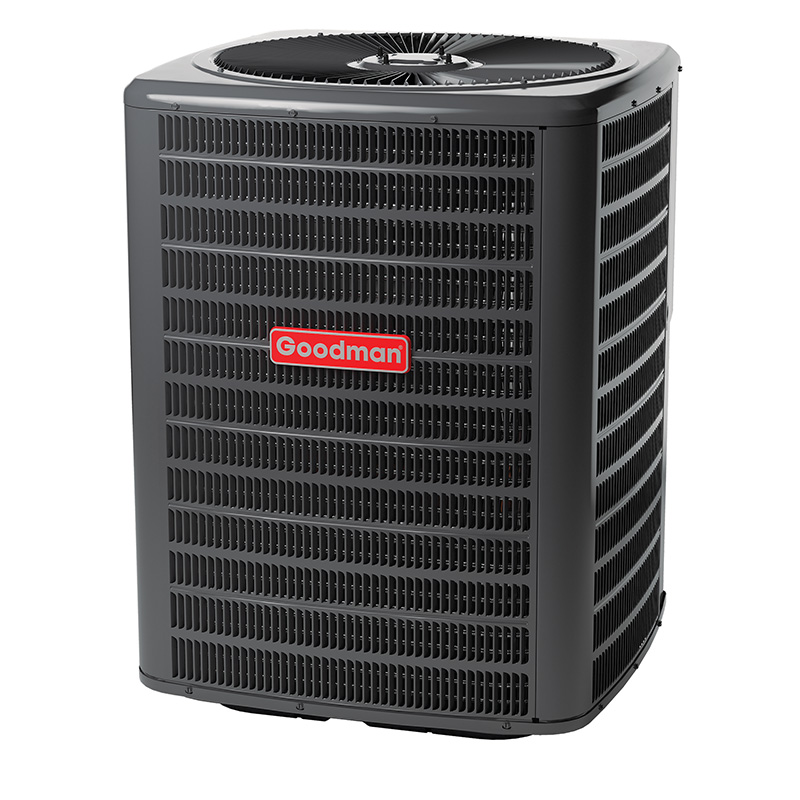
Goodman 3 Ton Up To 16 SEER2 R32 High-Efficiency Heat Pump Condenser (GLZS5BA3610)
View on AC Direct see your lowest price →Check current price on AC Direct →
Key features
- 3-ton capacity suited to approximately 1,400 to 1,800 sq ft (climate and insulation dependent)
- Up to 16 SEER2 efficiency rating, above the federal minimum for most U.S. regions
- R-32 refrigerant with lower global warming potential than R-410A
- Compatible with Goodman and select other brand air handlers and coil assemblies
- Single-stage compressor operation
- Backed by Goodman's standard limited warranty with registration requirement
About this system
The Goodman GLZS5BA3610 is a 3-ton heat pump condenser rated up to 16 SEER2, running on R-32 refrigerant. R-32 has a lower global warming potential than the older R-410A it replaces, and it operates at slightly higher efficiency, which is part of why this unit lands at the 16 SEER2 mark rather than the 14 or 15 SEER2 floor common in budget equipment. For a home in the 1,400 to 1,800 square foot range with reasonable insulation, this condenser paired with a compatible air handler or coil can handle cooling and heating loads across most of the continental U.S., including moderate heating climates where a heat pump makes economic sense year-round.
This system suits homeowners who want a meaningful step up in efficiency from minimum-code equipment without paying the premium commanded by Carrier, Trane, or Lennox. At 16 SEER2, you are not at the top tier of efficiency, but you are solidly above the federal minimum, and the savings over a 13 or 14 SEER2 unit are real on a monthly utility bill. The trade-off, well documented in Goodman’s ownership history, is that long-term reliability tends to trail premium brands, and the value proposition depends heavily on a clean, correct installation by an experienced technician.
The GLZS5BA3610 delivers above-minimum efficiency and the cost savings Goodman is known for, making it a workable choice for budget-conscious buyers who hire a skilled installer. Its reliability record is average at best, with capacitor failures and coil leaks showing up more often than on premium equipment, and compressor longevity that tends to fall short of the 15-plus years buyers expect from higher-end brands. It is a reasonable value pick if you go in with realistic expectations and budget for possible repairs after year seven.
Overall score is the average of the five ratings above.
What we like
- Priced 15 to 25 percent below comparable Carrier, Trane, and Lennox models
- 16 SEER2 rating offers meaningful efficiency above the federal minimum threshold
- R-32 refrigerant is more environmentally friendly and increasingly standard in new equipment
- Dual-run capacitor failures, the most common issue, are typically a low-cost repair in the $300 to $600 range
- Wide installer network makes parts and service accessible in most metro and suburban markets
Trade-offs
- Compressor lifespan averages 10 to 14 years versus 15 to 20 years on premium competing brands
- Evaporator coil leaks appear in a meaningful share of owner reports, which can be a costly repair outside warranty
- A minority of owners report refrigerant leaks within the first year, typically tied to install or initial charge quality
- ConsumerAffairs scores average around 2.5 out of 5, with repair cost complaints clustering after year seven
What homeowners and pros say about Goodman
Homeowners who have bought Goodman equipment tend to split into two camps. Those who had an experienced, thorough installer often report years of trouble-free operation and point to the lower upfront cost as a genuine win. Those who ran into problems tend to echo what shows up in Goodman’s ConsumerAffairs score of roughly 2.5 out of 5: repair bills climbing after year seven, frustration with coil leaks, and compressors that did not reach the 15-plus year lifespan they expected. Google dealer reviews average around 3.8 out of 5, and affordability is the most repeated compliment at that level, suggesting the value proposition lands for many buyers even if long-term ownership has more variance than premium brands.
HVAC technicians are candid about Goodman: the dual-run capacitor is the first thing many of them expect to replace on these systems, and while it is a low-cost fix in the $300 to $600 range, it comes up often enough to be a pattern rather than a fluke. Coil leaks are a more serious documented concern, and the consensus on compressor lifespan is that Goodman averages 10 to 14 years versus the 15 to 20 years pros associate with Carrier, Trane, or Lennox compressors. The technician’s consistent advice is that install quality matters more with Goodman than with premium brands, because tighter manufacturing tolerances on higher-end equipment provide more margin for error. With R-32 now in the mix, confirming your installer is certified for and stocked with that refrigerant before work begins is an added step worth taking.
Sources: ConsumerAffairs Goodman owner reviews, AHRI Directory of Certified Product Performance, U.S. DOE appliance and equipment efficiency standards, Goodman product specification sheets.
What it costs to run
At 16 SEER2, cooling this 3-ton system for a typical 1200-hour cooling season at the U.S. average electricity rate of $0.17/kWh works out to roughly $459 per year in cooling, about $89 less per year than a minimum-efficiency 13.4 SEER2 unit of the same size. Your real cost depends on your climate and local rate.
Method: (36,000 BTU/hr ÷ 16 SEER2) × 1200 hours ÷ 1000 × $0.17/kWh. Rate source: U.S. EIA average; cooling hours: moderate-climate estimate.
How it compares
| Brand | Comparable model | SEER2 | Stage | Price position |
|---|---|---|---|---|
| Goodman | GLZS5BA3610 | 16 | Single-stage | Value pick |
| Carrier | Performance 16 (25HPB636) | 16 | Single-stage | Typically 15 to 25 percent more than Goodman |
| Trane | XR16c | 16 | Single-stage | Typically 15 to 25 percent more than Goodman |
| Lennox | Merit ML17XP1 | 17 | Single-stage | Typically 20 to 30 percent more than Goodman |
Competitor rows are comparable single-stage units at similar efficiency; price is relative position, not a quote.
Questions about this system
Does the 16 SEER2 rating on this unit require a specific air handler or coil to achieve?
Yes. SEER2 ratings are system ratings, not condenser-only ratings. You need a matched, compatible air handler or coil as specified by Goodman to reach the 16 SEER2 rating in practice. Installing it with a mismatched indoor unit can reduce efficiency and may affect warranty coverage.
What does the switch to R-32 refrigerant mean for me as the owner?
R-32 has a lower global warming potential than R-410A and is becoming the new standard as R-410A is phased down. For most owners the day-to-day experience is the same, but if you ever need a refrigerant recharge, your technician must be certified to handle R-32 specifically, and not all older service trucks carry it yet, so confirm your installer stocks it.
How do I protect the warranty on this Goodman unit?
Goodman requires product registration within a set window after installation to qualify for the full limited warranty period. Failure to register typically drops coverage to a shorter base term. Keep your installation records and register on Goodman's website promptly after install.
What is the most likely repair I will face in the first ten years?
Based on documented owner experience, the dual-run capacitor is the most commonly reported failure on Goodman heat pumps. The good news is it is usually a straightforward repair in the $300 to $600 range. Evaporator coil leaks are a second, more expensive concern and appear in a meaningful share of longer-term owner reviews.
Is a Goodman heat pump a reasonable choice in a cold climate?
A standard single-stage heat pump like this one loses heating efficiency as outdoor temperatures drop below about 35 degrees Fahrenheit, and most systems require backup electric or gas heat below that threshold. If you are in a climate with extended periods below freezing, a cold-climate variable-speed heat pump or a dual-fuel system would be a more suitable choice than this unit.
Specifications
| Cooling capacity | 3 Ton |
| Efficiency | 16 SEER2 |
| Refrigerant | R-32 |
| Model | GLZS5BA3610 |