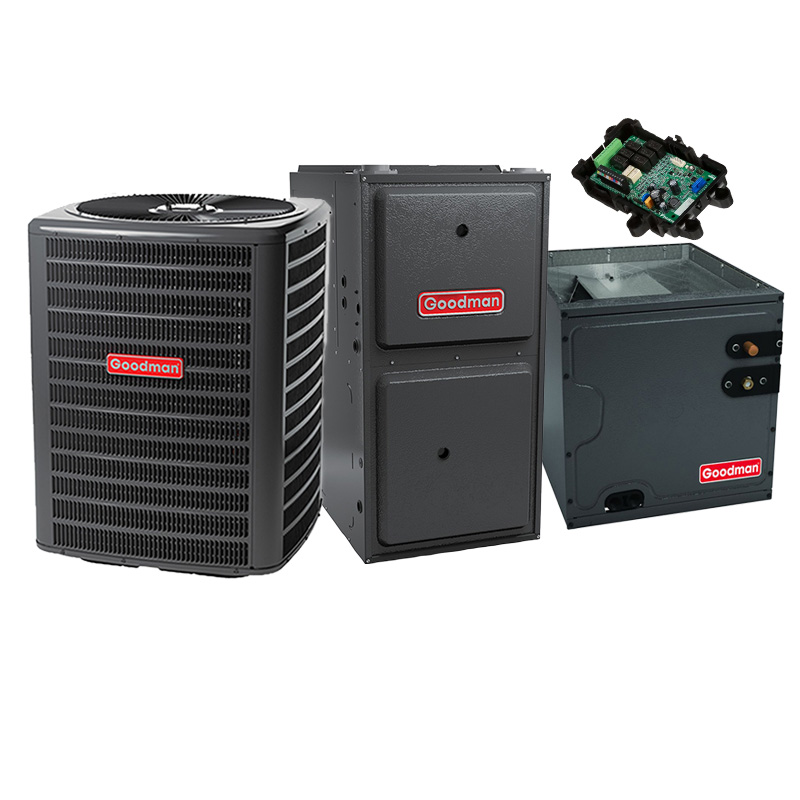
Goodman 4 Ton 13.4 SEER2 100000 BTU 96% AFUE Gas Furnace With R32 Air Condenser and Coil System – Upflow
View on AC Direct see your lowest price →Check current price on AC Direct →
Key features
- 4-ton cooling capacity suited to roughly 2,000 to 2,800 sq ft depending on load
- 96% AFUE high-efficiency gas furnace with 100,000 BTU heating output
- 13.4 SEER2 cooling efficiency meets current federal minimum standards
- R-32 refrigerant with lower global warming potential than R-410A
- Upflow configuration for basement or ground-level mechanical room installations
- Factory-matched condenser, evaporator coil, and furnace for simplified warranty claims
About this system
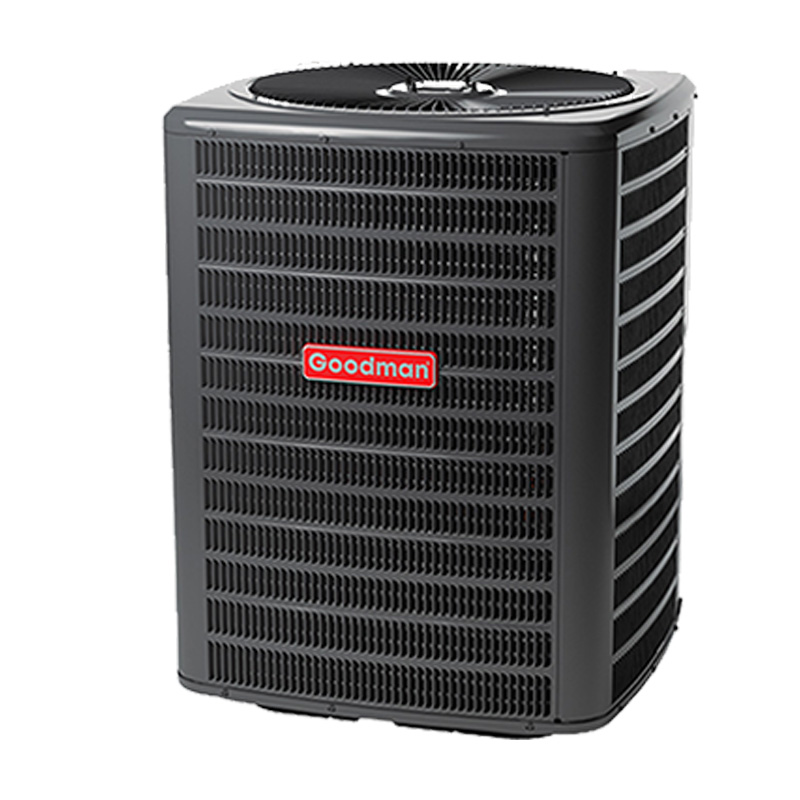
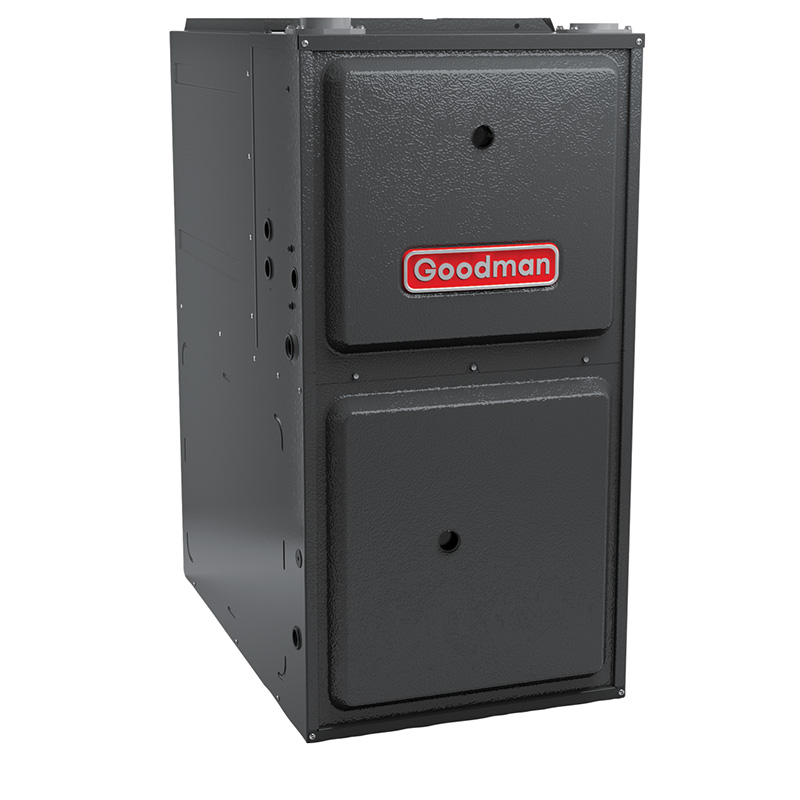
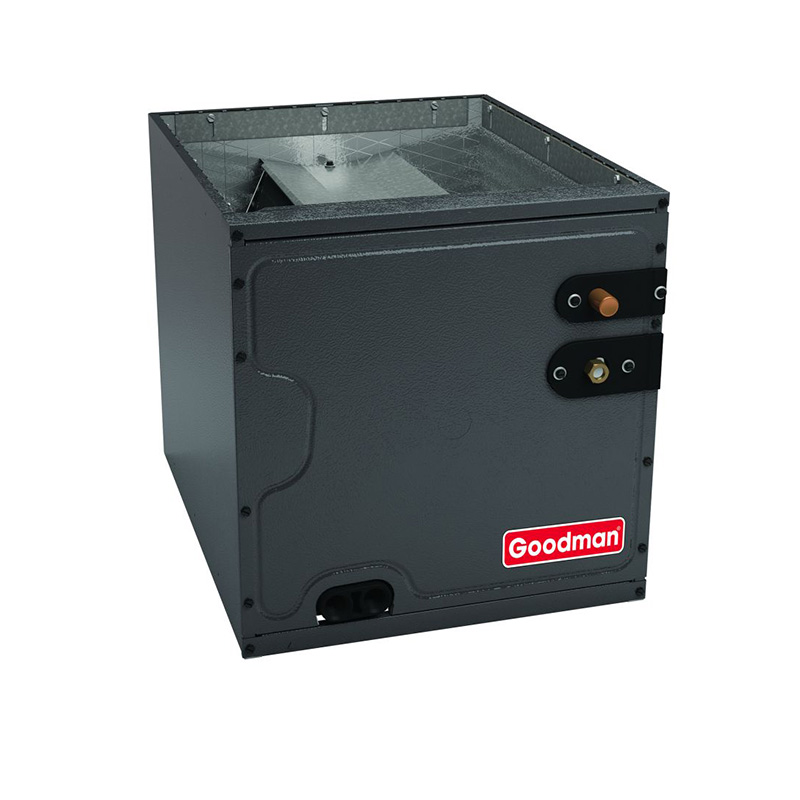
This Goodman upflow package pairs a 4-ton, 13.4 SEER2 R-32 air condenser and coil with a 100,000 BTU, 96% AFUE gas furnace, covering homes in roughly the 2,000 to 2,800 square foot range depending on climate and insulation. The 96% AFUE rating places the furnace solidly in the high-efficiency tier, meaning only about four cents of every heating dollar escapes as exhaust. The 13.4 SEER2 cooling efficiency meets the current federal minimums for most regions and is honest entry-level performance, not a standout number but a compliant one. R-32 refrigerant carries a lower global warming potential than the older R-410A it is replacing industry-wide, which matters for long-term serviceability as regulations on higher-GWP refrigerants tighten.
The upflow configuration directs conditioned air upward from the furnace cabinet, making it the standard choice for homes with a basement or a ground-level mechanical room feeding ductwork above. Bundling the condenser, evaporator coil, and furnace from one manufacturer simplifies warranty coverage and reduces the risk of mismatched components, a real concern when mixing brands. Goodman prices this system roughly 15 to 25 percent below equivalent tonnage and efficiency bundles from Trane, Carrier, and Lennox, which is the system’s clearest selling point for budget-focused buyers who plan to stay in a home long enough to recover the purchase price but not so long that long-term reliability eclipses upfront cost as the primary concern.
This Goodman bundle delivers legitimate high-efficiency heating and code-compliant cooling at a price point that undercuts the major premium brands by a meaningful margin. The trade-off is a brand track record that shows more variability in long-term reliability than Trane, Carrier, or Lennox, with install quality being the single largest determinant of how the system performs over time. It is a reasonable choice for cost-conscious buyers who hire a skilled contractor and carry a service plan.
Overall score is the average of the five ratings above.
What we like
- 96% AFUE furnace keeps heating bills low through genuine high-efficiency combustion
- Priced roughly 15 to 25 percent below comparable premium-brand bundles
- Factory-matched components reduce coil-to-system compatibility guesswork
- R-32 refrigerant improves long-term serviceability as R-410A is phased out
- Bundled warranty coverage is simpler to administer than mixed-brand setups
Trade-offs
- Dual-run capacitors are the most commonly reported failure point, typically years 5 to 9
- Compressors average 10 to 14 years versus 15 to 20 years for premium-brand compressors
- A minority of owners report refrigerant leaks in year one, most often linked to installation or initial charge issues
- Evaporator coil leaks appear in a meaningful share of owner reviews, adding potential repair cost after the warranty window
What homeowners and pros say about Goodman
Homeowners who research Goodman online encounter a split picture. On ConsumerAffairs, the brand scores around 2.5 out of 5, a low number that reflects the platform’s complaint-heavy nature, where the recurring theme is repair costs rising after roughly year seven of ownership. On Google dealer reviews, where buyers are rating the full installation experience, scores cluster around 3.8 out of 5 across hundreds of reviews per location, with affordability cited most often as the reason for satisfaction. For this specific 4-ton upflow system, the feedback patterns that show up across Goodman equipment generally are relevant: dual-run capacitor failures are the most frequently reported repair call, typically costing 300 to 600 dollars and usually surfacing in years five through nine. Evaporator coil leaks appear in a meaningful portion of owner accounts and carry a higher repair cost than a capacitor swap. A smaller share of owners report refrigerant issues in the first year, which technicians generally attribute to installation or initial charge problems rather than factory defects.
HVAC professionals who work on Goodman equipment regularly tend to hold a pragmatic view. They note that the brand performs closer to its rated specs when the installation is done carefully, with correct refrigerant charge, proper airflow, and clean electrical connections, and that corners cut during install show up faster on Goodman units than on premium-brand equipment with tighter manufacturing tolerances. Compressor longevity is a documented concern, with Goodman compressors averaging 10 to 14 years in real-world use compared to 15 to 20 years typical of Trane, Carrier, and Lennox compressors at similar efficiency tiers. Pros who recommend this system typically do so for customers with a clear budget ceiling who are committed to a quality install and a maintenance plan, and who understand that the lower purchase price may involve a higher lifetime service cost compared to spending more upfront on a premium brand.
Sources: ConsumerAffairs Goodman owner reviews, AHRI Directory of Certified Product Performance, U.S. DOE appliance and equipment efficiency standards, Goodman product specification sheets.
What it costs to run
At 13.4 SEER2, cooling this 4-ton system for a typical 1200-hour cooling season at the U.S. average electricity rate of $0.17/kWh works out to roughly $731 per year in cooling, about $0 less per year than a minimum-efficiency 13.4 SEER2 unit of the same size. Your real cost depends on your climate and local rate.
Method: (48,000 BTU/hr ÷ 13.4 SEER2) × 1200 hours ÷ 1000 × $0.17/kWh. Rate source: U.S. EIA average; cooling hours: moderate-climate estimate.
How it compares
| Brand | Comparable model | SEER2 | Stage | Price position |
|---|---|---|---|---|
| Goodman | 4-Ton 13.4 SEER2 / 96% AFUE Bundle (this system) | 13.4 | Single-stage | Value pick |
| Carrier | Comfort Series (24ACC636 / 59SC5) | 13.4 to 14.3 | Single-stage | Typically 15 to 25 percent more than this Goodman bundle |
| Trane | XR14 / S9V2 Series | 14.0 to 14.3 | Single-stage | Typically 15 to 25 percent more than this Goodman bundle |
| Lennox | Merit Series (ML14XC1 / ML196E) | 13.4 to 14.0 | Single-stage | Typically 15 to 25 percent more than this Goodman bundle |
Competitor rows are comparable single-stage units at similar efficiency; price is relative position, not a quote.
Questions about this system
Is 13.4 SEER2 enough for a hot climate like Texas or Arizona?
13.4 SEER2 meets the federal minimum for most northern regions but falls at or just at the southern minimum as well; it is legal and functional but not optimized for zones with long, intense cooling seasons. In climates where the air conditioner runs five or six months a year, a higher SEER2 unit would reduce monthly electricity costs enough to close some of the upfront price gap with a premium system over five to eight years.
What refrigerant does this system use and can my existing technician service it?
The condenser uses R-32, which requires technicians to have the same EPA Section 608 certification already required for R-410A work, though some recovery and charging equipment may need to be R-32 compatible. Most HVAC companies are already updating their equipment ahead of the broader industry shift, but it is worth confirming with your contractor before scheduling service.
How do I get the full parts warranty activated on this Goodman system?
Goodman typically requires registration of the equipment within a set window after installation, usually 60 days, to receive the full parts warranty period; failing to register generally drops coverage to a shorter base period. The installation must also be performed by a licensed HVAC contractor, and keeping a copy of the installation invoice is important if you ever file a claim.
The reviews mention capacitor failures. How worried should I be?
Dual-run capacitors are the most commonly reported failure point across Goodman equipment, and they do fail more frequently than on premium-brand units, often between years five and nine. The repair cost is typically in the 300 to 600 dollar range and is one of the faster service calls an HVAC technician makes, so it is an inconvenience rather than a catastrophe; budgeting for it or carrying a service agreement covers the exposure.
Will a 100,000 BTU furnace be too large for my house?
Furnace sizing depends on a Manual J heat load calculation specific to your home's square footage, insulation, window area, and climate zone, not a general rule of thumb. An oversized furnace short-cycles, which increases wear and reduces comfort; an undersized one cannot maintain setpoint on the coldest days. Ask your contractor to run the calculation before assuming 100,000 BTU is the right output for your specific home.
Specifications
| Cooling capacity | 4 Ton |
| Efficiency | 13.4 SEER2 |
| Furnace output | 100000 BTU |
| Furnace efficiency | 96% AFUE |
| Configuration | Upflow |
| Refrigerant | R-32 |