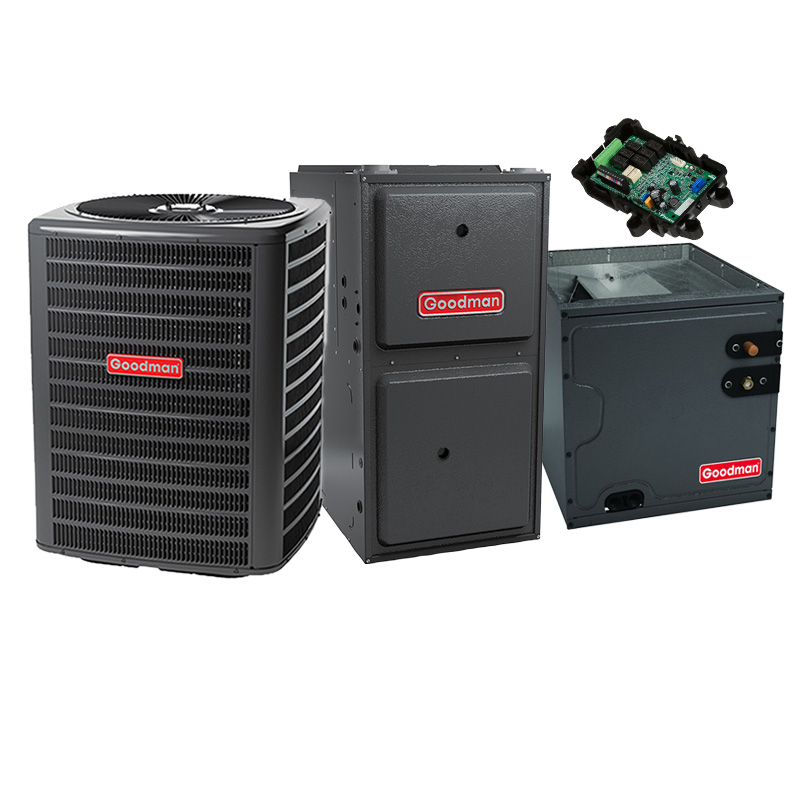
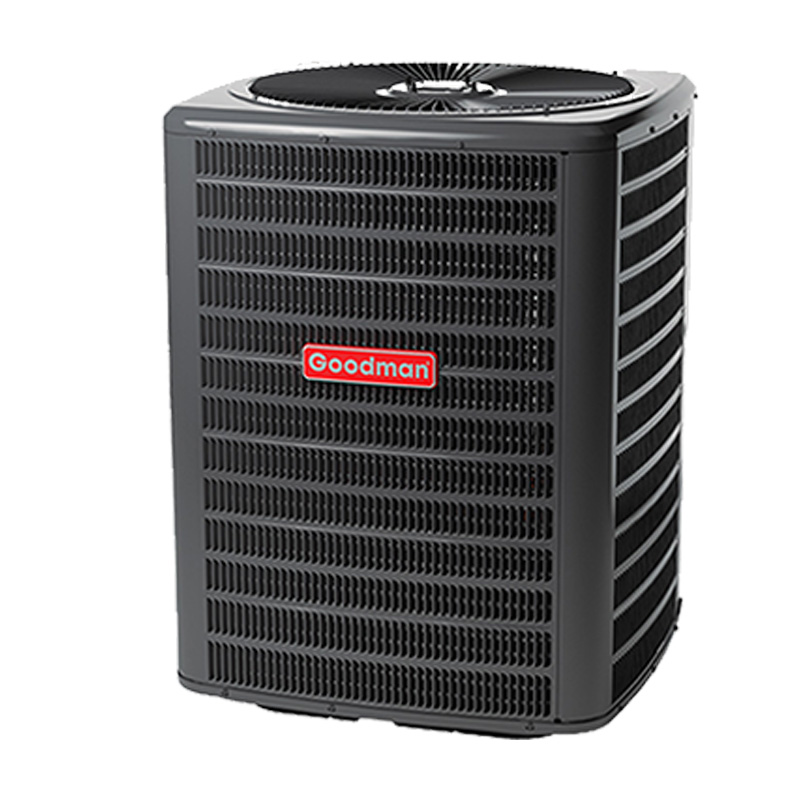
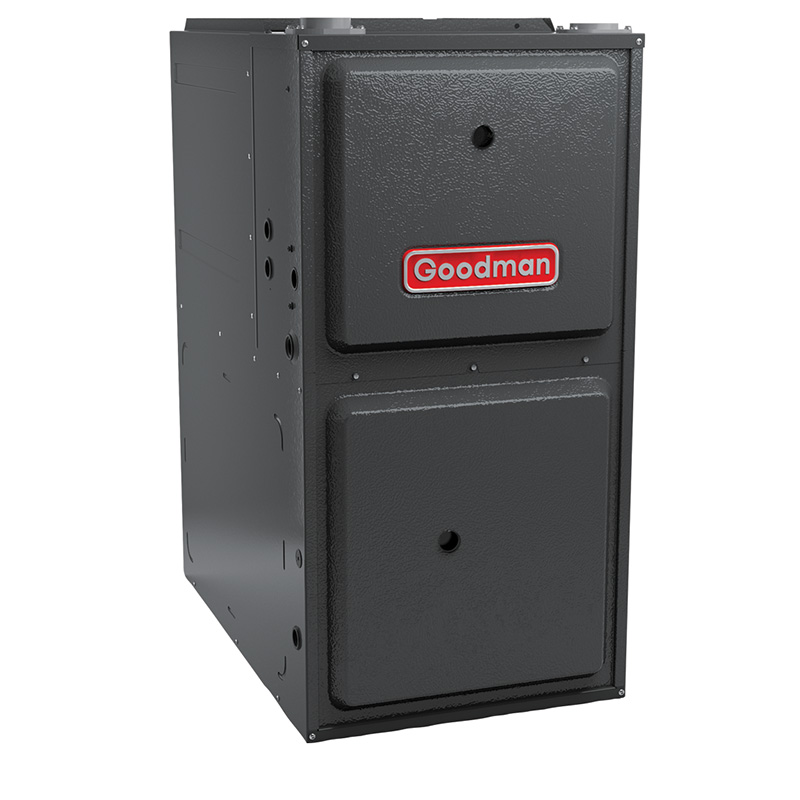
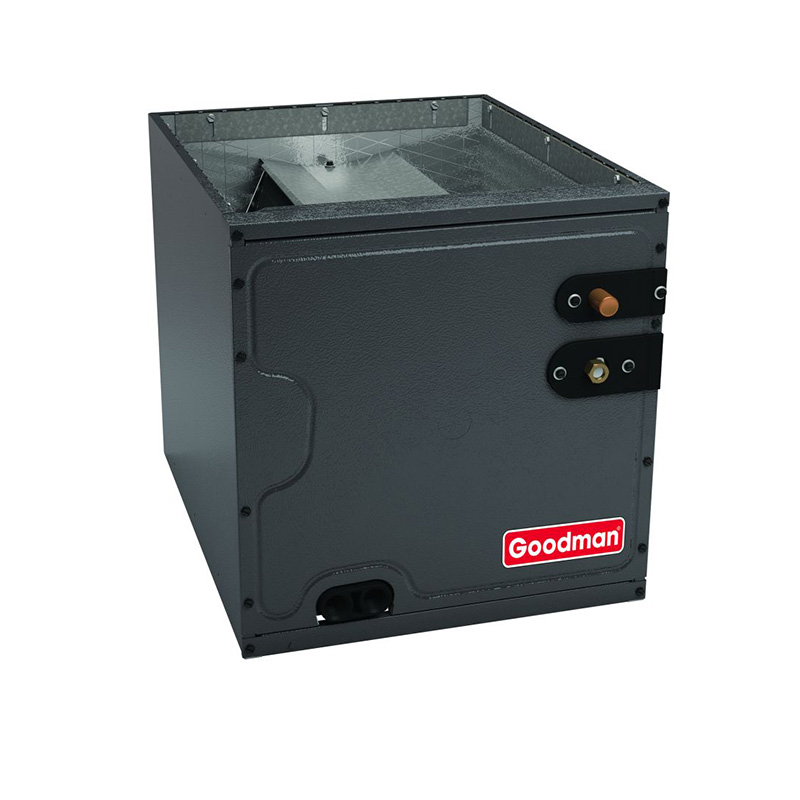
Goodman 4 Ton 13.4 SEER2 120000 BTU 96% AFUE Gas Furnace With R32 Air Condenser and Coil System – Upflow
View on AC Direct see your lowest price →Check current price on AC Direct →
Key features
- 4-ton cooling capacity with 13.4 SEER2 efficiency, meeting 2023 federal regional minimums
- 120,000 BTU 96% AFUE gas furnace for high-efficiency single-stage heating
- R-32 refrigerant with lower global warming potential than R-410A
- Upflow configuration for homes with basement or closet air handler and overhead ductwork
- Matched condenser, evaporator coil, and furnace sold as a system to preserve AHRI ratings
- Single-stage operation for straightforward installation and lower mechanical complexity
About this system
The Goodman 4-Ton 13.4 SEER2 / 96% AFUE upflow system pairs a gas furnace rated at 120,000 BTU with a matching R-32 air condenser and evaporator coil, making it a complete heating and cooling solution for larger homes, typically in the 2,000 to 2,800 square foot range depending on climate and insulation. The 96% AFUE rating sits in the high-efficiency furnace tier, meaning only about four cents of every fuel dollar escapes as exhaust, which translates to meaningful savings on gas bills versus an 80% AFUE unit over a heating season. The 13.4 SEER2 cooling efficiency meets the 2023 federal minimum for most U.S. regions, so it is compliant but not exceptional on the cooling side.
R-32 refrigerant is a step forward from the R-410A that Goodman used for years. It has a lower global warming potential, requires a smaller refrigerant charge by weight, and is increasingly the industry direction. The upflow configuration directs conditioned air upward into overhead ductwork, making it the standard choice for homes with the furnace in a basement or utility closet and ducts running through the ceiling or attic. This is not a zoning or variable-capacity system; it runs at a single stage, which suits buyers who want straightforward operation and lower upfront cost over the finer comfort control a variable-speed system offers.
As a complete matched system, the condenser, coil, and furnace are engineered to work together, which matters for warranty coverage and rated efficiency. Buyers who purchase mismatched components risk voiding AHRI ratings and warranty terms, so installing all three components as a set is important both practically and contractually.
This Goodman system delivers solid, code-compliant heating and cooling at a price point noticeably below Carrier, Trane, and Lennox equivalents, making it a reasonable choice for budget-conscious buyers in larger homes. The 96% AFUE furnace is a genuine standout, but the single-stage 13.4 SEER2 cooling is entry-level, and Goodman's documented history of capacitor failures and shorter compressor lifespan means long-term costs can close the initial price gap. Installation quality has an outsized impact on how this system performs and how long it lasts.
Overall score is the average of the five ratings above.
What we like
- 96% AFUE furnace is high-efficiency and delivers real fuel savings over an 80% unit
- Priced 15 to 25 percent below comparable Carrier, Trane, and Lennox systems, lowering the upfront cost barrier
- R-32 refrigerant is a more future-oriented choice than R-410A, with lower environmental impact
- Matched system design preserves AHRI efficiency ratings and warranty coverage
- Single-stage simplicity means fewer components that can fail and easier diagnostics for technicians
Trade-offs
- 13.4 SEER2 is entry-level cooling efficiency; higher-SEER2 options exist at modest additional cost
- Dual-run capacitors are the most commonly reported failure point and typically need replacement within the first several years
- Compressor lifespan averages 10 to 14 years versus 15 to 20 for premium-brand compressors, which matters for a 4-ton unit running hard in hot climates
- A minority of owners have reported refrigerant leaks in the first year, often traced to install or charge issues rather than manufacturing defects, making contractor selection critical
What homeowners and pros say about Goodman
Homeowners who have lived with Goodman systems tend to split along a predictable line. Those who had a skilled installer, keep up with annual maintenance, and replaced a capacitor or two along the way often report years of reliable service and point to the lower purchase price as money they kept in their pocket. That aligns with the around 3.8 out of 5 score seen across Google dealer reviews, where affordability and adequate performance are the most common themes. The less satisfied group, represented more heavily in the roughly 2.5 out of 5 ConsumerAffairs score, ran into repair costs that climbed after year seven, with evaporator coil leaks and compressor issues driving the frustration. Neither picture is wrong; they reflect the real spread in outcomes.
HVAC technicians are candid about what shapes those outcomes. They consistently name install quality as the dominant variable with Goodman equipment, more so than with premium brands that have tighter manufacturing tolerances and more robust components. The dual-run capacitor is widely acknowledged as the weak link in Goodman condensers and the first thing many techs replace proactively on older units. Coil leak reports are common enough in owner reviews to warrant attention during seasonal maintenance. And the compressor lifespan reality, averaging 10 to 14 years rather than the 15 to 20 years premium brands tend to deliver, is something buyers of a 4-ton unit running in a warm climate should factor into their long-term cost picture before signing off on the purchase.
Sources: ConsumerAffairs Goodman owner reviews, AHRI Directory of Certified Product Performance, U.S. DOE appliance and equipment efficiency standards, Goodman product specification sheets.
What it costs to run
At 13.4 SEER2, cooling this 4-ton system for a typical 1200-hour cooling season at the U.S. average electricity rate of $0.17/kWh works out to roughly $731 per year in cooling, about $0 less per year than a minimum-efficiency 13.4 SEER2 unit of the same size. Your real cost depends on your climate and local rate.
Method: (48,000 BTU/hr ÷ 13.4 SEER2) × 1200 hours ÷ 1000 × $0.17/kWh. Rate source: U.S. EIA average; cooling hours: moderate-climate estimate.
How it compares
| Brand | Comparable model | SEER2 | Stage | Price position |
|---|---|---|---|---|
| Goodman | 4-Ton 13.4 SEER2 / 96% AFUE Upflow System (this unit) | 13.4 | Single-stage | Value pick |
| Carrier | Performance 14 Series (24ACC4) with 96% AFUE 59TP6 Furnace | 14.0 | Single-stage | Roughly 20 to 25 percent more than this Goodman system |
| Trane | XR14c Condenser with S9X2 96% AFUE Furnace | 14.0 | Single-stage | Roughly 20 to 30 percent more than this Goodman system |
| Lennox | Merit 14ACX Condenser with ML96 96% AFUE Furnace | 13.8 | Single-stage | Roughly 15 to 25 percent more than this Goodman system |
Competitor rows are comparable single-stage units at similar efficiency; price is relative position, not a quote.
Questions about this system
Is 13.4 SEER2 going to cost me more to run than a higher-efficiency unit?
Yes, a 16 or 18 SEER2 system will use less electricity for the same cooling output, but the payback period on the premium depends on how many cooling hours your climate delivers. In moderate climates, the efficiency gap may take 8 to 12 years to recover in energy savings; in hot southern climates the payback is faster. For most buyers in this size range, upgrading to a two-stage or variable-speed system also adds comfort benefits beyond just efficiency.
What maintenance should I plan for given Goodman's documented failure points?
Budget for a dual-run capacitor replacement at some point, typically in the 300 to 600 dollar range for parts and labor, as this is the most commonly reported failure on Goodman condensers. Annual tune-ups that include checking refrigerant charge, inspecting the evaporator coil for early signs of leaks, and testing the capacitor will catch most issues before they become expensive. Coil leaks are a documented secondary concern on Goodman units, so ask your technician to inspect that area each season.
Does the R-32 refrigerant require any special handling compared to R-410A?
R-32 is mildly flammable (A2L classification), so not every technician is currently certified to handle it. When hiring for installation or future service, confirm your contractor is A2L-trained and has the appropriate equipment. Most major HVAC supply houses already stock R-32, so sourcing is not typically a problem.
Will a 120,000 BTU furnace be too large for my home?
Furnace sizing should come from a Manual J load calculation performed by your installer, not a general rule of thumb. A 120,000 BTU unit is on the larger end and can cause short-cycling if the home's actual heating load is significantly lower, which reduces efficiency and comfort. Ask your contractor to run the calculation before committing to this BTU rating; in some cases a 96,000 BTU unit in the same line may be more appropriate.
How does Goodman's warranty compare to Carrier or Trane on a system this size?
Goodman typically offers a 10-year parts warranty on registered systems, which is competitive on paper with most mid-tier offerings from Carrier and Trane. However, the warranty covers parts cost, not labor, and some owners have reported friction with warranty claims. Premium brands often have broader dealer networks with more consistent warranty service, which can matter when a compressor or coil needs replacing in year 8 or 9.
Specifications
| Cooling capacity | 4 Ton |
| Efficiency | 13.4 SEER2 |
| Furnace output | 120000 BTU |
| Furnace efficiency | 96% AFUE |
| Configuration | Upflow |
| Refrigerant | R-32 |