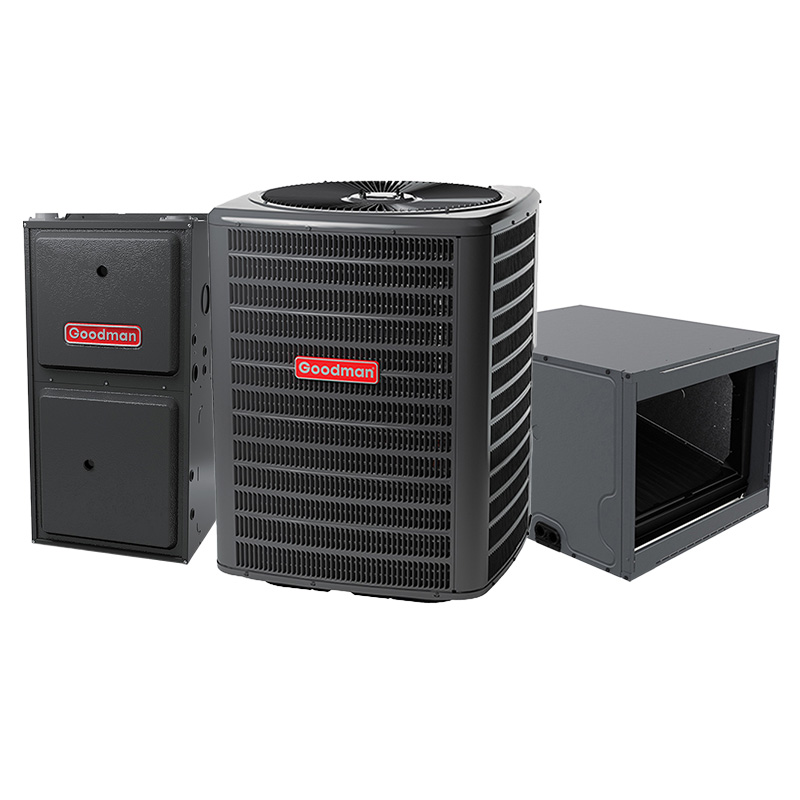
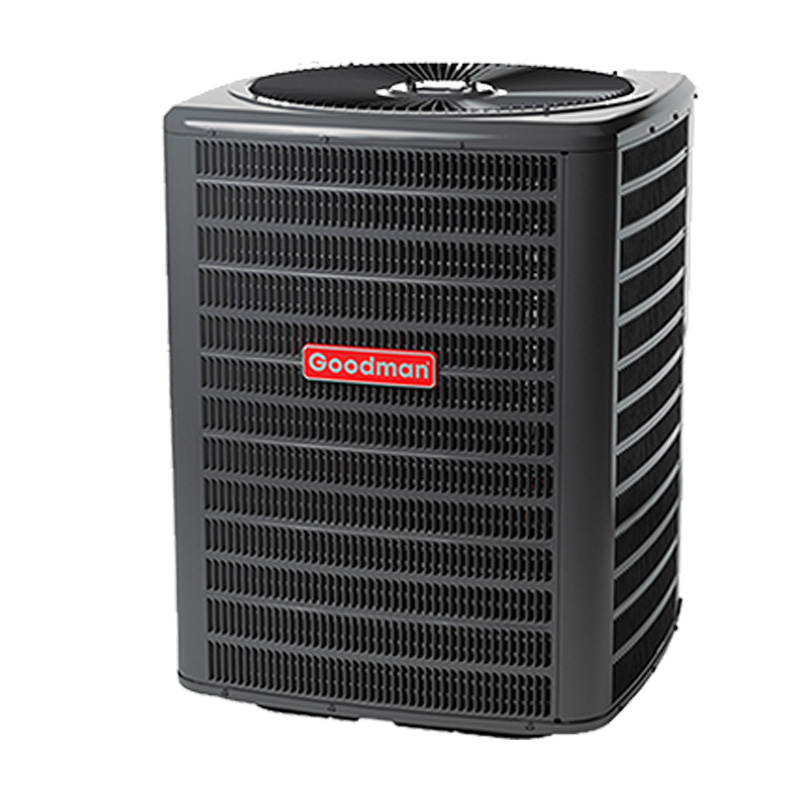
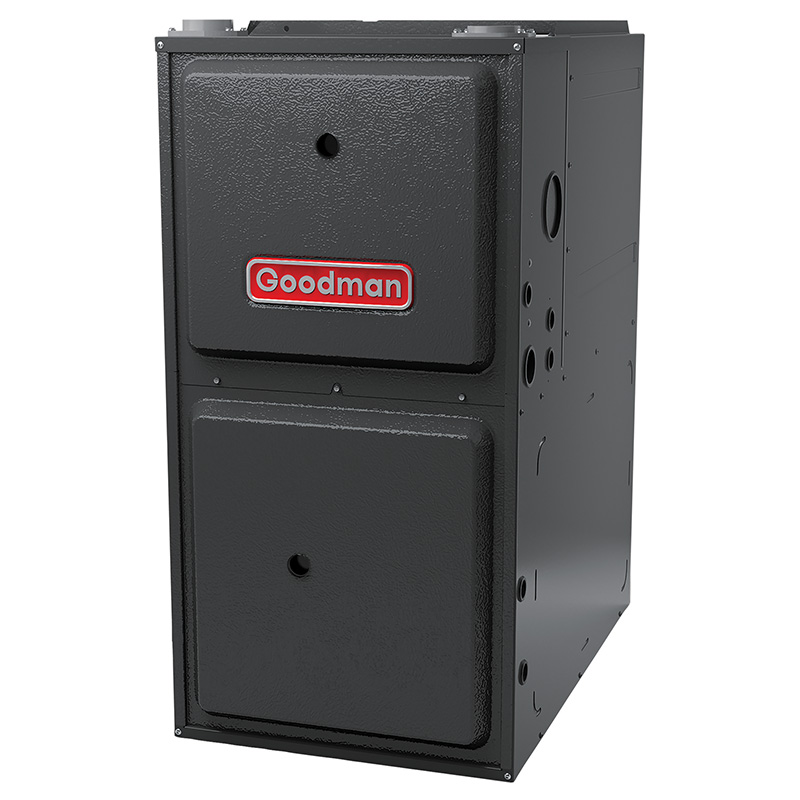
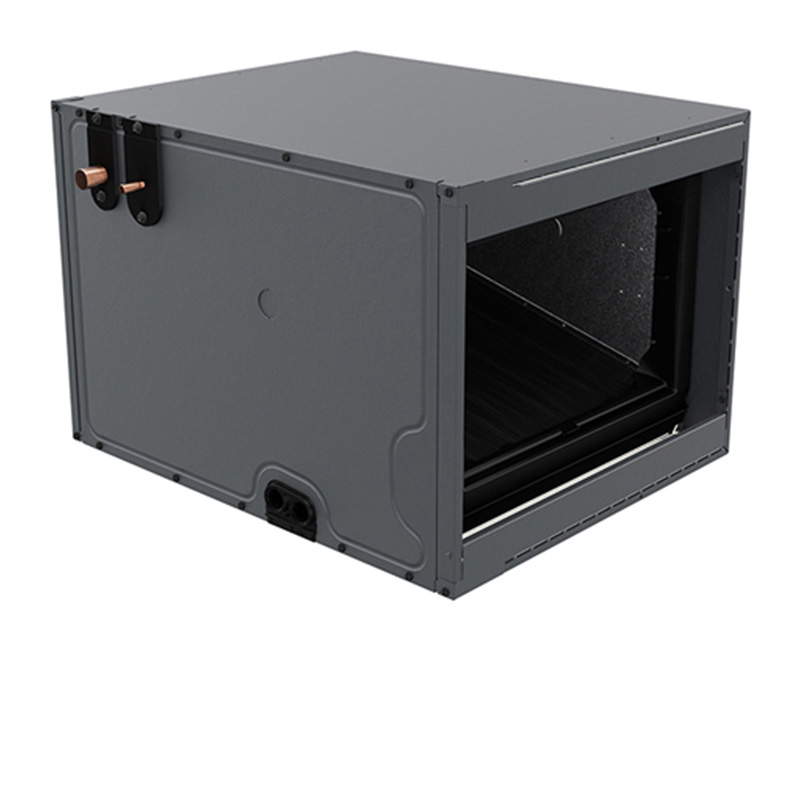
Goodman 4 Ton 13.4 SEER2 AC With 120000 BTU 96% AFUE 2-Stage Variable-Speed ECM Gas Furnace System – Horizontal | R32
View on AC Direct see your lowest price →Check current price on AC Direct →
Key features
- 4-ton cooling capacity rated at 13.4 SEER2 for baseline federal-standard efficiency
- 120,000 BTU two-stage gas furnace at 96% AFUE for near-condensing fuel efficiency
- Variable-speed ECM blower motor for quieter operation and improved humidity control
- Horizontal configuration designed for attic, crawlspace, or side-discharge installations
- R-32 refrigerant with lower global warming potential than R-410A
- Two-stage heating reduces short-cycling and improves temperature consistency
About this system
This Goodman 4-ton system pairs a 13.4 SEER2 air conditioner with a 120,000 BTU, 96% AFUE two-stage, variable-speed ECM gas furnace in a horizontal configuration, making it a practical choice for homes with attic or crawlspace installations where upflow or downflow units simply will not fit. The R-32 refrigerant charge is a forward-looking detail: R-32 has a lower global warming potential than the R-410A it replaces and is increasingly the industry standard, so parts and service support should remain accessible for the foreseeable future.
The two-stage furnace and variable-speed ECM blower are the standout specs here. Running on the lower stage the majority of the time, the furnace cycles less aggressively, holds temperature more evenly, and runs quieter than a single-stage unit. The ECM motor adjusts airflow continuously, which reduces electricity consumption at the air handler and improves humidity control during cooling season. For a 4-ton load, a 120,000 BTU furnace is at the upper end of typical sizing, so a proper Manual J load calculation before install is important to confirm this capacity fits the home rather than causes short-cycling. This system suits mid-to-large homes in mixed climates where both heating and cooling demands are meaningful and where budget is a real constraint.
This Goodman combo system delivers genuinely capable specs at a price point that undercuts Trane, Carrier, and Lennox by a meaningful margin, and the two-stage furnace with ECM blower adds real comfort benefits beyond entry-level equipment. The trade-off is that Goodman's long-term reliability record is more variable than premium brands, and the outcome depends heavily on who installs it and how well they commission it.
Overall score is the average of the five ratings above.
What we like
- Priced roughly 15 to 25 percent below comparable Trane, Lennox, and Carrier systems
- 96% AFUE two-stage furnace meaningfully cuts heating fuel costs versus single-stage 80% units
- Variable-speed ECM blower improves comfort, reduces electricity use, and lowers blower noise
- R-32 refrigerant is future-ready and easier to service than older R-410A systems
- Horizontal config opens up installation options for homes without suitable vertical airflow paths
Trade-offs
- Dual-run capacitors are the most commonly reported failure point, typically surfacing within the first several years
- Evaporator coil leaks appear in a notable share of owner reports, a concern for long-term refrigerant retention
- Compressor lifespan averages 10 to 14 years versus 15 to 20 years typical of premium-brand compressors
- A minority of owners have reported refrigerant leaks within the first year, most often tied to install or initial charge quality
What homeowners and pros say about Goodman
Homeowners who share feedback on Goodman equipment tend to split along a clear line. Those who had experienced, careful installers often report years of trouble-free operation and consistently point to the lower purchase price as the reason they chose the brand. Goodman holds a Google dealer review average of around 3.8 out of 5, where affordability is the most frequently mentioned positive. On ConsumerAffairs, where the score sits at roughly 2.5 out of 5, the pattern shifts: that channel draws a disproportionate share of frustrated owners, and the recurring complaint is that repair costs become significant after roughly year seven. For this specific system, the components most worth watching are the dual-run capacitors, which are the most commonly reported failure point across Goodman cooling equipment and typically cost 300 to 600 dollars to replace, and the evaporator coil, where refrigerant leaks appear in a notable share of owner reports over time.
HVAC technicians who work on Goodman equipment regularly tend to hold a pragmatic view. Most will say the equipment itself is serviceable and that parts availability is generally not a problem, but they are consistent about one thing: installation quality determines how the machine performs far more than the nameplate does. The compressor lifespan on Goodman systems is documented to average 10 to 14 years, which is measurably shorter than the 15 to 20 years technicians typically see from premium brands, and some attribute that gap as much to how the equipment is set up as to the hardware itself. For a horizontal install like this one, where drain line pitch, refrigerant charge accuracy, and airflow balance all require extra attention, the installer you hire matters at least as much as the brand on the box.
Sources: ConsumerAffairs Goodman owner reviews, AHRI Directory of Certified Product Performance, U.S. DOE appliance and equipment efficiency standards, Goodman product specification sheets.
What it costs to run
At 13.4 SEER2, cooling this 4-ton system for a typical 1200-hour cooling season at the U.S. average electricity rate of $0.17/kWh works out to roughly $731 per year in cooling, about $0 less per year than a minimum-efficiency 13.4 SEER2 unit of the same size. Your real cost depends on your climate and local rate.
Method: (48,000 BTU/hr ÷ 13.4 SEER2) × 1200 hours ÷ 1000 × $0.17/kWh. Rate source: U.S. EIA average; cooling hours: moderate-climate estimate.
How it compares
| Brand | Comparable model | SEER2 | Stage | Price position |
|---|---|---|---|---|
| Goodman | 4-Ton 13.4 SEER2 AC + 120,000 BTU 96% AFUE 2-Stage ECM Furnace (Horizontal, R-32) | 13.4 | Two-stage furnace / single-stage AC | Value pick |
| Carrier | Comfort Series (24ACC6 AC + 59SC2 furnace) | 13.4-14.3 | Single-stage | Typically 15 to 25 percent more than Goodman |
| Trane | XR Series (XR14c AC + S9X2 furnace) | 13.4-14.0 | Single-stage | Typically 15 to 25 percent more than Goodman |
| Lennox | Merit Series (ML14XC1 AC + ML196E furnace) | 13.4-14.3 | Single-stage | Typically 15 to 25 percent more than Goodman |
Competitor rows are comparable single-stage units at similar efficiency; price is relative position, not a quote.
Questions about this system
Is 120,000 BTU the right furnace size for a 4-ton AC system?
Not automatically. A 4-ton cooling load and a 120,000 BTU heating load are sized independently based on the home's actual heat loss calculation. In many climates, a home needing 4 tons of cooling will need considerably less than 120,000 BTU of heat, and oversizing the furnace causes short-cycling that reduces comfort and efficiency. Ask your installer to run a Manual J before confirming this configuration.
What does horizontal configuration actually mean for installation?
It means the air handler is oriented on its side so air enters from one end and exits from the other, which is required when the unit sits in an attic, a tight crawlspace, or a closet where vertical airflow is not possible. Not every technician installs horizontal systems regularly, so confirm your installer has done it before, since improper pitch or drain line routing is a common source of condensate problems.
Why does this system use R-32 instead of R-410A?
R-410A is being phased out under EPA regulations due to its high global warming potential. R-32 has roughly one-third the climate impact of R-410A, is more efficient as a refrigerant by weight, and is the direction the industry is moving. Servicing an R-32 system does require technicians with specific training and equipment, so verify that your local contractors are equipped to handle it before purchase.
What are the most likely repair costs to budget for over the first 10 years?
Dual-run capacitor replacement is the most frequently reported Goodman repair, and it typically runs 300 to 600 dollars including labor. Evaporator coil leaks are documented in a meaningful share of owner reports and cost substantially more to address. A compressor replacement, if needed before the 10-year mark, is one of the more expensive repairs on any system, which is one reason registering the warranty promptly matters.
Does Goodman's warranty cover both the furnace and the AC unit in this bundle?
Goodman generally offers a 10-year parts limited warranty on registered equipment, which applies to covered components on both units. The warranty typically requires registration within a set window after installation and does not cover labor costs, which can be substantial. Read the specific warranty documents for each unit in this bundle, since furnace and AC coverage terms can differ slightly.
Specifications
| Cooling capacity | 4 Ton |
| Efficiency | 13.4 SEER2 |
| Furnace output | 120000 BTU |
| Furnace efficiency | 96% AFUE |
| Configuration | Horizontal |
| Refrigerant | R-32 |