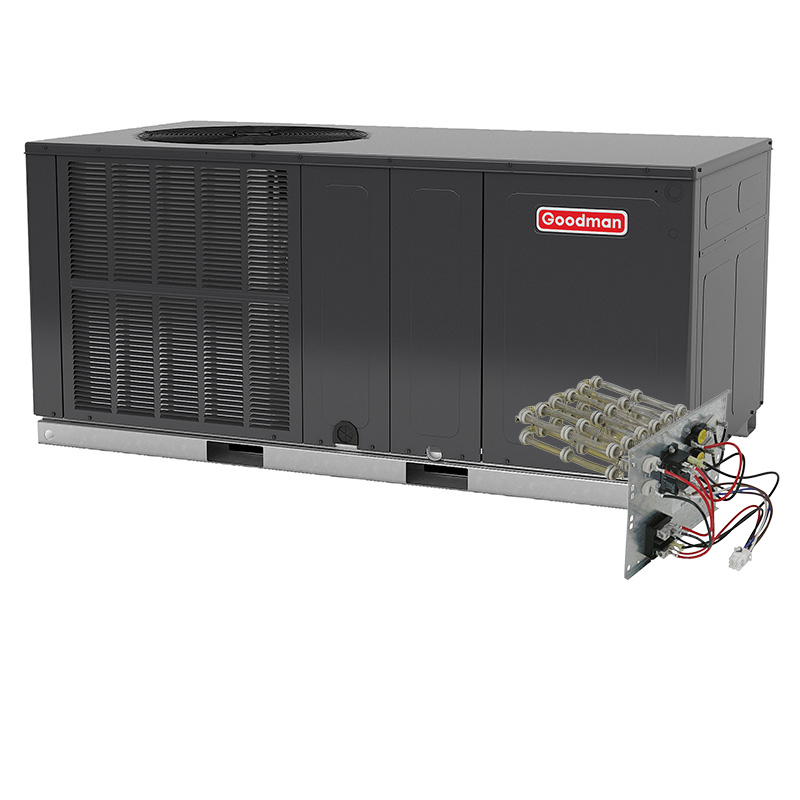
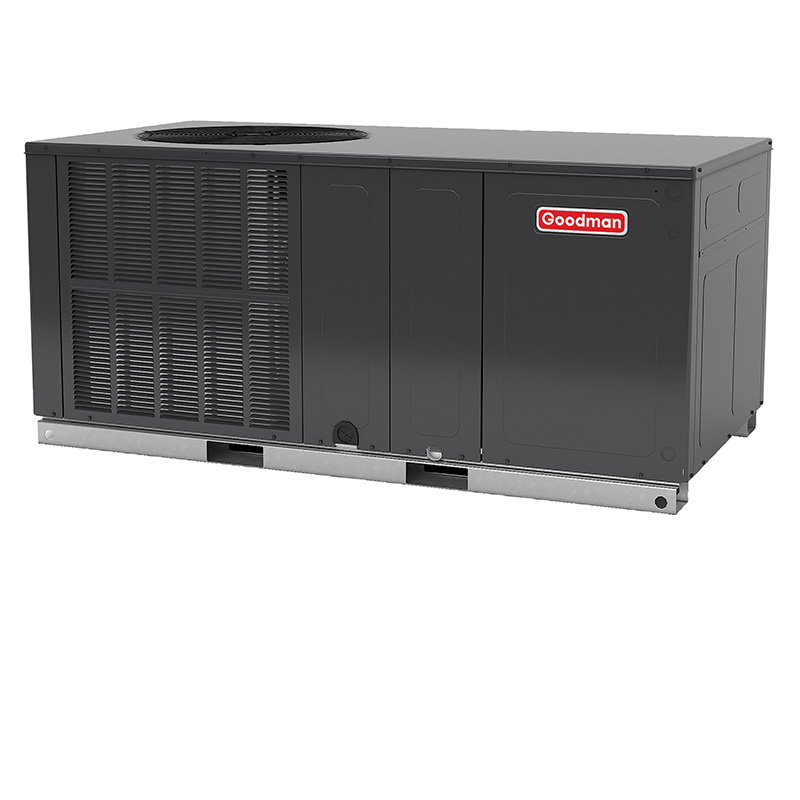
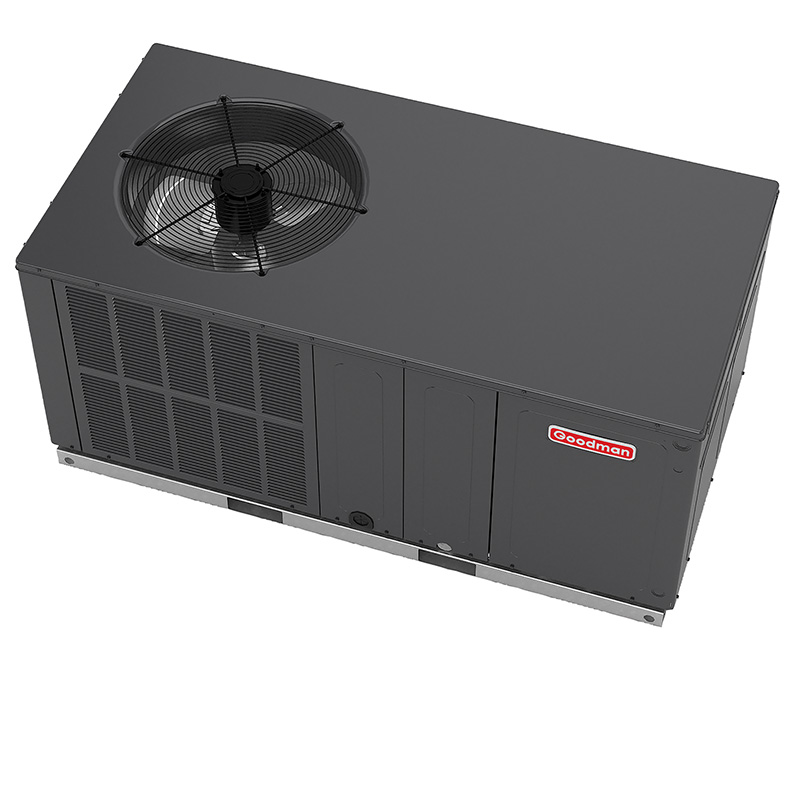
Goodman 4 Ton Package Unit Heat Pump & AC | 13.4 SEER2 Horizontal Discharge | R32
View on AC Direct see your lowest price →Check current price on AC Direct →
Key features
- 4-ton capacity suits larger homes in the 2,000 to 2,600 sq ft range (subject to load calculation)
- 13.4 SEER2 efficiency meets current federal minimum standards for most U.S. climate regions
- Horizontal discharge configuration designed for rooftop or side-mount applications
- R-32 refrigerant offers lower global warming potential than R-410A and strong availability
- All-in-one package unit eliminates the need for a separate indoor air handler or furnace
- Single-stage scroll compressor delivers straightforward operation and widely available service parts
About this system
The Goodman 4-ton horizontal-discharge package unit combines a heat pump and air conditioner into a single self-contained cabinet, making it a practical choice for homes where a mechanical room or basement is unavailable and the unit must be mounted on a rooftop or a side-of-structure slab with horizontal airflow. At 4 tons of capacity, it targets larger homes in roughly the 2,000 to 2,600 square foot range, though actual sizing always depends on local climate, insulation, and Manual J load calculations. The horizontal discharge configuration limits installation flexibility compared to a vertical-discharge unit, so confirm that your duct entry points and clearances are compatible before purchasing.
The 13.4 SEER2 rating lands squarely at the current federal minimum efficiency threshold, which means operating costs are competitive with entry-level equipment but will not match the savings of 16 SEER2 or higher systems over time. R-32 refrigerant is a meaningful upgrade over the older R-410A found in much of Goodman’s back catalog: it has a lower global warming potential, slightly better thermodynamic properties, and is the direction the industry is moving, which should keep service costs reasonable for years ahead. For a buyer prioritizing upfront affordability over long-term efficiency gains, this system occupies a sensible position in the market.
This Goodman package unit is a cost-conscious, code-compliant option for homeowners who need a rooftop or horizontal-mount solution without a premium price tag. At 13.4 SEER2 it will not win efficiency awards, and Goodman's documented reliability record means budgeting for potential repairs after year seven is a realistic part of ownership. It makes the most sense when professional installation and a solid service agreement are part of the plan from day one.
Overall score is the average of the five ratings above.
What we like
- Priced 15 to 25 percent below comparable Carrier, Trane, and Lennox package units
- R-32 refrigerant is forward-looking and has better environmental credentials than R-410A
- All-in-one cabinet simplifies installation where no indoor mechanical space exists
- Horizontal discharge suits rooftop and crawl-space duct configurations directly
- Scroll compressor design and single-stage operation mean straightforward, widely understood service needs
Trade-offs
- 13.4 SEER2 is minimum-tier efficiency; monthly energy costs will be higher than mid- or high-efficiency alternatives over the system's life
- Compressor lifespan averages 10 to 14 years versus 15 to 20 years for premium-brand compressors, per Goodman's documented track record
- Dual-run capacitor failures and evaporator coil leaks are the most commonly reported repair issues, and repair costs tend to climb after roughly year seven
- A minority of owners report refrigerant leaks within the first year, typically traced to installation or initial charge quality rather than the unit itself
What homeowners and pros say about Goodman
Goodman’s reputation among homeowners and HVAC technicians is one of honest trade-offs. On Google dealer reviews the brand averages around 3.8 out of 5, where the most consistent praise is straightforward: the equipment costs less than the name-brand alternatives, and for a buyer on a fixed budget that matters. ConsumerAffairs tells a more complicated story with a score of about 2.5 out of 5, though that platform tends to attract people who had a bad experience rather than satisfied owners who never thought to leave a review. The recurring theme in the negative reviews there is repair costs that start climbing around year seven or eight, which aligns with what technicians observe in the field.
For this specific 4-ton horizontal package unit, the failure modes most worth knowing about are consistent with Goodman’s broader lineup. Dual-run capacitors are the brand’s most commonly reported breakdown, a repair that usually runs 300 to 600 dollars and is quick to address. Evaporator coil leaks show up in a meaningful share of longer-term owner accounts and are a more expensive fix. Compressor lifespan on Goodman units tends to average 10 to 14 years rather than the 15 to 20 years more often associated with Trane, Carrier, or Lennox compressors, which is a real consideration for a package unit that will be difficult and costly to access on a rooftop. A small number of first-year refrigerant leak reports exist, but technicians generally attribute those to installation or charge quality rather than the unit coming out of the factory defective. The consistent message from pros is that Goodman equipment rewards careful installation and regular maintenance, and punishes neglect faster than premium alternatives.
Sources: ConsumerAffairs Goodman owner reviews, AHRI Directory of Certified Product Performance, U.S. DOE appliance and equipment efficiency standards, Goodman product specification sheets.
What it costs to run
At 13.4 SEER2, cooling this 4-ton system for a typical 1200-hour cooling season at the U.S. average electricity rate of $0.17/kWh works out to roughly $731 per year in cooling, about $0 less per year than a minimum-efficiency 13.4 SEER2 unit of the same size. Your real cost depends on your climate and local rate.
Method: (48,000 BTU/hr ÷ 13.4 SEER2) × 1200 hours ÷ 1000 × $0.17/kWh. Rate source: U.S. EIA average; cooling hours: moderate-climate estimate.
How it compares
| Brand | Comparable model | SEER2 | Stage | Price position |
|---|---|---|---|---|
| Goodman | 4-Ton Horizontal Package Heat Pump (this unit) | 13.4 | Single-stage | Value pick |
| Carrier | WeatherMaster 50XC Series Package Heat Pump | 14.0–15.0 | Single-stage | 15 to 25 percent higher than this unit |
| Trane | Precedent TWE/TWH Series Package Heat Pump | 14.0–15.5 | Single-stage | 15 to 25 percent higher than this unit |
| Lennox | LRP14HP Package Heat Pump | 14.0 | Single-stage | 10 to 20 percent higher than this unit |
Competitor rows are comparable single-stage units at similar efficiency; price is relative position, not a quote.
Questions about this system
Why does this unit discharge horizontally, and does that limit where I can install it?
Horizontal discharge means the conditioned air exits through the side of the cabinet rather than the top, which is specifically designed for rooftop curb mounts and side-of-structure installations where ductwork enters horizontally. It cannot be used interchangeably with vertical-discharge package units without modifying the duct connections, so verify your curb dimensions and duct entry orientation before ordering.
Is R-32 refrigerant harder to service than the R-410A I had in my last unit?
R-32 requires technicians to use slightly different handling procedures because it is mildly flammable (A2L classification), but it is increasingly common and most licensed HVAC technicians are already trained for it or can be quickly. Availability of R-32 is growing, and it is not expected to face the supply or cost issues that R-22 owners experienced during that phase-out.
What are the most common repairs I should budget for on this Goodman unit?
The dual-run capacitor is Goodman's most frequently reported failure point and typically costs 300 to 600 dollars to replace, including labor. Evaporator coil leaks show up in a meaningful share of long-term owner reviews and carry a higher repair cost, and a small number of owners have reported refrigerant leaks within the first year that turned out to be installation or charge issues rather than factory defects.
How many square feet will a 4-ton package unit comfortably cool?
A rough rule of thumb puts 4 tons at roughly 2,000 to 2,600 square feet, but that estimate is heavily influenced by ceiling height, insulation levels, window area, and local climate. A proper Manual J load calculation by your installing contractor is the only reliable way to confirm that 4 tons is the right size for your specific home.
Does the 13.4 SEER2 rating mean I will pay significantly more to operate this unit compared to a higher-efficiency model?
Compared to a 15 or 16 SEER2 unit, you can expect modestly higher monthly energy costs, with the gap becoming more noticeable in climates with long cooling seasons or high electricity rates. The lower upfront price often offsets a portion of those extra operating costs in the short term, but over a 10 to 15 year lifespan, a higher-efficiency unit typically comes out ahead on total cost of ownership in hot climates.
Specifications
| Cooling capacity | 4 Ton |
| Efficiency | 13.4 SEER2 |
| Configuration | Horizontal |
| Refrigerant | R-32 |