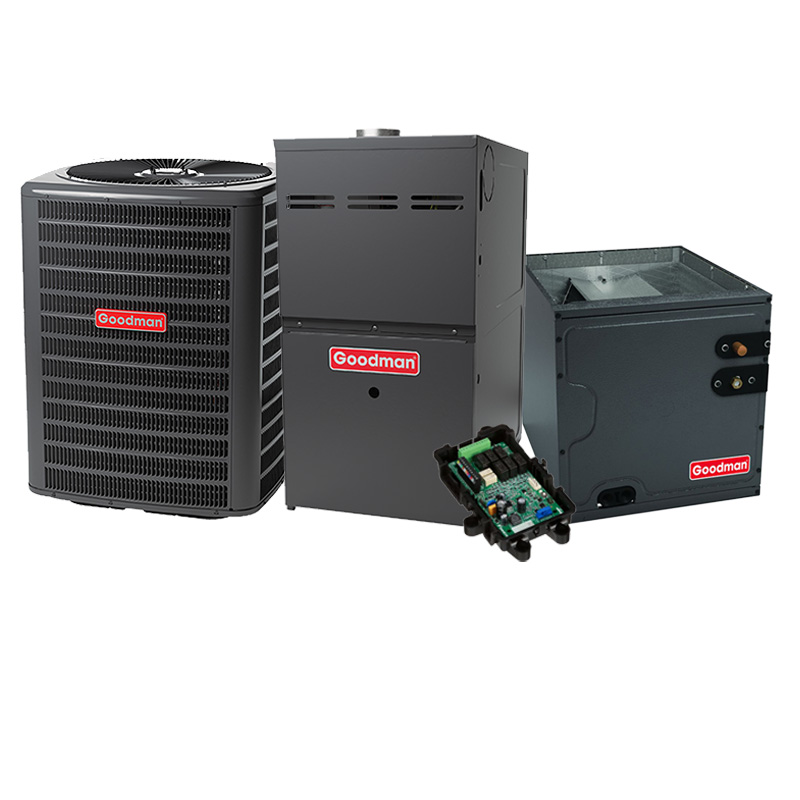
Goodman 4 Ton 13.5 SEER2 120000 BTU 80% Gas Furnace With R32 Air Conditioning Condenser And Coil System – Upflow
View on AC Direct see your lowest price →Check current price on AC Direct →
Key features
- 4-ton cooling capacity suited to larger homes, roughly 2,200 to 3,000 sq ft depending on load
- 13.5 SEER2 efficiency rating meets federal minimums in most U.S. climate zones
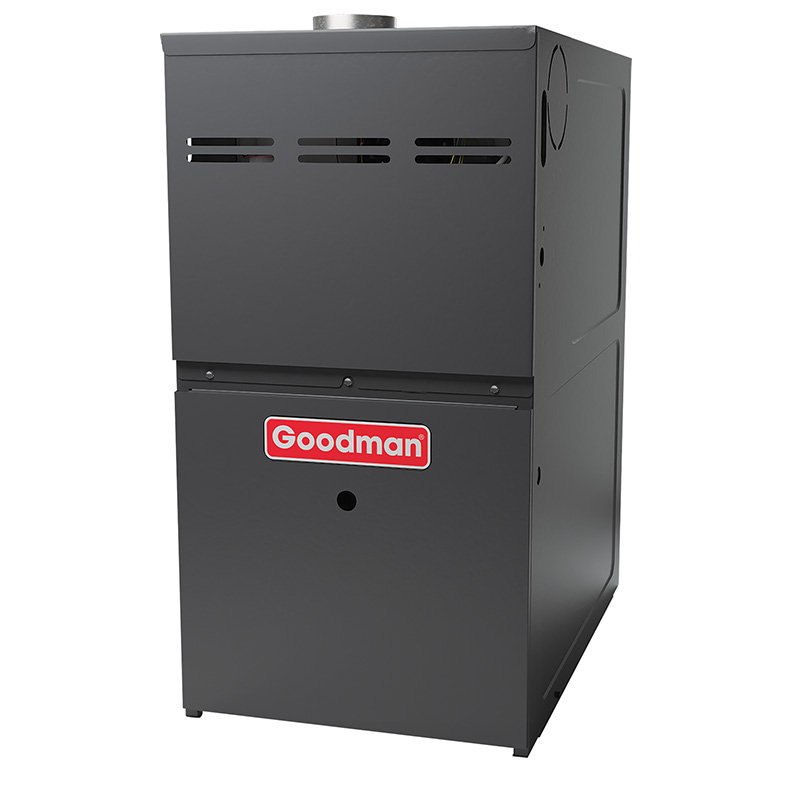
- 120,000 BTU 80% AFUE gas furnace in upflow configuration for basement or closet installs
- R-32 refrigerant with lower global warming potential than outgoing R-410A
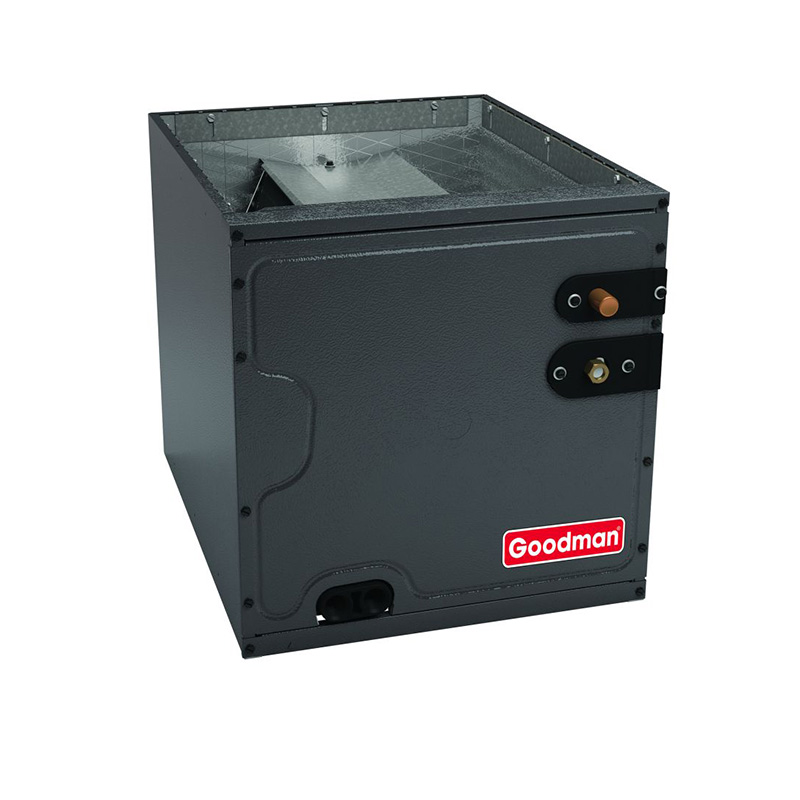
- Matched condenser, evaporator coil, and furnace sold as a single bundle for compatibility
- Single-stage cooling and heating operation for straightforward installation and servicing
About this system
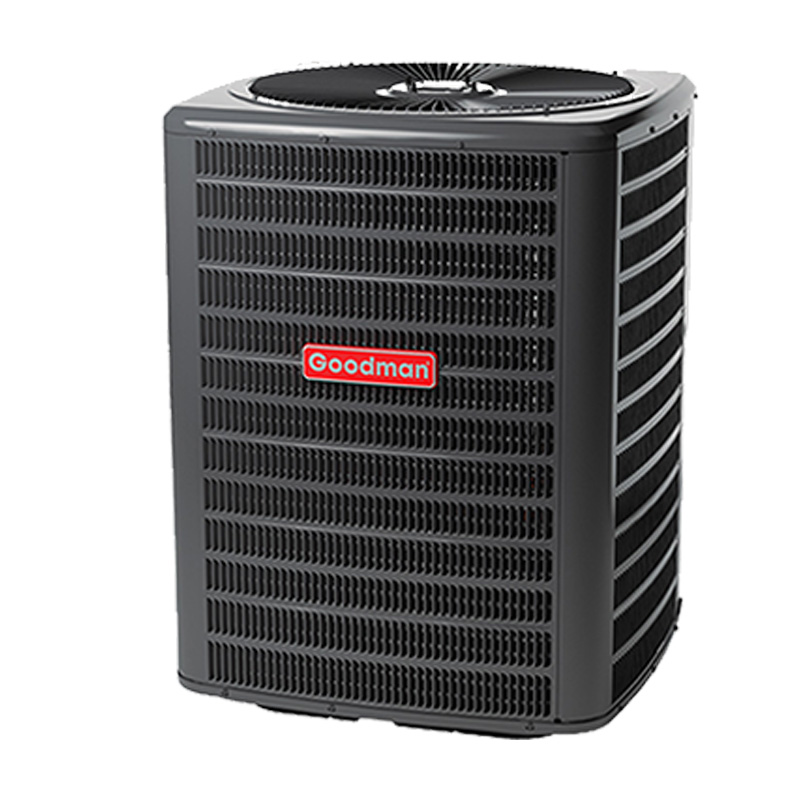
This Goodman upflow system pairs a 4-ton, 13.5 SEER2 R-32 air conditioning condenser and matching evaporator coil with a 120,000 BTU 80% AFUE gas furnace, making it a full split-system bundle aimed at larger homes, typically in the 2,200 to 3,000 square foot range depending on climate and insulation. The upflow configuration means the furnace sits at floor level and discharges conditioned air upward into the duct system, which suits the majority of basement and closet installations in the U.S. R-32 refrigerant carries a lower global warming potential than the R-410A it is replacing across the industry, and it requires slightly less charge by weight, which can simplify future servicing as R-410A supply tightens.
At 13.5 SEER2, this system sits at the entry-level efficiency tier, just above the federal minimum in most climate zones. Homeowners in moderate climates who run the air conditioner a few months per year will find the efficiency gap between this and a 17 or 18 SEER2 system hard to recover through energy savings alone over a typical 10 to 12 year payback window. The 80% AFUE furnace means roughly 20 cents of every gas dollar exits through the flue; stepping up to a 96% AFUE model would cut that loss considerably, and is worth pricing out if you are in a cold-winter region. For buyers in the Sun Belt or mid-Atlantic who want a reliable, code-compliant replacement without a premium brand price tag, the specs here are a reasonable fit.
This Goodman bundle delivers a code-compliant, full-system replacement at a price point 15 to 25 percent below premium brands, which makes real financial sense for budget-conscious buyers or landlords with shorter ownership horizons. The trade-off is a documented history of capacitor failures, evaporator coil leaks, and compressor longevity that trails premium competitors, so the value equation depends heavily on installer quality and your appetite for potential repair costs after year seven. It is a workable choice, not a set-it-and-forget-it one.
Overall score is the average of the five ratings above.
What we like
- Priced 15 to 25 percent below comparable Trane, Lennox, and Carrier bundles
- R-32 refrigerant is forward-compatible as R-410A supply phases out
- Matched coil and condenser from the same manufacturer reduces compatibility guesswork
- 13.5 SEER2 meets federal minimum efficiency requirements in most climate zones
- Single-stage operation keeps service calls straightforward and parts widely available
Trade-offs
- Dual-run capacitors are the most frequently reported failure, typically surfacing within the first several years and costing $300 to $600 to repair
- Evaporator coil leaks appear in a meaningful share of owner reports, sometimes requiring coil replacement well before the system's expected lifespan
- Compressor longevity averages 10 to 14 years versus 15 to 20 years for premium brands, meaning a full system replacement may come sooner
- 80% AFUE furnace leaves roughly 20% of gas heat unrecovered, a meaningful operating cost in cold climates compared to high-efficiency 96%+ alternatives
What homeowners and pros say about Goodman
Homeowners who purchase Goodman systems tend to split into two camps. Those who land a skilled installer and keep up with basic maintenance, particularly annual capacitor inspections, often report years of trouble-free operation and cite the lower purchase price as the clearest win. That affordability praise shows up consistently in Google dealer reviews, where Goodman systems average around 3.8 out of 5 across hundreds of dealer-level reviews. The picture on ConsumerAffairs is less flattering, with ratings hovering around 2.5 out of 5, and the recurring complaint is repair costs that begin climbing after roughly year seven, often tied to the documented failure modes: dual-run capacitors going out, evaporator coil leaks developing over time, and compressors that average 10 to 14 years rather than the 15 to 20 years more commonly associated with premium brands.
HVAC technicians tend to view Goodman as a competent but unforgiving brand. Pros note that a properly commissioned Goodman system, one with a verified refrigerant charge, correct airflow, and a full startup checklist, performs close to its rated specs and is easy to service given the wide parts availability. The concern they raise most often is that this equipment amplifies the consequences of a rushed or careless install, including the first-year refrigerant leaks that a minority of owners report and that are almost always traced back to install or charging errors rather than manufacturing defects. For a 4-ton, 120,000 BTU bundle at this price point, the honest professional consensus is that you are buying acceptable equipment at a real discount, with the understanding that the installer you choose matters at least as much as the brand on the label.
Sources: ConsumerAffairs Goodman owner reviews, AHRI Directory of Certified Product Performance, U.S. DOE appliance and equipment efficiency standards, Goodman product specification sheets.
What it costs to run
At 13.5 SEER2, cooling this 4-ton system for a typical 1200-hour cooling season at the U.S. average electricity rate of $0.17/kWh works out to roughly $725 per year in cooling, about $6 less per year than a minimum-efficiency 13.4 SEER2 unit of the same size. Your real cost depends on your climate and local rate.
Method: (48,000 BTU/hr ÷ 13.5 SEER2) × 1200 hours ÷ 1000 × $0.17/kWh. Rate source: U.S. EIA average; cooling hours: moderate-climate estimate.
How it compares
| Brand | Comparable model | SEER2 | Stage | Price position |
|---|---|---|---|---|
| Goodman | GSX16S / GMVC8 / CAPF series (this bundle) | 13.5 | Single-stage | Value pick |
| Carrier | Performance 14 (24ACC4 series) with 80% AFUE furnace | 13.4 to 14.3 | Single-stage | Moderately higher than this Goodman bundle |
| Trane | XR14c with S8X1 80% AFUE furnace | 13.4 to 14.5 | Single-stage | Notably higher than this Goodman bundle |
| Lennox | Merit ML14XC1 with 80% AFUE Merit series furnace | 13.4 to 14.3 | Single-stage | Moderately to notably higher than this Goodman bundle |
Competitor rows are comparable single-stage units at similar efficiency; price is relative position, not a quote.
Questions about this system
Will this system work with my existing ductwork sized for a 4-ton unit?
Likely yes, but duct sizing should be verified by your installer with a Manual D calculation before swapping in the new system. Oversized or undersized duct runs affect both comfort and efficiency regardless of the equipment brand, and a 120,000 BTU furnace in particular demands adequate airflow to avoid heat exchanger stress.
Why does this system use R-32 instead of R-410A, and does that affect service costs?
Goodman and other manufacturers are transitioning to R-32 because it has a significantly lower global warming potential and is more efficient to handle in smaller charge weights. Service costs should remain comparable to R-410A work, though your technician will need recovery equipment rated for R-32, which most shops are already acquiring as the industry shifts.
Is the 80% AFUE furnace going to cost me noticeably more to run than a 96% model?
In cold climates where the furnace runs heavily from November through March, the roughly 16-percentage-point efficiency gap translates to real annual savings with a high-efficiency unit, often enough to justify upgrading if you plan to stay in the home more than five to seven years. In mild-winter regions where heating loads are modest, the payback period on the upgrade stretches considerably.
What should I know about the documented failure history on Goodman systems before I buy?
Dual-run capacitor failures are the most commonly reported issue and are typically a quick, low-cost fix in the $300 to $600 range. Evaporator coil leaks and compressor failures that appear before the 10-year mark are also documented in owner reviews, which is why installer quality and a proper startup check are especially important with Goodman equipment.
Does Goodman's warranty on this bundle require professional registration, and what does it cover?
Goodman typically requires the system to be registered within a set window after installation by a licensed contractor to qualify for the extended parts warranty; unregistered units revert to a shorter base coverage period. The warranty generally covers parts but not labor, so budget for service call costs if a covered component fails outside the first year.
Specifications
| Cooling capacity | 4 Ton |
| Efficiency | 13.5 SEER2 |
| Furnace output | 120000 BTU |
| Configuration | Upflow |
| Refrigerant | R-32 |