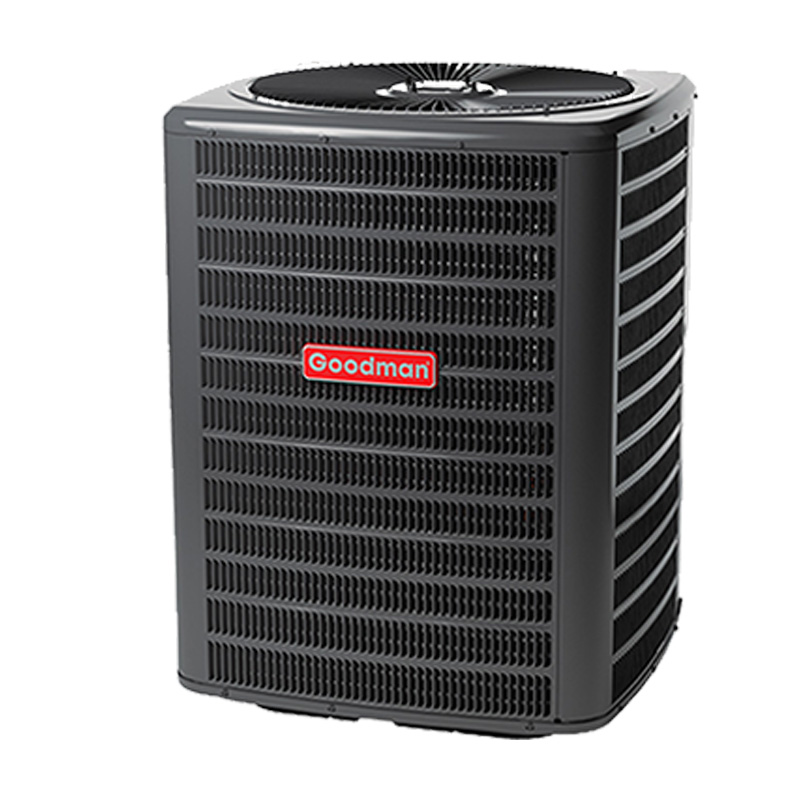
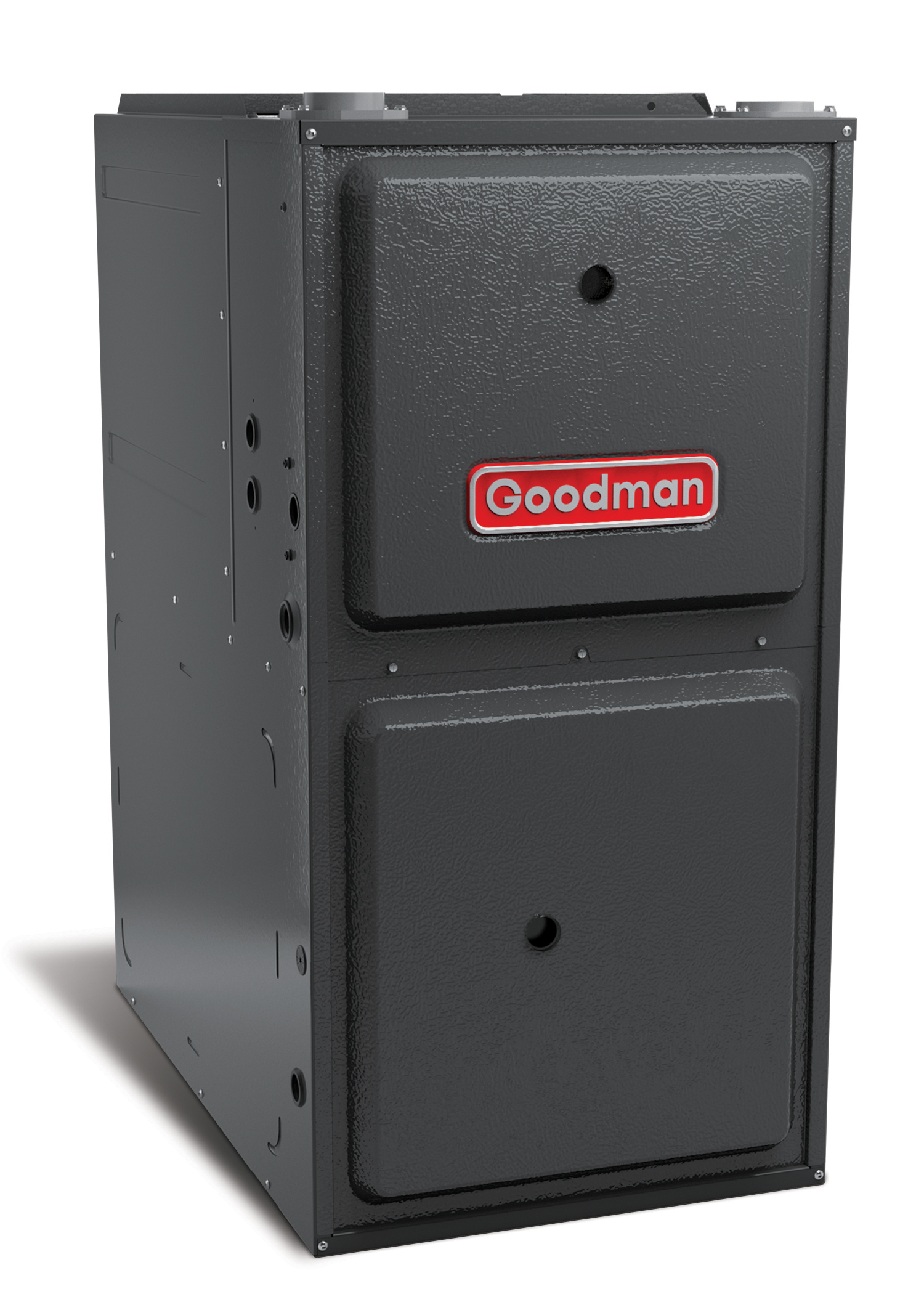
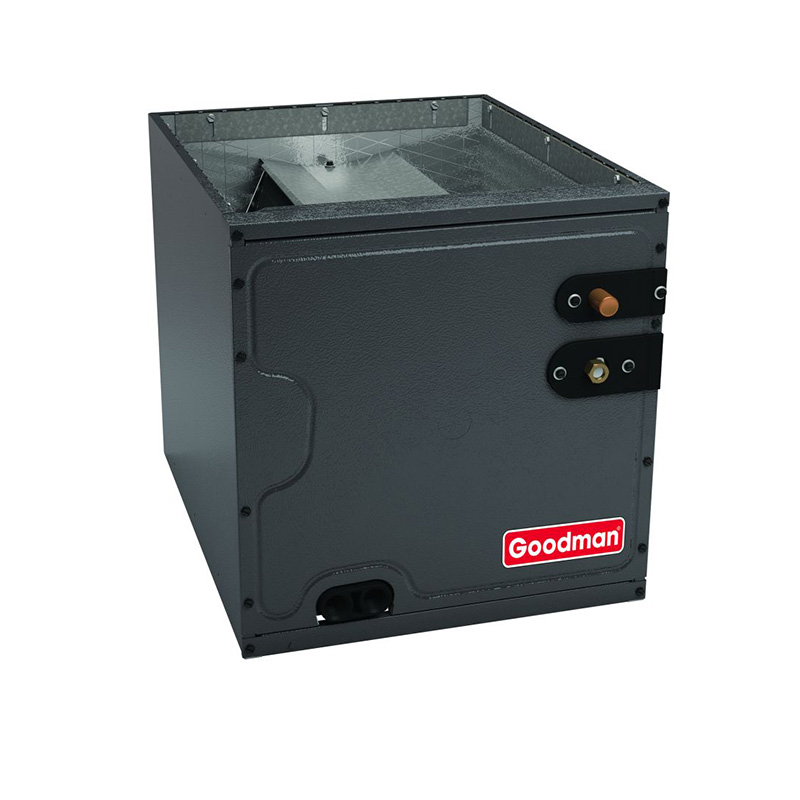
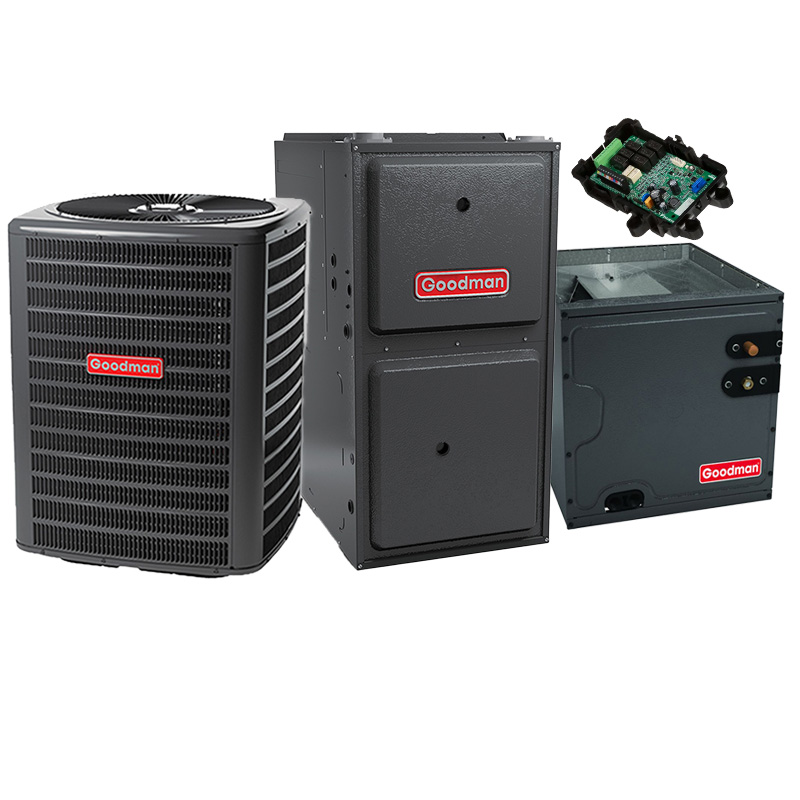
Goodman 4 Ton 13.5 SEER2 80000 BTU 96% AFUE Two-Stage Gas Furnace With R32 Air Condenser and Coil System – Upflow
View on AC Direct see your lowest price →Check current price on AC Direct →
Key features
- 4-ton cooling capacity with 13.5 SEER2 efficiency rating
- 96% AFUE two-stage gas furnace rated at 80,000 BTU/hr
- R-32 refrigerant, replacing legacy R-410A for lower environmental impact
- Upflow air handler orientation for basement or ground-level closet installs
- Two-stage heating reduces short-cycling and improves comfort consistency
- Matched coil and condenser sold as a system for simplified equipment compatibility
About this system
This Goodman bundle pairs a 4-ton, 13.5 SEER2 R-32 air condenser and matching evaporator coil with an 80,000 BTU, 96% AFUE two-stage gas furnace in an upflow configuration. The combination is built for homes in the 2,000 to 2,800 square foot range that need serious heating capacity alongside reliable warm-season cooling. The two-stage furnace runs at a lower output stage the majority of the time, which reduces temperature swings, keeps humidity more consistent indoors, and burns less gas than a single-stage unit running at full blast every cycle. At 96% AFUE, nearly all of the fuel you pay for becomes usable heat, putting it squarely in the high-efficiency category for gas furnaces.
The 13.5 SEER2 rating meets current federal minimum efficiency standards for most U.S. climate zones and is a solid starting point for moderate cooling loads. It is not a top-tier efficiency rating, so homeowners in climates with long, brutal summers may want to weigh a higher SEER2 option before committing. The R-32 refrigerant is a newer low-global-warming-potential alternative to the older R-410A, which is being phased out. Upflow configuration means the furnace draws air from the bottom and discharges heated or cooled air upward through the duct system, making it a natural fit for basement or closet installs where the ducts run through the floor system above.
This Goodman system gives budget-minded buyers access to genuine high-efficiency heating and code-compliant cooling at a price point that is 15 to 25 percent below comparable equipment from Carrier, Trane, or Lennox. The two-stage furnace and 96% AFUE are real performance advantages, but the brand's documented reliability history and installer-dependent outcomes mean buyers should invest in a skilled contractor just as much as in the equipment itself. It is a reasonable value pick for cost-conscious homeowners who go in with realistic expectations.
Overall score is the average of the five ratings above.
What we like
- 96% AFUE two-stage furnace delivers genuine efficiency and comfort improvement over single-stage units
- Priced 15 to 25 percent below premium brands for comparable specs, leaving room in the budget for a quality install
- R-32 refrigerant is future-ready as R-410A is phased out industry-wide
- Matched system components simplify contractor selection and warranty coverage
- Two-stage operation reduces temperature swings and improves humidity control during mild weather
Trade-offs
- Dual-run capacitors are the most commonly reported failure point, typically surfacing within the first several years
- Evaporator coil leaks appear in a meaningful share of owner reports, a recurring concern for this brand
- Compressor lifespan averages 10 to 14 years versus 15 to 20 years typical of premium brands
- 13.5 SEER2 is a baseline efficiency rating; homeowners in hot climates may see limited savings on summer utility bills compared to higher SEER2 alternatives
What homeowners and pros say about Goodman
Homeowners who choose Goodman most often point to the price gap as the deciding factor, and that sentiment shows up clearly in Google dealer reviews, which average around 3.8 out of 5 stars across hundreds of location-level reviews. Affordability is the most repeated praise, and buyers who matched the equipment with a skilled installer tend to report satisfaction in the early years of ownership. The picture shifts when you look at ConsumerAffairs, where Goodman sits near 2.5 out of 5. That platform skews toward owners who had problems worth writing about, and the recurring theme there is repair costs that climb after roughly year seven, particularly around the dual-run capacitor and evaporator coil. Neither failure is catastrophic on its own, but together they represent a pattern buyers should factor into their long-term cost estimate.
HVAC technicians tend to have a nuanced view of Goodman. Many install it regularly and point out that the equipment performs adequately when sized and charged correctly, but they are also the ones who see the documented failure modes up close: capacitors that fail under summer load, evaporator coil leaks that show up in a meaningful share of systems, and compressors that tend to average 10 to 14 years rather than the 15 to 20 years more common in premium brands. A minority of owners also report refrigerant leaks within the first year, which technicians typically attribute to installation or charge issues rather than the equipment itself. The consistent takeaway from the trade is that Goodman’s outcome depends heavily on who installs it, making contractor vetting at least as important as the equipment decision.
Sources: ConsumerAffairs Goodman owner reviews, AHRI Directory of Certified Product Performance, U.S. DOE appliance and equipment efficiency standards, Goodman product specification sheets.
What it costs to run
At 13.5 SEER2, cooling this 4-ton system for a typical 1200-hour cooling season at the U.S. average electricity rate of $0.17/kWh works out to roughly $725 per year in cooling, about $6 less per year than a minimum-efficiency 13.4 SEER2 unit of the same size. Your real cost depends on your climate and local rate.
Method: (48,000 BTU/hr ÷ 13.5 SEER2) × 1200 hours ÷ 1000 × $0.17/kWh. Rate source: U.S. EIA average; cooling hours: moderate-climate estimate.
How it compares
| Brand | Comparable model | SEER2 | Stage | Price position |
|---|---|---|---|---|
| Goodman | 4-Ton 13.5 SEER2 / 80K BTU 96% AFUE Two-Stage Bundle (this system) | 13.5 | Two-stage | Value pick |
| Carrier | Performance 24ACC636 Condenser with 58TP Two-Stage Furnace | 14.0-15.0 | Two-stage | Approximately 20 to 25 percent above this Goodman bundle |
| Trane | XR15 Condenser with S9V2 Two-Stage Gas Furnace | 14.3-15.0 | Two-stage | Approximately 20 to 30 percent above this Goodman bundle |
| Lennox | Merit ML14XC1 Condenser with ML196E Two-Stage Furnace | 13.8-14.5 | Two-stage | Approximately 15 to 25 percent above this Goodman bundle |
Competitor rows are comparable single-stage units at similar efficiency; price is relative position, not a quote.
Questions about this system
Does the 96% AFUE furnace require PVC venting, and does that add to my install cost?
Yes, a 96% AFUE condensing furnace uses PVC or CPVC pipe for its flue and combustion air intake rather than a metal B-vent. If your home is replacing an older 80% furnace, the installer will need to cap the old metal flue and run new PVC lines, which typically adds labor time and some material cost to the project. Get an itemized quote that spells this out before signing.
Why does Goodman use R-32 refrigerant, and will it be harder or more expensive to service?
Goodman shifted to R-32 as the industry moves away from R-410A, which is being phased down under federal regulations. R-32 is widely available among HVAC distributors today, and most technicians who service R-410A systems can work with R-32 after reviewing the handling differences. It is mildly flammable, which requires that technicians follow updated safety procedures, but this should not translate into significantly higher service costs in most markets.
What is the warranty on this system, and what do I need to do to activate it?
Goodman typically offers a 10-year parts warranty on registered equipment, with the compressor often carrying its own 10-year coverage as well. Registration must be completed within a set window after installation, usually 60 days, through Goodman's website. Failure to register generally drops coverage to a shorter base warranty, so confirm the registration requirement with your installer before they leave the job.
How often do Goodman capacitors fail, and how serious is that repair?
Dual-run capacitors are the single most commonly reported failure on Goodman equipment, and they can fail within the first few years of operation, often in peak summer heat. The repair is not catastrophic; it is typically a straightforward service call in the 300 to 600 dollar range, depending on labor rates in your area. Keeping the capacitor on your annual tune-up checklist is worthwhile because a failing capacitor can stress the compressor if ignored.
Is a 4-ton unit the right size for my house, or should I have a load calculation done?
Tonnage should always be confirmed with a Manual J load calculation before purchase, not estimated by square footage alone. A 4-ton system can be correct for roughly 2,000 to 2,800 square feet depending on insulation levels, window area, local climate, and ceiling height, but an oversized system will short-cycle, leaving humidity high and wearing components faster. Ask your contractor to provide the load calculation results in writing before equipment is ordered.
Specifications
| Cooling capacity | 4 Ton |
| Efficiency | 13.5 SEER2 |
| Furnace output | 80000 BTU |
| Furnace efficiency | 96% AFUE |
| Configuration | Upflow |
| Refrigerant | R-32 |