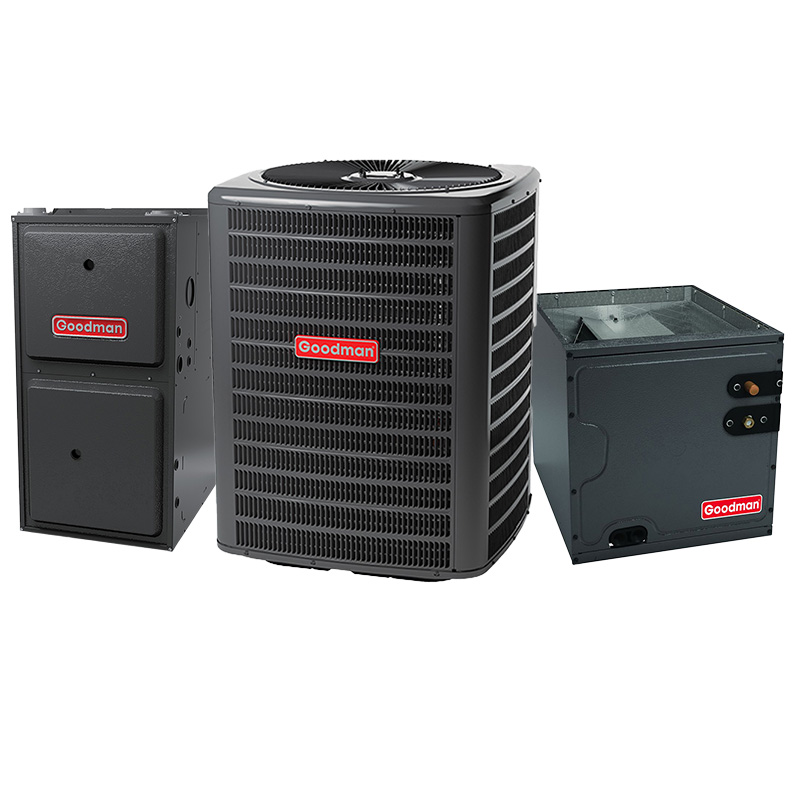
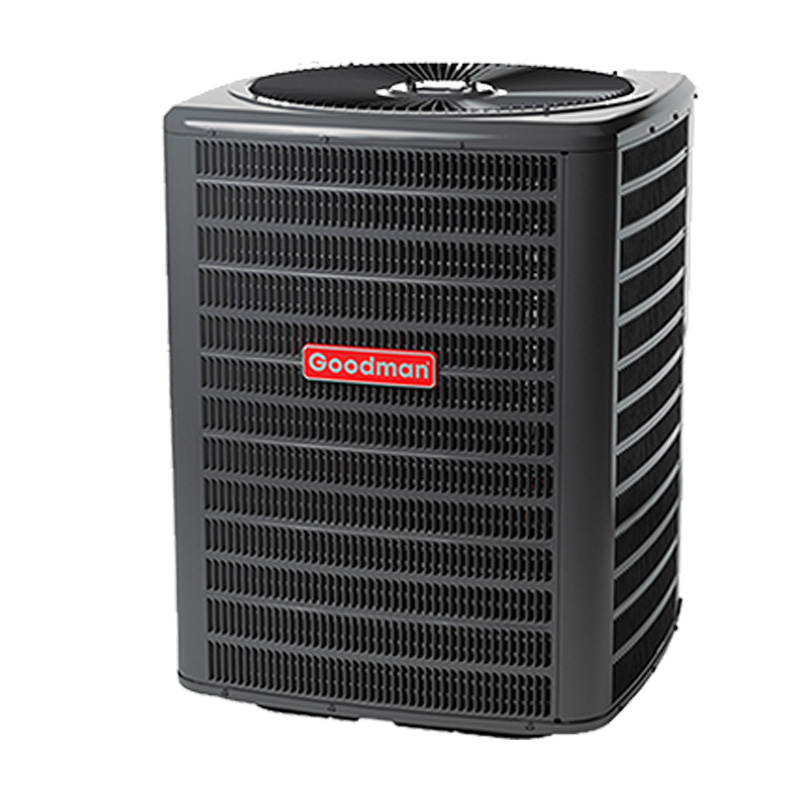
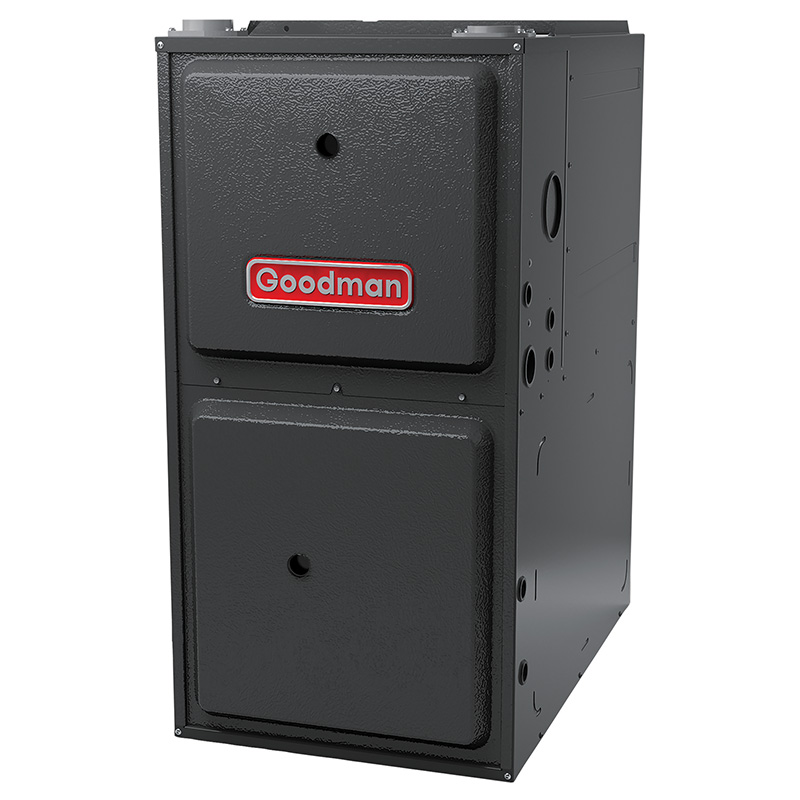
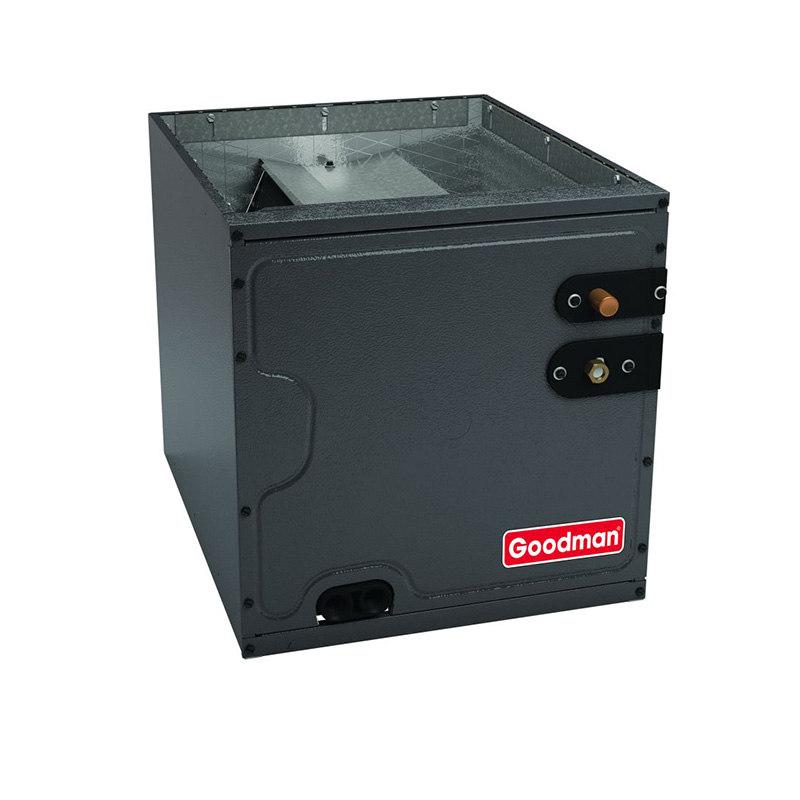
Goodman 4 Ton 13.5 SEER2 AC With 80000 BTU 96% AFUE 2-Stage Variable-Speed ECM Gas Furnace System – Upflow | R32
View on AC Direct see your lowest price →Check current price on AC Direct →
Key features
- 4-ton cooling capacity suits roughly 2,000 to 2,600 sq ft depending on climate and insulation
- 13.5 SEER2 meets current federal minimum efficiency standards for most U.S. regions
- 96% AFUE two-stage gas furnace qualifies for federal energy efficiency tax credit consideration
- Variable-speed ECM blower motor lowers blower electricity use and reduces temperature swings
- R-32 refrigerant offers lower global warming potential than outgoing R-410A systems
- Upflow cabinet design routes conditioned air upward to overhead duct systems
About this system
This Goodman bundle pairs a 4-ton, 13.5 SEER2 central air conditioner with an 80,000 BTU, 96% AFUE two-stage gas furnace in an upflow configuration, making it a reasonable fit for homes in the 2,000 to 2,600 square foot range that need both cooling and heating replaced at once. The 96% AFUE rating means only 4% of fuel is lost as exhaust, which puts this furnace in the condensing tier and qualifies it for potential federal efficiency tax credits. The variable-speed ECM blower motor runs at lower speeds most of the time, which translates to quieter operation, more consistent temperatures from room to room, and lower blower electricity costs compared with a single-speed motor.
The two-stage gas valve is worth noting: on milder days the furnace fires at a reduced capacity, which extends run time, reduces temperature swings, and keeps humidity more in check during heating season. On the cooling side, 13.5 SEER2 is a baseline-compliant efficiency level. It meets current federal minimums for most U.S. regions but sits well below what mid- or high-efficiency compressors offer. Buyers who pay high electricity rates or run their AC heavily through a long summer may find that a higher SEER2 unit pays back the price gap over time. R-32 refrigerant has a lower global warming potential than the older R-410A it replaces and is now the industry standard for new residential equipment.
The upflow configuration requires that supply air exits the top of the furnace cabinet, so this system is designed for installations where ductwork runs overhead, typically a basement or ground-level mechanical closet. It is not interchangeable with a downflow or horizontal application without a different cabinet, so confirming your duct layout before ordering is essential.
This Goodman bundle delivers a high-efficiency furnace and code-compliant AC in one purchase at a price that undercuts comparable Trane, Carrier, and Lennox systems by a meaningful margin. The 96% AFUE furnace with two-stage operation and ECM blower is genuinely good hardware at this price tier, though the 13.5 SEER2 cooling side is entry-level and the brand's documented repair history after year seven means budgeting for eventual service calls is realistic, not pessimistic.
Overall score is the average of the five ratings above.
What we like
- Priced roughly 15 to 25 percent below comparable Trane, Lennox, and Carrier bundles
- 96% AFUE condensing furnace with two-stage gas valve reduces fuel bills and temperature swings
- Variable-speed ECM motor runs quieter and uses less electricity than single-speed alternatives
- R-32 refrigerant is the current industry standard with a lower environmental footprint
- Buying furnace and AC as a matched system ensures coil compatibility and simplifies warranty claims
Trade-offs
- 13.5 SEER2 is the minimum compliant efficiency tier; owners with high electricity rates may see limited cooling-season savings
- Dual-run capacitor failures are the most commonly reported repair issue, typically appearing in years four through eight
- Compressor lifespan averages 10 to 14 years, noticeably shorter than the 15 to 20 years reported for premium brands
- Evaporator coil leaks and first-year refrigerant leaks appear in a meaningful share of owner reports, often tied to installation quality
What homeowners and pros say about Goodman
Homeowners who chose Goodman most often point to the lower upfront cost as the deciding factor, and that holds true for this bundle. On Google dealer reviews the brand averages around 3.8 out of 5, with affordability and straightforward installation being the recurring positives. The two-stage furnace and ECM blower in this specific system draw more favorable comments than Goodman’s entry-level single-stage equipment, because the comfort difference is noticeable day to day. That said, the ConsumerAffairs score sits at roughly 2.5 out of 5, a channel weighted toward owners who had something go wrong, and the complaints that stack up there center on repair costs climbing after around year seven. That pattern is consistent with what HVAC technicians say independently: Goodman equipment is not unusually fragile out of the box, but it does not have the same component longevity as premium brands.
Among service technicians, the most commonly cited failure point for Goodman systems is the dual-run capacitor, a relatively low-stakes repair in the $300 to $600 range but one that comes up more often and earlier than on Trane or Carrier units. More significant is the documented pattern of evaporator coil leaks in a share of installations and a compressor lifespan that averages 10 to 14 years compared with 15 to 20 years for premium-tier equipment. A minority of owners also report refrigerant leaks within the first year, which experienced installers attribute more to charge procedures than to factory quality. The consistent pro message is this: a properly installed Goodman by a skilled contractor performs reasonably well for its price tier, but the equipment is less forgiving of a sloppy startup than a Lennox or Carrier unit would be.
Sources: ConsumerAffairs Goodman owner reviews, AHRI Directory of Certified Product Performance, U.S. DOE appliance and equipment efficiency standards, Goodman product specification sheets.
What it costs to run
At 13.5 SEER2, cooling this 4-ton system for a typical 1200-hour cooling season at the U.S. average electricity rate of $0.17/kWh works out to roughly $725 per year in cooling, about $6 less per year than a minimum-efficiency 13.4 SEER2 unit of the same size. Your real cost depends on your climate and local rate.
Method: (48,000 BTU/hr ÷ 13.5 SEER2) × 1200 hours ÷ 1000 × $0.17/kWh. Rate source: U.S. EIA average; cooling hours: moderate-climate estimate.
How it compares
| Brand | Comparable model | SEER2 | Stage | Price position |
|---|---|---|---|---|
| Goodman | GSXH504810 + GMVC960803BN (this system) | 13.5 | Two-stage / variable-speed ECM | Value pick |
| Carrier | Comfort 14 Series (24ACC4) | 13.8 to 14 | Single-stage | Typically 15 to 25 percent more than this Goodman bundle |
| Trane | XR14c Series | 14 | Single-stage | Typically 15 to 25 percent more than this Goodman bundle |
| Lennox | Merit ML14XC1 Series | 14 | Single-stage | Typically 15 to 25 percent more than this Goodman bundle |
Competitor rows are comparable single-stage units at similar efficiency; price is relative position, not a quote.
Questions about this system
Does the 96% AFUE furnace in this system qualify for the federal energy efficiency tax credit?
As of current IRS guidelines, gas furnaces at 97% AFUE or higher qualify for the 25C federal tax credit; at 96% AFUE this furnace falls just below that threshold for most installations. Tax rules can change, so confirm eligibility with a tax professional or check the current IRS guidance before purchasing based on that assumption.
Can this upflow system be installed in a horizontal or downflow position?
No. The upflow cabinet is designed to discharge air from the top of the unit into overhead ductwork. Using it in a horizontal attic application or a downflow configuration requires a different cabinet entirely. Verify your existing duct orientation before ordering.
How serious are the evaporator coil leak reports, and is there anything I can do to reduce that risk?
Coil leaks appear in a meaningful share of Goodman owner reviews and are one of the brand's documented weak points. The best mitigation is hiring an experienced, licensed HVAC contractor who will properly charge the system and perform a leak check at startup. A first-year refrigerant issue is frequently a charge or installation problem rather than a factory defect, so installer quality matters as much as the equipment itself.
What does the two-stage furnace actually do differently from a single-stage model?
A two-stage gas valve fires at a reduced capacity, often around 65 percent, on mild days and only ramps to full output when temperatures drop significantly. This extends run time, which helps the system distribute heat more evenly, reduces the on-off cycling that stresses heat exchangers, and generally keeps the home at a steadier temperature. Most homeowners notice quieter, gentler heat delivery compared with a single-stage furnace.
What is the expected cost if the dual-run capacitor fails, and how soon does that typically happen?
Capacitor replacement is one of the lower-cost HVAC repairs, typically falling in the $300 to $600 range including labor. It is the most commonly reported failure point for Goodman equipment and tends to show up anywhere from year four onward, with complaints clustering around years seven and beyond based on owner feedback. The part itself is inexpensive; most of the bill is the service call and labor.
Specifications
| Cooling capacity | 4 Ton |
| Efficiency | 13.5 SEER2 |
| Furnace output | 80000 BTU |
| Furnace efficiency | 96% AFUE |
| Configuration | Upflow |
| Refrigerant | R-32 |