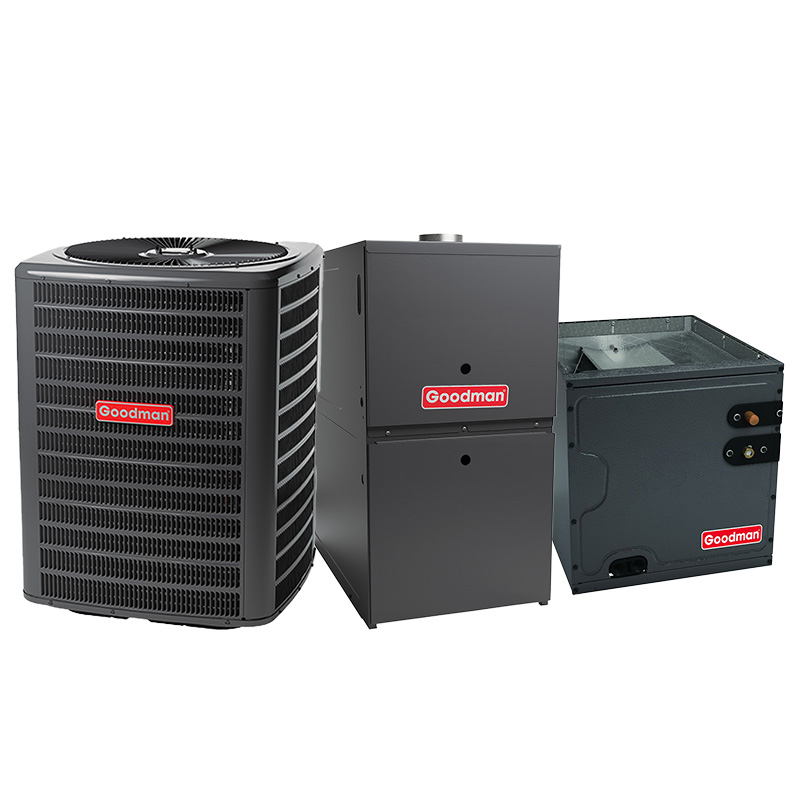
Goodman 4 Ton 13.8 SEER2 AC & Gas Furnace System – Two Stage Variable-Speed, 100000 BTU Gas Furnace, 80% AFUE, Upflow, R32
View on AC Direct see your lowest price →Check current price on AC Direct →
Key features
- Two-stage compressor reduces short-cycling and improves humidity control on part-load days
- Variable-speed blower motor for quieter, more even airflow compared with single-speed models
- 80% AFUE gas furnace rated at 100,000 BTU for heating in larger homes
- R-32 refrigerant, a lower global-warming-potential alternative to R-410A
- Upflow configuration suits basement and ground-level utility closet installations
- 13.8 SEER2 efficiency rating meets current federal minimums for most regions
About this system
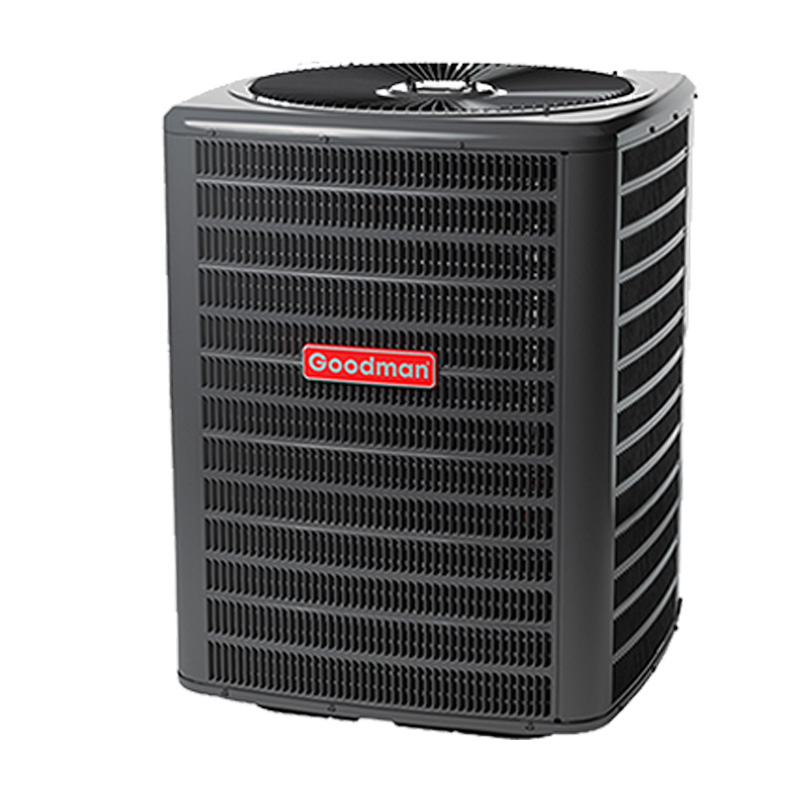
The Goodman 4-ton, 13.8 SEER2 split system pairs a two-stage air conditioner with a variable-speed, 80% AFUE gas furnace rated at 100,000 BTU. The 4-ton capacity targets homes in roughly the 2,000 to 2,600 square foot range, though the right size always depends on a proper Manual J load calculation. Two-stage cooling means the compressor runs at a reduced capacity on mild days and steps up only when demand rises, which cuts short-cycling, moderates humidity better than a single-stage unit, and softens peak electricity draw compared with running full-blast every cycle.
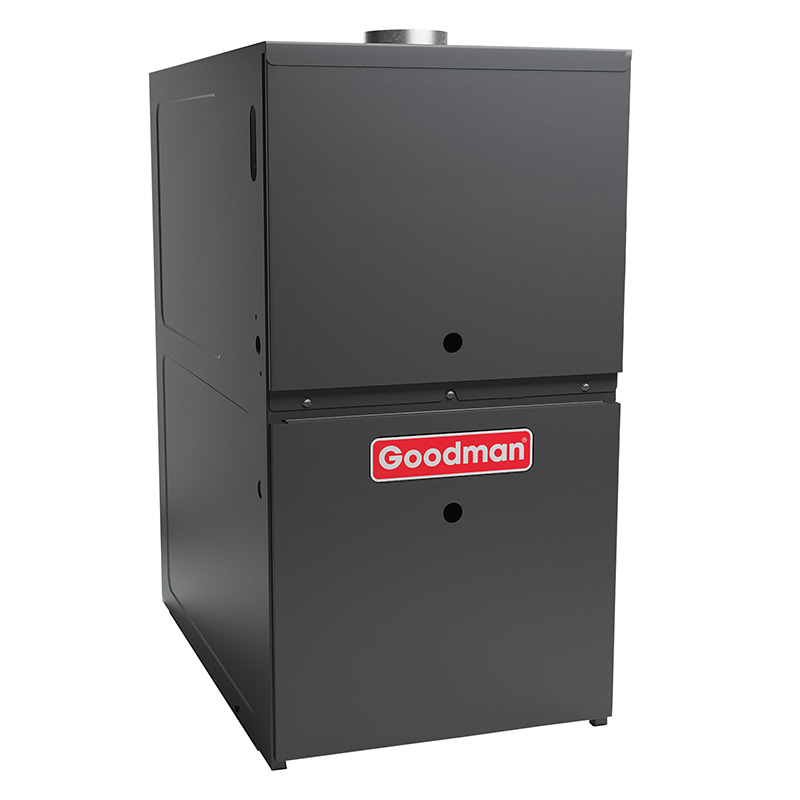
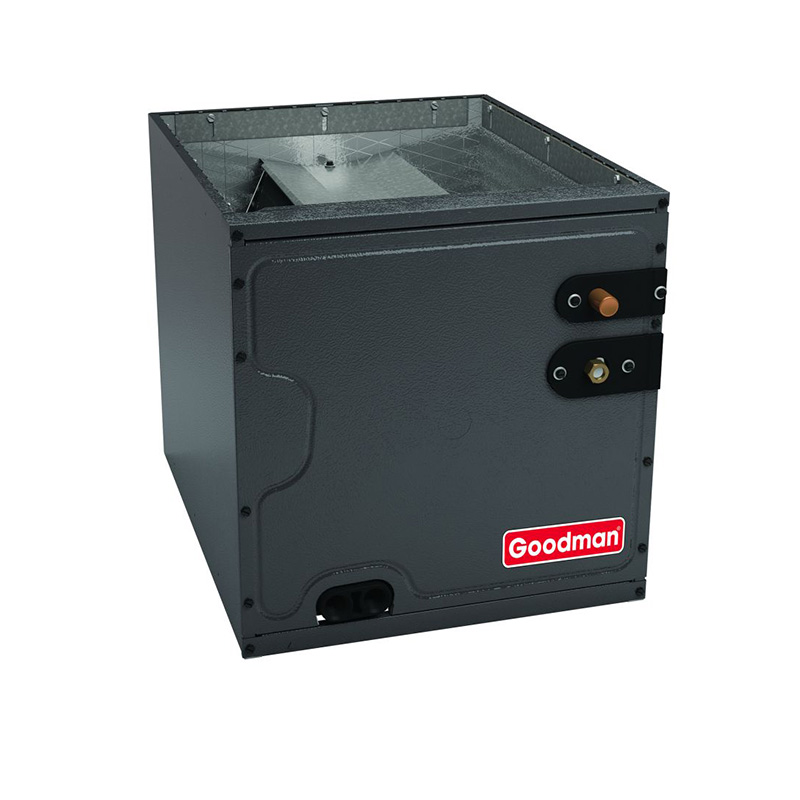
The furnace side uses a variable-speed blower motor, which ramps airflow gradually rather than blasting on and off at one fixed speed. That translates to quieter operation, more even temperatures across rooms, and a modest improvement in heating efficiency beyond the baseline 80% AFUE rating. R-32 refrigerant has a lower global-warming potential than the older R-410A it is gradually replacing, and it is compatible with the current generation of service equipment. Upflow configuration means conditioned air exits through the top of the air handler, the standard orientation for most basement and utility-closet installs where ductwork runs overhead.
This package will appeal most to budget-conscious buyers who want more comfort features than a basic single-stage system offers but are not ready to pay premium-brand prices. The trade-off is a shorter average compressor lifespan and documented component failure modes that demand attentive install work and routine maintenance to keep the system running well past the ten-year mark.
This Goodman package delivers real comfort upgrades over a basic single-stage system at a price point that undercuts comparable Carrier, Trane, and Lennox equipment by roughly 15 to 25 percent. Component longevity, particularly compressor lifespan, trails premium brands, and the system's long-term performance depends heavily on install quality and consistent maintenance. For buyers who prioritize upfront value and plan to stay on top of annual tune-ups, it is a reasonable choice; for buyers who want a lower-maintenance system they can largely forget about, a premium brand is worth the added cost.
Overall score is the average of the five ratings above.
What we like
- Priced 15 to 25 percent below comparable Trane, Carrier, and Lennox systems
- Two-stage operation improves humidity control and reduces short-cycling vs. single-stage
- Variable-speed blower delivers quieter, more even heat distribution
- R-32 refrigerant is serviceable with current technician equipment and has lower environmental impact than R-410A
- Upflow design is widely compatible with existing ductwork in basements and utility closets
Trade-offs
- Compressors average 10 to 14 years versus 15 to 20 for premium brands, raising long-term replacement risk
- Dual-run capacitor failures are the most commonly reported service call, typically adding 300 to 600 dollars per event
- Evaporator coil leaks appear in a meaningful share of owner reviews, often outside the basic parts warranty window
- A minority of owners report refrigerant leaks within the first year, most tied to install or initial charge issues
What homeowners and pros say about Goodman
On review platforms, Goodman earns notably different scores depending on where you look. ConsumerAffairs places the brand at roughly 2.5 out of 5, a number that reflects the self-selecting nature of that channel, where dissatisfied owners are far more likely to write than satisfied ones. The recurring complaint is repair costs climbing after around year seven, with dual-run capacitor failures and evaporator coil leaks cited most often. Google dealer reviews tell a somewhat different story, averaging around 3.8 out of 5 across hundreds of location-level reviews, where affordability draws consistent praise and negative feedback tends to center on install or service experiences rather than the equipment itself.
HVAC technicians generally describe Goodman as a capable but maintenance-sensitive brand. They point to capacitors as the most predictable service call, usually a low-stakes repair in the 300 to 600 dollar range when caught early. Coil leaks are a more significant concern, as they often surface outside the basic parts coverage window and can run into higher repair costs. Compressor lifespan is the area where technicians draw the clearest distinction between Goodman and premium brands: a Goodman compressor averaging 10 to 14 years versus 15 to 20 for Carrier, Trane, or Lennox hardware. Across both homeowner and professional feedback, the consistent theme is that a well-installed, annually serviced Goodman performs reliably for its price class, while a neglected or poorly installed unit will confirm every concern about the brand ahead of schedule.
Sources: ConsumerAffairs Goodman owner reviews, AHRI Directory of Certified Product Performance, U.S. DOE appliance and equipment efficiency standards, Goodman product specification sheets.
What it costs to run
At 13.8 SEER2, cooling this 4-ton system for a typical 1200-hour cooling season at the U.S. average electricity rate of $0.17/kWh works out to roughly $710 per year in cooling, about $21 less per year than a minimum-efficiency 13.4 SEER2 unit of the same size. Your real cost depends on your climate and local rate.
Method: (48,000 BTU/hr ÷ 13.8 SEER2) × 1200 hours ÷ 1000 × $0.17/kWh. Rate source: U.S. EIA average; cooling hours: moderate-climate estimate.
How it compares
| Brand | Comparable model | SEER2 | Stage | Price position |
|---|---|---|---|---|
| Goodman | GSZ2 / GMVC8 Series (this system) | 13.8 | Two-stage / variable-speed | Value pick |
| Carrier | Comfort 14 Series (24ACC4) | 13.8–14.3 | Single-stage | Typically 15 to 25 percent more than this Goodman package |
| Trane | XR14 Series (4TTR4) | 13.8–14.3 | Single-stage | Typically 15 to 25 percent more than this Goodman package |
| Lennox | Merit 14 Series (ML14XC1) | 13.8–14.3 | Single-stage | Typically 15 to 25 percent more than this Goodman package |
Competitor rows are comparable single-stage units at similar efficiency; price is relative position, not a quote.
Questions about this system
Is 4 tons the right size for my house?
Tonnage should be determined by a Manual J load calculation, not square footage alone. Climate zone, insulation levels, ceiling height, and window area all affect the answer. An oversized 4-ton unit will short-cycle, hurt humidity control, and accelerate wear on the two-stage compressor, so get a load calc before ordering.
The system uses R-32 refrigerant. Will local technicians be able to service it?
R-32 requires EPA 608 certification and equipment rated for its slightly higher operating pressures, but most licensed HVAC technicians have updated their tools as R-32 becomes more common. Confirm your service contractor is equipped for R-32 before signing a maintenance agreement.
What does the Goodman warranty actually cover on this system?
Goodman typically offers a 10-year parts warranty when the unit is registered within a set window after installation, and a limited lifetime heat exchanger warranty on the furnace. Coverage does not include labor, refrigerant, or diagnostic costs, which is where a significant portion of real repair bills accumulate. Read the warranty documents carefully before purchase.
How serious is the capacitor failure issue I keep reading about?
Dual-run capacitors are a common wear item across many AC brands, but Goodman owners report them failing with some frequency. The repair is usually straightforward and costs 300 to 600 dollars with a service call. Keeping up with annual tune-ups, during which a technician can test capacitor health, is the best way to catch this before it becomes an emergency breakdown.
Does the 80% AFUE furnace make sense for my climate, or should I upgrade to a higher-efficiency model?
In mild-winter climates or homes where heating loads are a secondary concern, 80% AFUE is often adequate and the upfront cost savings are real. In cold climates where the furnace runs hard for four or more months, a 96% or higher AFUE furnace can offset its premium cost through fuel savings over a 10-year period. Run a rough annual fuel cost comparison for your local gas rates before deciding.
Specifications
| Cooling capacity | 4 Ton |
| Efficiency | 13.8 SEER2 |
| Furnace output | 100000 BTU |
| Furnace efficiency | 80% AFUE |
| Configuration | Upflow |
| Refrigerant | R-32 |