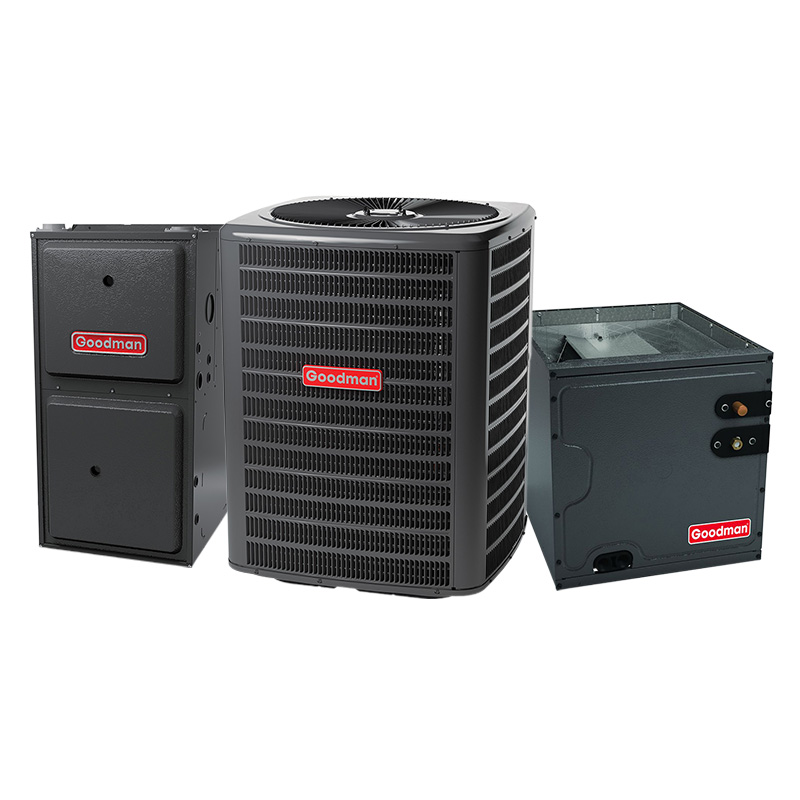
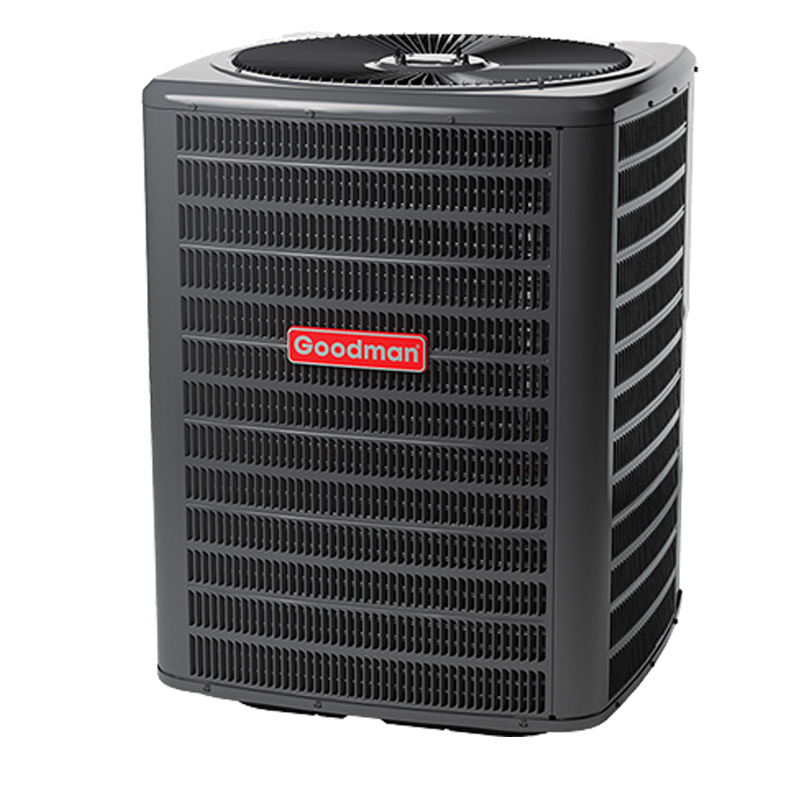
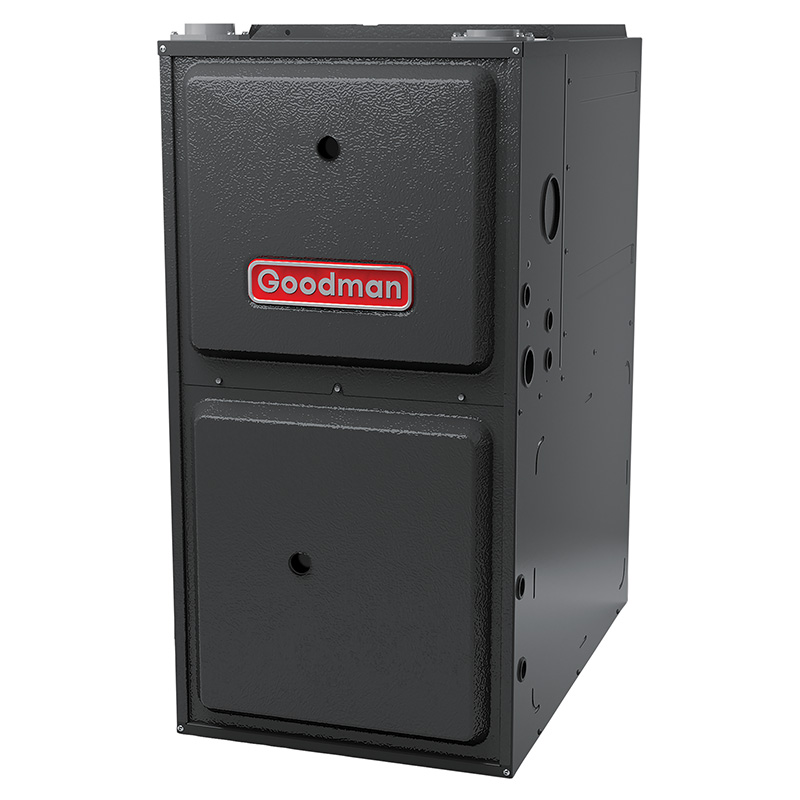
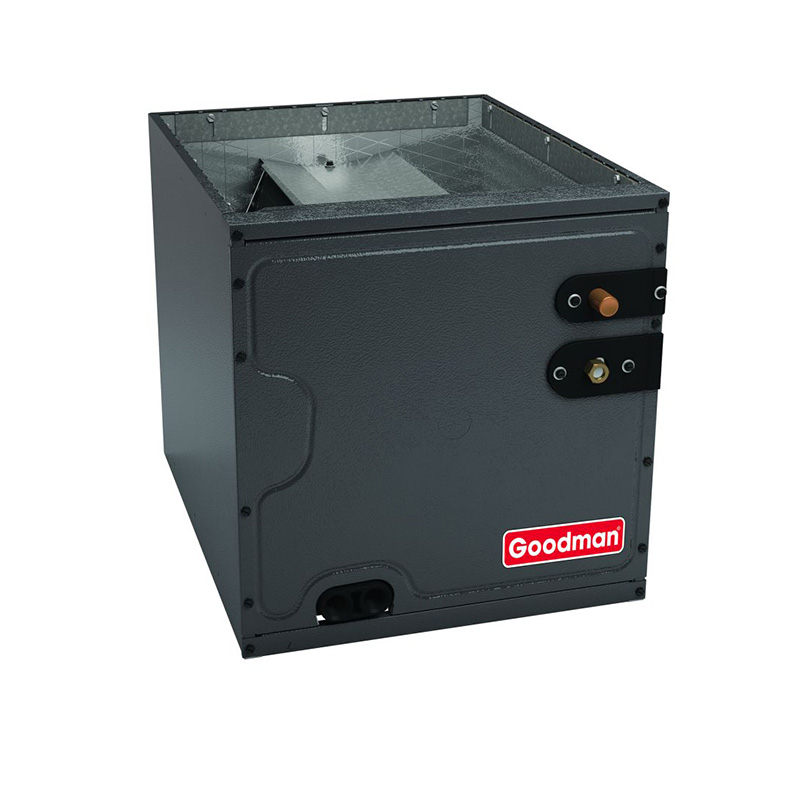
Goodman 4 Ton 14.3 SEER2 AC & Gas Furnace System – Multi-Speed, 80000 BTU Gas Furnace, 92% AFUE, Upflow, R32
View on AC Direct see your lowest price →Check current price on AC Direct →
Key features
- 4-ton single-stage cooling rated at 14.3 SEER2, meeting current federal efficiency minimums
- 80,000 BTU gas furnace with 92% AFUE for mid-efficiency fuel use
- Upflow configuration designed for basement or ground-level installations
- R-32 refrigerant charge with lower global warming potential than R-410A
- Multi-speed furnace blower for improved airflow and humidity control flexibility
- Priced 15 to 25 percent below comparable Trane, Lennox, and Carrier systems
About this system
The Goodman GLXS4BA4810 pairs a 4-ton, 14.3 SEER2 single-stage air conditioner with an 80,000 BTU, 92% AFUE upflow gas furnace charged with R-32 refrigerant. This configuration is a practical fit for homes in the 2,000 to 2,600 square foot range that have a basement or ground-level mechanical room where an upflow air handler arrangement works naturally. The 92% AFUE rating means roughly 92 cents of every fuel dollar goes toward usable heat, placing this furnace solidly in the mid-efficiency tier and clear of the 80% AFUE baseline that older equipment often carries.
At 14.3 SEER2, the cooling side meets the 2023 federal minimum efficiency standard for most U.S. climate regions, so you are not paying a premium for efficiency headroom you may not need. R-32 refrigerant has a lower global warming potential than the R-410A it replaces and is increasingly the industry standard going forward, which matters for long-term serviceability. The multi-speed furnace blower allows some airflow flexibility for comfort and humidity management even though the compressor itself runs at a single stage. This system suits budget-conscious homeowners who want a code-compliant, functional replacement without the price tag of variable-speed or two-stage premium equipment.
The GLXS4BA4810 is a straightforward, budget-friendly replacement system that checks the code-compliance boxes and delivers adequate efficiency without premium pricing. Its limitations are real: single-stage cooling, a compressor lifespan that typically trails premium brands, and a brand track record that depends heavily on how well the system is installed and maintained. For homeowners who prioritize upfront cost and plan to stay on top of maintenance, it is a reasonable choice; for those wanting long-term worry-free operation, the gap to premium brands may be worth closing.
Overall score is the average of the five ratings above.
What we like
- Lower upfront cost, typically 15 to 25 percent less than Carrier, Trane, or Lennox equivalents
- 92% AFUE furnace delivers meaningful fuel savings over 80% AFUE equipment
- R-32 refrigerant is forward-compatible and has better environmental credentials than R-410A
- Multi-speed blower provides more comfort and humidity flexibility than a fixed-speed unit
- Dual-run capacitor failures, the most common documented issue, are generally inexpensive to repair at roughly 300 to 600 dollars
Trade-offs
- Compressor lifespan averages 10 to 14 years versus 15 to 20 years for premium brands, meaning earlier potential replacement costs
- Evaporator coil leaks appear in a meaningful share of owner reviews, a documented failure mode worth monitoring
- A minority of owners report refrigerant leaks in the first year, typically tied to install or initial charge quality
- ConsumerAffairs rating sits around 2.5 out of 5, with recurring complaints about repair costs rising after year 7
What homeowners and pros say about Goodman
Homeowners who have installed Goodman equipment tend to land in two camps. Those who had a quality installation and kept up with annual maintenance often report years of uneventful service and point to the lower purchase price as a clear win. That sentiment shows up in Google dealer reviews, which average around 3.8 out of 5 across hundreds of reviews per location, with affordability cited most often as the reason for satisfaction. The other camp, more visible on complaint-oriented platforms like ConsumerAffairs where the score sits around 2.5 out of 5, describes repair bills that start to accumulate after roughly year 7. The documented failure modes align with that pattern: dual-run capacitors are the most commonly reported breakdown and are generally a low-cost fix, but evaporator coil leaks and a compressor lifespan that typically runs 10 to 14 years rather than the 15 to 20 years more common in premium brands can shift the long-term cost picture meaningfully.
HVAC technicians tend to hold a nuanced view of Goodman. Many will install it without hesitation for customers on a budget, while being candid that the equipment rewards good installation practices more than some premium brands do. A poorly commissioned Goodman system, including one with an improper refrigerant charge, is where the first-year refrigerant leak complaints documented in owner reviews tend to originate. Pros who take the time to verify charge levels, check coil connections, and confirm airflow report far fewer callbacks on Goodman equipment than those who treat it as a quick swap job. For this 4-ton, 92% AFUE system specifically, getting the duct system sized correctly for the upflow configuration and confirming the R-32 charge at startup are the two areas where the installation quality argument is most likely to determine whether this system becomes a long-term value or an early headache.
Sources: ConsumerAffairs Goodman owner reviews, AHRI Directory of Certified Product Performance, U.S. DOE appliance and equipment efficiency standards, Goodman product specification sheets.
What it costs to run
At 14.3 SEER2, cooling this 4-ton system for a typical 1200-hour cooling season at the U.S. average electricity rate of $0.17/kWh works out to roughly $685 per year in cooling, about $46 less per year than a minimum-efficiency 13.4 SEER2 unit of the same size. Your real cost depends on your climate and local rate.
Method: (48,000 BTU/hr ÷ 14.3 SEER2) × 1200 hours ÷ 1000 × $0.17/kWh. Rate source: U.S. EIA average; cooling hours: moderate-climate estimate.
How it compares
| Brand | Comparable model | SEER2 | Stage | Price position |
|---|---|---|---|---|
| Goodman | GLXS4BA4810 | 14.3 | Single-stage | Value pick |
| Carrier | Comfort 14 (24ACC4) | 14.3 | Single-stage | Typically 15 to 25 percent more than Goodman |
| Trane | XR14 series | 14.3 | Single-stage | Typically 15 to 25 percent more than Goodman |
| Lennox | Merit ML14 series | 14.3 | Single-stage | Typically 15 to 25 percent more than Goodman |
Competitor rows are comparable single-stage units at similar efficiency; price is relative position, not a quote.
Questions about this system
Is 14.3 SEER2 going to cost me more to run than a higher-efficiency unit?
Yes, modestly. A 16 or 18 SEER2 system will use less electricity to produce the same cooling, and the gap is most noticeable in hot climates with long cooling seasons. For mild or moderate climates, the payback period on a higher-efficiency unit can stretch to 8 to 12 years, so the savings math does not always favor spending more upfront.
Why does Goodman score so low on ConsumerAffairs compared to Google dealer reviews?
ConsumerAffairs skews toward owners who experienced problems, since satisfied customers rarely seek out review platforms. Google dealer reviews, which sit around 3.8 out of 5, capture a broader mix including happy customers who liked the price. The ConsumerAffairs score of about 2.5 out of 5 reflects a real pattern of repair costs rising after roughly year 7, but it is not a representative sample of all owners.
What is the most likely repair I should plan for over the system's life?
Dual-run capacitors are the most commonly reported failure point for Goodman systems and usually run 300 to 600 dollars to replace. Evaporator coil leaks are the second documented failure mode to watch for. Keeping up with annual tune-ups and catching refrigerant pressure issues early can reduce the risk of larger repairs.
Does the upflow configuration limit where this system can be installed?
Yes. Upflow means the furnace pulls return air from the bottom and discharges conditioned air from the top, which works well in basements and first-floor mechanical rooms with ductwork running through the ceiling. It is not suitable for attic installations or applications requiring a downflow or horizontal unit.
Will R-32 refrigerant be easy to service in the future?
R-32 is the direction the HVAC industry is moving, and most major equipment manufacturers are transitioning to it, so finding technicians who stock and handle it should become easier over time, not harder. It does require slightly different handling procedures than R-410A, so confirming your service technician is certified to work with it is a reasonable step.
Specifications
| Cooling capacity | 4 Ton |
| Efficiency | 14.3 SEER2 |
| Furnace output | 80000 BTU |
| Furnace efficiency | 92% AFUE |
| Configuration | Upflow |
| Refrigerant | R-32 |
| Model | GLXS4BA4810 |