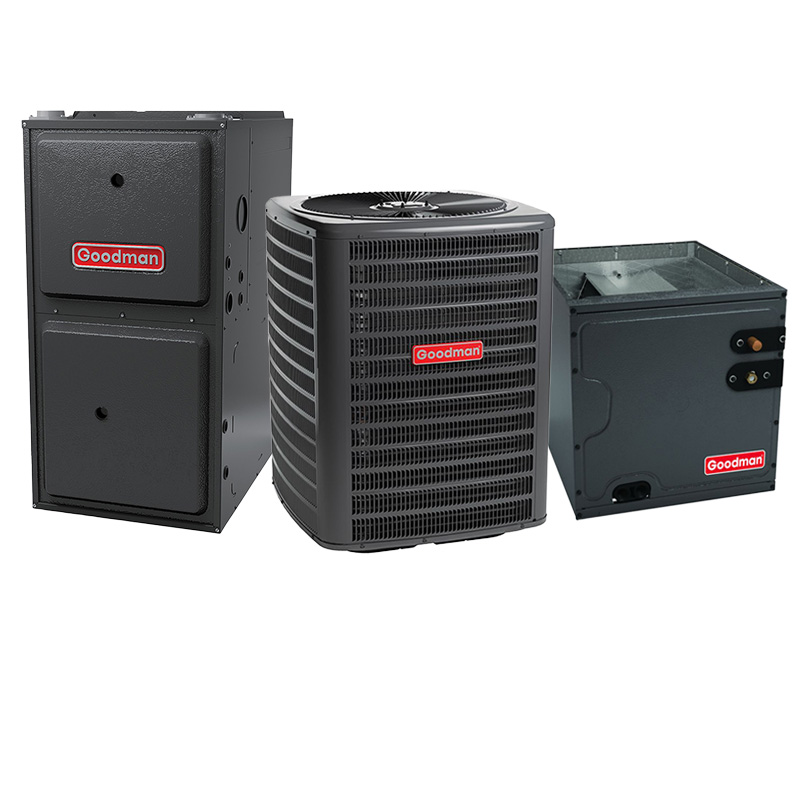
Goodman 4 Ton 14.5 SEER2 80000 BTU 80% AFUE Two Stage Multi-Speed ECM Gas Furnace System – Upflow | R32
View on AC Direct see your lowest price →Check current price on AC Direct →
Key features
- 4-ton, 14.5 SEER2 cooling capacity for mid-size homes in moderate climates
- Two-stage compressor runs at low capacity most of the time for steadier temps and humidity control
- 80,000 BTU two-stage gas furnace rated at 80% AFUE
- Multi-speed ECM blower motor reduces energy use and lowers operating noise at part load
- R-32 refrigerant charge meets current and anticipated near-term regulatory requirements
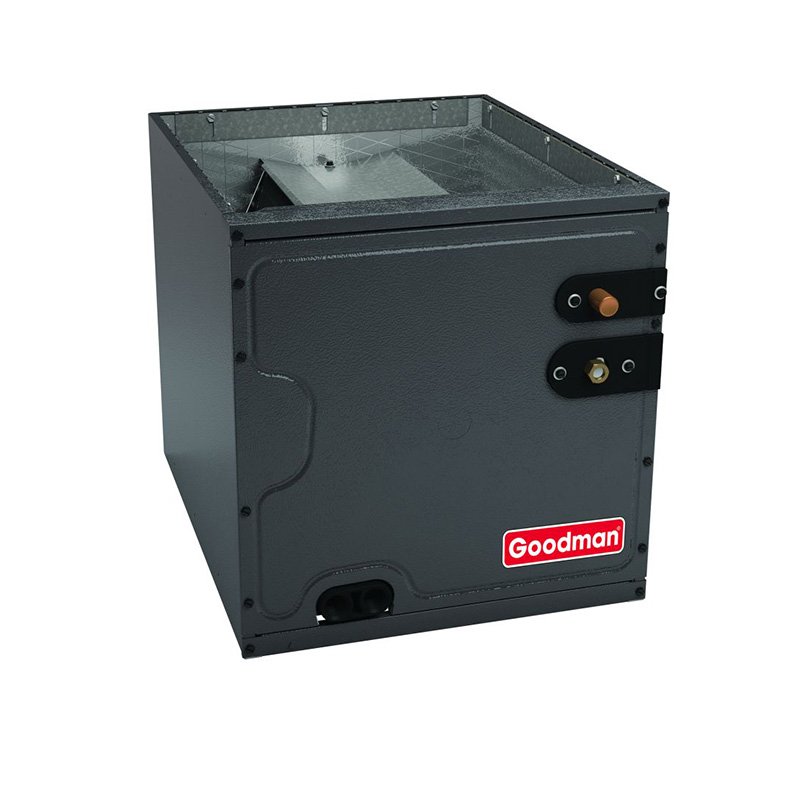
- Upflow configuration suits installations where supply air exits through the top of the air handler into overhead duct runs
About this system
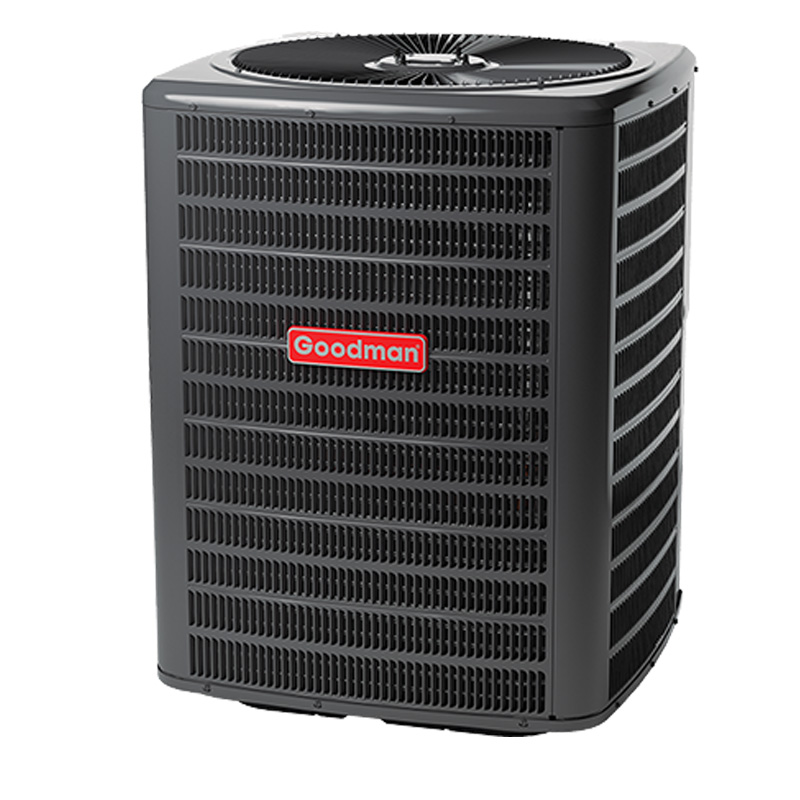
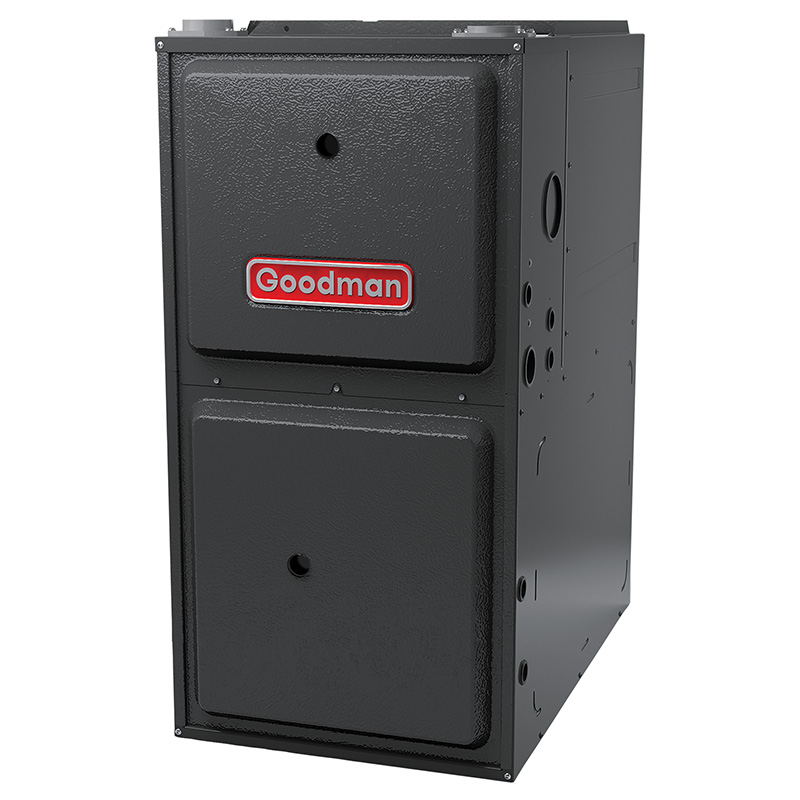
The Goodman GLXS4BA4810 pairs a 4-ton, 14.5 SEER2 air conditioner with an 80,000 BTU, 80% AFUE two-stage gas furnace in an upflow configuration, making it a practical choice for mid-size homes in moderate climates where extreme efficiency ratings are not a financial priority. The system uses R-32 refrigerant, a lower-global-warming-potential option that is becoming the new standard as R-410A is phased out, so it is already positioned for near-term regulatory requirements without any retrofit cost to you.
Two-stage cooling and heating mean the system runs at a reduced capacity most of the time, only ramping to full output on the hottest or coldest days. Paired with a multi-speed ECM blower motor, that translates to steadier indoor temperatures, quieter part-load operation, and meaningfully better humidity control compared to a single-stage system at a similar efficiency rating. The 80% AFUE furnace is a code-minimum or just-above-minimum choice in many regions, so buyers in cold climates where gas costs are high should weigh whether a 96% AFUE unit would recover the price difference over a typical equipment lifespan.
This bundle suits homeowners replacing aging equipment in homes between roughly 2,000 and 2,600 square feet, depending on insulation and climate zone, who want two-stage comfort without paying Carrier, Trane, or Lennox prices. It is not the system for a buyer who wants the longest possible compressor life or the best available efficiency, but for a budget-conscious replacement where install quality will be controlled by a trusted contractor, it covers the fundamentals honestly.
The GLXS4BA4810 is a straightforward, mid-efficiency two-stage system that delivers genuine comfort improvements over single-stage equipment at a price point that undercuts comparable premium brands by 15 to 25 percent. Its long-term ownership story hinges on installation quality and a willingness to budget for capacitor replacements and possible coil issues after year seven. It is an honest value pick, not a premium one.
Overall score is the average of the five ratings above.
What we like
- Two-stage operation provides noticeably more even temperatures and better humidity removal than single-stage alternatives at this price
- Multi-speed ECM motor reduces blower energy draw and lowers sound levels during the long part-load run cycles
- R-32 refrigerant is future-ready as R-410A production winds down, reducing long-term service compatibility concerns
- Priced 15 to 25 percent below comparable Trane, Carrier, and Lennox systems, freeing budget for a quality installation
- Two-stage furnace modulates heat output, which reduces temperature swings and cold-start blasts common with single-stage furnaces
Trade-offs
- 80% AFUE is at or near code minimum in many northern states, meaning higher gas bills over the system's life compared to a 96% alternative
- Dual-run capacitors are a documented and recurring failure point, typically needing replacement between year 5 and 10 at a cost of roughly $300 to $600 per service call
- Compressor lifespan averages 10 to 14 years in documented owner experience, several years shorter than premium-brand benchmarks of 15 to 20 years
- Evaporator coil leaks appear in a meaningful share of owner reports, and a minority of owners report refrigerant leaks within the first year that point to install or factory-charge issues
What homeowners and pros say about Goodman
Homeowners who share their experience with Goodman equipment tend to cluster around two poles. On Google dealer reviews, where the audience includes satisfied buyers who chose Goodman deliberately for its affordability, the brand averages around 3.8 out of 5 across hundreds of reviews per location, with the most consistent praise centering on the lower upfront cost. On ConsumerAffairs, a channel that skews toward owners with a grievance to report, Goodman sits at roughly 2.5 out of 5, and the recurring theme there is repair costs that begin to accumulate after roughly year seven of ownership. Neither number tells the whole story, but together they sketch a brand that delivers reasonable early-life performance and hits harder on the wallet as the system ages.
HVAC technicians who work on Goodman equipment regularly point to dual-run capacitors as the most predictable service call on these systems, a repair that typically runs $300 to $600 and is not unique to Goodman but appears with more frequency in owner-reported complaints here than on premium-tier brands. Evaporator coil leaks show up in a meaningful share of longer-term owner reviews and are worth factoring into a true cost-of-ownership estimate. Compressor longevity, based on documented owner experience, averages 10 to 14 years against a 15 to 20 year benchmark for Trane, Carrier, and Lennox. A minority of owners report refrigerant leaks in the first year, and technicians consistently attribute those to install quality rather than the equipment itself, which is the clearest argument for spending what you save on equipment price on a more experienced installation contractor. For this specific two-stage R-32 system, the same logic applies: the hardware is capable, but the install is where the outcome is really decided.
Sources: ConsumerAffairs Goodman owner reviews, AHRI Directory of Certified Product Performance, U.S. DOE appliance and equipment efficiency standards, Goodman product specification sheets.
What it costs to run
At 14.5 SEER2, cooling this 4-ton system for a typical 1200-hour cooling season at the U.S. average electricity rate of $0.17/kWh works out to roughly $675 per year in cooling, about $56 less per year than a minimum-efficiency 13.4 SEER2 unit of the same size. Your real cost depends on your climate and local rate.
Method: (48,000 BTU/hr ÷ 14.5 SEER2) × 1200 hours ÷ 1000 × $0.17/kWh. Rate source: U.S. EIA average; cooling hours: moderate-climate estimate.
How it compares
| Brand | Comparable model | SEER2 | Stage | Price position |
|---|---|---|---|---|
| Goodman | GLXS4BA4810 | 14.5 | Two-stage | Value pick |
| Carrier | Comfort 14 (24ACC4) with 58MVC furnace | 14.3 to 15.2 depending on match | Single-stage | Typically 15 to 25 percent more than the Goodman |
| Trane | XR14 (4TTR4) with S8X1 furnace | 14.3 to 15.0 depending on match | Single-stage | Typically 15 to 25 percent more than the Goodman |
| Lennox | Merit 14ACX with ML180 furnace | 14.3 range depending on match | Single-stage | Typically 15 to 25 percent more than the Goodman |
Competitor rows are comparable single-stage units at similar efficiency; price is relative position, not a quote.
Questions about this system
Is 80% AFUE enough for my climate, or should I step up to a 96% furnace?
In southern and mild-winter states, 80% AFUE is often the practical ceiling where the added cost of a 96% unit never fully pays back. In cold-climate states like Minnesota, Wisconsin, or New England, a 96% furnace typically recovers the price difference in gas savings within 5 to 8 years, so the upgrade is worth running the numbers on before committing to this system.
What maintenance should I plan for to get the longest life out of this Goodman system?
Annual professional tune-ups are the single highest-return maintenance item, including capacitor testing since dual-run capacitors are the most commonly reported failure point on Goodman equipment. Keeping coil surfaces clean, changing filters on schedule, and having refrigerant charge verified at installation also reduce the risk of the evaporator coil leaks that appear in owner complaints.
The system uses R-32 refrigerant. Will that be hard to service in the future?
R-32 is increasingly the refrigerant of choice for new residential equipment as R-410A production is phased down under federal regulations, so supply and technician familiarity are expected to grow rather than shrink over this system's lifespan. It does require technicians to follow specific handling procedures due to its mild flammability classification, but any properly certified HVAC contractor should be equipped for it.
A minority of owners report refrigerant leaks within the first year. How do I protect against that?
Early refrigerant leaks in Goodman systems are most often traced to installation errors or an improper factory charge rather than manufacturing defects in the equipment itself, which is why contractor selection matters more than brand in this price segment. Ask your installer to verify refrigerant charge using subcooling and superheat measurements at startup, and get that reading documented so any warranty claim has a baseline.
How does two-stage cooling actually feel different from single-stage at this efficiency level?
On a typical day the compressor runs at roughly 65 to 70 percent capacity for longer, steadier cycles rather than short full-blast bursts, which means the air handler has more time to pull humidity out of the air before the thermostat satisfies and shuts down. Most owners notice this as a less clammy feeling at the same thermostat setpoint, particularly in humid climates, and the longer low-speed cycles also tend to be quieter than single-stage start-stop cycling.
Specifications
| Cooling capacity | 4 Ton |
| Efficiency | 14.5 SEER2 |
| Furnace output | 80000 BTU |
| Furnace efficiency | 80% AFUE |
| Configuration | Upflow |
| Refrigerant | R-32 |
| Model | GLXS4BA4810 |