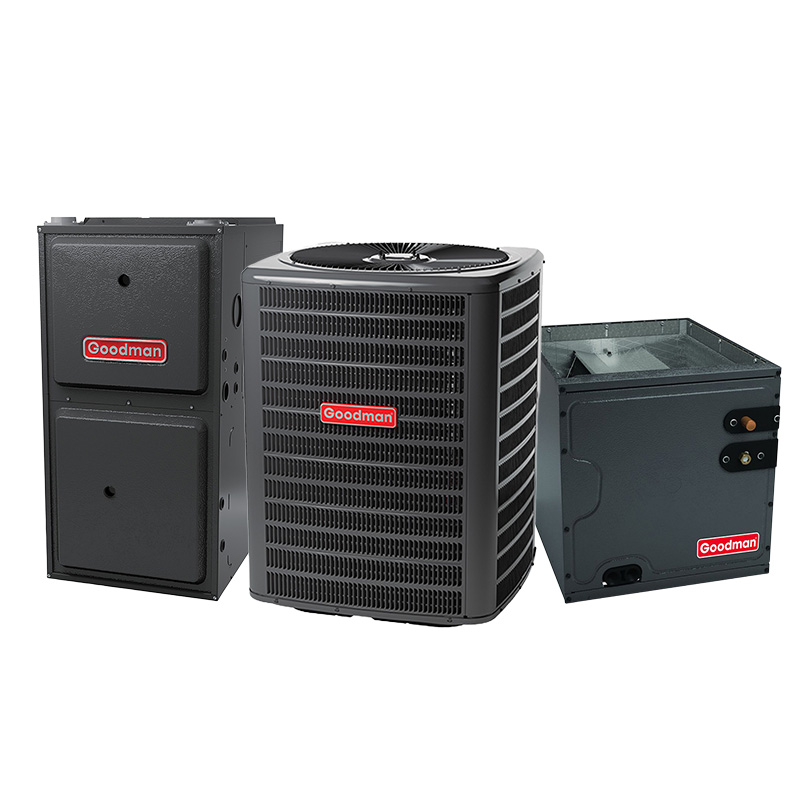
Goodman 4 Ton 14.5 SEER2 AC & Gas Furnace System – Two Stage Variable-Speed, 120000 BTU Gas Furnace, 96% AFUE, Upflow, R32
View on AC Direct see your lowest price →Check current price on AC Direct →
Key features
- Two-stage cooling compressor reduces short-cycling and improves humidity control on mild days
- 96% AFUE gas furnace qualifies for federal high-efficiency energy tax credits
- Variable-speed ECM blower motor lowers electricity consumption and reduces noise at part load
- R-32 refrigerant with lower global warming potential and smaller charge requirement than R-410A
- Upflow cabinet configuration suits basement and crawl-space duct systems
- Factory-matched 4-ton / 120,000 BTU system simplifies AHRI certification and permitting
About this system
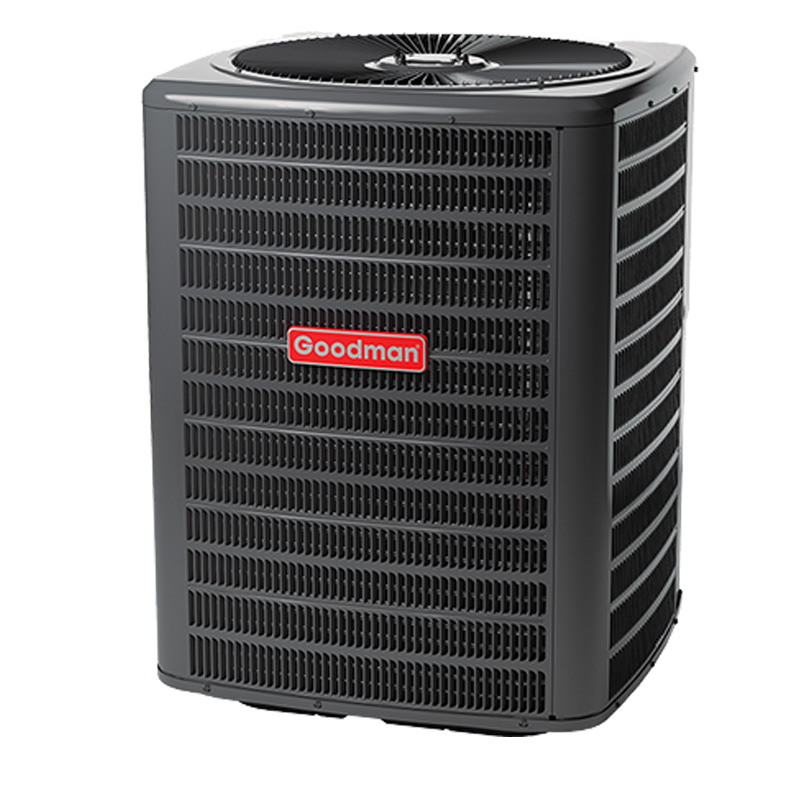
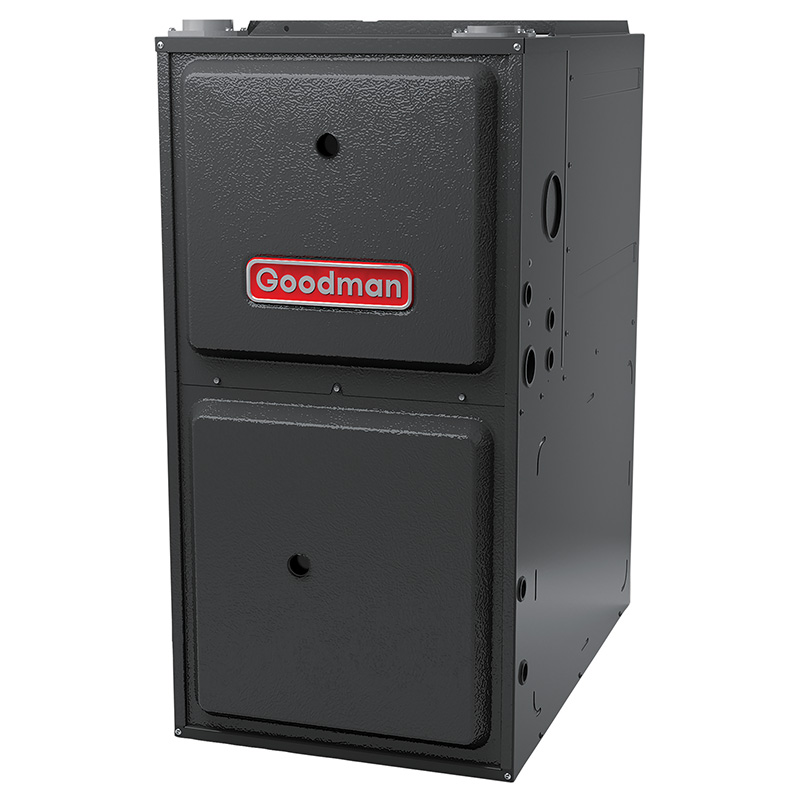
The Goodman GLXS4BA4810 pairs a 4-ton, 14.5 SEER2 two-stage air conditioner with a 120,000 BTU, 96% AFUE variable-speed gas furnace in an upflow configuration. The two-stage cooling compressor runs at a lower capacity on mild days and ramps up only when outdoor conditions demand it, which reduces short-cycling, keeps humidity more consistent than a single-stage unit, and trims runtime costs compared to systems sitting at the entry-level 13.4 SEER2 floor. The 96% AFUE rating means roughly 96 cents of every dollar spent on gas becomes usable heat, placing this furnace among the high-efficiency tier and making it eligible for federal energy tax credits under current IRA guidelines.
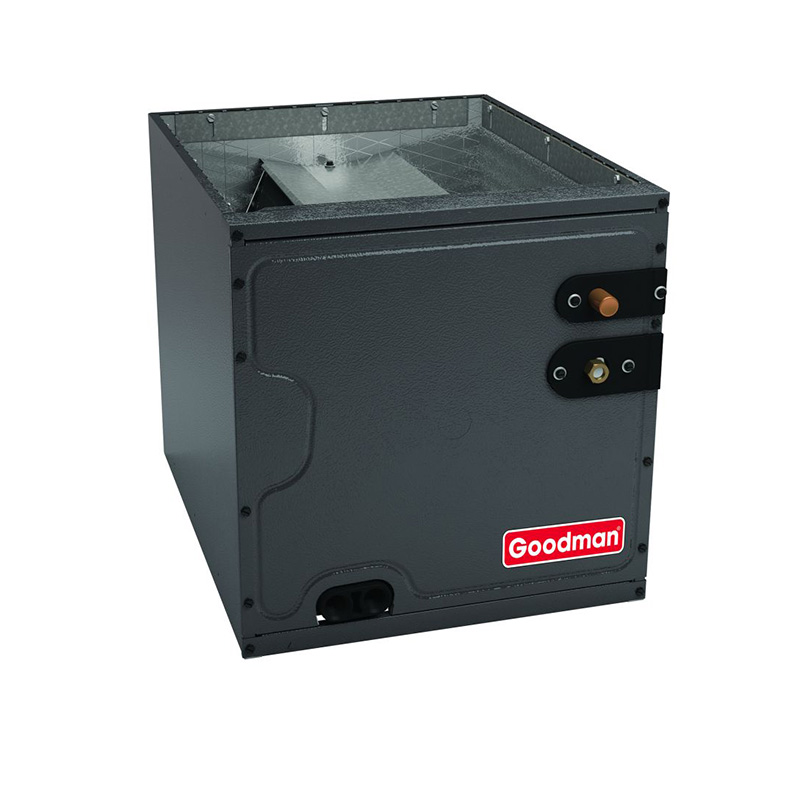
R-32 refrigerant is a meaningful upgrade over the R-410A that dominated the market for two decades. It has a lower global warming potential, requires a smaller charge by weight, and is increasingly the direction the industry is moving as R-410A phases down. The upflow cabinet routes supply air upward through floor-level ductwork, which suits most North American basement and crawl-space installations but is not a match for attic or horizontal applications. At 4 tons, this system is sized for homes roughly in the 2,000 to 2,600 square foot range, though a proper Manual J load calculation should always govern final sizing. The variable-speed air handler blower pairs well with the two-stage compressor to maintain even temperatures across zones and run quieter at part-load conditions.
The GLXS4BA4810 delivers a genuinely high-efficiency, two-stage system at a price point roughly 15 to 25 percent below comparable Trane, Lennox, and Carrier equipment, making the core value case real and not just marketing. The trade-off is a documented history of capacitor failures, evaporator coil leaks in a meaningful share of units, and compressors that tend to reach end-of-life earlier than premium brands, meaning long-term ownership costs can narrow the upfront savings gap. If you have a skilled installer, a good service plan, and realistic expectations about the brand tier, this system earns its place; if you want top-end durability with minimal intervention, budget up.
Overall score is the average of the five ratings above.
What we like
- 96% AFUE and 14.5 SEER2 represent genuine high-efficiency performance at a value price
- Two-stage compressor with variable-speed blower provides better comfort and humidity control than single-stage alternatives
- R-32 refrigerant is forward-compatible as R-410A phases out under EPA regulations
- Factory-matched system simplifies AHRI certification, warranty claims, and permit documentation
- Upfront cost is typically 15 to 25 percent below comparably spec'd Carrier, Trane, or Lennox systems
Trade-offs
- Dual-run capacitors are the most commonly reported failure point, with repair costs typically in the $300 to $600 range
- A meaningful share of owner reviews cite evaporator coil leaks, which are a more expensive and disruptive repair
- Compressor lifespan averages 10 to 14 years versus 15 to 20 years for premium brands, potentially narrowing the long-term value advantage
- A minority of owners report refrigerant leaks within the first year, most traced to installation or charge issues rather than the equipment itself
What homeowners and pros say about Goodman
On ConsumerAffairs, Goodman scores around 2.5 out of 5, a figure shaped heavily by owners who experienced repair costs climbing after roughly year 7. The failure modes showing up most often in those accounts are dual-run capacitor failures (a relatively affordable fix in the $300 to $600 range but still an annoyance), evaporator coil leaks that are more costly and time-consuming to address, and compressors reaching end-of-life in the 10 to 14 year range rather than the 15 to 20 years owners of premium brands tend to report. A minority of first-year owners also report refrigerant leaks, which Goodman-familiar technicians typically attribute to installation or charge errors rather than factory defects.
On Google dealer reviews, the tone shifts. Across hundreds of reviews per location, Goodman averages around 3.8 out of 5, and affordability is consistently the most praised quality. HVAC technicians who work on these systems regularly point out that installation quality is the single biggest variable in how long a Goodman unit lasts, which is why buyers in this price tier are advised to spend carefully on the installer rather than cutting corners there to save money. The two-stage, variable-speed configuration in the GLXS4BA4810 adds more components than a single-stage system, which means a skilled commissioning process matters even more than it would on a basic single-stage setup. Get the install right, schedule annual maintenance, and the value case for this system holds up; skip those steps and the gap between Goodman and premium brands closes faster than the upfront savings suggest.
Sources: ConsumerAffairs Goodman owner reviews, AHRI Directory of Certified Product Performance, U.S. DOE appliance and equipment efficiency standards, Goodman product specification sheets.
What it costs to run
At 14.5 SEER2, cooling this 4-ton system for a typical 1200-hour cooling season at the U.S. average electricity rate of $0.17/kWh works out to roughly $675 per year in cooling, about $56 less per year than a minimum-efficiency 13.4 SEER2 unit of the same size. Your real cost depends on your climate and local rate.
Method: (48,000 BTU/hr ÷ 14.5 SEER2) × 1200 hours ÷ 1000 × $0.17/kWh. Rate source: U.S. EIA average; cooling hours: moderate-climate estimate.
How it compares
| Brand | Comparable model | SEER2 | Stage | Price position |
|---|---|---|---|---|
| Goodman | GLXS4BA4810 | 14.5 | Two-stage | Value pick |
| Carrier | Comfort 24ACC636A003 with 59TP6 furnace | 14.3 to 15 | Single-stage | Typically 15 to 25 percent more than this Goodman system |
| Trane | XR14c with S9X2 furnace | 14.3 to 15 | Single-stage | Typically 15 to 25 percent more than this Goodman system |
| Lennox | Merit ML14XC1 with ML196E furnace | 14.3 to 15 | Single-stage | Typically 15 to 25 percent more than this Goodman system |
Competitor rows are comparable single-stage units at similar efficiency; price is relative position, not a quote.
Questions about this system
Does the 96% AFUE furnace qualify for a federal tax credit, and if so, how much?
Yes. Under current IRA guidelines, gas furnaces at 96% AFUE or higher qualify for a federal energy efficiency tax credit of up to $600 for the furnace component alone. You would file IRS Form 5695 with your return for the year the system is placed in service; consult a tax professional to confirm eligibility for your specific situation.
How long can I realistically expect the compressor to last?
Based on documented owner experience with Goodman equipment, compressors in this line tend to average 10 to 14 years, compared to 15 to 20 years for premium brands like Trane or Carrier. Proper installation, correct refrigerant charge, and annual maintenance are the factors most likely to push the unit toward the longer end of that range.
Is the R-32 refrigerant a problem to service, and can any HVAC technician work with it?
R-32 requires the same EPA Section 608 certification that technicians already hold for R-410A, so it is not a barrier for any licensed HVAC professional. It does require slightly different handling procedures because it is mildly flammable (A2L classification), so confirm your service provider is familiar with A2L refrigerants before scheduling work.
What does the two-stage compressor actually do differently from a standard single-stage unit?
A two-stage compressor runs at a lower capacity, roughly 65 to 70 percent, on mild days and only switches to full capacity when outdoor heat load demands it. This means the system runs longer, quieter cycles rather than blasting on and off, which removes more moisture from indoor air and keeps temperatures more consistent from room to room.
Goodman's ConsumerAffairs score is only about 2.5 out of 5. Should that stop me from buying this system?
ConsumerAffairs is a complaint-skewed channel where dissatisfied owners are far more likely to leave reviews than satisfied ones, so the 2.5 score reflects the worst-case end of the ownership experience rather than a balanced average. Goodman dealer reviews on Google average around 3.8 out of 5, and the most common theme there is affordability. The recurring concern in owner complaints is repair costs climbing after roughly year 7, particularly around capacitors and coil leaks, which is worth factoring into your service-plan decision rather than treating as a reason to walk away from the price advantage.
Specifications
| Cooling capacity | 4 Ton |
| Efficiency | 14.5 SEER2 |
| Furnace output | 120000 BTU |
| Furnace efficiency | 96% AFUE |
| Configuration | Upflow |
| Refrigerant | R-32 |
| Model | GLXS4BA4810 |