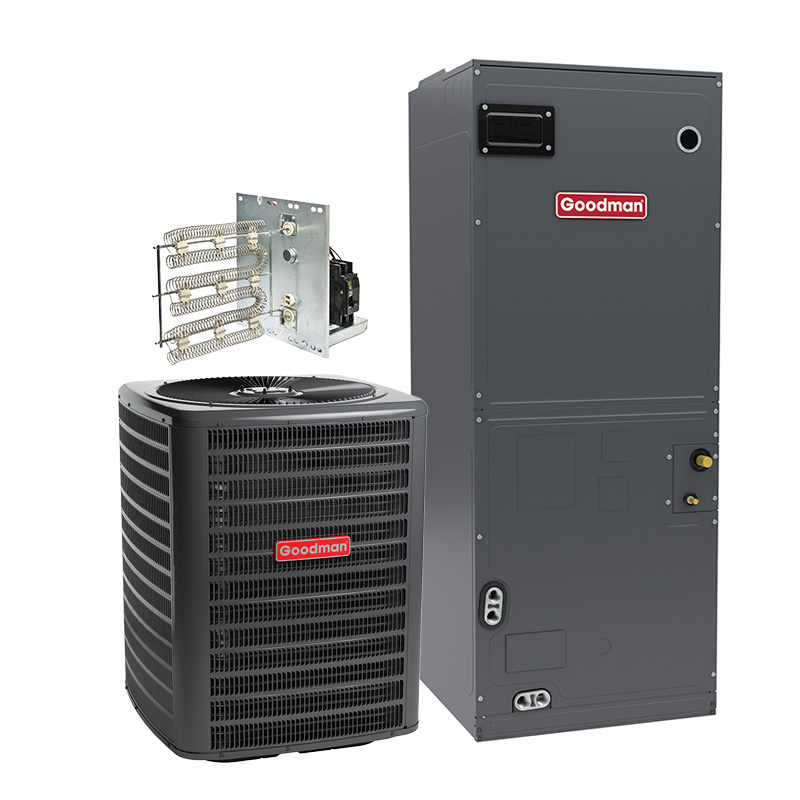
Goodman 4 Ton 14 SEER2 R32 Air Conditioner Split System With Electric Heat
View on AC Direct see your lowest price →Check current price on AC Direct →
Key features
- 4-ton capacity for larger homes typically between 2,000 and 2,600 square feet
- 14 SEER2 efficiency rating meets current federal minimum standards
- R-32 refrigerant with lower global warming potential than R-410A
- Single-stage operation with electric resistance heat strips
- Split-system configuration requires a compatible indoor air handler
- Priced roughly 15 to 25 percent below comparable Carrier, Trane, and Lennox equipment
About this system
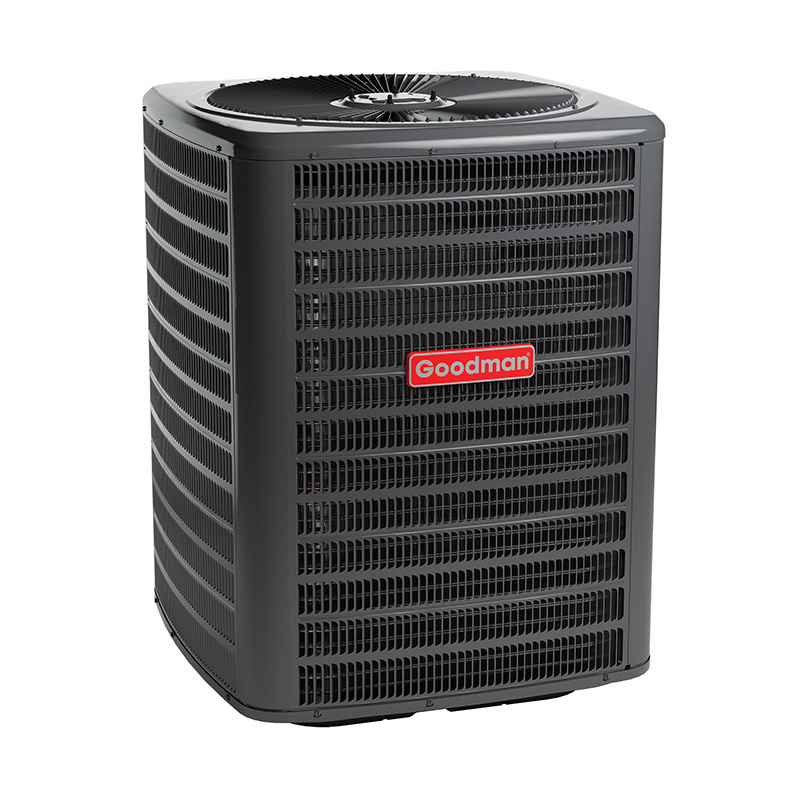
The Goodman 4-ton 14 SEER2 split system with electric heat is a straightforward, single-stage cooling and electric heating package sized for larger homes, typically in the 2,000 to 2,600 square foot range depending on climate, insulation, and ceiling height. At 14 SEER2, it meets the minimum federal efficiency standard that took effect in 2023, so it is not a high-efficiency unit by today’s spectrum, but it is a fully compliant, functional workaround for homes in moderate climates that do not justify the premium of a 16 or 18 SEER2 system. The R-32 refrigerant is a meaningful forward step: it has a lower global warming potential than R-410A and, because it runs at lower pressures, it can make leak recovery marginally simpler for certified technicians.
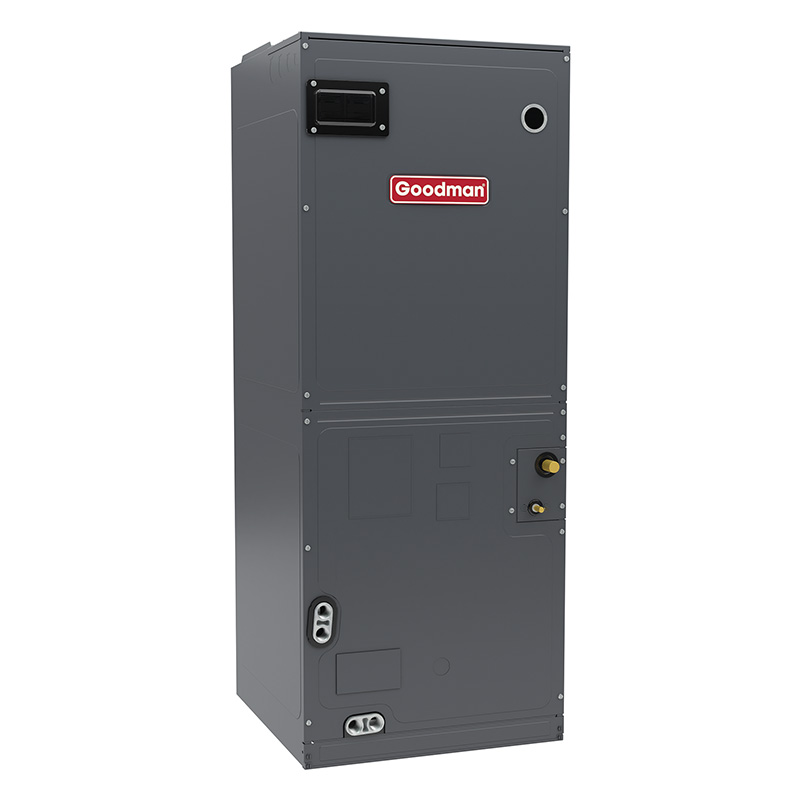
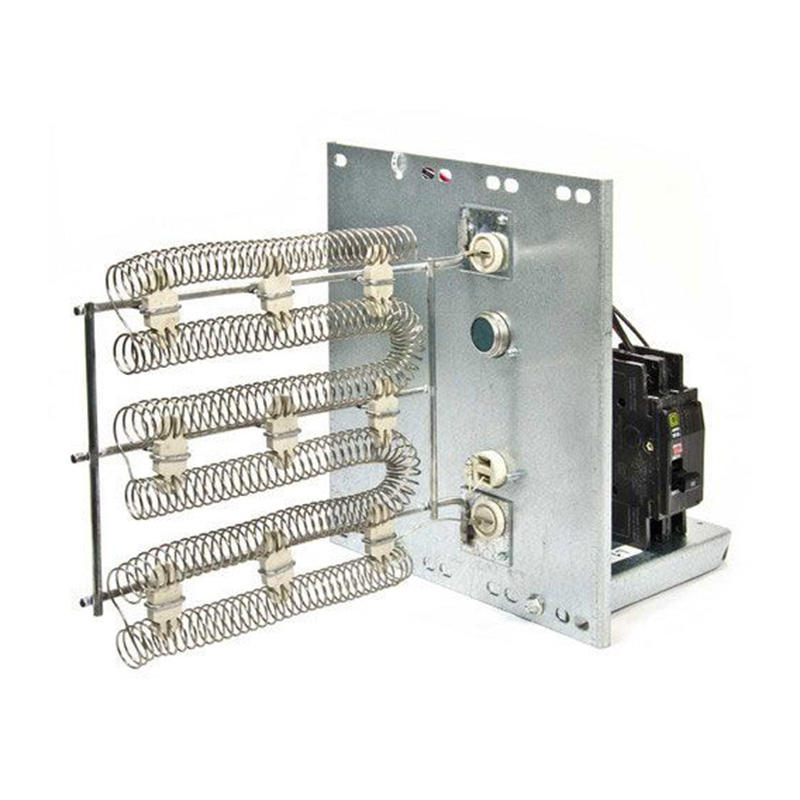
The electric heat configuration means this unit pairs an air conditioner with an air handler that uses electric resistance heating strips rather than a gas furnace. That setup suits all-electric homes, additions, or properties without gas service. Operating costs for electric resistance heat are higher per BTU than gas in most U.S. markets, so buyers in cold climates who run the heat heavily should factor that into the total cost of ownership. As a Goodman product, this system sits at the value end of the market and is priced accordingly, making it a practical choice for landlords, budget-conscious homeowners, and anyone replacing aging equipment without plans to move soon.
This Goodman system delivers entry-level cooling and electric heat at a price point that is hard to argue with if your budget is the primary constraint. It does its job competently when properly installed, but the 14 SEER2 rating and single-stage compressor leave efficiency and comfort on the table compared to mid-tier and premium alternatives. Buyers should budget for a skilled installer and a capacitor replacement somewhere in years 5 to 10, and should understand the compressor lifespan averages shorter than premium brands.
Overall score is the average of the five ratings above.
What we like
- Lowest upfront cost in its capacity class, typically 15 to 25 percent below Carrier, Trane, and Lennox equivalents
- R-32 refrigerant is more environmentally responsible than R-410A and aligns with long-term regulatory direction
- Electric heat configuration works without gas service, making it viable for all-electric properties
- Straightforward single-stage design means fewer electronic components that can fail
- Widely stocked through HVAC distributors, so parts and contractor familiarity are generally not an issue
Trade-offs
- 14 SEER2 is minimum-compliant efficiency; monthly energy bills will be noticeably higher than a 16 or 18 SEER2 system over time
- Dual-run capacitors and evaporator coil leaks are documented recurring failure modes, with capacitors often needing replacement in the 300 to 600 dollar range
- Compressor lifespan averages 10 to 14 years versus 15 to 20 years for premium brands, so total lifecycle cost narrows the upfront savings
- Electric resistance heat is significantly more expensive to operate per BTU than a gas furnace or heat pump in most U.S. markets
What homeowners and pros say about Goodman
Homeowners who buy Goodman equipment tend to split into two camps fairly quickly. Those who had a skilled installer who properly sized and charged the system often report years of trouble-free operation and point to the lower upfront cost as a genuine win. Those who did not are often the ones leaving reviews on ConsumerAffairs, where Goodman’s rating sits at around 2.5 out of 5, with repair costs climbing after roughly year 7 being the most consistent complaint thread. Google dealer reviews tell a more moderate story, averaging around 3.8 out of 5 across several hundred reviews per location, where affordability is by far the most frequently praised characteristic. Both data points together suggest the brand performs closer to average when installation conditions are good and closer to its worst reviews when they are not.
HVAC technicians who discuss Goodman in trade forums are fairly consistent on a few points specific to this type of system. Dual-run capacitors are the most commonly flagged failure point in the field, a repair that usually runs 300 to 600 dollars and is not catastrophic but does require a service call. Evaporator coil leaks show up with enough frequency in owner reports to be considered a known risk rather than a fluke. And the compressor longevity gap is real: Goodman compressors averaging 10 to 14 years versus the 15 to 20 years more typically associated with Trane, Carrier, and Lennox means the upfront savings can erode if you stay in the home long enough. For a 4-ton electric heat system going into a property where cost control is the first priority, Goodman is a rational choice with eyes open to those trade-offs.
Sources: ConsumerAffairs Goodman owner reviews, AHRI Directory of Certified Product Performance, U.S. DOE appliance and equipment efficiency standards, Goodman product specification sheets.
What it costs to run
At 14 SEER2, cooling this 4-ton system for a typical 1200-hour cooling season at the U.S. average electricity rate of $0.17/kWh works out to roughly $699 per year in cooling, about $32 less per year than a minimum-efficiency 13.4 SEER2 unit of the same size. Your real cost depends on your climate and local rate.
Method: (48,000 BTU/hr ÷ 14 SEER2) × 1200 hours ÷ 1000 × $0.17/kWh. Rate source: U.S. EIA average; cooling hours: moderate-climate estimate.
How it compares
| Brand | Comparable model | SEER2 | Stage | Price position |
|---|---|---|---|---|
| Goodman | 4-Ton 14 SEER2 R-32 Split System with Electric Heat | 14 | Single-stage | Value pick |
| Carrier | Comfort Series (24ACC4) | 14-15 | Single-stage | Typically 15 to 25 percent more than Goodman |
| Trane | XR14c | 14 | Single-stage | Typically 15 to 25 percent more than Goodman |
| Lennox | Merit Series (ML14XC1) | 14-15 | Single-stage | Typically 15 to 25 percent more than Goodman |
Competitor rows are comparable single-stage units at similar efficiency; price is relative position, not a quote.
Questions about this system
Will this system work in a home that doesn't have a gas line?
Yes, the electric heat configuration is specifically designed for all-electric homes. The air handler uses resistance heating strips powered entirely by electricity, so no gas connection is required. Keep in mind that electric resistance heat costs more to operate per BTU than a gas furnace in most markets, which matters most in cold climates with long heating seasons.
How long should I expect the compressor to last?
Based on documented owner and technician experience, Goodman compressors tend to average 10 to 14 years, which is shorter than the 15 to 20 years more commonly reported with premium brands like Trane and Carrier. Install quality and whether the unit is properly charged at startup have a significant effect on how close to the top of that range you land.
What repairs should I set money aside for?
Dual-run capacitor failure is the most commonly reported issue with Goodman equipment and typically costs 300 to 600 dollars to repair. Evaporator coil leaks also appear in a meaningful share of owner reports and are more expensive to address. A small minority of owners have reported refrigerant leaks within the first year, which is usually tied to an incomplete or improper installation charge rather than a unit defect.
Is R-32 refrigerant hard to find service technicians for?
R-32 is becoming increasingly common as manufacturers transition away from R-410A, and most licensed HVAC technicians are already certified to handle it. However, it is worth confirming with any contractor you hire that they have the proper equipment and certification for R-32 before scheduling service.
Is 4 tons the right size for my home?
A 4-ton unit is a common match for homes roughly in the 2,000 to 2,600 square foot range, but correct sizing depends on your local climate, insulation levels, window area, ceiling height, and duct system. Oversizing is a frequent mistake that leads to short cycling, humidity problems, and premature component wear. Ask your contractor to perform a Manual J load calculation before installation rather than relying on square footage rules of thumb alone.
Specifications
| Cooling capacity | 4 Ton |
| Efficiency | 14 SEER2 |
| Refrigerant | R-32 |