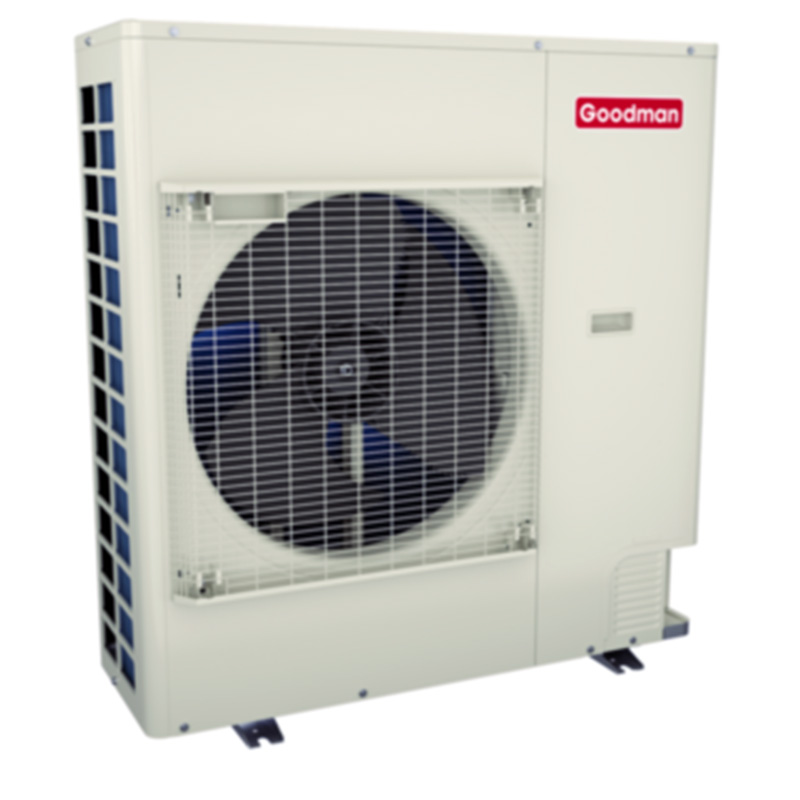
Goodman 4 Ton Up to 17.2 SEER2 Variable-Speed Inverter AC Side Discharge Condenser, R32 (GXV6SS4810)
View on AC Direct see your lowest price →Check current price on AC Direct →
Key features
- Variable-speed inverter compressor for continuous capacity modulation and improved humidity control
- Up to 17.2 SEER2 efficiency rating, high-efficiency tier for central ducted split systems
- R-32 refrigerant, lower global-warming-potential than R-410A
- 4-ton capacity, suited for larger homes typically 2,000 to 2,800 sq ft depending on load
- Side-discharge condenser configuration for standard pad or ground-level installation
- Compatible with Goodman variable-speed air handlers for full system efficiency matching
About this system
The Goodman GXV6SS4810 is a 4-ton, up to 17.2 SEER2 variable-speed inverter condenser designed for larger homes, typically in the 2,000 to 2,800 square foot range depending on local climate and insulation. It runs on R-32 refrigerant, a lower global-warming-potential option that is becoming the new standard as older R-410A equipment phases out. The variable-speed inverter compressor is the headline feature here: rather than cycling fully on and off, it modulates its output continuously to match the actual cooling load, which translates to more stable indoor temperatures, reduced humidity, and lower operating costs compared to single- or two-stage units.
At up to 17.2 SEER2, this unit sits solidly in the high-efficiency tier without reaching into the premium-price territory of 19 SEER2 and above equipment. For most buyers in mixed or hot climates, that efficiency level delivers real energy savings over a baseline 14 SEER2 unit while keeping upfront costs manageable. The side-discharge configuration suits standard backyard or side-yard pad installations but is not suited for confined rooftop or courtyard applications where top-discharge is required. This condenser must be paired with a compatible air handler or furnace with matching coil, and performance is highly sensitive to proper refrigerant charge and airflow, making professional installation critical to hitting the rated efficiency numbers.
The GXV6SS4810 offers a genuine variable-speed inverter at a price point 15 to 25 percent below comparable Trane, Lennox, and Carrier units, making it an attractive option for budget-conscious buyers who want modern comfort features. The trade-off is a documented history of capacitor failures, coil leaks, and a compressor lifespan that tends to trail premium brands, along with performance that depends heavily on the quality of the installing technician. Buyers who prioritize upfront value and have a reliable installer will find this a reasonable system; those who want the lowest long-term repair probability should consider spending more.
Overall score is the average of the five ratings above.
What we like
- Significantly lower purchase price than Carrier, Trane, or Lennox variable-speed equivalents
- Variable-speed inverter compressor delivers better temperature consistency and humidity control than single-stage units
- 17.2 SEER2 efficiency is genuinely high and can reduce monthly cooling costs meaningfully versus older baseline equipment
- R-32 refrigerant is a forward-looking choice as R-410A supply tightens and pricing rises
- Capacitor failures, the most common reported issue, are typically a low-cost repair in the $300 to $600 range and do not require compressor work
Trade-offs
- Compressor lifespan tends to average 10 to 14 years, shorter than the 15 to 20 years reported for premium brands
- Evaporator coil leaks appear in a meaningful share of owner reviews and are a more costly repair
- A minority of owners report refrigerant leaks within the first year, generally traced to installation or charge issues rather than product defects
- ConsumerAffairs rating sits around 2.5 out of 5, with recurring complaints about repair frequency after year 7
What homeowners and pros say about Goodman
Homeowners who research Goodman before buying often encounter a split picture. Google dealer reviews across Goodman-installing contractors average around 3.8 out of 5, where the most consistent praise centers on affordability and the ability to get a modern variable-speed system without the price tag of a Carrier or Trane. ConsumerAffairs tells a different story, with Goodman sitting at roughly 2.5 out of 5, though that platform draws disproportionately from frustrated owners who had repair problems, which skews the number downward. The honest read is somewhere in between: many owners go years without issues, while a notable share run into repairs after year 7 or so.
HVAC technicians who service Goodman equipment tend to point to a few recurring issues specific to this brand. Dual-run capacitor failures are the most common service call, generally a straightforward repair in the $300 to $600 range. More costly are evaporator coil leaks, which appear with enough frequency in owner accounts to be a real consideration, and compressor longevity that averages 10 to 14 years compared to 15 to 20 years for premium-brand compressors. Pros also note that Goodman’s performance is particularly dependent on install quality. A careful, experienced technician who verifies refrigerant charge and airflow can close much of the reliability gap; a rushed install can accelerate the problems the brand is already known for.
Sources: ConsumerAffairs Goodman owner reviews, AHRI Directory of Certified Product Performance, U.S. DOE appliance and equipment efficiency standards, Goodman product specification sheets.
What it costs to run
At 17.2 SEER2, cooling this 4-ton system for a typical 1200-hour cooling season at the U.S. average electricity rate of $0.17/kWh works out to roughly $569 per year in cooling, about $162 less per year than a minimum-efficiency 13.4 SEER2 unit of the same size. Your real cost depends on your climate and local rate.
Method: (48,000 BTU/hr ÷ 17.2 SEER2) × 1200 hours ÷ 1000 × $0.17/kWh. Rate source: U.S. EIA average; cooling hours: moderate-climate estimate.
How it compares
| Brand | Comparable model | SEER2 | Stage | Price position |
|---|---|---|---|---|
| Goodman | GXV6SS4810 | 17.2 | Variable-speed inverter | Value pick |
| Carrier | Infinity 26 (24VNA6) | 17.5+ | Variable-speed inverter | Premium, typically 25 to 40 percent more than this Goodman |
| Trane | XV18 (4TWV8) | 18+ | Variable-speed inverter | Premium, typically 20 to 35 percent more than this Goodman |
| Lennox | XC21 | 17.5+ | Variable-speed | Premium, typically 20 to 35 percent more than this Goodman |
Competitor rows are comparable single-stage units at similar efficiency; price is relative position, not a quote.
Questions about this system
Does the GXV6SS4810 require a specific matching air handler to reach the 17.2 SEER2 rating?
Yes. SEER2 ratings are system ratings, not unit ratings. To achieve up to 17.2 SEER2, this condenser must be paired with a compatible Goodman variable-speed air handler and matched coil. Running it with a mismatched or lower-tier air handler will reduce the system's actual efficiency and may void the matched-system warranty.
How does R-32 refrigerant affect servicing and repair costs compared to R-410A?
R-32 requires technicians with compatible recovery equipment and cylinders, which most newer HVAC companies already carry or are acquiring. Availability is expanding, but in some rural markets fewer techs are equipped for it today. Long-term, R-32 is positioned as the successor refrigerant, so service access should improve over the unit's lifetime.
What is the warranty on this unit and what does it actually cover?
Goodman typically offers a 10-year parts warranty when registered within 60 days of installation, covering major components including the compressor. Labor is not included, which means out-of-pocket costs for repairs after the first year still involve service call and labor fees. Failing to register on time usually reduces coverage to 5 years, so registration is important.
Is this unit appropriate for a two-story home in a hot and humid climate like Florida or Texas?
A 4-ton variable-speed unit can work well in hot and humid climates because the inverter compressor runs at lower speeds for extended periods, which removes more moisture than a single-stage unit cycling on and off. However, proper Manual J load calculation is essential at this size, since oversizing a variable-speed unit reduces its dehumidification advantage and can cause comfort problems.
How common are refrigerant leaks on this model and how would I know if I have one?
A minority of owners report refrigerant leaks in the first year, and these are usually linked to installation issues rather than a factory defect in the unit itself. Signs include reduced cooling capacity, ice forming on the refrigerant lines, or the system running continuously without reaching the set temperature. Any suspected leak should be addressed quickly, as running low on refrigerant stresses the compressor.
Specifications
| Cooling capacity | 4 Ton |
| Efficiency | 17.2 SEER2 |
| Refrigerant | R-32 |
| Model | GXV6SS4810 |