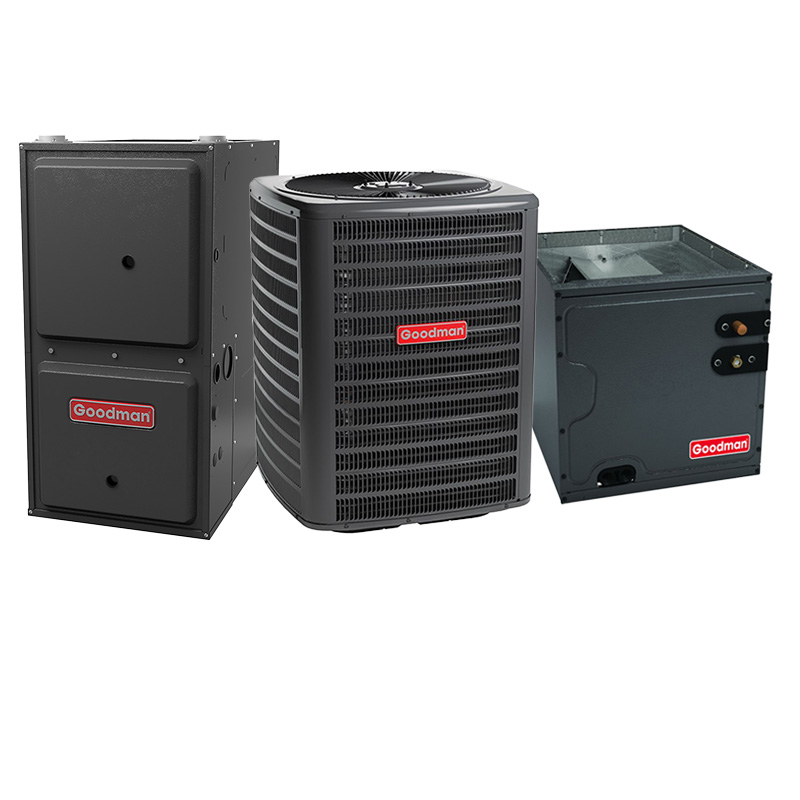
Goodman 4 Ton 15.2 SEER2 R32 AC System with 80,000 BTU 80% AFUE Gas Furnace – California & Colorado Ultra Low NOx, Upflow, Multi-Speed ECM
View on AC Direct see your lowest price →Check current price on AC Direct →
Key features
- 15.2 SEER2 cooling efficiency with R-32 refrigerant — lower GWP than R-410A
- 80,000 BTU 80% AFUE gas furnace meets California and Colorado Ultra Low NOx standards
- Multi-speed ECM blower motor for quieter operation and improved humidity management
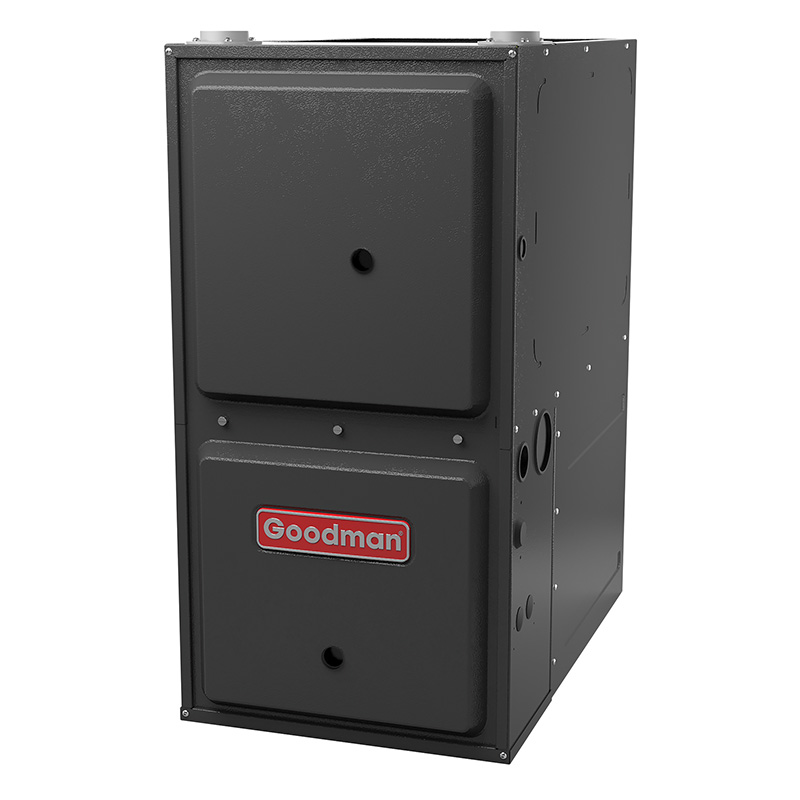
- Upflow configuration designed for basement or utility-closet installations with overhead duct systems
- 4-ton capacity suited to homes approximately 1,800 to 2,400 square feet depending on load
- Goodman's 10-year parts limited warranty requires online registration within 60 days of install
About this system
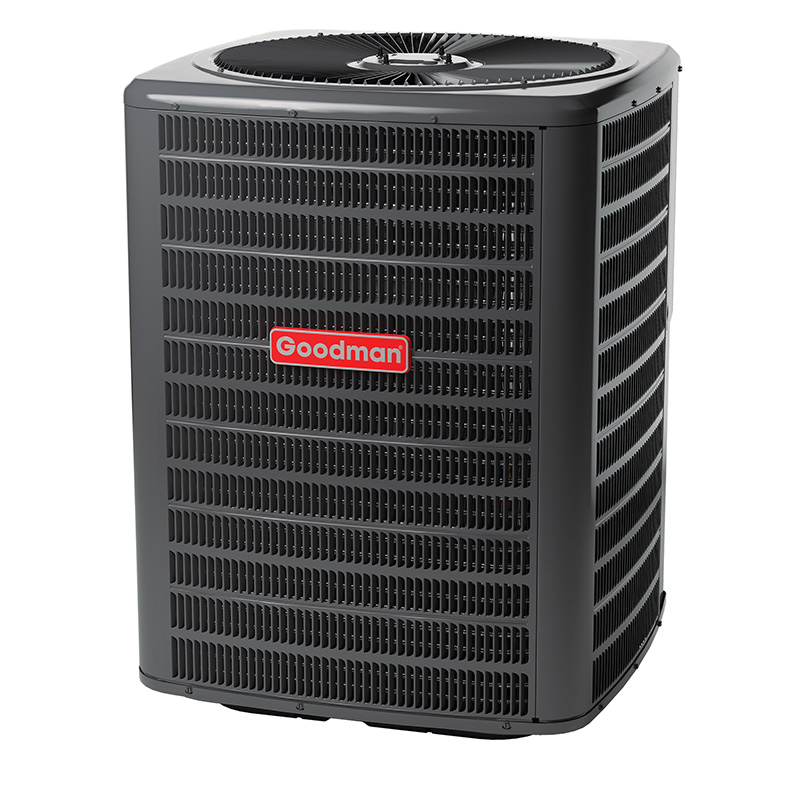
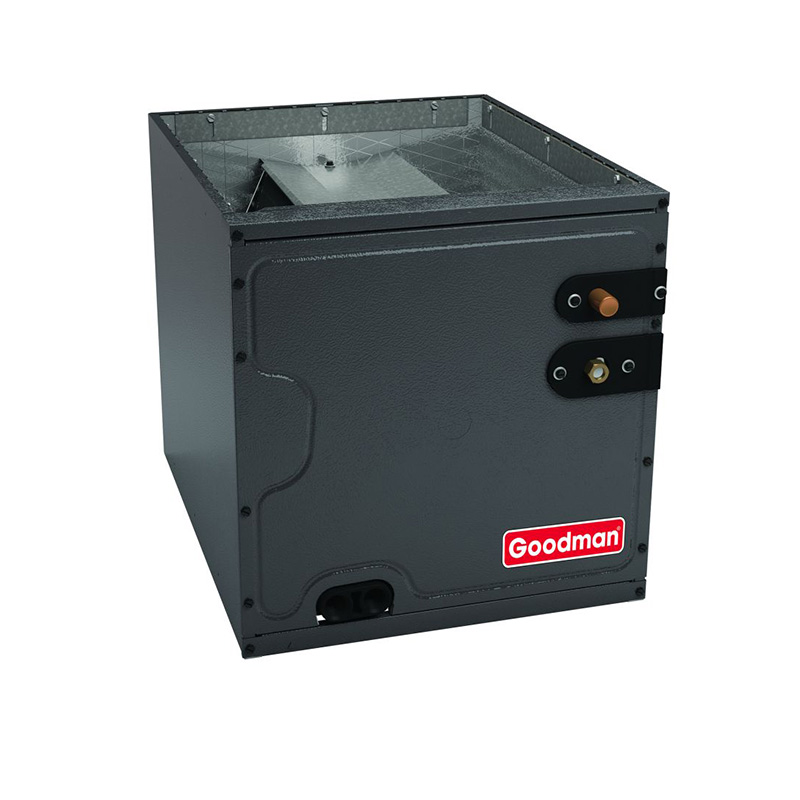
The Goodman 4-Ton 15.2 SEER2 system pairs a split-system air conditioner using next-generation R-32 refrigerant with an 80,000 BTU, 80% AFUE upflow gas furnace. The combination is aimed at homeowners in California and Colorado who need equipment that meets those states’ strict Ultra Low NOx combustion requirements — a real purchasing constraint that limits available options. At 4 tons, this system is sized for homes roughly in the 1,800 to 2,400 square foot range depending on local climate, insulation quality, and duct layout, and the multi-speed ECM blower motor gives it better humidity control and quieter part-load operation than a basic single-speed unit.
The 15.2 SEER2 rating clears the federal minimum for most climate zones but sits at the lower tier of what the current market offers — you are not getting premium efficiency here. The 80% AFUE furnace is similarly entry-level on the heating side; up to 20 cents of every heating dollar goes out the flue. R-32 is a meaningful upgrade from R-410A in terms of global warming potential, and it will be easier to service as the refrigerant transition continues. The upflow configuration means warm air exits the top of the furnace and rises through supply ducts, which works well in basements and utility closets where ductwork runs through a floor above — buyers with downflow or horizontal applications will need a different model.
This system delivers a code-compliant, budget-conscious solution for California and Colorado homeowners who need Ultra Low NOx equipment and can live with entry-level efficiency ratings. You get solid feature content for the price — R-32 refrigerant, an ECM blower, and a real parts warranty — but you are accepting a shorter expected compressor lifespan and a history of coil and capacitor issues compared to premium brands. Install quality will determine more of this system's long-term performance than the nameplate specs will.
Overall score is the average of the five ratings above.
What we like
- Priced 15 to 25 percent below comparable Carrier, Trane, and Lennox equipment at similar efficiency
- R-32 refrigerant is lower GWP and increasingly serviceable as the industry transitions away from R-410A
- ECM multi-speed blower improves comfort and humidity control over basic single-speed alternatives
- Meets California and Colorado Ultra Low NOx combustion requirements, clearing a real regulatory hurdle
- 10-year parts limited warranty (with registration) provides meaningful coverage on major components
Trade-offs
- 80% AFUE is entry-level heating efficiency — a 96% AFUE unit would recover its cost premium in colder climates over time
- Compressors average 10 to 14 years versus 15 to 20 years for premium brands, raising long-term replacement cost risk
- Dual-run capacitor failures and evaporator coil leaks are documented recurring issues in owner feedback
- 15.2 SEER2 sits at the lower edge of current market offerings, so energy savings versus a higher-SEER2 unit leave money on the table annually
What homeowners and pros say about Goodman
Homeowners who research Goodman online encounter a split picture. On ConsumerAffairs, where complaint-driven reviews dominate, the brand scores around 2.5 out of 5, with the most consistent theme being repair bills that start climbing after roughly year seven — capacitor replacements, coil leaks, and compressor failures are the most cited culprits. On Google dealer reviews, where the full range of customer experience is better represented, Goodman averages closer to 3.8 out of 5, and affordability at the point of purchase is the most frequent reason owners say they are satisfied. Those two data points together sketch a realistic picture: most buyers get a functioning system, but a meaningful share encounter parts failures sooner than they expected.
HVAC technicians are generally consistent in what they say about Goodman: the equipment can perform well when it is properly sized and installed, but it leaves less margin for error than premium brands do. Dual-run capacitors are the most commonly reported failure — a low-cost, fast fix in most cases, but an annoyance. Evaporator coil leaks show up with enough regularity in owner feedback to be worth budgeting for. Compressor longevity averages 10 to 14 years based on documented failure patterns, which is meaningfully shorter than the 15 to 20 years technicians associate with top-tier brands. For this specific system, the R-32 refrigerant and ECM blower are genuine positives that service pros tend to note favorably, and the Ultra Low NOx compliance removes a real headache for California and Colorado buyers. The value proposition holds up best when the install is done right and the owner registers the warranty on time.
Sources: ConsumerAffairs Goodman owner reviews, AHRI Directory of Certified Product Performance, U.S. DOE appliance and equipment efficiency standards, Goodman product specification sheets.
What it costs to run
At 15.2 SEER2, cooling this 4-ton system for a typical 1200-hour cooling season at the U.S. average electricity rate of $0.17/kWh works out to roughly $644 per year in cooling, about $87 less per year than a minimum-efficiency 13.4 SEER2 unit of the same size. Your real cost depends on your climate and local rate.
Method: (48,000 BTU/hr ÷ 15.2 SEER2) × 1200 hours ÷ 1000 × $0.17/kWh. Rate source: U.S. EIA average; cooling hours: moderate-climate estimate.
How it compares
| Brand | Comparable model | SEER2 | Stage | Price position |
|---|---|---|---|---|
| Goodman | 4-Ton 15.2 SEER2 R-32 AC + 80K BTU 80% AFUE Ultra Low NOx Upflow | 15.2 | Single-stage | Value pick |
| Carrier | Comfort 24ACC636 series with 58MCA furnace | 15.2 | Single-stage | Typically 15 to 25 percent more than Goodman |
| Trane | XR15 series with S8B1 furnace | 15.2 | Single-stage | Typically 15 to 25 percent more than Goodman |
| Lennox | Merit ML15 series with ML180 furnace | 15.2 | Single-stage | Typically 15 to 25 percent more than Goodman |
Competitor rows are comparable single-stage units at similar efficiency; price is relative position, not a quote.
Questions about this system
Does this system actually meet California's Ultra Low NOx rules, and do I need any extra paperwork to get it permitted?
Yes, the furnace is rated to meet the Ultra Low NOx standards required in California's South Coast AQMD and other non-attainment districts, as well as Colorado's equivalent requirements. Your installing contractor handles the permit paperwork, but you should confirm the specific district rules in your county because some areas have additional requirements beyond the base state standard.
What does the 10-year parts warranty actually cover, and what can void it?
Goodman's 10-year limited parts warranty covers the compressor, heat exchanger, and other functional components, but it requires online product registration within 60 days of the installation date — without that step, coverage drops to 5 years in most cases. The warranty covers parts only, not labor, so a compressor replacement in year 8 could still mean a significant labor bill. Using an unregistered or non-licensed installer can also affect claims.
R-32 refrigerant is new to me — is it harder or more expensive to service than R-410A?
R-32 requires certified technicians and specific handling procedures because it is mildly flammable, but it is not exotic — most commercial HVAC supply houses already stock it and most certified technicians are trained on it. Service costs today are comparable to R-410A, and availability is expected to improve as R-410A is phased down under current EPA rules, so R-32 is actually the more forward-looking choice here.
The specs show 80% AFUE — how much more would I spend on gas compared to a 96% AFUE furnace?
On a rough basis, a 96% AFUE furnace converts about 16 percent more of each gas dollar into usable heat versus this 80% unit. For a home spending $1,200 per year on gas heating, that gap is roughly $160 to $200 annually. Whether the upgrade cost pencils out depends on your local gas rates, how cold your winters are, and how long you plan to stay in the home.
Is a 4-ton unit definitely the right size, or should I get a load calculation first?
A Manual J load calculation is always the right starting point before purchasing any system — a 4-ton unit is commonly matched to homes in the 1,800 to 2,400 square foot range, but ceiling height, insulation levels, window area, and local climate can shift the correct size meaningfully in either direction. An oversized system short-cycles and worsens humidity control; an undersized one runs constantly on peak days. Ask your installer to provide a written load calculation before ordering.
Specifications
| Cooling capacity | 4 Ton |
| Efficiency | 15.2 SEER2 |
| Furnace output | 80,000 BTU |
| Furnace efficiency | 80% AFUE |
| Configuration | Upflow |
| Refrigerant | R-32 |