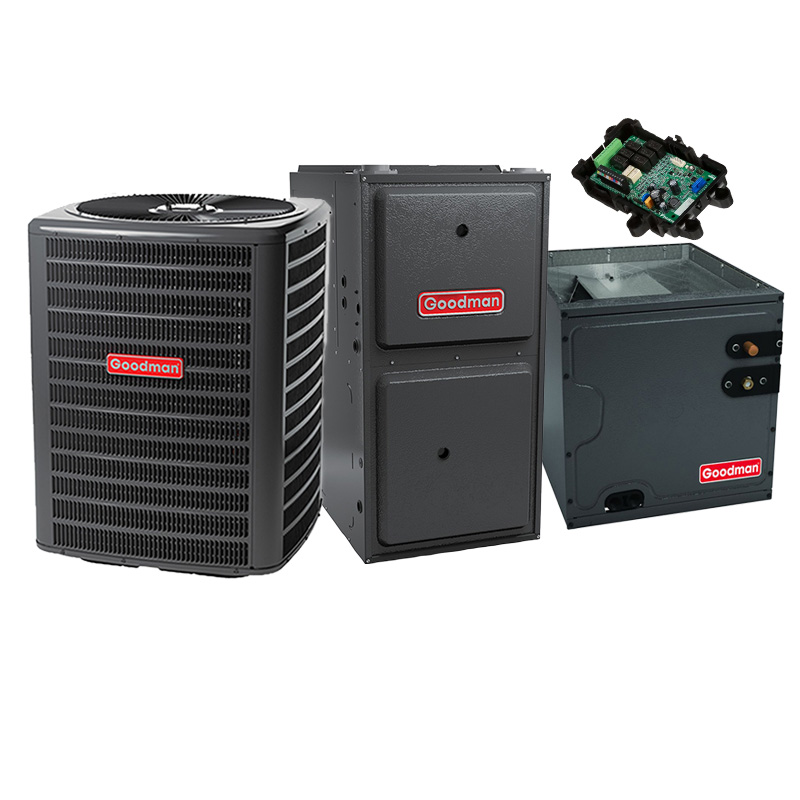
Goodman 5 Ton 13.4 SEER2 80000 BTU 96% AFUE Gas Furnace With R32 Air Condenser and Coil System – Upflow
View on AC Direct see your lowest price →Check current price on AC Direct →
Key features
- 5-ton cooling capacity with 13.4 SEER2 efficiency rating
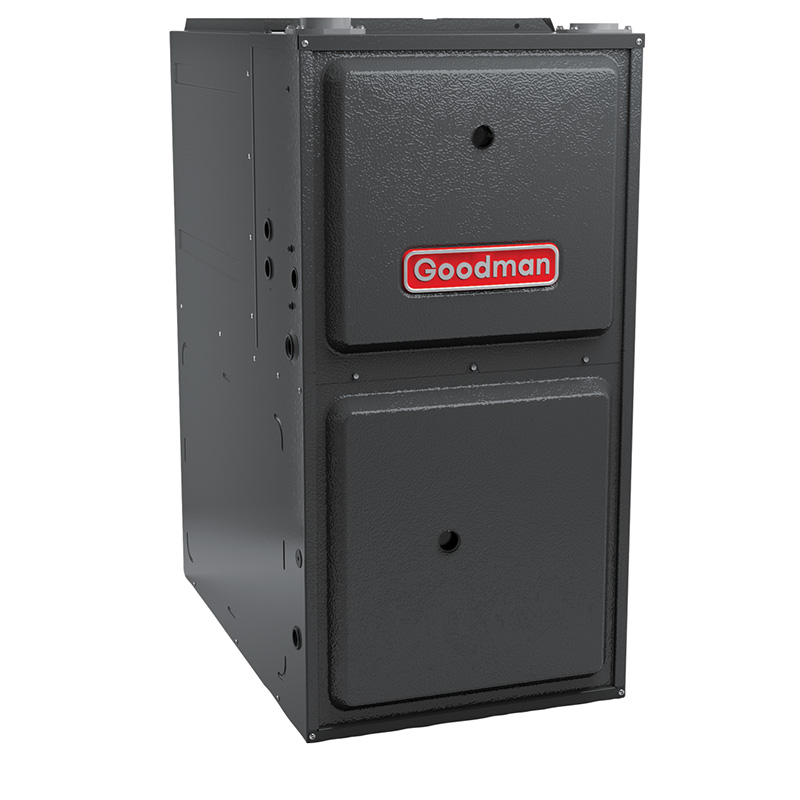
- 96% AFUE upflow gas furnace, 80,000 BTU output
- R-32 refrigerant with lower global warming potential than R-410A
- Single-stage operation on both cooling and heating
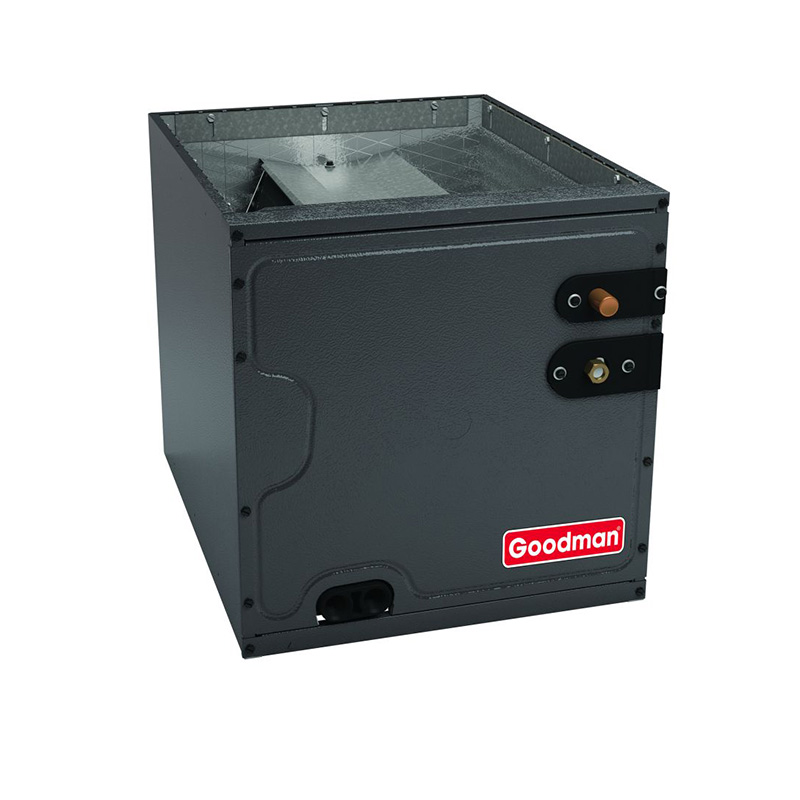
- Matched evaporator coil included for a factory-verified system
- Upflow configuration for basement or ground-floor installs with overhead ductwork
About this system
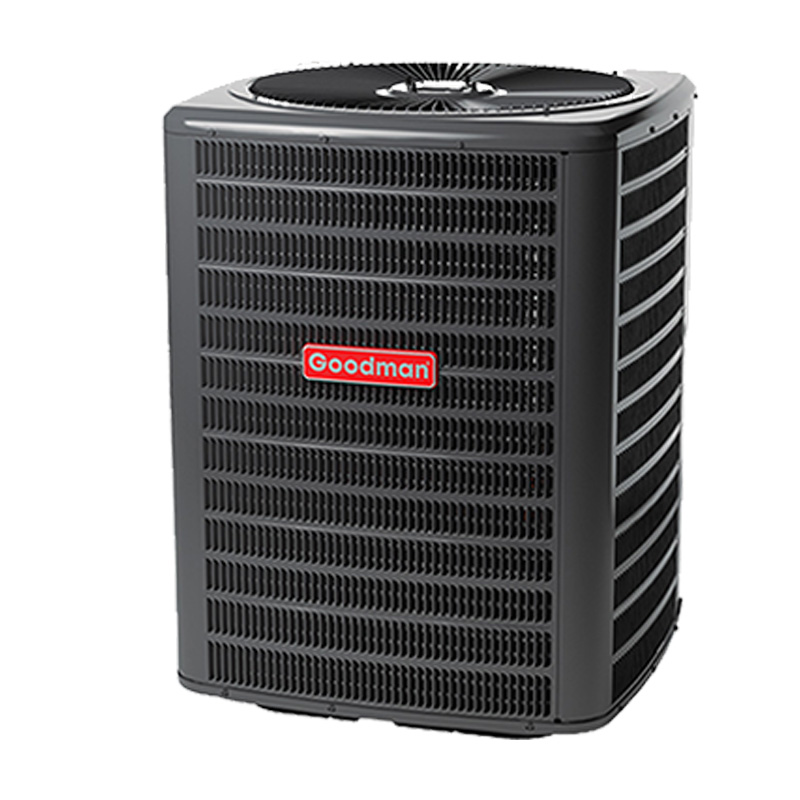
This Goodman bundle pairs a 5-ton, 13.4 SEER2 R-32 air condenser and matching evaporator coil with an 80,000 BTU, 96% AFUE upflow gas furnace. The result is a complete split system aimed at larger homes — roughly 2,400 to 3,200 square feet depending on climate and insulation — that need serious cooling capacity alongside high-efficiency winter heating. The 96% AFUE rating means 96 cents of every dollar spent on gas becomes usable heat, which puts this furnace in the upper efficiency tier and qualifies it for rebates in many utility districts. The 13.4 SEER2 rating meets the current federal minimum for most U.S. regions, so it is code-compliant but not a high-efficiency cooling standout.
R-32 refrigerant is a meaningful forward-looking choice. It has roughly one-third the global warming potential of the older R-410A it replaces, and its higher energy density can translate to slightly better real-world performance in the refrigeration cycle. The upflow configuration suits the most common installation scenario: a furnace in a basement or ground-floor utility closet blowing conditioned air upward into ductwork overhead. Buyers should be aware that this is a single-stage system on both the cooling and heating side, meaning it runs at full capacity or not at all. That is simpler and less expensive to service, but it will cycle on and off more frequently than a two-stage or variable-capacity system, which can affect humidity control and comfort during mild weather.
This Goodman system delivers strong furnace efficiency and a future-ready refrigerant at a price point noticeably below Carrier, Trane, and Lennox equivalents. The trade-off is a reliability track record that is serviceable but not class-leading, and single-stage operation that leaves something to be desired on comfort and humidity control in larger homes. It is a reasonable buy when budget matters and installation quality is not in question.
Overall score is the average of the five ratings above.
What we like
- 96% AFUE furnace ranks in the high-efficiency tier and can reduce annual gas bills meaningfully versus 80% units
- Priced roughly 15 to 25 percent below comparable Carrier, Trane, and Lennox systems, freeing budget for quality installation
- R-32 refrigerant is environmentally preferable to R-410A and is increasingly favored by the industry
- Matched coil-and-condenser bundle simplifies AHRI certification and helps ensure rated performance
- Single-stage design means fewer electronic components, lower service complexity, and generally lower repair costs when issues do arise
Trade-offs
- Compressor lifespan averages 10 to 14 years in owner reports, shorter than the 15 to 20 years typical of premium brands
- Evaporator coil leaks appear with notable frequency in owner reviews and can be a costly mid-life repair
- Single-stage cooling at 5 tons can short-cycle on mild days, leaving humidity higher than a two-stage or variable system would
- ConsumerAffairs score sits around 2.5 out of 5, with owners frequently citing rising repair costs after year seven
What homeowners and pros say about Goodman
Homeowners who have lived with a Goodman system for several years tend to split along a familiar line. Those who had an experienced contractor perform a thorough install — verified charge, proper airflow, quality line-set brazing — often report years of trouble-free operation and point to affordability as the reason they would buy Goodman again. Google dealer reviews across multiple locations average around 3.8 out of 5, and the word that comes up most often is value. The frustration, when it appears, usually surfaces around year seven or eight: a capacitor fails, then perhaps another component, and some owners feel the repair costs begin to erode the savings they captured at purchase. ConsumerAffairs shows a much rougher picture at roughly 2.5 out of 5, though that platform skews toward people motivated by a bad experience, which means it captures the tail risk more than the typical outcome.
HVAC technicians have a more nuanced view of Goodman equipment specifically at the 5-ton level. The dual-run capacitor is the component they see fail most often across the brand’s lineup, and most describe it as a routine, inexpensive service call. The concern they raise more seriously is evaporator coil integrity: coil leaks show up in owner accounts with enough regularity that experienced installers recommend confirming the coil is properly supported and that the refrigerant charge is set precisely at startup. Compressor longevity is the other honest conversation a technician will have with you: the 10-to-14-year average for Goodman compressors is real, and at 5 tons, a compressor replacement is not a small bill. None of this makes Goodman a bad choice, but it does make who installs it and how they install it a more consequential decision than it would be with a Trane or Carrier of the same size.
Sources: ConsumerAffairs Goodman owner reviews, AHRI Directory of Certified Product Performance, U.S. DOE appliance and equipment efficiency standards, Goodman product specification sheets.
What it costs to run
At 13.4 SEER2, cooling this 5-ton system for a typical 1200-hour cooling season at the U.S. average electricity rate of $0.17/kWh works out to roughly $913 per year in cooling, about $0 less per year than a minimum-efficiency 13.4 SEER2 unit of the same size. Your real cost depends on your climate and local rate.
Method: (60,000 BTU/hr ÷ 13.4 SEER2) × 1200 hours ÷ 1000 × $0.17/kWh. Rate source: U.S. EIA average; cooling hours: moderate-climate estimate.
How it compares
| Brand | Comparable model | SEER2 | Stage | Price position |
|---|---|---|---|---|
| Goodman | GSXH5 / GMVC96 / CHPF coil bundle | 13.4 | Single-stage | Value pick |
| Carrier | Comfort 24ACC6 / 59SC5 series | 13.4–14.0 | Single-stage | Typically 15 to 25 percent more than this Goodman bundle |
| Trane | XR15 / S9X1 series | 14.0–15.0 | Single-stage | Typically 15 to 25 percent more than this Goodman bundle |
| Lennox | Merit ML14XC1 / ML196 series | 13.4–14.0 | Single-stage | Typically 15 to 25 percent more than this Goodman bundle |
Competitor rows are comparable single-stage units at similar efficiency; price is relative position, not a quote.
Questions about this system
Is 5 tons the right size for my house, or could I get away with 4 tons?
Sizing depends on your climate zone, insulation, window area, and ceiling height, not square footage alone. A proper Manual J load calculation by your installer is the only reliable way to confirm. Oversizing a 5-ton unit in a home that needs 4 tons will cause short-cycling, poor humidity removal, and accelerated wear on the compressor.
What does R-32 refrigerant mean for me as an owner, and can my existing technician service it?
R-32 is mildly flammable (A2L classification), so technicians need specific training and compatible recovery equipment to work on it safely. Most major HVAC service companies are already certified, but it is worth confirming with your contractor before purchase. As an owner, the practical day-to-day experience is identical to older R-410A systems.
What are the most likely repairs I should budget for over the first 10 years?
Dual-run capacitors are the most commonly reported failure on Goodman equipment and typically cost 300 to 600 dollars to replace, including labor. Evaporator coil leaks are documented with more frequency than on premium brands and can run into the thousands depending on scope. Setting aside a small annual service fund is a realistic approach for any system, but especially this one.
Does the 96% AFUE furnace qualify for federal or utility rebates?
The federal Inflation Reduction Act tax credit currently requires 97% AFUE for gas furnaces to qualify, so this 96% unit falls just short of that threshold. However, many state and utility programs have lower thresholds and may still offer rebates; check your utility's website or DSIRE.org with your specific zip code before purchasing.
How important is the installer, and what should I ask before hiring someone?
Goodman technicians and owners consistently identify install quality as the single largest factor in how well and how long one of these systems performs. Ask your contractor whether they will perform a Manual J load calculation, verify refrigerant charge with gauges, and pressure-test the line set before startup. Skipping any of these steps is the most common cause of early refrigerant leaks and efficiency loss.
Specifications
| Cooling capacity | 5 Ton |
| Efficiency | 13.4 SEER2 |
| Furnace output | 80000 BTU |
| Furnace efficiency | 96% AFUE |
| Configuration | Upflow |
| Refrigerant | R-32 |