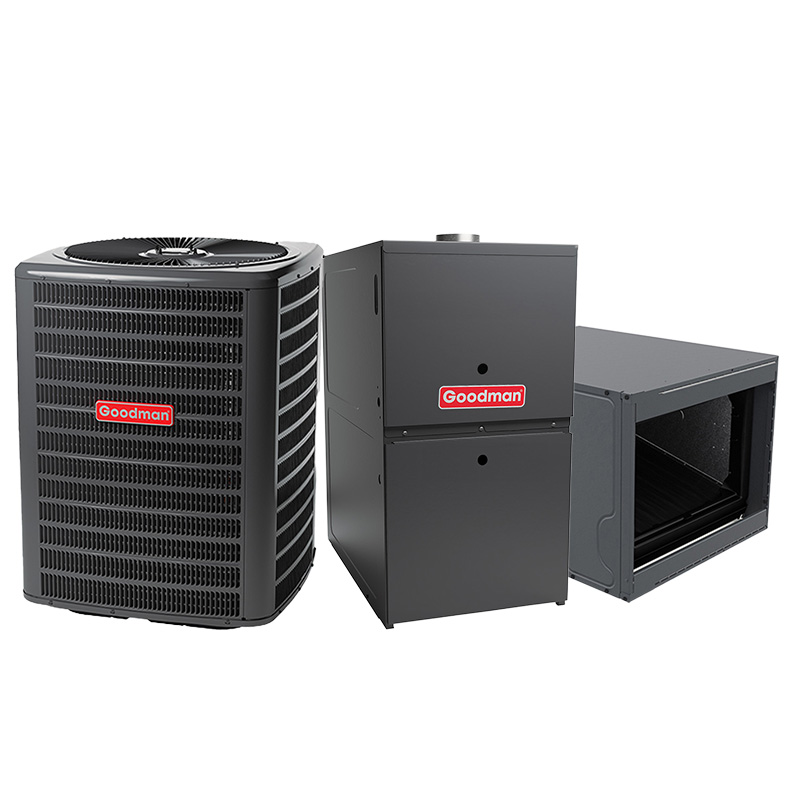
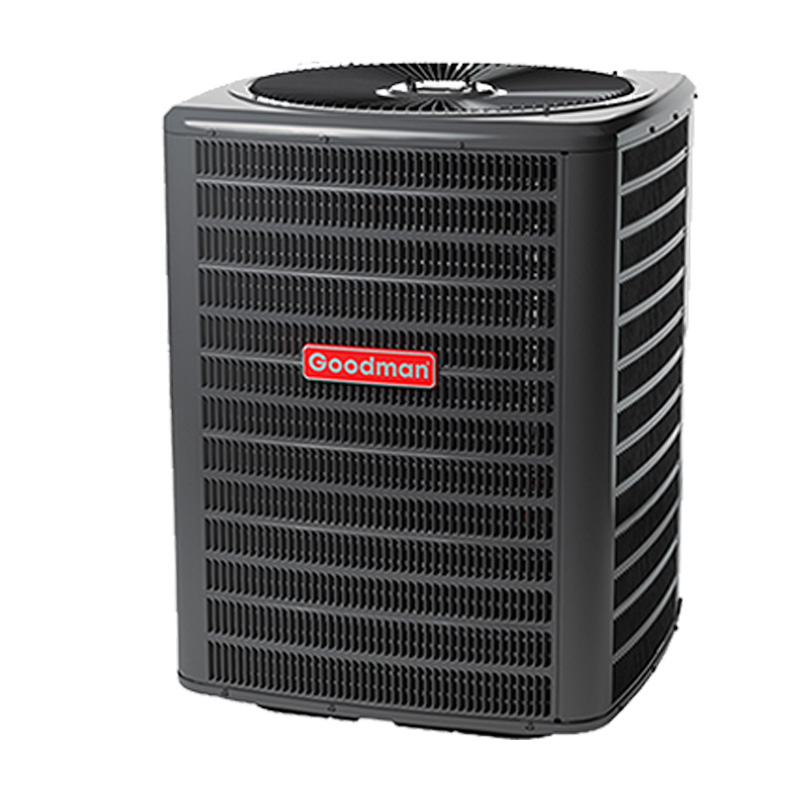
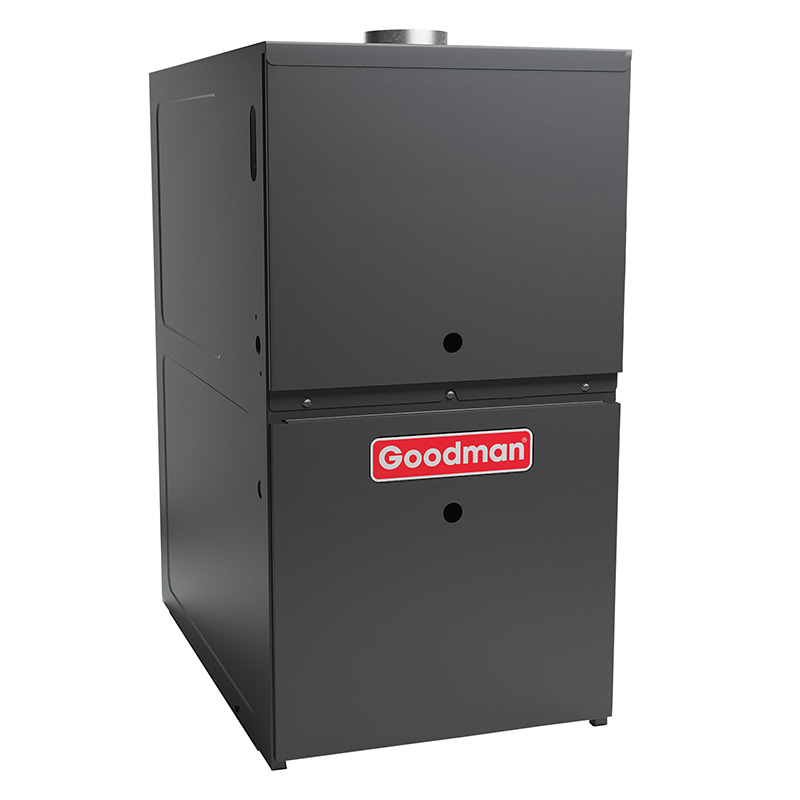
Goodman 5 Ton 13.4 SEER2 AC & Gas Furnace System – Two Stage Variable-Speed, 80000 BTU Gas Furnace, 80% AFUE, Horizontal, R32
View on AC Direct see your lowest price →Check current price on AC Direct →
Key features
- 5-ton two-stage cooling matched to a variable-speed 80,000 BTU gas furnace
- 13.4 SEER2 efficiency rating, meeting current federal minimum standards
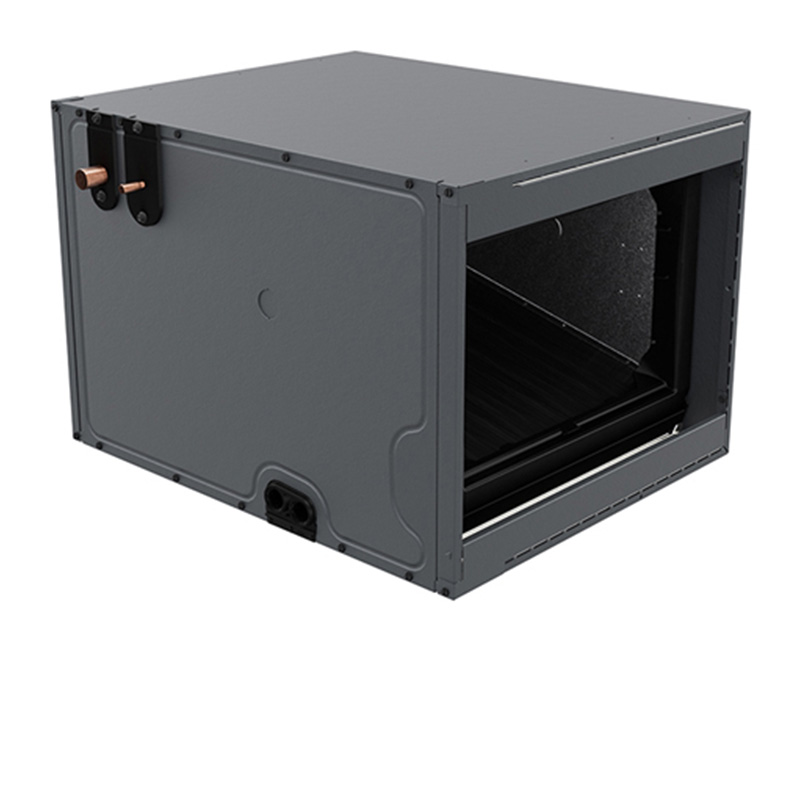
- Horizontal cabinet orientation designed for attic, crawl space, or side-discharge installs
- R-32 refrigerant charge, lower global warming potential than legacy R-410A
- 80% AFUE furnace combustion efficiency, entry-level but widely available for service
- Variable-speed blower motor for quieter operation and more consistent temperature distribution
About this system
The Goodman 5-ton, 13.4 SEER2 split system pairs a two-stage air conditioner with a variable-speed, 80,000 BTU gas furnace rated at 80% AFUE. The horizontal configuration makes it a practical fit for attic installs, crawl-space applications, and manufactured homes where a standard upflow cabinet simply will not fit. At 5 tons, this is sized for larger homes, typically in the 2,200 to 3,000 square foot range depending on climate zone, insulation, and local heat load, so a proper Manual J calculation before purchase is not optional.
The two-stage compressor runs on a lower capacity most of the time, which reduces short cycling, keeps humidity more consistently in check versus a single-stage unit, and takes some load off components during mild weather. The variable-speed furnace blower fine-tunes airflow to match heating and cooling demand rather than just switching between high and low. R-32 refrigerant has a lower global warming potential than the R-410A it replaces and is increasingly the industry standard as R-410A is phased down. The 80% AFUE furnace is entry-level efficiency, meaning one-fifth of combustion energy exits through the flue, which is worth considering if natural gas prices are high in your region or if a 96% AFUE unit would pay back its premium within your ownership horizon.
This system is aimed at cost-conscious buyers who want a functional, code-compliant upgrade without paying the premium attached to Trane, Lennox, or Carrier nameplates. The trade-off is a brand with a mixed long-term track record and a compressor lifespan that, on average, runs shorter than those of top-tier competitors. Getting the most from this equipment means investing in a careful, properly commissioned installation by a licensed HVAC contractor.
This Goodman bundle delivers a functional two-stage, variable-speed system at a price point that undercuts most name-brand alternatives by 15 to 25 percent, and the horizontal configuration solves a real installation problem for attic or crawl-space setups. Efficiency and first-year costs are reasonable, but owners should go in with clear eyes about Goodman's documented reliability history and plan for component repairs after year seven. Install quality will determine more of this system's lifespan than the nameplate will.
Overall score is the average of the five ratings above.
What we like
- Priced 15 to 25 percent below comparable Carrier, Trane, and Lennox equipment, reducing upfront cost
- Two-stage compressor improves humidity control and reduces short cycling versus single-stage units
- Variable-speed blower delivers quieter, more consistent airflow throughout the home
- Horizontal configuration is a genuine solution for attic and crawl-space installations
- R-32 refrigerant is forward-compatible as R-410A is phased out of new equipment
Trade-offs
- Compressor lifespan averages 10 to 14 years in documented owner experience, shorter than the 15 to 20 years reported for premium brands
- Evaporator coil leaks appear in a meaningful share of owner reviews and can be costly to address
- 80% AFUE furnace leaves 20 percent of combustion energy vented, a real operating-cost gap in colder climates compared to 96% AFUE options
- ConsumerAffairs ratings sit around 2.5 out of 5, with repair costs after roughly year seven as the most common complaint theme
What homeowners and pros say about Goodman
Homeowners who share feedback on Goodman equipment tend to cluster at the poles. Google dealer reviews across multiple locations average around 3.8 out of 5, where affordability is the most common thread of praise, particularly from buyers who got competitive bids and found the Goodman-equipped quotes running noticeably lower than the field. ConsumerAffairs tells a different story, with ratings sitting around 2.5 out of 5, a channel that skews toward people motivated enough by frustration to write a review. The recurring complaint there is not early catastrophic failure but rather repair costs that begin climbing after roughly year seven, which aligns with the documented compressor lifespan of 10 to 14 years versus the 15 to 20 years more commonly associated with Trane, Carrier, and Lennox compressors.
HVAC contractors who work on Goodman equipment regularly point to dual-run capacitors as the most predictable wear item, typically a straightforward 300-to-600-dollar repair when it comes up. More consequential are evaporator coil leaks, which appear in enough owner accounts to be worth factoring into long-term cost planning. A minority of owners also report refrigerant leaks within the first year of ownership, a pattern that technicians almost universally attribute to installation errors or improper refrigerant charging rather than factory defects. That context matters for this specific system: a horizontal install in an attic or crawl space introduces more variables than a standard basement upflow setup, and the consensus among professionals is that Goodman’s real-world longevity depends on installation quality more heavily than most competing brands. The value case holds, but it holds most strongly when paired with a careful, properly commissioned install.
Sources: ConsumerAffairs Goodman owner reviews, AHRI Directory of Certified Product Performance, U.S. DOE appliance and equipment efficiency standards, Goodman product specification sheets.
What it costs to run
At 13.4 SEER2, cooling this 5-ton system for a typical 1200-hour cooling season at the U.S. average electricity rate of $0.17/kWh works out to roughly $913 per year in cooling, about $0 less per year than a minimum-efficiency 13.4 SEER2 unit of the same size. Your real cost depends on your climate and local rate.
Method: (60,000 BTU/hr ÷ 13.4 SEER2) × 1200 hours ÷ 1000 × $0.17/kWh. Rate source: U.S. EIA average; cooling hours: moderate-climate estimate.
How it compares
| Brand | Comparable model | SEER2 | Stage | Price position |
|---|---|---|---|---|
| Goodman | GSZC5 / GMVC8 Series (this system) | 13.4 | two-stage | Value pick |
| Carrier | Comfort 14 Series (24ACC4) | 13.4 to 14.3 | single-stage | Typically 15 to 25 percent more than this Goodman bundle |
| Trane | XR14 Series (4TTR4) | 13.8 to 14.3 | single-stage | Typically 15 to 25 percent more than this Goodman bundle |
| Lennox | Merit Series ML14XC1 | 13.4 to 14.3 | single-stage | Typically 15 to 25 percent more than this Goodman bundle |
Competitor rows are comparable single-stage units at similar efficiency; price is relative position, not a quote.
Questions about this system
Why does this system have a horizontal configuration, and can it be installed vertically?
The horizontal cabinet is built specifically for applications where the air handler must lie on its side, such as attic platforms or low-clearance crawl spaces. Installing a horizontal-configuration unit in an upflow or downflow orientation is not supported and can affect drainage, airflow, and warranty coverage, so verify your installation space before ordering.
Is 80% AFUE good enough, or should I spend more on a higher-efficiency furnace?
80% AFUE meets federal minimums in most northern climate zones and is widely supported for parts and service. Whether upgrading to 96% AFUE makes financial sense depends on your local gas prices, heating degree days, and how long you plan to own the home. In climates with long, cold winters the payback period on a high-efficiency unit can be under ten years; in mild climates it often is not.
What are the most common repair issues I should budget for with this Goodman system?
Dual-run capacitors are the most frequently reported failure point on Goodman AC units and typically cost 300 to 600 dollars to replace, including labor. Evaporator coil leaks show up in a meaningful share of owner feedback and are more expensive to address. Compressors have averaged 10 to 14 years in documented owner experience, so budgeting for a possible compressor replacement or system swap in that window is prudent.
Does this system use R-32 refrigerant, and does that affect service costs?
Yes, this unit is charged with R-32. R-32 has a lower global warming potential than R-410A and is increasingly stocked by HVAC distributors as the industry transitions away from R-410A. Service technicians generally handle it without special certification beyond standard EPA Section 608, though you should confirm your contractor has experience with R-32 systems, as handling procedures differ slightly from R-410A.
How much does installation complexity affect this system's long-term performance?
Significantly. Goodman's own performance reputation is closely tied to install quality, and HVAC technicians consistently cite it as the single biggest factor in how long one of these systems lasts. A small share of owners report refrigerant leaks within the first year, which is typically traced to improper installation or charging rather than a factory defect. Hiring a licensed contractor who will pull a permit, perform a Manual J load calculation, and commission the system properly is not optional with this equipment.
Specifications
| Cooling capacity | 5 Ton |
| Efficiency | 13.4 SEER2 |
| Furnace output | 80000 BTU |
| Furnace efficiency | 80% AFUE |
| Configuration | Horizontal |
| Refrigerant | R-32 |