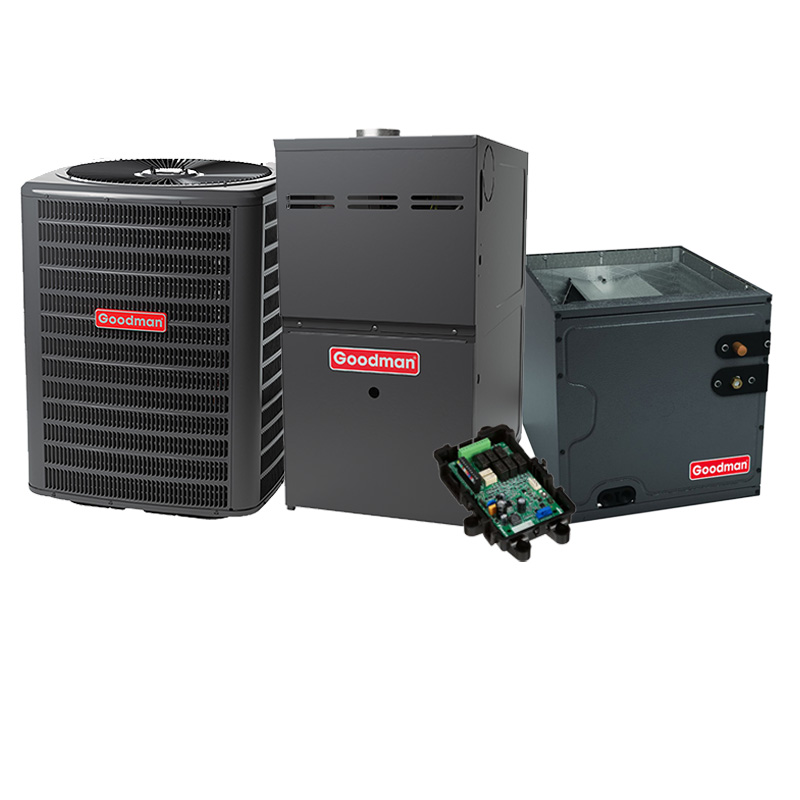
Goodman 5 Ton 13.6 SEER2 100000 BTU 80% Two-Stage Variable Speed Gas Furnace With R32 AC Condenser And Coil System – Upflow
View on AC Direct see your lowest price →Check current price on AC Direct →
Key features
- 5-ton cooling capacity paired with 100,000 BTU two-stage gas furnace
- 13.6 SEER2 efficiency rating at the current federal minimum threshold
- R-32 refrigerant with lower global warming potential than R-410A
- Variable-speed blower motor for improved comfort and humidity control
- Upflow configuration for basement or utility closet installations
- 80% AFUE furnace converts four out of five units of gas into usable heat
About this system
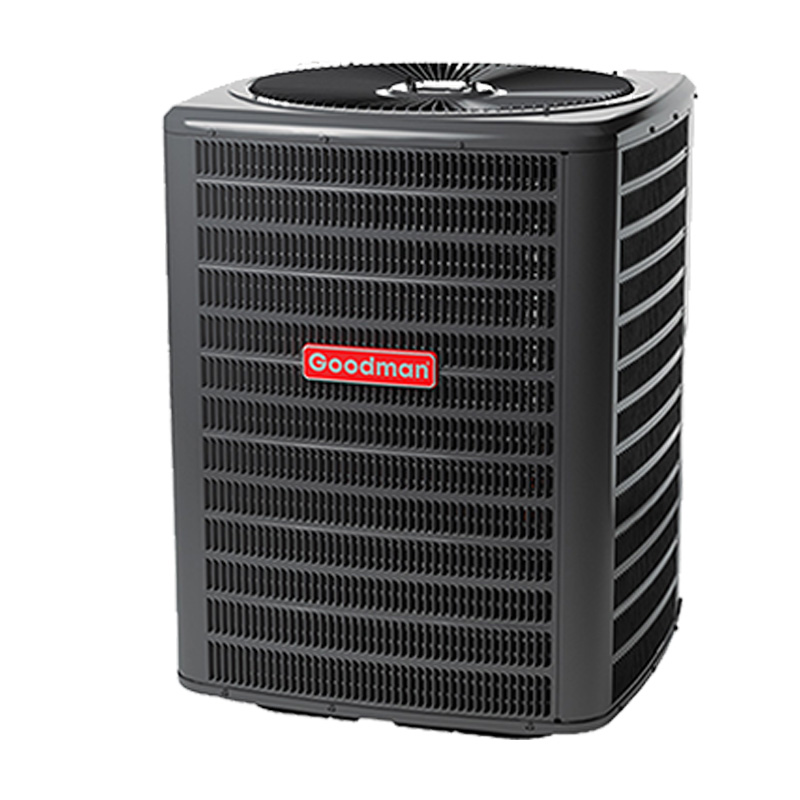
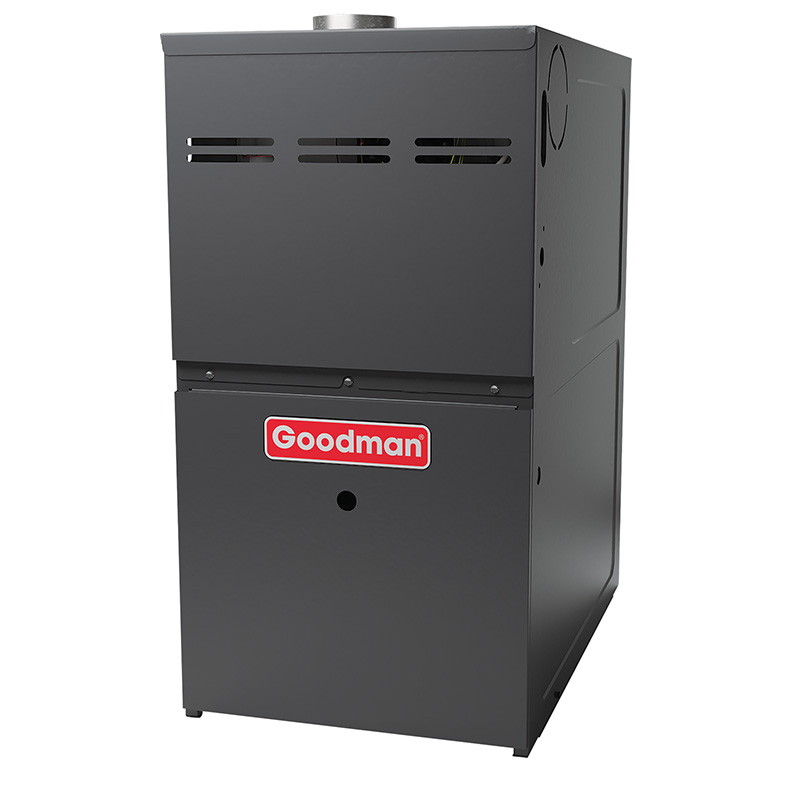
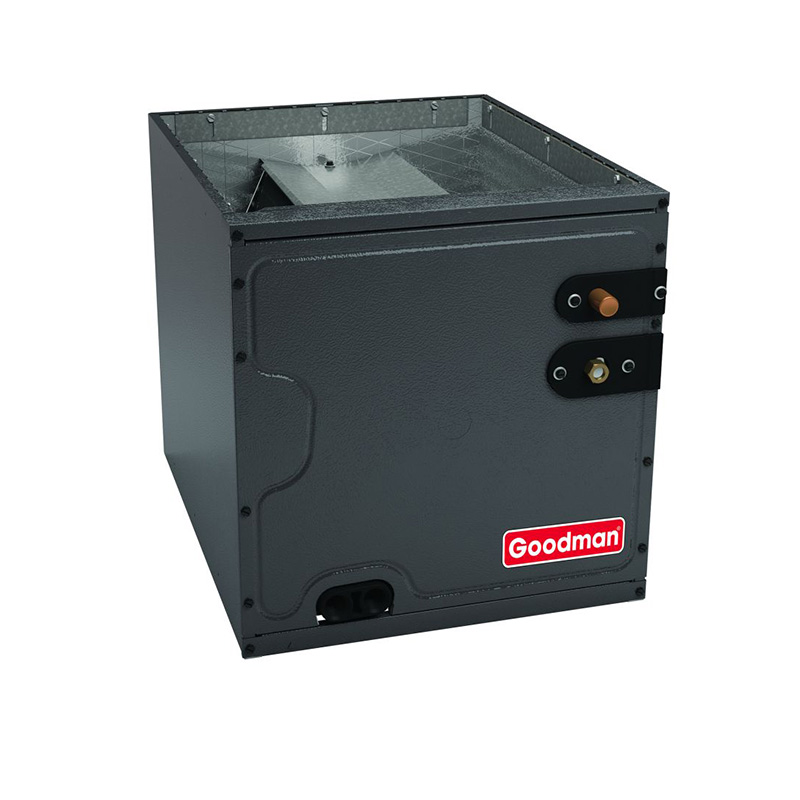
This Goodman 5-ton system bundles a 13.6 SEER2 R-32 air conditioning condenser and matched evaporator coil with a 100,000 BTU 80% AFUE two-stage variable-speed gas furnace in an upflow configuration. That combination suits larger homes in the 2,500 to 3,500 square foot range that need serious heating muscle alongside respectable cooling efficiency. The two-stage furnace runs on a lower fire most of the time, which smooths out temperature swings and reduces short-cycling, while the variable-speed air handler improves comfort and keeps humidity in check better than a single-speed blower would.
The R-32 refrigerant is a forward-looking choice. It carries a lower global warming potential than the R-410A it replaces and is becoming the industry standard, so finding service technicians and replacement refrigerant in coming years should not be a problem. At 13.6 SEER2 this system sits at the federal minimum efficiency tier for most U.S. climate zones, which keeps the purchase price down but means energy savings over a higher-efficiency unit will be modest. Homeowners in mild climates who want dependable comfort at a lower upfront cost are the clearest fit; those in regions with extreme summer heat or sky-high utility rates may find the efficiency ceiling leaves money on the table long-term.
This Goodman package delivers a complete, code-compliant heating and cooling system at a price point 15 to 25 percent below comparable Carrier, Trane, and Lennox equipment, making it a reasonable choice for budget-conscious buyers who understand that long-term reliability leans heavily on installer quality. The 13.6 SEER2 rating and 80% AFUE are floor-level specs rather than premium ones, and the brand's documented failure history with capacitors and evaporator coil leaks means ownership costs beyond year seven deserve attention. For buyers who vet their installer carefully and plan for periodic maintenance, it represents fair value; for buyers expecting set-it-and-forget-it longevity, premium alternatives are worth the price gap.
Overall score is the average of the five ratings above.
What we like
- Significantly lower purchase price than Carrier, Trane, or Lennox equivalents of similar size
- Two-stage furnace operation reduces temperature swings and improves day-to-day comfort
- Variable-speed blower aids humidity management and quieter low-load operation
- R-32 refrigerant is future-ready and widely serviceable as the industry transitions
- Dual-run capacitor failures, the most common documented issue, are a low-cost repair in the $300 to $600 range
Trade-offs
- 13.6 SEER2 is the federal minimum tier, so cooling efficiency savings versus higher-SEER2 options are limited
- 80% AFUE means roughly one dollar in five of gas spend goes up the flue, a real gap versus 96% units in cold climates
- Compressor lifespan averages 10 to 14 years versus 15 to 20 years for premium brands, and evaporator coil leaks appear in a meaningful share of owner reports
- A minority of owners report refrigerant leaks within the first year, typically tied to install or charge issues rather than factory defects
What homeowners and pros say about Goodman
Homeowners and HVAC technicians hold fairly consistent views on Goodman equipment, and this 5-ton system is unlikely to change that picture. On ConsumerAffairs the brand scores around 2.5 out of 5, a channel skewed toward people who had problems, where the recurring complaint is repair costs that climb after roughly year seven. Google dealer reviews paint a more moderate picture at around 3.8 out of 5, where affordability is the most frequently mentioned reason buyers chose the brand in the first place. The gap between those two numbers tells you something honest: when Goodman works, owners are generally satisfied with what they paid; when it does not, the repair experience can feel disproportionate to the savings.
Among the specific failure modes technicians encounter, dual-run capacitor failures come up most often and are considered a quick, inexpensive fix in the $300 to $600 range, the kind of issue a well-maintained system might only see once. More consequential are evaporator coil leaks, which appear in a meaningful share of owner reports and represent a costlier repair. Compressor longevity is another honest consideration: Goodman compressors average roughly 10 to 14 years in real-world use, compared to the 15 to 20 years owners tend to see from Trane, Carrier, and Lennox equipment. A minority of owners also report refrigerant leaks within the first year, and technicians consistently attribute those to installation or initial charge issues rather than factory defects, which underscores why installer selection matters as much as equipment selection with this brand.
Sources: ConsumerAffairs Goodman owner reviews, AHRI Directory of Certified Product Performance, U.S. DOE appliance and equipment efficiency standards, Goodman product specification sheets.
What it costs to run
At 13.6 SEER2, cooling this 5-ton system for a typical 1200-hour cooling season at the U.S. average electricity rate of $0.17/kWh works out to roughly $900 per year in cooling, about $13 less per year than a minimum-efficiency 13.4 SEER2 unit of the same size. Your real cost depends on your climate and local rate.
Method: (60,000 BTU/hr ÷ 13.6 SEER2) × 1200 hours ÷ 1000 × $0.17/kWh. Rate source: U.S. EIA average; cooling hours: moderate-climate estimate.
How it compares
| Brand | Comparable model | SEER2 | Stage | Price position |
|---|---|---|---|---|
| Goodman | 5-Ton 13.6 SEER2 / 100K BTU 80% Two-Stage Variable Speed (this system) | 13.6 | Two-stage furnace / standard condenser | Value pick |
| Carrier | Comfort 24ACC636 condenser with 58TP two-stage furnace | 14.3 | Two-stage furnace / single-stage condenser | Approximately 20 to 25 percent more than this Goodman system |
| Trane | XR14 condenser with S9V2 two-stage variable-speed furnace | 14.0 | Two-stage furnace / single-stage condenser | Approximately 20 to 30 percent more than this Goodman system |
| Lennox | Merit ML14 condenser with ML196 two-stage furnace | 14.3 | Two-stage furnace / single-stage condenser | Approximately 25 to 35 percent more than this Goodman system |
Competitor rows are comparable single-stage units at similar efficiency; price is relative position, not a quote.
Questions about this system
Is 5 tons and 100,000 BTU the right size for my house?
A proper Manual J load calculation is the only reliable answer to that question. As a rough benchmark, 5 tons typically suits 2,500 to 3,500 square feet in average U.S. climates, but ceiling height, insulation, window area, and local design temperatures all shift that range. Oversizing a furnace this large causes short-cycling and humidity problems, so insist your installer runs the numbers before ordering.
What does 13.6 SEER2 mean in practice, and is it good enough?
SEER2 is the federal seasonal efficiency rating measured under slightly more realistic conditions than the older SEER standard. At 13.6 this system meets current federal minimums for most regions but is not a high-efficiency unit. In moderate climates with average utility rates the operating cost difference versus a 17 or 18 SEER2 system may never fully offset the higher upfront price of the premium unit, but in hot southern climates that run air conditioning heavily, the gap widens over a decade.
Why does this system use R-32 instead of R-410A?
R-410A is being phased down under federal regulations because of its high global warming potential. R-32 is an industry-standard replacement that Goodman and most major brands have adopted. It is widely available, and technicians are rapidly becoming familiar with it, so servicing this system in five or ten years should be straightforward.
What are the most likely repair costs I should budget for over the first 10 years?
Dual-run capacitor failure is the single most commonly reported issue on Goodman equipment and typically costs $300 to $600 to repair, including service labor. Evaporator coil leaks show up in a notable portion of owner reports and are a more significant repair. A small share of owners encounter refrigerant leaks in the first year, which are usually traced to installation rather than the equipment itself, so choosing an experienced installer reduces that risk meaningfully.
Does the upflow configuration limit where I can install this system?
Upflow means the furnace pulls return air in at the bottom and pushes heated or cooled air upward into the supply duct system, which is the standard arrangement for basement or ground-level utility closet installs with ductwork running overhead. If your existing ductwork is configured for downflow or horizontal, this unit would require duct modifications or a different configuration, so confirm the orientation with your installer before purchase.
Specifications
| Cooling capacity | 5 Ton |
| Efficiency | 13.6 SEER2 |
| Furnace output | 100000 BTU |
| Configuration | Upflow |
| Refrigerant | R-32 |