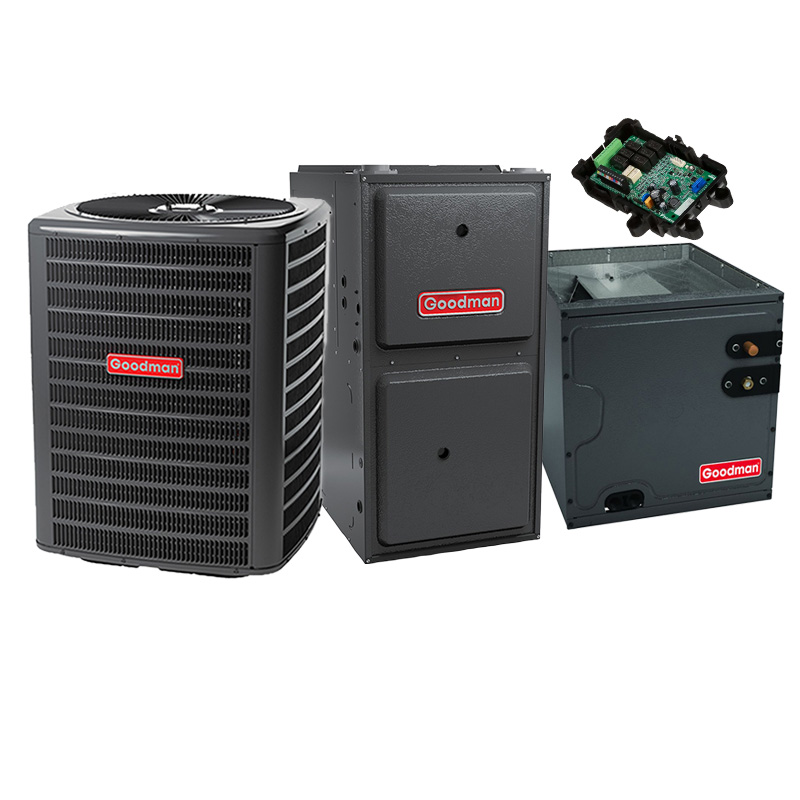
Goodman 5 Ton 13.6 SEER2 120000 BTU 96% AFUE Gas Furnace With R32 Air Condenser and Coil System – Upflow
View on AC Direct see your lowest price →Check current price on AC Direct →
Key features
- 5-ton cooling capacity with 13.6 SEER2 efficiency rating
- 120,000 BTU gas furnace at 96% AFUE for high-efficiency heating
- R-32 refrigerant with lower global warming potential than R-410A
- Upflow furnace configuration for basement or ground-level utility closet installs
- Matched condenser, evaporator coil, and furnace sold as a complete system
- Single-stage operation on both the cooling and heating sides
About this system
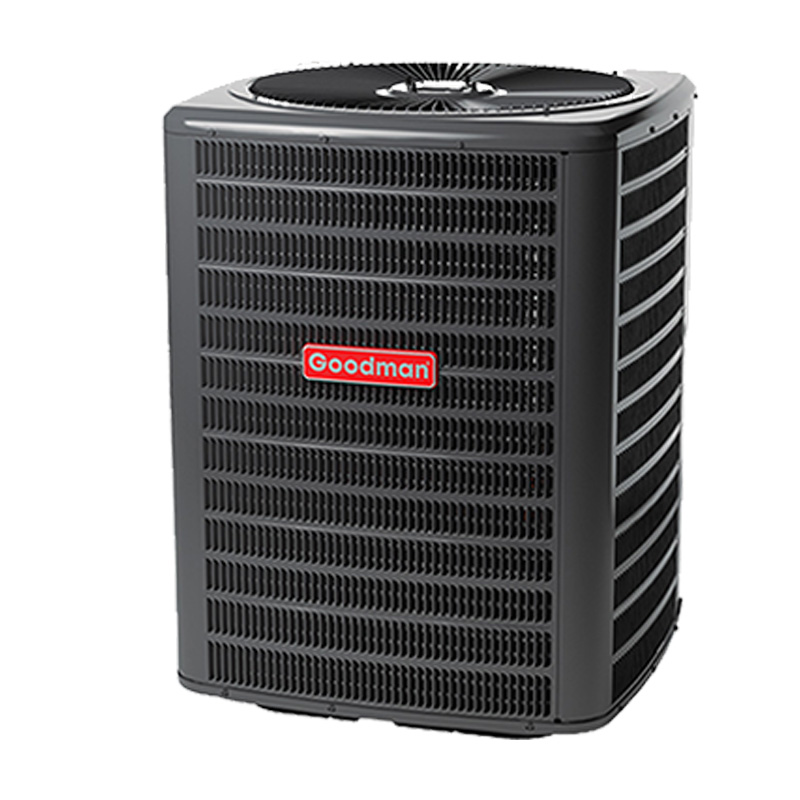
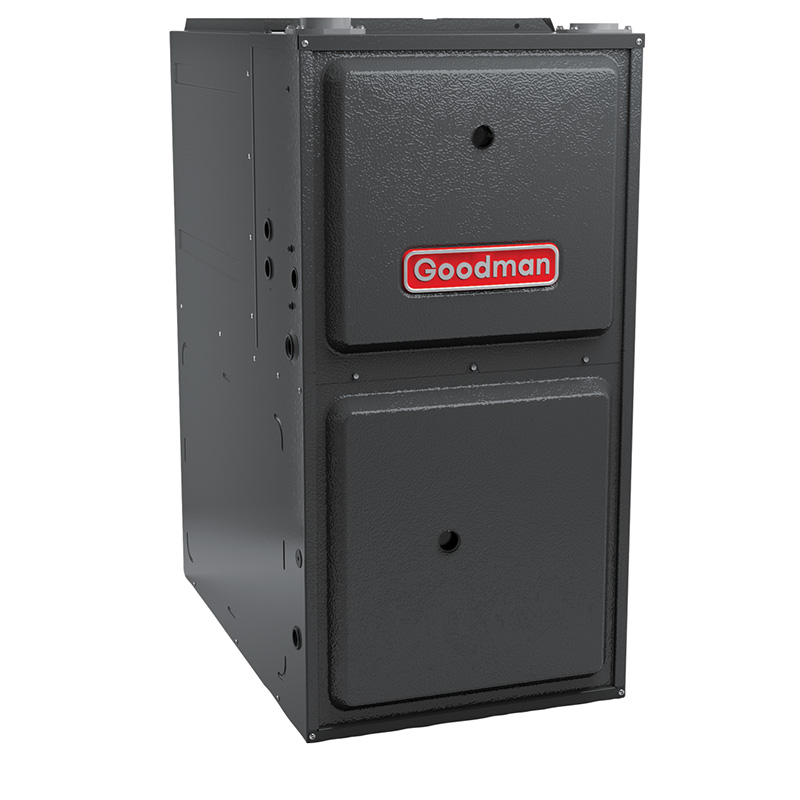
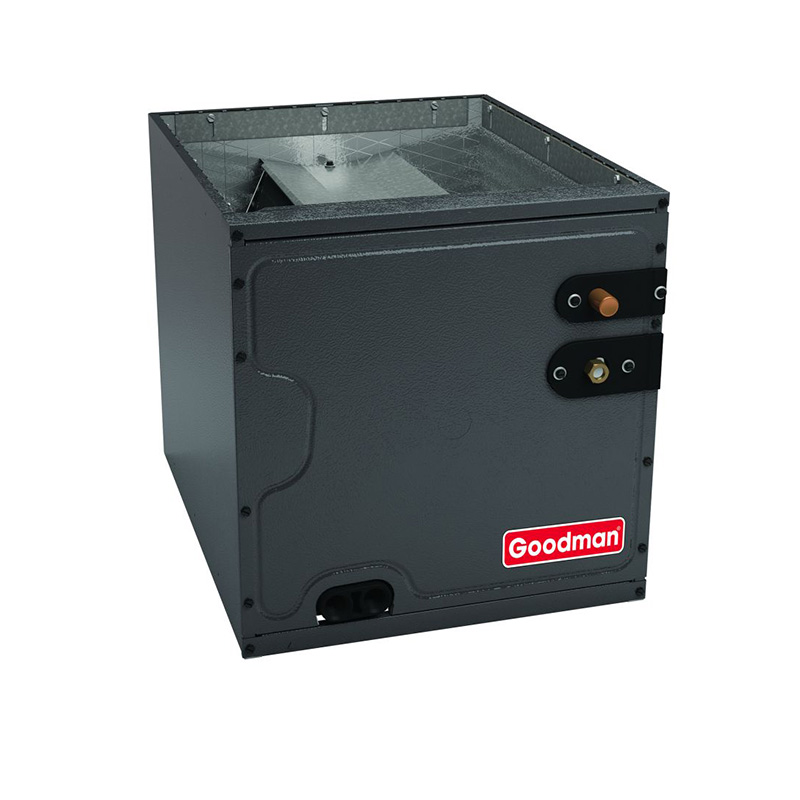
This Goodman package pairs a 5-ton, 13.6 SEER2 R-32 air condenser and matching evaporator coil with a 120,000 BTU, 96% AFUE upflow gas furnace. The result is a complete split system sized for larger homes, typically in the 2,400 to 3,000 square foot range depending on climate, insulation, and duct layout. The 96% AFUE rating means only four cents of every heating dollar escapes as exhaust, putting this furnace in the high-efficiency tier and making it eligible for federal tax credits in most years. The switch to R-32 refrigerant reflects current regulatory direction: R-32 has a lower global warming potential than the R-410A it replaces, and supply should remain stable as the industry moves away from older refrigerants.
The 13.6 SEER2 efficiency rating sits at the entry point of current federal minimums for most U.S. climate regions, so this is not a premium-efficiency cooling system. Homeowners in regions with long, hot summers may find the energy savings from a higher-SEER2 unit pay back the price difference over time. What this system does offer is a complete, matched assembly at a price point well below comparable tonnage from Trane, Carrier, or Lennox, making it a practical choice for budget-conscious buyers who are replacing aging equipment and prioritize upfront cost. The upflow configuration is the most common furnace orientation and suits homes where the air handler sits in a basement or utility closet with ductwork running upward.
This Goodman system delivers high-efficiency heating and code-compliant cooling in a matched package at a price that undercuts the major premium brands by a meaningful margin. The trade-off is a cooling efficiency that just clears the federal minimum, a compressor lifespan that historically trails premium competitors, and a reliability record that depends heavily on who installs and maintains it. Buyers who budget for routine maintenance and use a quality installer tend to get acceptable service life; those who cut corners on labor often see the documented failure points emerge sooner.
Overall score is the average of the five ratings above.
What we like
- 96% AFUE furnace meaningfully reduces winter gas bills versus 80% AFUE equipment
- Complete matched system reduces compatibility guesswork and simplifies permitting
- R-32 refrigerant aligns with current and near-future regulatory standards
- Purchase price typically 15 to 25 percent below Trane, Carrier, and Lennox equivalents
- Upflow configuration suits the most common residential duct layout
Trade-offs
- 13.6 SEER2 is entry-level cooling efficiency; higher-SEER2 options exist in the same price tier from Goodman itself
- Dual-run capacitors are a well-documented early failure point, though repairs typically run $300 to $600
- Compressor lifespan averages 10 to 14 years versus 15 to 20 years reported for premium-brand compressors
- Evaporator coil leaks and first-year refrigerant loss appear in a meaningful share of owner accounts, often tied to install quality
What homeowners and pros say about Goodman
Homeowners who track Goodman on ConsumerAffairs give it roughly 2.5 out of 5, a score shaped partly by the platform’s tendency to attract complaints rather than satisfied customers. The recurring theme in those reviews is repair costs that start climbing after about year seven, with dual-run capacitor failures and evaporator coil leaks cited most often. Google dealer reviews paint a somewhat more balanced picture at around 3.8 out of 5 across hundreds of reviews per location, where the most consistent praise is affordability at the time of purchase. A minority of owners report refrigerant leaks in the first year, something HVAC technicians typically attribute to install or initial charge issues rather than a defect in the equipment itself.
Among HVAC professionals, the consensus on Goodman for a system like this 5-ton, 96% AFUE package is roughly consistent: the equipment is adequate when it is installed carefully and maintained on a regular schedule, but it leaves less margin for error than premium brands. Compressors on Goodman condensers tend to average 10 to 14 years in real-world service, compared to the 15 to 20 years more commonly reported for Trane, Carrier, and Lennox compressors at similar usage levels. Technicians who work on a lot of Goodman equipment stock capacitors routinely because the call volume for that repair is predictable. The overall picture is a system that earns its lower price point honestly, delivering reasonable performance when conditions are right and asking the owner to stay on top of maintenance rather than simply setting and forgetting it.
Sources: ConsumerAffairs Goodman owner reviews, AHRI Directory of Certified Product Performance, U.S. DOE appliance and equipment efficiency standards, Goodman product specification sheets.
What it costs to run
At 13.6 SEER2, cooling this 5-ton system for a typical 1200-hour cooling season at the U.S. average electricity rate of $0.17/kWh works out to roughly $900 per year in cooling, about $13 less per year than a minimum-efficiency 13.4 SEER2 unit of the same size. Your real cost depends on your climate and local rate.
Method: (60,000 BTU/hr ÷ 13.6 SEER2) × 1200 hours ÷ 1000 × $0.17/kWh. Rate source: U.S. EIA average; cooling hours: moderate-climate estimate.
How it compares
| Brand | Comparable model | SEER2 | Stage | Price position |
|---|---|---|---|---|
| Goodman | GMVC96 / GSXH5 / CAPF series | 13.6 | Single-stage | Value pick |
| Carrier | Comfort 24ACC6 / 58TP series | 13.8 to 14.3 | Single-stage | Typically 15 to 25 percent more than this Goodman system |
| Trane | XR14 / S9X1 series | 14.0 to 14.5 | Single-stage | Typically 15 to 25 percent more than this Goodman system |
| Lennox | Merit ML14XC1 / ML195 series | 14.0 | Single-stage | Typically 15 to 25 percent more than this Goodman system |
Competitor rows are comparable single-stage units at similar efficiency; price is relative position, not a quote.
Questions about this system
Is 13.6 SEER2 going to cost me significantly more to run than a higher-efficiency unit?
Compared to a 16 SEER2 system, a 13.6 SEER2 unit uses roughly 15 to 18 percent more electricity for the same cooling output. In a hot climate with long summers, that gap can add up over the life of the system, so it is worth pricing out a higher-SEER2 model if cooling costs are a major concern. In mild climates with shorter cooling seasons, the payback period on a more efficient unit stretches considerably.
What does R-32 refrigerant mean for me as the owner?
R-32 is mildly flammable, which means only certified technicians should handle it, but that is already a legal requirement for refrigerant work. From a practical standpoint, R-32 equipment is widely serviced today and refrigerant availability is expected to be stable as the industry moves away from R-410A. You should not notice any difference in day-to-day operation.
How likely am I to need a capacitor replacement, and what does that cost?
Dual-run capacitor failure is the most commonly reported repair on Goodman equipment. It is a relatively simple fix that typically runs $300 to $600 with a service call, and most units will need at least one replacement over a 10 to 15 year lifespan. Keeping a service contract or scheduling annual tune-ups helps catch a weakening capacitor before it strands you on a hot day.
Does Goodman's warranty on this system cover parts and labor?
Goodman's registered warranty generally covers parts for ten years on the compressor, heat exchanger, and other covered components, but labor is not included. You will pay out of pocket for a technician's time on any warranty repair, which is a meaningful cost difference from some premium-brand extended warranties that bundle labor coverage.
Will any licensed HVAC contractor be able to install this, or do I need a Goodman dealer?
Any licensed HVAC contractor can install this system, but the installer must be EPA 608 certified to handle R-32 refrigerant, which is standard for any refrigerant-certified tech. To activate the full ten-year registered warranty, the system typically needs to be registered within 60 days of installation, often through the contractor or directly on Goodman's website. Using an experienced installer matters more than brand affiliation, because install quality is the single biggest factor in how long Goodman equipment lasts.
Specifications
| Cooling capacity | 5 Ton |
| Efficiency | 13.6 SEER2 |
| Furnace output | 120000 BTU |
| Furnace efficiency | 96% AFUE |
| Configuration | Upflow |
| Refrigerant | R-32 |