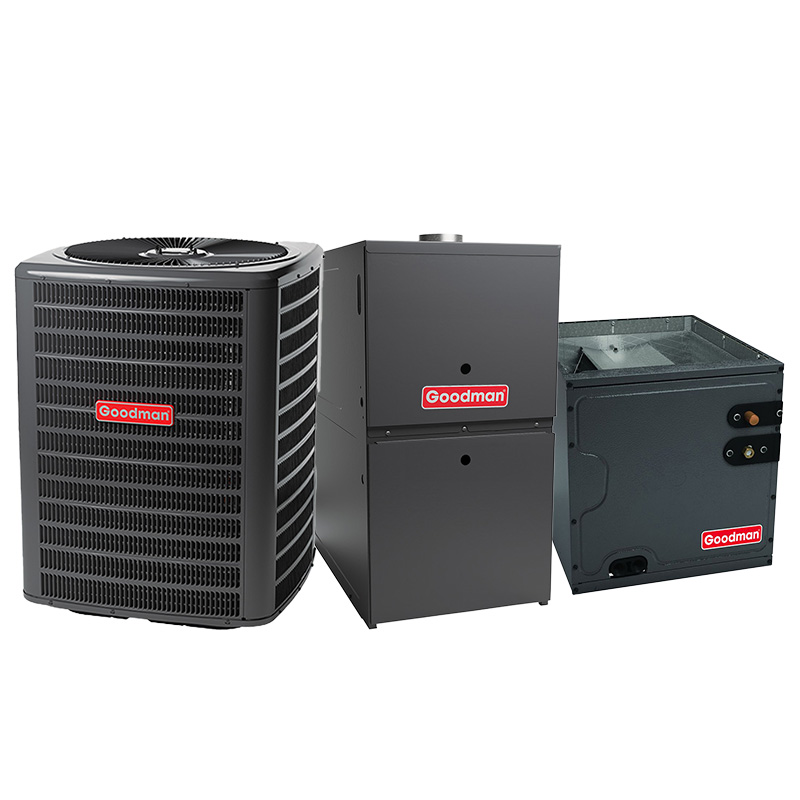
Goodman 5 Ton 14.3 SEER2 AC & Gas Furnace System – Two Stage Variable-Speed 100000 BTU Gas Furnace, 80% AFUE, Upflow, R32
View on AC Direct see your lowest price →Check current price on AC Direct →
Key features
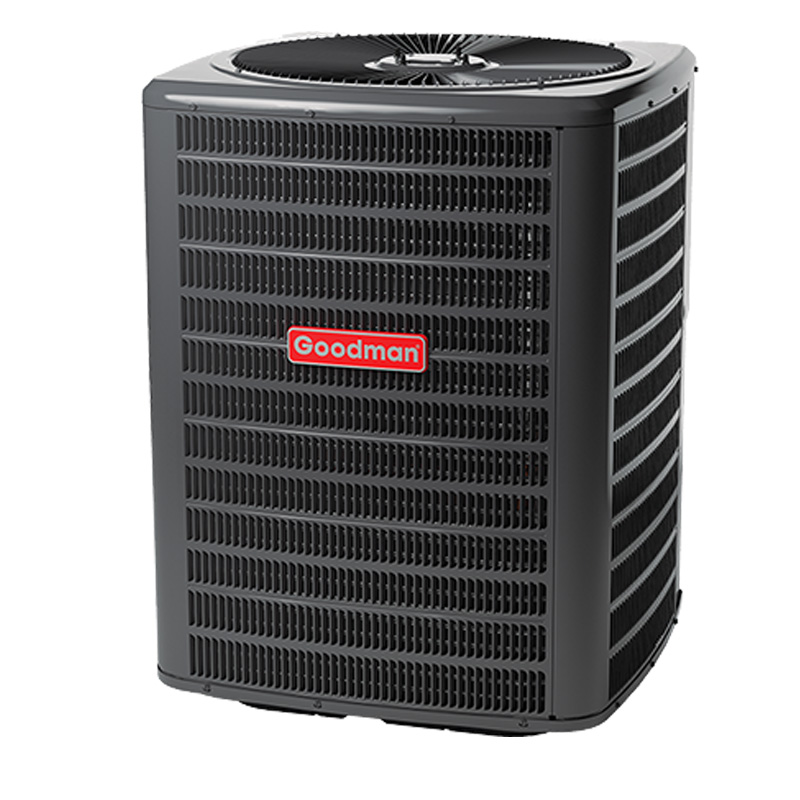
- Two-stage 5-ton AC compressor reduces short-cycling and improves humidity control on part-load days
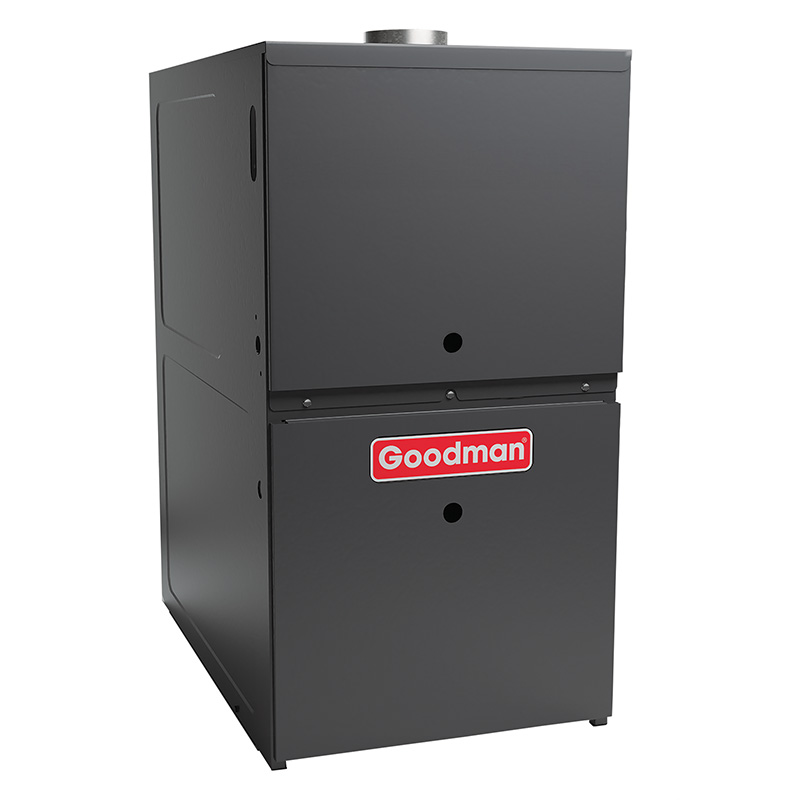
- Variable-speed ECM furnace blower delivers quieter, more even airflow compared to single- or multi-speed alternatives
- 100,000 BTU upflow gas furnace rated 80% AFUE, suited for moderate to cold climates with standard flue venting
- R-32 refrigerant with lower global warming potential than R-410A and reduced refrigerant costs if service is needed
- 14.3 SEER2 efficiency rating meets current federal minimums and qualifies for standard utility rebates in most regions
- Upflow cabinet orientation compatible with most basement, utility room, and ground-floor closet installations
About this system
The Goodman 5-ton, 14.3 SEER2 split system pairs a two-stage air conditioner with a variable-speed, 100,000 BTU upflow gas furnace rated at 80% AFUE. At 5 tons, this system is sized for larger homes, typically in the 2,400 to 3,000 square foot range depending on climate zone, insulation, and duct layout. The two-stage cooling compressor runs at a lower capacity on mild days and ramps up only when demand requires it, which reduces short-cycling, lowers humidity levels, and cuts energy use compared to single-stage equipment at a similar SEER2 rating.
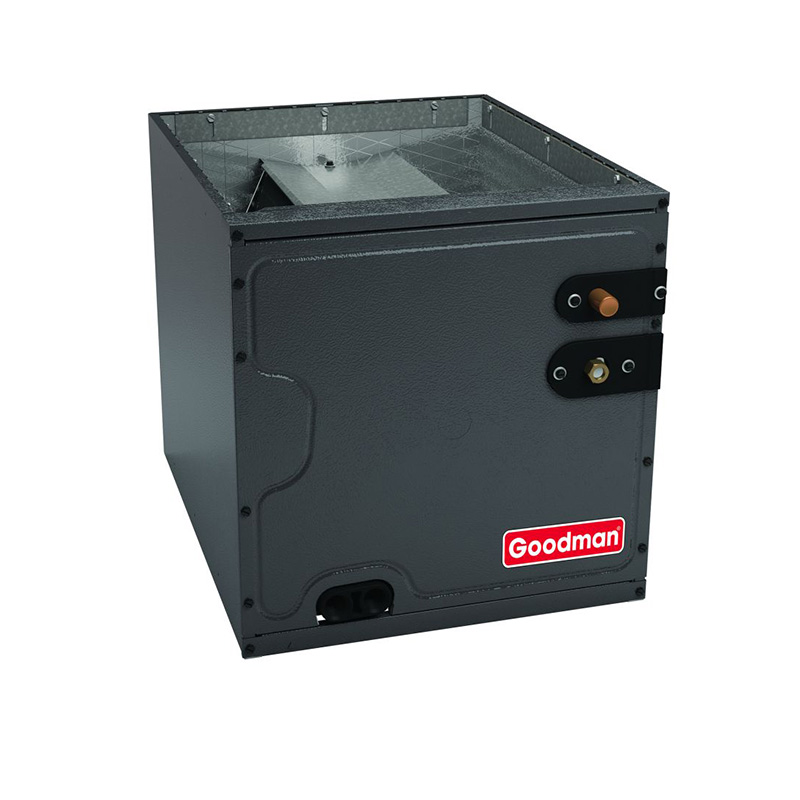
The variable-speed furnace blower is the standout spec here. Unlike fixed-speed blowers, it ramps airflow up and down to match demand, which means quieter operation, more even temperatures room to room, and better dehumidification when paired with the AC. The 80% AFUE rating means one-fifth of combustion energy exits as exhaust, so homeowners in very cold climates may want to weigh a 96% AFUE alternative. R-32 refrigerant replaces the older R-410A and carries a lower global warming potential, which also means somewhat lower refrigerant costs if a top-off is ever needed. The upflow configuration requires the furnace to sit below the coil with air discharging upward, the standard arrangement for most basement and closet installs.
This system suits a homeowner who needs reliable whole-home comfort in a large space, wants two-stage and variable-speed performance without the price of a premium brand, and is comfortable with the understanding that Goodman’s long-term track record depends heavily on who installs it and how well the refrigerant charge is set at startup.
This Goodman bundle gives large-home buyers two-stage cooling and variable-speed heating at a price point that undercuts comparable Carrier, Trane, and Lennox systems by a meaningful margin. The comfort features are real and the specs are solid for the money, but the brand's documented repair history after year seven and its compressor longevity gap versus premium brands are trade-offs a buyer should weigh before committing. A quality installation by a certified technician is not optional here; it is the single largest predictor of how long this system performs.
Overall score is the average of the five ratings above.
What we like
- Priced roughly 15 to 25 percent below comparable Trane, Lennox, and Carrier equipment
- Two-stage compressor and variable-speed blower together provide noticeably better humidity control and comfort than single-stage systems
- R-32 refrigerant lowers environmental impact and can reduce top-off costs compared to R-410A
- Variable-speed ECM blower cuts operating noise and can reduce fan electricity use over the life of the system
- 80% AFUE furnace uses standard venting, keeping installation simpler and less expensive than high-efficiency 96%+ units requiring PVC exhaust
Trade-offs
- 80% AFUE leaves 20% of fuel energy as exhaust heat, a real cost gap versus 96% AFUE furnaces for homeowners in cold climates with high heating loads
- Goodman compressors average 10 to 14 years in owner reports, a shorter lifespan than the 15 to 20 years more commonly seen with premium brands
- Dual-run capacitor failures are the most frequently documented repair, and evaporator coil leaks appear in a meaningful share of owner reviews
- A minority of owners report refrigerant leaks in the first year, typically tied to install or initial charge quality rather than the equipment itself
What homeowners and pros say about Goodman
Homeowners who post about Goodman equipment on review platforms tend to split into two camps. On ConsumerAffairs, where the brand scores around 2.5 out of 5, the loudest complaints center on repair costs that start climbing after roughly year seven, with capacitor replacements and coil leaks as the most repeated grievances. On Google dealer review pages, where Goodman equipment earns closer to 3.8 out of 5 across hundreds of reviews per location, the tone is more favorable and affordability is the most common point of praise. The gap between those two scores reflects something real: owners who had a smooth install and a reliable contractor tend to report satisfaction, while those who ran into early failures or poor service are the ones most likely to leave a detailed complaint.
HVAC technicians who work on Goodman equipment regularly point to install quality as the variable that matters most for this brand. Dual-run capacitor failures are the repair call they see most often, described as a quick and relatively low-cost fix in the $300 to $600 range, but a sign that the system is being worked hard. Evaporator coil leaks and refrigerant loss in the first year, which pros attribute more often to charge errors at startup than to the equipment itself, are the failure modes that generate the more frustrated owner reviews. Compressor lifespan running in the 10 to 14 year range rather than the 15 to 20 years seen with premium brands is a documented reality that factors into the total cost of ownership calculation, particularly on a large 5-ton system where compressor replacement is a significant expense.
Sources: ConsumerAffairs Goodman owner reviews, AHRI Directory of Certified Product Performance, U.S. DOE appliance and equipment efficiency standards, Goodman product specification sheets.
What it costs to run
At 14.3 SEER2, cooling this 5-ton system for a typical 1200-hour cooling season at the U.S. average electricity rate of $0.17/kWh works out to roughly $856 per year in cooling, about $57 less per year than a minimum-efficiency 13.4 SEER2 unit of the same size. Your real cost depends on your climate and local rate.
Method: (60,000 BTU/hr ÷ 14.3 SEER2) × 1200 hours ÷ 1000 × $0.17/kWh. Rate source: U.S. EIA average; cooling hours: moderate-climate estimate.
How it compares
| Brand | Comparable model | SEER2 | Stage | Price position |
|---|---|---|---|---|
| Goodman | GSZ2 / GMVC8 Series (this system) | 14.3 | two-stage | Value pick |
| Carrier | Comfort 14 / 59SC5 Series | 14.3 | single-stage | Typically 15 to 25 percent more than this Goodman system |
| Trane | XR14 / S8X1 Series | 14.3 | single-stage | Typically 15 to 25 percent more than this Goodman system |
| Lennox | Merit 14 / ML14 Series | 14.3 | single-stage | Typically 15 to 25 percent more than this Goodman system |
Competitor rows are comparable single-stage units at similar efficiency; price is relative position, not a quote.
Questions about this system
Is 5 tons the right size for my home?
A 5-ton system is generally appropriate for homes in the 2,400 to 3,000 square foot range, but the correct size depends on your climate zone, insulation levels, window area, and ceiling height. An oversized system will short-cycle and leave humidity high; an undersized one will run constantly. Ask your installer to perform a Manual J load calculation before ordering.
Why does this furnace use 80% AFUE instead of 96% or higher?
An 80% AFUE furnace vents through a standard metal flue, which simplifies installation and lowers labor cost, especially in homes where PVC drain lines for a high-efficiency unit would be difficult to route. The trade-off is that roughly 20 cents of every dollar in gas cost exits as exhaust. If your heating season is long or gas prices are high in your area, the efficiency upgrade may pay back over time.
What does the variable-speed blower actually do for comfort?
The variable-speed ECM motor adjusts airflow continuously rather than switching between fixed high and low settings. In practice this means the system runs longer at lower speeds, which pulls more moisture out of the air during cooling season, reduces temperature swings between cycles, and operates at lower noise levels most of the time.
What are the most common repairs I should budget for over the life of this system?
Dual-run capacitor failure is the most frequently reported issue across Goodman equipment and typically costs between $300 and $600 to repair. Evaporator coil leaks appear in a meaningful share of long-term owner reviews and can be more expensive to address. Compressor replacement is the major cost risk if the unit reaches the 10 to 14 year range without a warranty still in force.
Does this system use R-32 refrigerant, and does that affect service costs?
Yes, this system is charged with R-32, which has a lower global warming potential than the R-410A common in older equipment. R-32 is widely available and currently costs less per pound than R-410A, so top-off or recharge service calls are somewhat less expensive. Note that R-32 is mildly flammable, classified as A2L, so service must be performed by a technician familiar with A2L handling procedures.
Specifications
| Cooling capacity | 5 Ton |
| Efficiency | 14.3 SEER2 |
| Furnace output | 100000 BTU |
| Furnace efficiency | 80% AFUE |
| Configuration | Upflow |
| Refrigerant | R-32 |