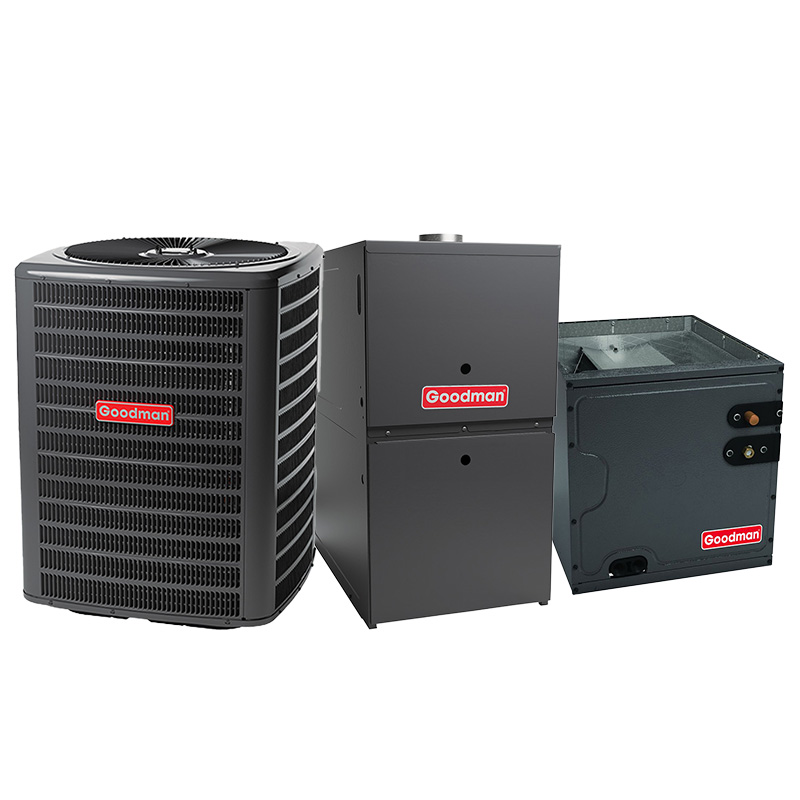
Goodman 5 Ton 14.3 SEER2 AC & Gas Furnace System – Two Stage Variable-Speed 80000 BTU Gas Furnace, 80% AFUE, Upflow, R32
View on AC Direct see your lowest price →Check current price on AC Direct →
Key features
- 5-ton two-stage compressor reduces short-cycling and improves comfort in larger homes
- 14.3 SEER2 efficiency meets current federal minimum standards for most U.S. climate regions
- Variable-speed furnace blower provides consistent airflow and quieter operation
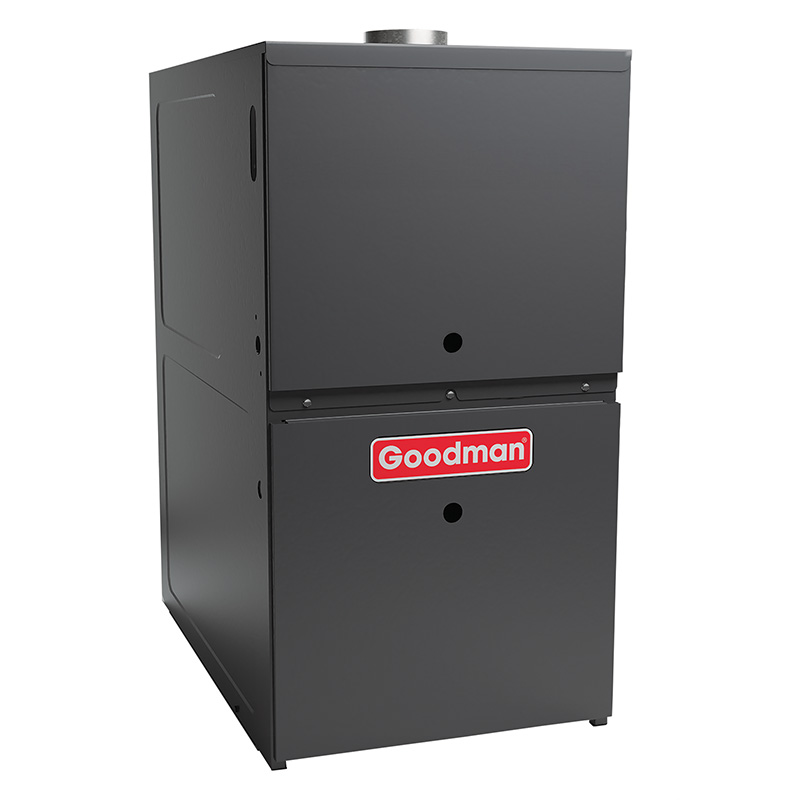
- 80,000 BTU, 80% AFUE upflow gas furnace suits basements and utility closet installations
- R-32 refrigerant offers a lower global-warming potential than the outgoing R-410A standard
- Goodman factory warranty covers the compressor and heat exchanger for 10 years with registration
About this system
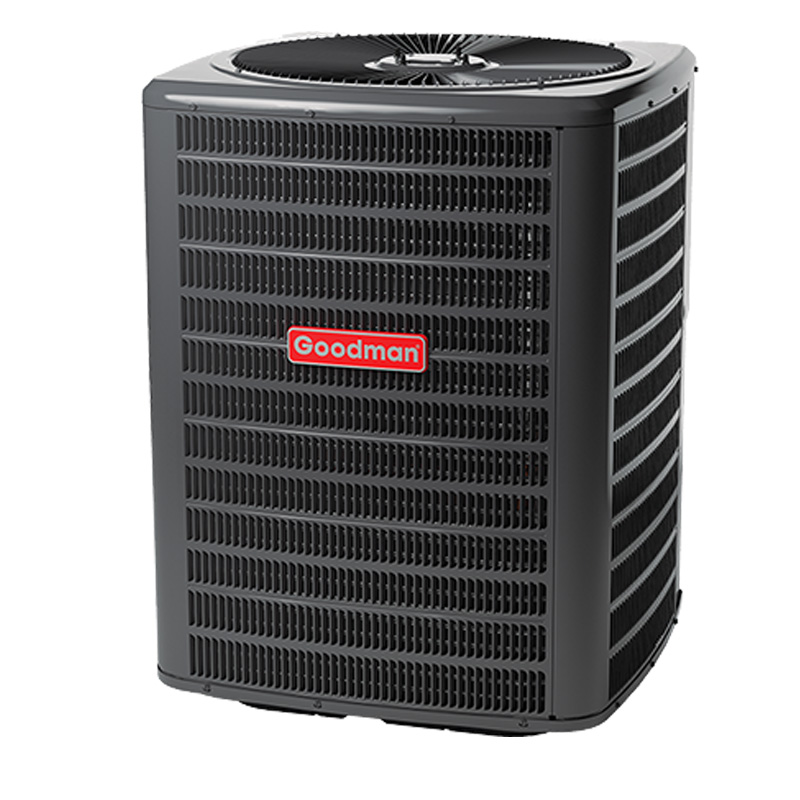
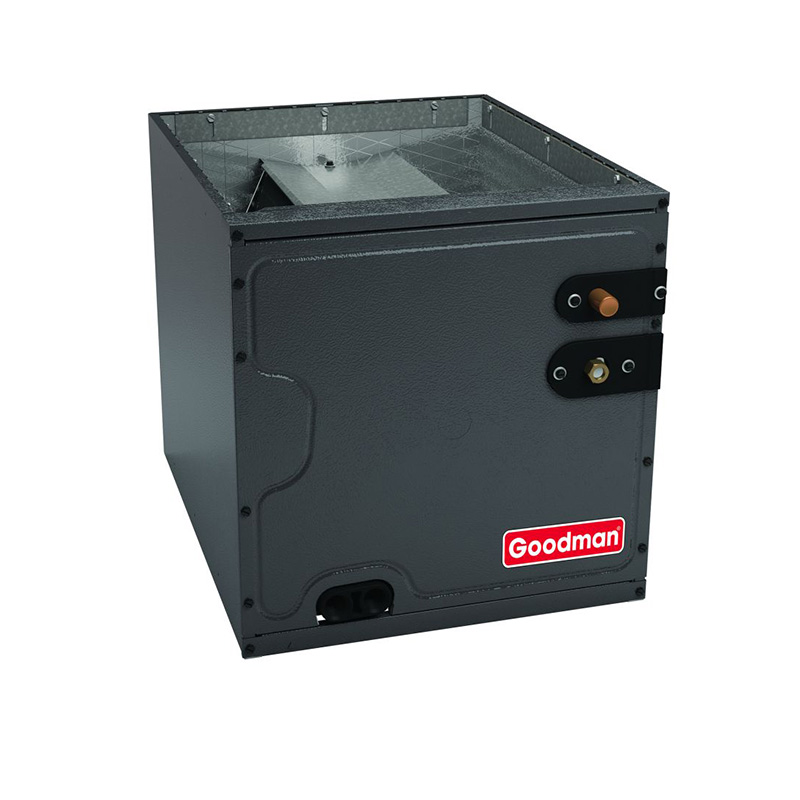
The Goodman 5-ton, 14.3 SEER2 split system pairs a two-stage air conditioner with a variable-speed, 80,000 BTU, 80% AFUE upflow gas furnace. At 5 tons, this system is sized for larger homes, typically in the 2,400 to 3,000 square foot range depending on climate, insulation, and ceiling height. The two-stage compressor is a meaningful upgrade over single-stage units: it runs at low capacity during mild weather, reducing short-cycling, evening out temperatures room to room, and lowering energy bills compared to a compressor that is either fully on or fully off. The variable-speed air handler fan reinforces that by modulating airflow continuously rather than blasting at one fixed speed.
The 80% AFUE furnace rating means 80 cents of every dollar spent on gas becomes heat, with 20 cents lost through the flue. That is the federal minimum for most northern climate zones and a reasonable baseline for moderate climates, though homeowners in cold regions should weigh whether a 96% or 98% AFUE unit would recover its price premium through fuel savings. R-32 refrigerant is the newer, lower global-warming-potential alternative to R-410A, and its growing adoption means parts availability is improving steadily. The upflow configuration suits homes with a basement or utility closet where the furnace sits below the ductwork, blowing conditioned air upward.
This system occupies the value tier. Goodman positions itself 15 to 25 percent below Trane, Lennox, and Carrier for comparable equipment, and that gap is real and consistent. The trade-off is that Goodman’s long-term reliability record is more mixed than premium brands, and how well this system performs over its lifespan is closely tied to installation quality and routine maintenance. Buyers who hire a licensed, experienced installer and keep up with filter changes and annual tune-ups typically get solid service; those who cut corners on install often see problems surface earlier.
This Goodman bundle offers a legitimate two-stage, variable-speed system at a price point that undercuts major premium brands by a meaningful margin, making it a reasonable choice for cost-conscious buyers who prioritize upfront savings. The 14.3 SEER2 and 80% AFUE ratings are entry-level numbers, not headline performers, and Goodman's reliability record is decent but not class-leading. Buyers should budget for possible capacitor replacements after several years and factor in the cost of a skilled installer, since this system's long-term outcome depends heavily on how well it goes in.
Overall score is the average of the five ratings above.
What we like
- Two-stage compressor improves temperature consistency and reduces energy use on mild days compared to single-stage alternatives
- Variable-speed blower provides quieter, more even airflow than fixed-speed units at this price tier
- R-32 refrigerant is modern, widely available, and more environmentally responsible than R-410A
- Upfront cost is typically 15 to 25 percent below comparable Trane, Carrier, and Lennox systems
- 10-year parts warranty with registration is competitive for a value-tier brand
Trade-offs
- 80% AFUE is the federal minimum in many regions and will cost more to operate over time than a high-efficiency furnace, especially in cold climates
- Dual-run capacitor failures are the most commonly reported issue, typically surfacing after year five to seven and costing $300 to $600 to fix
- Compressor lifespan averages 10 to 14 years versus 15 to 20 years for premium brands, meaning potential replacement costs come sooner
- A minority of owners report refrigerant leaks within the first year, which usually points to an installation or charge error rather than a defective unit but still creates early service calls
What homeowners and pros say about Goodman
Homeowners who choose Goodman tend to fall into two camps, and their experiences reflect that divide pretty clearly. Those who had a careful, experienced installer and stuck to annual maintenance often report years of reliable service and point to the lower upfront cost as a genuine win. Those who ran into problems early, usually refrigerant leaks within the first year or capacitor failures not long after, are well represented in Goodman’s ConsumerAffairs score, which sits at roughly 2.5 out of 5. That channel skews toward people with complaints, but the recurring theme, repair costs climbing after about year seven, is consistent enough to take seriously. Google dealer reviews land closer to 3.8 out of 5, where affordability comes up most often as the reason buyers chose the brand in the first place.
HVAC technicians who regularly service Goodman equipment tend to have a pragmatic take on it. The dual-run capacitor is the component they replace most often on these condensing units, typically a low-stakes fix in the $300 to $600 range, but one that comes up more frequently than on premium brands. Evaporator coil leaks show up in a meaningful share of owner reports and are more disruptive repairs. On compressor longevity, the honest expectation for a Goodman compressor is 10 to 14 years of service; premium brands commonly reach 15 to 20 years. For this specific two-stage, variable-speed bundle, the added comfort features are a real differentiator at the price point, but that long-term compressor gap is the honest cost of buying in the value tier.
Sources: ConsumerAffairs Goodman owner reviews, AHRI Directory of Certified Product Performance, U.S. DOE appliance and equipment efficiency standards, Goodman product specification sheets.
What it costs to run
At 14.3 SEER2, cooling this 5-ton system for a typical 1200-hour cooling season at the U.S. average electricity rate of $0.17/kWh works out to roughly $856 per year in cooling, about $57 less per year than a minimum-efficiency 13.4 SEER2 unit of the same size. Your real cost depends on your climate and local rate.
Method: (60,000 BTU/hr ÷ 14.3 SEER2) × 1200 hours ÷ 1000 × $0.17/kWh. Rate source: U.S. EIA average; cooling hours: moderate-climate estimate.
How it compares
| Brand | Comparable model | SEER2 | Stage | Price position |
|---|---|---|---|---|
| Goodman | GSXH5 / GMVC8 Series (this system) | 14.3 | Two-stage / Variable-speed | Value pick |
| Carrier | Comfort 24ACC6 with 58MVC Furnace | 14.3 to 15.2 | Single-stage / Variable-speed | Typically 15 to 25 percent more than this Goodman system |
| Trane | XR15 with S9V2 Furnace | 14.3 to 15.0 | Single-stage / Variable-speed | Typically 15 to 25 percent more than this Goodman system |
| Lennox | Merit ML14XC1 with ML196V Furnace | 14.3 to 15.0 | Single-stage / Variable-speed | Typically 15 to 25 percent more than this Goodman system |
Competitor rows are comparable single-stage units at similar efficiency; price is relative position, not a quote.
Questions about this system
Is 14.3 SEER2 good enough, or should I pay more for a higher-efficiency unit?
14.3 SEER2 is the current federal minimum for most regions, so it meets code but does not lead the market in efficiency. In hot climates where the AC runs heavily for five or more months, stepping up to a 16 or 17 SEER2 unit can recover the price difference through lower utility bills over several years. In moderate climates with shorter cooling seasons, the payback period stretches considerably, and the 14.3 SEER2 tier makes more financial sense.
Why does the furnace only have 80% AFUE, and does that matter for my climate?
80% AFUE is the federally mandated minimum for non-condensing upflow furnaces in many U.S. regions. For homeowners in the South or Southwest where the furnace runs infrequently, the efficiency gap between 80% and 96% AFUE rarely justifies the higher upfront cost. In the Midwest, Northeast, or mountain states where the furnace may run hundreds of hours each winter, a high-efficiency condensing furnace would typically pay back the cost difference in fuel savings within five to eight years.
What is the most likely repair this system will need, and what does it cost?
Based on documented owner experience, the dual-run capacitor is the most common failure point on Goodman condensing units, usually showing up after year five to seven. Capacitor replacement is a straightforward service call and typically runs $300 to $600 including labor. Evaporator coil leaks and refrigerant issues have also been reported by a meaningful share of owners, so keeping up with annual inspections helps catch small problems before they become expensive ones.
Does R-32 refrigerant affect my service costs compared to the old R-410A systems?
R-32 is increasingly common, and most licensed HVAC technicians either already carry it or can source it readily. Because R-32 operates at higher pressure than R-410A, service technicians need compatible gauges and recovery equipment, so confirm your service provider is equipped before scheduling any refrigerant work. Over time, R-32 is expected to remain more available and potentially more affordable than R-410A as the industry transitions away from higher-GWP refrigerants.
How important is the installer for a system like this, and what should I look for?
Installer quality is arguably the single largest variable in how this system performs and how long it lasts. Technicians who work on Goodman equipment consistently point to improper refrigerant charge, poor duct connections, and skipped commissioning steps as the root cause of early failures reported by owners. Look for an NATE-certified technician, ask for a Manual J load calculation to confirm the 5-ton sizing is correct for your home, and get a written startup checklist showing refrigerant charge was verified after installation.
Specifications
| Cooling capacity | 5 Ton |
| Efficiency | 14.3 SEER2 |
| Furnace output | 80000 BTU |
| Furnace efficiency | 80% AFUE |
| Configuration | Upflow |
| Refrigerant | R-32 |