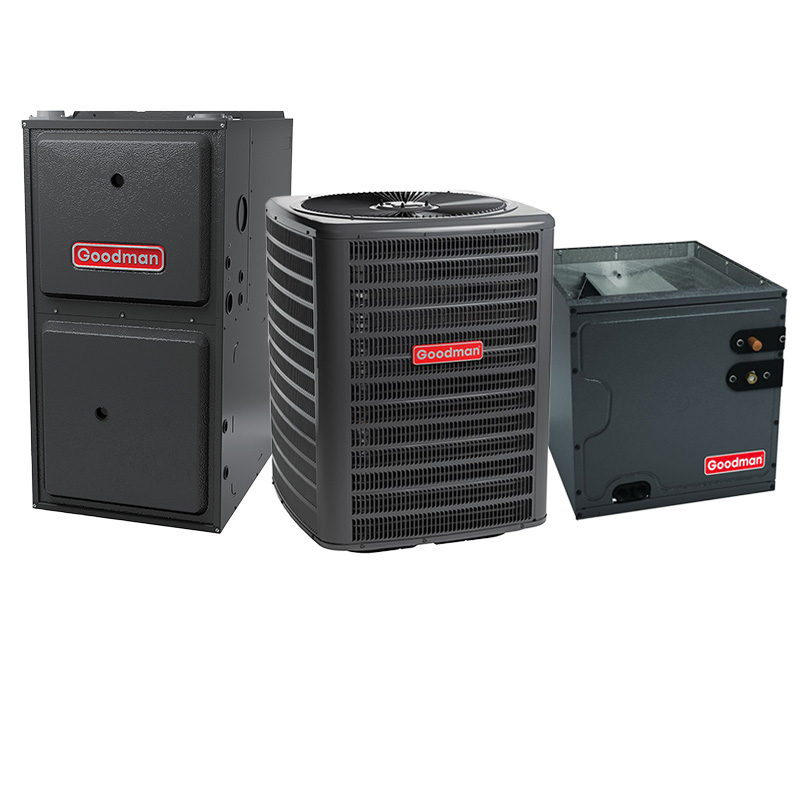
Goodman 5 Ton 14.5 SEER2 80000 BTU 80% AFUE Two Stage Multi-Speed ECM Gas Furnace System – Upflow | R32
View on AC Direct see your lowest price →Check current price on AC Direct →
Key features
- 5-ton cooling capacity rated at 14.5 SEER2 under current DOE test standards
- 80,000 BTU two-stage gas furnace at 80% AFUE for balanced output on mild and peak-demand days
- Multi-speed ECM blower motor for quieter airflow and improved humidity management
- R-32 refrigerant with lower global-warming potential than legacy R-410A
- Upflow configuration suited to basement or main-floor mechanical room installations
- Value-tier pricing typically 15 to 25 percent below comparable Trane, Carrier, and Lennox systems
About this system
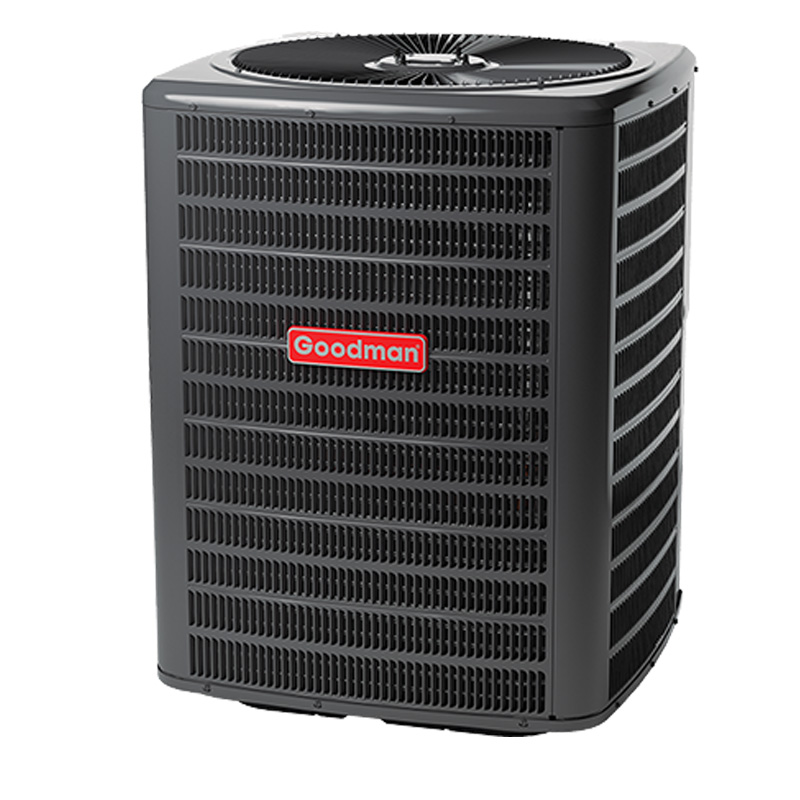
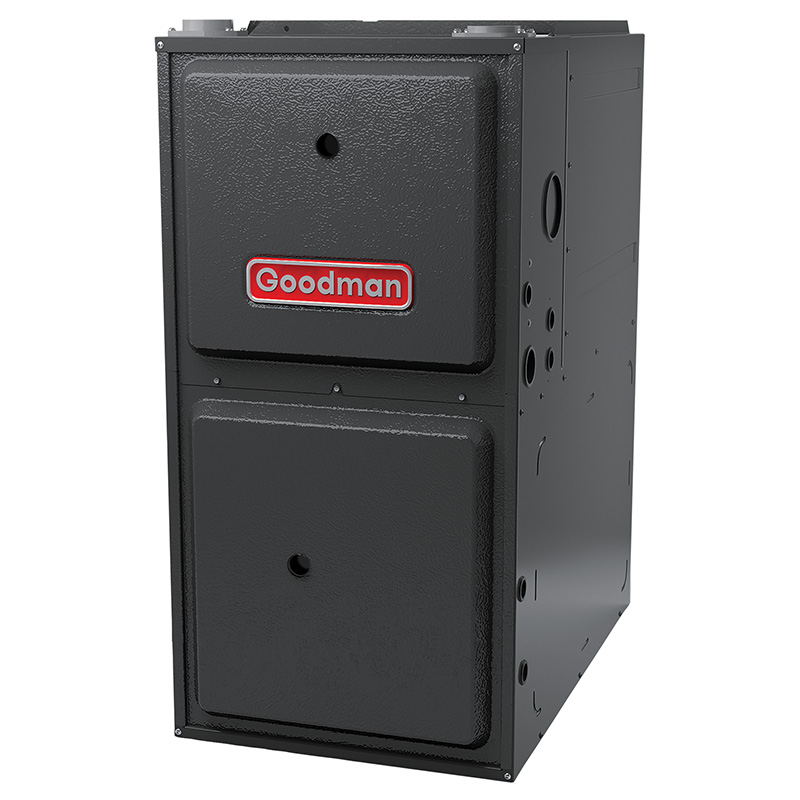
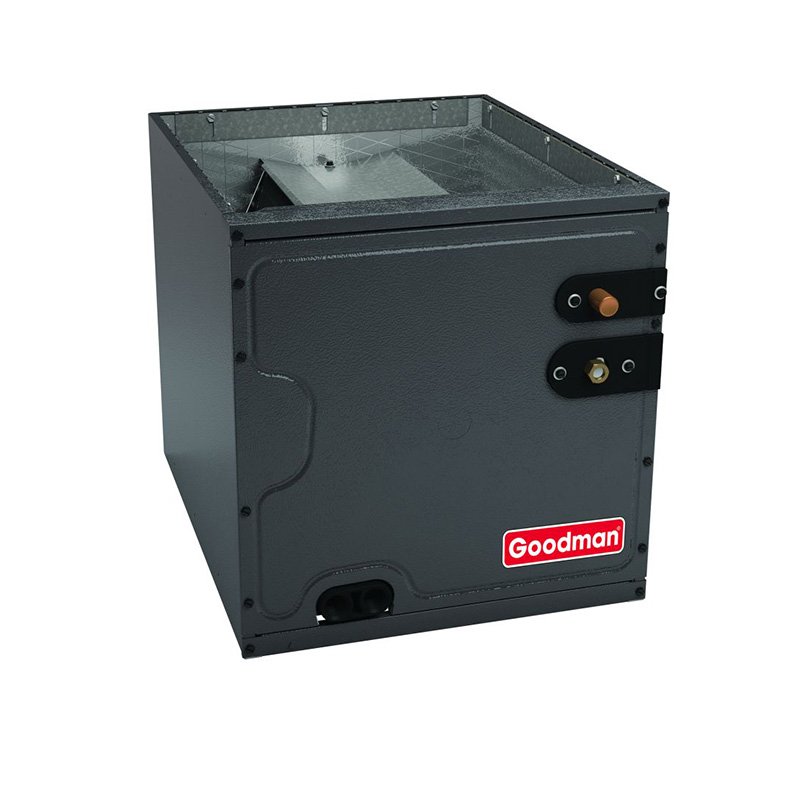
The Goodman GLXS4BA6010 pairs a 5-ton, 14.5 SEER2 split-system air conditioner with an 80,000 BTU, 80% AFUE two-stage gas furnace in an upflow configuration, making it a practical match for larger homes in the 2,500 to 3,500 square-foot range that need serious cooling capacity and moderate heating efficiency. The system uses R-32 refrigerant, a lower global-warming-potential option that is becoming standard across new residential equipment, and the furnace runs a multi-speed ECM blower motor, which delivers quieter operation and better humidity control than a standard single-speed motor without climbing to the cost of a fully variable-speed system.
Two-stage heating means the furnace operates at a lower firing rate on mild days and ramps to full output only when the load demands it, which translates to fewer short-cycling complaints and more even room temperatures compared to single-stage equipment. At 80% AFUE the furnace meets federal minimum efficiency standards for most of the country but falls short of the 90%-plus condensing tier, so homeowners in climates with long, cold heating seasons should weigh whether the higher upfront cost of a 96% AFUE unit would recover itself over time. The 14.5 SEER2 rating sits at the entry-level efficiency tier introduced under current DOE standards, satisfying minimum requirements in most regions while leaving room for premium alternatives that go higher.
Upflow configuration means the furnace draws return air from the bottom and discharges heated or cooled air upward, the standard arrangement for homes with a basement or first-floor mechanical room. Installation quality carries enormous weight with this brand specifically. A meticulous startup, proper refrigerant charge, and thorough duct sealing will determine more about long-term performance than almost any spec on the data sheet.
The Goodman GLXS4BA6010 is a capable, no-frills system for budget-conscious homeowners who understand they are trading some long-term reliability ceiling and premium support for a meaningful reduction in upfront cost. The two-stage furnace and ECM motor add real comfort value at this price point, but the 80% AFUE rating and 14.5 SEER2 efficiency are both entry-level numbers that premium brands routinely surpass. How long it lasts depends heavily on who installs it and how consistently it is maintained.
Overall score is the average of the five ratings above.
What we like
- Two-stage furnace reduces short cycling and provides more consistent room temperatures than single-stage alternatives at the same price tier
- ECM multi-speed blower motor improves humidity control and lowers blower electricity use compared to PSC motors
- R-32 refrigerant is a forward-looking choice with lower environmental impact than R-410A
- Upfront price is typically 15 to 25 percent below Trane, Lennox, and Carrier equipment of similar capacity
- Dual-run capacitor failures, the most commonly reported issue, are generally a straightforward low-cost repair in the 300 to 600 dollar range
Trade-offs
- Compressor lifespan averages 10 to 14 years versus 15 to 20 years documented for premium-brand compressors
- 80% AFUE is the federal minimum tier, not a high-efficiency furnace, and will cost more to operate in cold climates than 90-plus AFUE alternatives
- Evaporator coil leaks appear in a meaningful share of owner reports, and a minority of owners have reported refrigerant leaks within the first year
- ConsumerAffairs scores average around 2.5 out of 5, with recurring reports of rising repair costs after roughly year 7
What homeowners and pros say about Goodman
Homeowners who research Goodman before buying tend to land in two camps: those who appreciate the frank value proposition and those who wish they had read more reviews first. On Google dealer pages, Goodman equipment earns around 3.8 out of 5 across hundreds of reviews per location, and affordability is consistently the most praised attribute. ConsumerAffairs tells a harder story, with scores averaging around 2.5 out of 5, a platform that skews toward people motivated enough by frustration to write a review. The recurring theme there is repair costs climbing after roughly year 7, which lines up with the documented compressor lifespan average of 10 to 14 years versus the 15 to 20 years more typical of premium brands.
HVAC technicians who work on this specific product are consistent in one observation: the system they pull from the box is rarely the variable that determines a good or bad outcome. Dual-run capacitor failures are the most common service call on Goodman equipment and are usually a low-cost fix, but evaporator coil leaks show up in enough owner accounts to be worth noting, and a small share of owners have reported refrigerant issues within the first year that trace back to installation rather than the factory. For the GLXS4BA6010 specifically, the two-stage furnace and ECM motor are genuine comfort upgrades that are not always available at this price tier, and technicians generally regard those as well-executed features. The honest summary is that this system rewards careful installation and regular maintenance more than most, and punishes neglect faster than premium alternatives would.
Sources: ConsumerAffairs Goodman owner reviews, AHRI Directory of Certified Product Performance, U.S. DOE appliance and equipment efficiency standards, Goodman product specification sheets.
What it costs to run
At 14.5 SEER2, cooling this 5-ton system for a typical 1200-hour cooling season at the U.S. average electricity rate of $0.17/kWh works out to roughly $844 per year in cooling, about $69 less per year than a minimum-efficiency 13.4 SEER2 unit of the same size. Your real cost depends on your climate and local rate.
Method: (60,000 BTU/hr ÷ 14.5 SEER2) × 1200 hours ÷ 1000 × $0.17/kWh. Rate source: U.S. EIA average; cooling hours: moderate-climate estimate.
How it compares
| Brand | Comparable model | SEER2 | Stage | Price position |
|---|---|---|---|---|
| Goodman | GLXS4BA6010 (this system) | 14.5 | Two-stage furnace / single-stage condenser | Value pick |
| Carrier | Comfort 14 Series (24ACC4) | 14 to 15 | Single-stage | Typically 15 to 25 percent more than this Goodman |
| Trane | XR14 Series | 14 to 15 | Single-stage | Typically 15 to 25 percent more than this Goodman |
| Lennox | Merit ML14XC1 Series | 14 to 15 | Single-stage | Typically 15 to 25 percent more than this Goodman |
Competitor rows are comparable single-stage units at similar efficiency; price is relative position, not a quote.
Questions about this system
Is 14.5 SEER2 enough for my climate, or should I step up to a higher-efficiency unit?
14.5 SEER2 meets current federal minimum standards and is adequate in most moderate climates, but if you are in a hot, humid region where the system runs six or more months per year, a 16 or 17 SEER2 unit can reduce operating costs enough to partially offset its higher purchase price over time. For most northern climates with shorter cooling seasons, the payback math on stepping up is much longer.
What does R-32 refrigerant mean for me as a homeowner?
R-32 has a lower global-warming potential than R-410A and is increasingly common in new residential equipment. Practically speaking, it requires technicians who have the equipment and training to handle it safely, so confirm your service contractor is set up for R-32 before signing a maintenance agreement. Pricing for R-32 service calls may vary from what you have paid historically for R-410A work.
How important is installer quality with a Goodman system specifically?
More important than with premium brands, according to technicians who work on both. Goodman's performance and lifespan lean heavily on a correct refrigerant charge, properly sealed ductwork, and a thorough commissioning at startup. A minority of owners who report refrigerant leaks within the first year are typically dealing with an install or charge issue rather than a factory defect.
The furnace is 80% AFUE. Should I have gone with 96% instead?
The 80% AFUE furnace costs less to purchase and install because it does not require PVC condensate piping, but it exhausts more heat through the flue than a condensing unit. If your heating bills are a significant concern and your climate has four or more cold months per year, the 96% AFUE option often justifies its upfront premium over a typical system lifespan. If you are in the South or Southwest where heating is minimal, 80% is usually fine.
What are the most likely repair costs I should budget for over the life of this system?
Dual-run capacitors are the most commonly documented failure point on Goodman equipment and typically cost 300 to 600 dollars to replace, which is a manageable expense. Evaporator coil leaks appear in a meaningful share of owner reviews and can be considerably more expensive depending on coil availability and labor. Compressors on this platform average roughly 10 to 14 years, so budgeting for a potential compressor replacement or system replacement in that window is realistic.
Specifications
| Cooling capacity | 5 Ton |
| Efficiency | 14.5 SEER2 |
| Furnace output | 80000 BTU |
| Furnace efficiency | 80% AFUE |
| Configuration | Upflow |
| Refrigerant | R-32 |
| Model | GLXS4BA6010 |