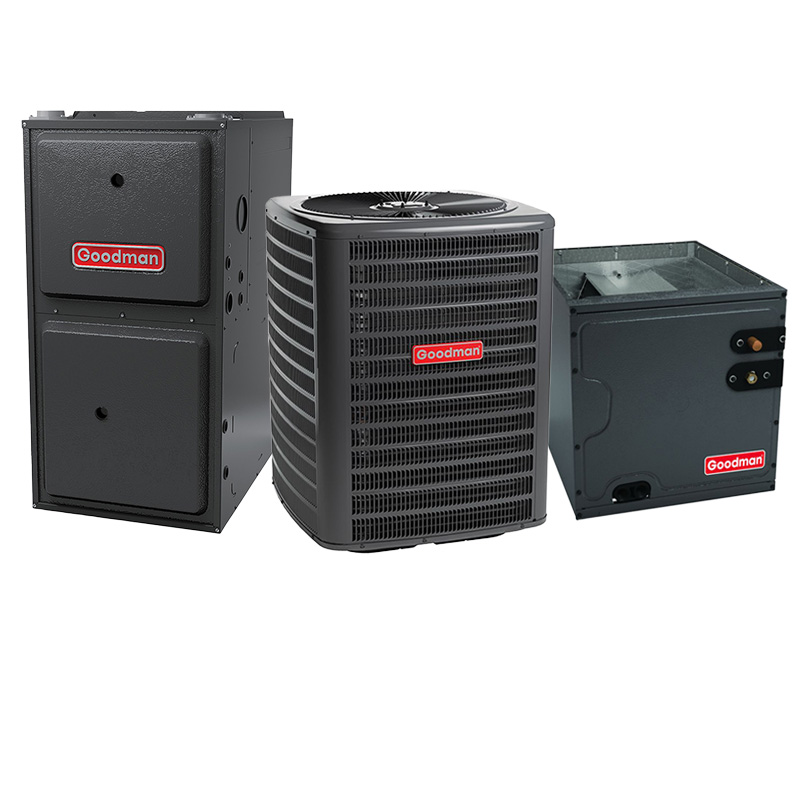
Goodman 5 Ton 14 SEER2 100000 BTU 80% AFUE Two Stage Multi-Speed ECM Gas Furnace System – Upflow | R32
View on AC Direct see your lowest price →Check current price on AC Direct →
Key features
- 5-ton cooling capacity paired with 100,000 BTU two-stage gas heating
- 14 SEER2 efficiency rating meets current federal minimum standards
- 80% AFUE furnace recovers 80 cents of heat energy per dollar of gas burned
- Multi-speed ECM blower motor reduces energy use and improves airflow consistency
- R-32 refrigerant with lower global warming potential than R-410A
- Upflow configuration designed for basement or ground-level air handler placement
About this system
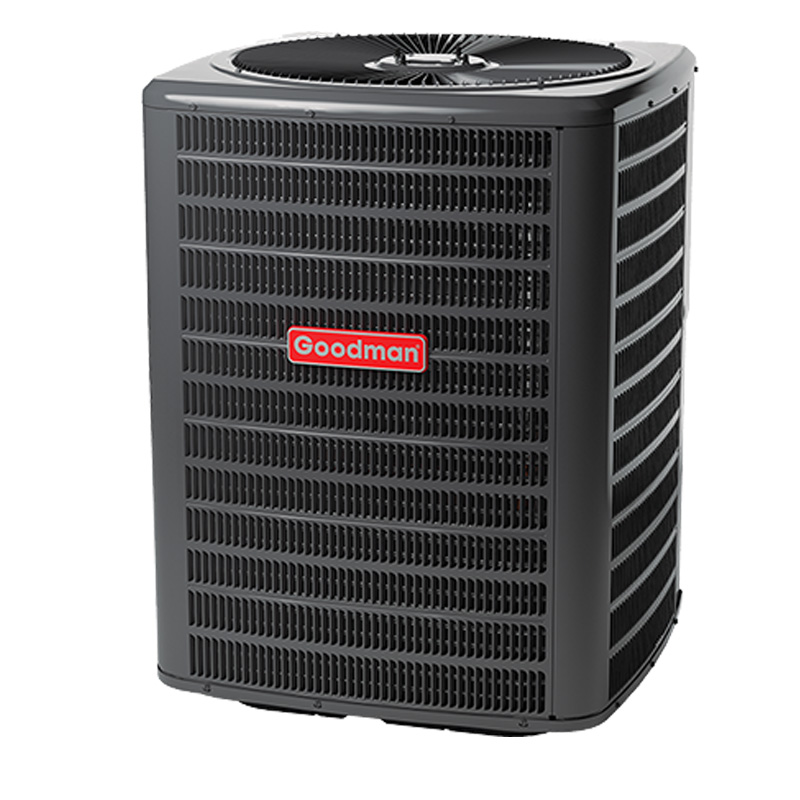
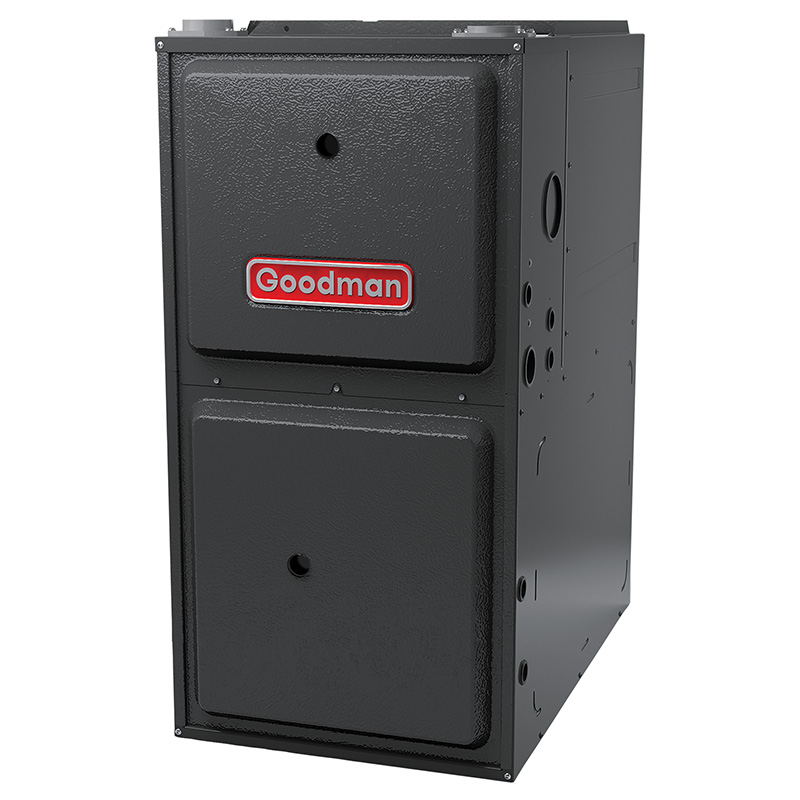
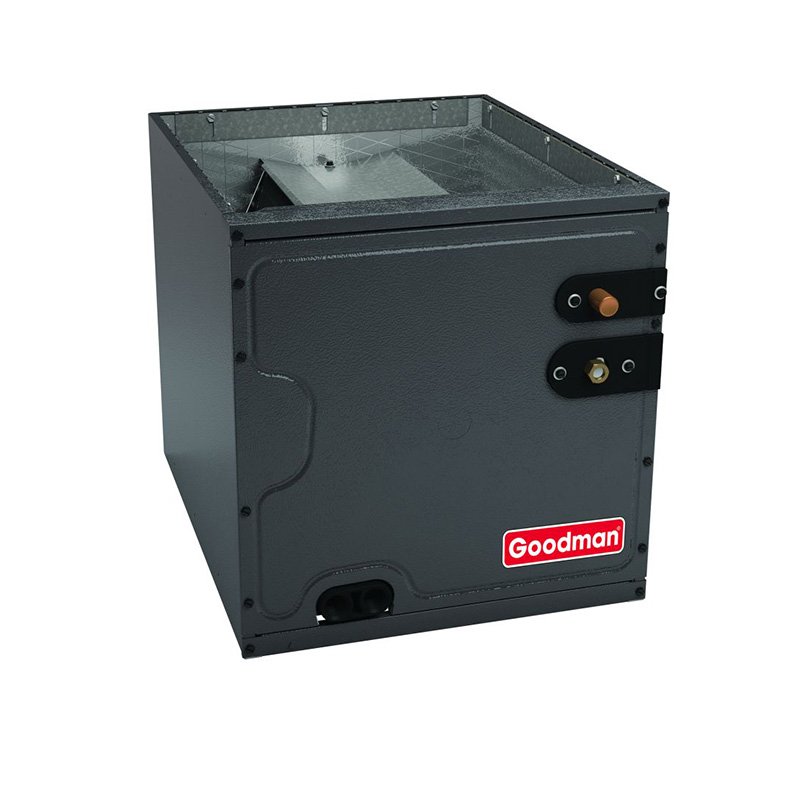
The Goodman GLXS4BA6010 pairs a 5-ton, 14 SEER2 R-32 split-system air conditioner with a 100,000 BTU, 80% AFUE two-stage gas furnace in an upflow configuration. At 5 tons, this system is sized for larger homes typically in the 2,400 to 3,000 square foot range, though a proper Manual J load calculation should always determine the final sizing. The 14 SEER2 rating sits at the current federal minimum efficiency threshold for most U.S. climate zones, which means it meets code but does not lead the market on operating costs. The two-stage furnace and multi-speed ECM blower do add meaningful real-world comfort over a basic single-stage setup: the system runs on a lower first stage most of the time, reducing temperature swings and cycling noise while improving humidity control in cooling mode.
R-32 refrigerant is a forward-looking choice. It carries a lower global warming potential than the R-410A it replaces and is becoming the new industry standard, so future service technicians and refrigerant supply should not be a concern. The upflow configuration means the air handler draws from the bottom and discharges from the top, which suits homes with a basement or closet installation where ductwork runs overhead. Buyers considering this package should weigh it as a code-compliant, budget-conscious system rather than a premium efficiency or premium longevity purchase. It suits homeowners who want reliable climate control at a lower upfront cost and are comfortable with the understanding that long-term costs depend heavily on installation quality and routine maintenance.
This Goodman package delivers a functional, code-compliant system at a price point 15 to 25 percent below comparable Carrier, Trane, and Lennox offerings, making it a reasonable choice for cost-conscious buyers who prioritize upfront savings over long-term premium durability. The two-stage furnace and ECM blower add genuine comfort benefits that basic single-stage systems lack. The trade-off is a compressor lifespan that averages shorter than premium brands and a brand track record that is meaningfully dependent on who installs and services it.
Overall score is the average of the five ratings above.
What we like
- Upfront cost is typically 15 to 25 percent lower than equivalent Carrier, Trane, or Lennox systems
- Two-stage furnace operation reduces temperature swings and lowers noise during mild weather
- ECM blower motor improves airflow efficiency and supports better humidity control in cooling mode
- R-32 refrigerant is serviceability-forward and aligns with the industry's regulatory direction
- Widely available parts network means repair technicians across most markets can source components quickly
Trade-offs
- Compressor lifespan averages 10 to 14 years versus 15 to 20 years for premium brand compressors
- Dual-run capacitors are the most commonly reported failure, typically needed within the first decade
- Evaporator coil leaks appear in a meaningful share of owner reports and can be costly to address
- A minority of owners have reported refrigerant leaks within the first year, most traced to installation or initial charge issues
What homeowners and pros say about Goodman
Homeowners who have lived with Goodman equipment tend to land in two camps. Those who had a careful installation, changed filters consistently, and had annual tune-ups often report years of uneventful service and praise the lower purchase price. Those who ran into problems tend to flag them loudly: Goodman’s ConsumerAffairs score sits around 2.5 out of 5, a channel where complaints dominate and the recurring pattern is repair costs climbing after roughly year seven. Google dealer reviews tell a more balanced story, averaging around 3.8 out of 5 across hundreds of reviews per location, where affordability comes up repeatedly as the reason buyers chose the brand. The honest read is that both groups are probably right, and the difference often comes down to the installer and the maintenance history.
HVAC technicians who work on Goodman equipment regularly point to a predictable set of failure modes: dual-run capacitors are the most common callout and a straightforward fix in the 300 to 600 dollar range, but evaporator coil leaks show up in a meaningful share of owner accounts and are a more costly repair. Compressor longevity is a real consideration too, with Goodman compressors averaging 10 to 14 years of service compared to 15 to 20 years for equipment from premium brands. On this specific 5-ton two-stage system, a small number of owners across the broader Goodman lineup have also reported refrigerant leaks in the first year, almost always attributed to installation or initial charge problems rather than factory defects. For a system this size, the installation crew matters as much as the equipment itself.
Sources: ConsumerAffairs Goodman owner reviews, AHRI Directory of Certified Product Performance, U.S. DOE appliance and equipment efficiency standards, Goodman product specification sheets.
What it costs to run
At 14 SEER2, cooling this 5-ton system for a typical 1200-hour cooling season at the U.S. average electricity rate of $0.17/kWh works out to roughly $874 per year in cooling, about $39 less per year than a minimum-efficiency 13.4 SEER2 unit of the same size. Your real cost depends on your climate and local rate.
Method: (60,000 BTU/hr ÷ 14 SEER2) × 1200 hours ÷ 1000 × $0.17/kWh. Rate source: U.S. EIA average; cooling hours: moderate-climate estimate.
How it compares
| Brand | Comparable model | SEER2 | Stage | Price position |
|---|---|---|---|---|
| Goodman | GLXS4BA6010 (this system) | 14 | Two-stage furnace / multi-speed ECM | Value pick |
| Carrier | Comfort Series (24ACC6 / 58TP) | 14-15 | Single-stage | Typically 15 to 25 percent more than Goodman |
| Trane | XR14 / S8X1 Series | 14-15 | Single-stage | Typically 15 to 25 percent more than Goodman |
| Lennox | Merit Series (14ACX / ML180) | 14-15 | Single-stage | Typically 15 to 25 percent more than Goodman |
Competitor rows are comparable single-stage units at similar efficiency; price is relative position, not a quote.
Questions about this system
Is 14 SEER2 going to cost me noticeably more to run than a higher-efficiency unit?
Yes, compared to a 16 or 18 SEER2 system, a 14 SEER2 unit will use more electricity per hour of cooling. On a 5-ton system running frequently in a hot climate, that difference adds up over a full season. If your home is in a region with high summer cooling loads and high electricity rates, stepping up to a higher SEER2 unit typically pays back the price difference over several years.
What does 80% AFUE actually mean for my heating bills compared to a 96% AFUE furnace?
An 80% AFUE furnace exhausts roughly 20 cents of every gas dollar as combustion byproduct, while a 96% AFUE unit loses only about 4 cents. On a 100,000 BTU furnace, that gap is meaningful in cold climates with long heating seasons. In mild climates where heating runs only a few months per year, the payback period on the higher-efficiency furnace stretches considerably and the 80% unit may make financial sense.
How serious is the dual-run capacitor failure issue, and what does it cost to fix?
Capacitor failure is the most commonly reported problem with Goodman equipment and it is also one of the least alarming. It is a standard wear part, usually diagnosed quickly, and replacement typically runs in the 300 to 600 dollar range including labor. Keeping a service contract or scheduling annual tune-ups gives a technician the chance to catch a weakening capacitor before it strands you on a hot day.
Does this system work with my existing R-410A line set, or do I need new refrigerant lines?
R-32 and R-410A are not interchangeable, and a system charged with R-32 should use line sets appropriate for R-32 service. Your installing contractor should verify that existing copper line sets are compatible in diameter, length, and condition before reusing them. In most cases a properly sized and clean existing line set can be reused, but this is a conversation to have explicitly with your installer before the job starts.
The system is 5 tons but I want to make sure it is not oversized for my house. How do I verify?
A Manual J load calculation is the only reliable way to confirm sizing. Rules of thumb like square footage per ton vary too much with insulation levels, window area, climate zone, and ceiling height to be trusted for a system this size. An oversized unit will short-cycle, reduce humidity control in summer, and put extra wear on the compressor, so asking your contractor to document a load calc before the install is a reasonable and standard request.
Specifications
| Cooling capacity | 5 Ton |
| Efficiency | 14 SEER2 |
| Furnace output | 100000 BTU |
| Furnace efficiency | 80% AFUE |
| Configuration | Upflow |
| Refrigerant | R-32 |
| Model | GLXS4BA6010 |