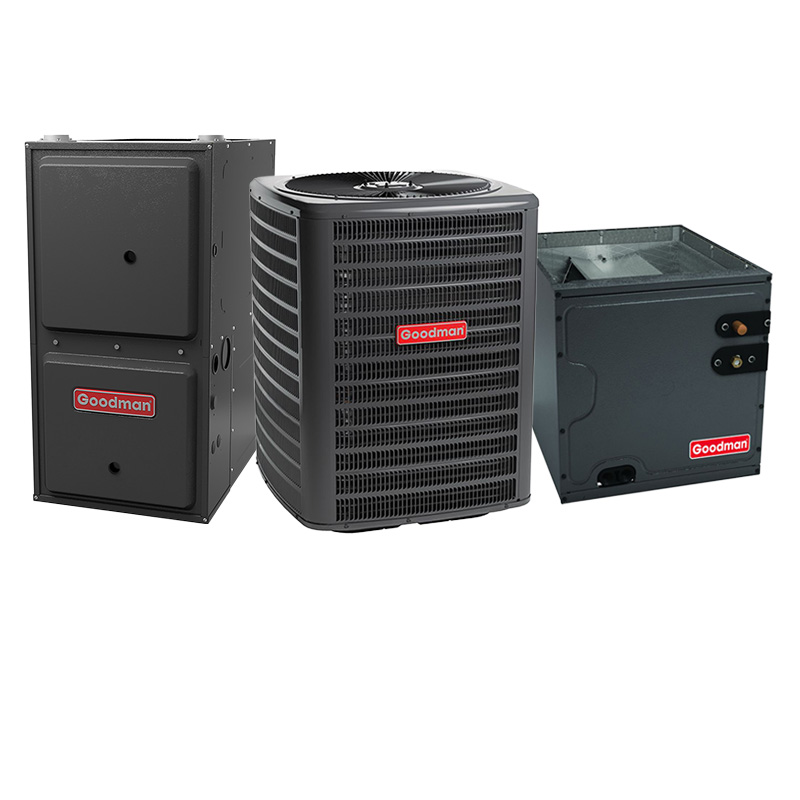
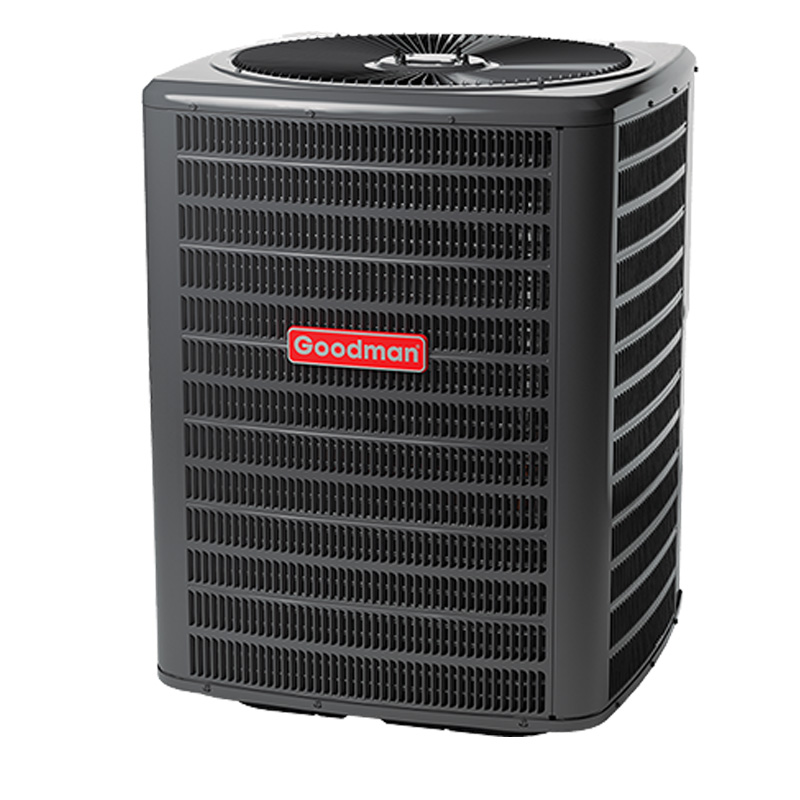
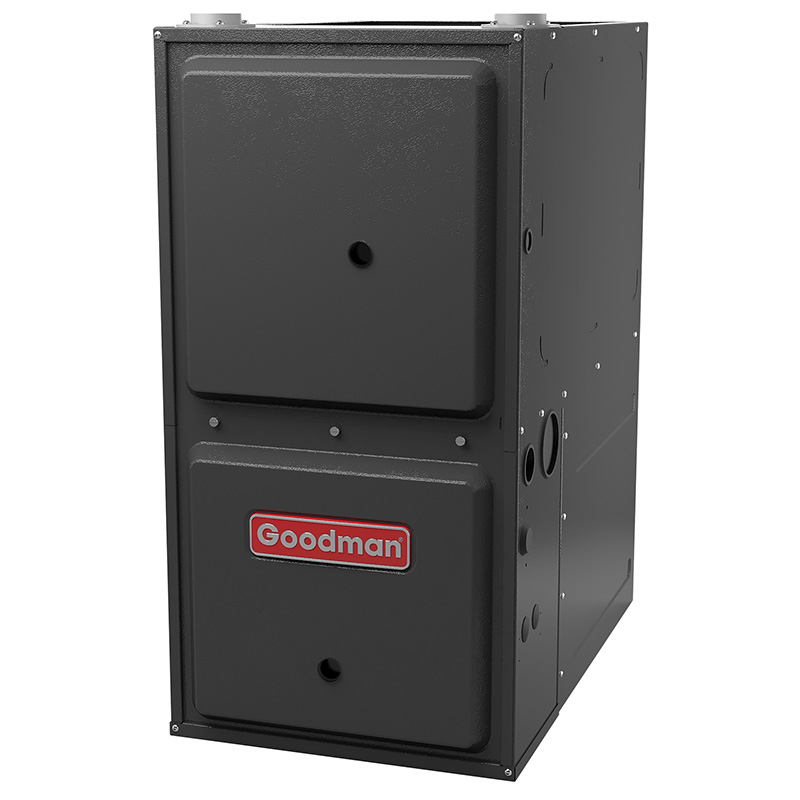
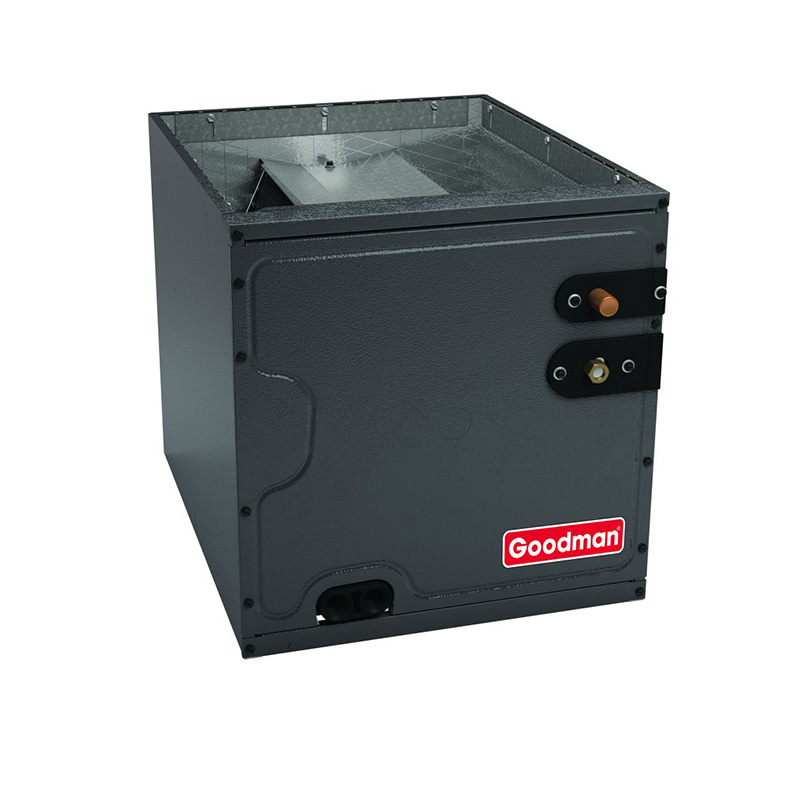
Goodman 5 Ton 14 SEER2 80000 BTU 80% AFUE Multi-Speed ECM Gas Furnace System – Downflow | R32
View on AC Direct see your lowest price →Check current price on AC Direct →
Key features
- 5-ton cooling capacity with 14 SEER2 efficiency rating, meeting current federal minimums
- 80,000 BTU gas furnace at 80% AFUE for single-stage heating output
- Downflow airflow configuration for slab or crawl-space duct systems
- R-32 refrigerant with lower global-warming potential than R-410A
- Multi-speed ECM blower motor for quieter airflow and improved humidity control versus PSC motors
- Priced approximately 15 to 25 percent below comparable Trane, Carrier, and Lennox systems
About this system
The Goodman 5-ton, 14 SEER2, 80,000 BTU downflow system pairs a mid-efficiency central air conditioner with an 80% AFUE gas furnace in a downflow configuration, meaning the furnace discharges conditioned air downward through the floor rather than upward through the ceiling. That setup is standard in homes where ductwork runs beneath the living space, such as houses built on crawl spaces or slabs with under-floor distribution. The system uses R-32 refrigerant, a lower global-warming-potential refrigerant that is increasingly common as the industry moves away from R-410A. At 5 tons of cooling capacity, this unit is sized for larger homes, generally in the 2,400 to 3,200 square foot range depending on local climate, insulation quality, and window load.
The 14 SEER2 rating sits at the current federal minimum for most U.S. climate zones, so this is an entry-level efficiency system rather than an energy-saving upgrade. The 80% AFUE furnace likewise sits at the lower end of the efficiency scale, converting 80 cents of every dollar of gas into usable heat and venting the remaining 20 percent as exhaust. Homeowners in colder climates, or those replacing an older low-efficiency unit, should weigh whether a 96% AFUE furnace would recover its cost premium through lower gas bills over time. Where this system earns its place is for buyers who need a proven, straightforward replacement at a competitive price point and are less concerned with long-term operating cost optimization.
This Goodman system is a competent, no-frills replacement option for larger homes that need a downflow configuration and want to keep upfront costs down. The multi-speed ECM motor is a genuine advantage over single-speed alternatives at this price, but the 80% AFUE furnace and baseline 14 SEER2 rating mean operating costs will be higher over the unit's life than a higher-efficiency pairing. Long-term performance depends heavily on installation quality and willingness to budget for eventual component repairs, particularly capacitors and possibly the evaporator coil.
Overall score is the average of the five ratings above.
What we like
- Upfront price is typically 15 to 25 percent lower than Carrier, Trane, or Lennox equivalents
- Multi-speed ECM blower improves comfort and humidity management compared to single-speed PSC motors
- R-32 refrigerant is forward-looking as the industry transitions away from R-410A
- Downflow configuration directly serves slab and under-floor duct systems without modification
- Capacitor failures, the most common documented repair, are generally a quick low-cost fix in the $300 to $600 range
Trade-offs
- 80% AFUE furnace wastes 20 percent of fuel input; meaningful cost gap versus 96% AFUE alternatives in cold climates
- 14 SEER2 is the regulatory floor, not an efficiency achievement, so monthly cooling costs will be higher than mid- or high-efficiency options
- Compressor lifespan averages 10 to 14 years versus 15 to 20 years for premium brands, shortening the replacement cycle
- Evaporator coil leaks appear in a meaningful share of owner reviews, and a minority of owners report refrigerant leaks within the first year
What homeowners and pros say about Goodman
Homeowners who have lived with Goodman equipment tend to split along two lines. Those who had it professionally installed by an experienced contractor and kept up with annual maintenance often report years of unremarkable, functional service, with the most common repair call being a failed dual-run capacitor, a minor issue that lands in the $300 to $600 range. On ConsumerAffairs, where Goodman scores around 2.5 out of 5, the recurring complaint is repair costs that begin climbing after roughly year seven, with evaporator coil leaks and refrigerant issues appearing regularly in longer-term ownership accounts. Google dealer reviews paint a more moderate picture at around 3.8 out of 5, where affordability is the most frequent point of praise and satisfaction often correlates with how much attention the installing technician paid to the details of the job.
HVAC professionals tend to hold a pragmatic view of Goodman. Many installers note that the brand performs adequately when the fundamentals are right: correct sizing, careful refrigerant charging, proper airflow setup, and tight duct connections. Where they raise flags is on compressor longevity, with typical lifespans of 10 to 14 years compared to 15 to 20 years for premium brands, and on the documented pattern of evaporator coil leaks in a meaningful share of units. A minority of owners also report refrigerant loss within the first year, which technicians generally attribute to charge or connection issues at installation rather than a factory defect. The honest summary from the trade is that a well-installed Goodman is a reasonable system for its price, but the margin for a sloppy installation is smaller than it is with higher-end equipment.
Sources: ConsumerAffairs Goodman owner reviews, AHRI Directory of Certified Product Performance, U.S. DOE appliance and equipment efficiency standards, Goodman product specification sheets.
What it costs to run
At 14 SEER2, cooling this 5-ton system for a typical 1200-hour cooling season at the U.S. average electricity rate of $0.17/kWh works out to roughly $874 per year in cooling, about $39 less per year than a minimum-efficiency 13.4 SEER2 unit of the same size. Your real cost depends on your climate and local rate.
Method: (60,000 BTU/hr ÷ 14 SEER2) × 1200 hours ÷ 1000 × $0.17/kWh. Rate source: U.S. EIA average; cooling hours: moderate-climate estimate.
How it compares
| Brand | Comparable model | SEER2 | Stage | Price position |
|---|---|---|---|---|
| Goodman | This system (5-ton 14 SEER2 / 80% AFUE Downflow) | 14 | Single-stage cooling, multi-speed ECM heat | Value pick |
| Carrier | Comfort Series (24ACC6 / 58SB0) | 14-15 | Single-stage | Typically 15 to 25 percent more than this Goodman system |
| Trane | XR14 / S8B1 Series | 14-15 | Single-stage | Typically 15 to 25 percent more than this Goodman system |
| Lennox | Merit ML14 / Merit Series Gas Furnace | 14 | Single-stage | Typically 15 to 25 percent more than this Goodman system |
Competitor rows are comparable single-stage units at similar efficiency; price is relative position, not a quote.
Questions about this system
Is a 14 SEER2 system going to cost me noticeably more to run than a higher-efficiency unit?
Yes, compared to a 17 or 18 SEER2 system you can expect meaningfully higher electricity bills during cooling season, with the gap widening in hot climates where the unit runs for many months. For a 5-ton unit in a warm region, the annual difference can be substantial enough that a higher-efficiency system pays back its price premium within several years. In mild climates with short cooling seasons the payback period stretches considerably.
Why does the downflow configuration matter and how do I confirm my home needs it?
A downflow furnace discharges heated or cooled air through an outlet at the bottom of the unit and into ductwork that runs under the floor. If your home sits on a slab or has ductwork in a crawl space rather than an attic, downflow is almost certainly the correct configuration. Installing the wrong airflow direction requires significant duct modification and is not a simple field conversion, so confirm your existing duct layout with your installer before ordering.
What is the warranty on this Goodman system and what does it actually cover?
Goodman typically offers a 10-year parts limited warranty on registered systems, covering components including the compressor and heat exchanger. Registration must be completed within a set window after installation or the warranty period shortens. Labor costs are not covered, and some exclusions apply, so review the actual warranty certificate for this specific model configuration rather than relying on general Goodman marketing claims.
R-32 refrigerant is new to me. Will my current technician be able to service it?
R-32 requires EPA 608 certification, which most licensed HVAC technicians already hold, but it does have different handling procedures than R-410A due to its mildly flammable classification. Most established HVAC service companies are equipped for it, but it is worth confirming with your service provider before committing to the system, particularly in rural areas where equipment access may be more limited.
How concerned should I be about the evaporator coil and capacitor failure reports?
Dual-run capacitor failure is the most frequently documented issue with Goodman equipment, though it is also one of the cheapest repairs in the HVAC world at roughly $300 to $600 including labor. Evaporator coil leaks are more serious and appear in a meaningful share of long-term owner reviews. Keeping the unit on a regular maintenance schedule and having refrigerant levels and coil condition checked annually gives you the best chance of catching either issue before it escalates into a larger repair.
Specifications
| Cooling capacity | 5 Ton |
| Efficiency | 14 SEER2 |
| Furnace output | 80000 BTU |
| Furnace efficiency | 80% AFUE |
| Configuration | Downflow |
| Refrigerant | R-32 |