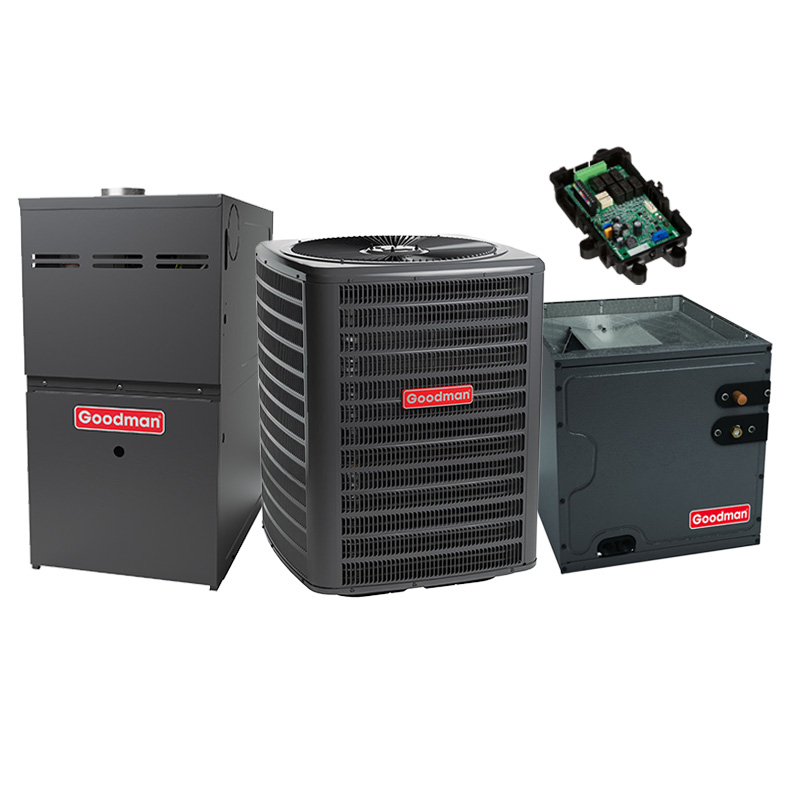
Goodman 5 Ton 14 SEER2 80000 BTU 80% Gas Furnace With R32 Air Conditioning Condenser And Coil System – Upflow
View on AC Direct see your lowest price →Check current price on AC Direct →
Key features
- 5-ton cooling capacity with 14 SEER2 efficiency rating at the federal minimum threshold
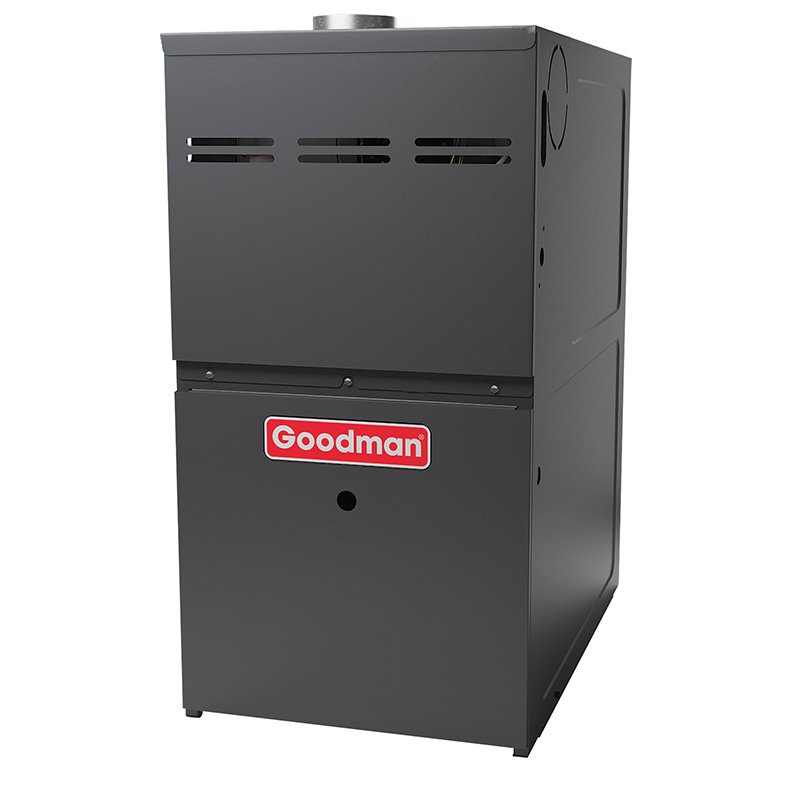
- 80,000 BTU upflow gas furnace rated at 80% AFUE for standard heating efficiency
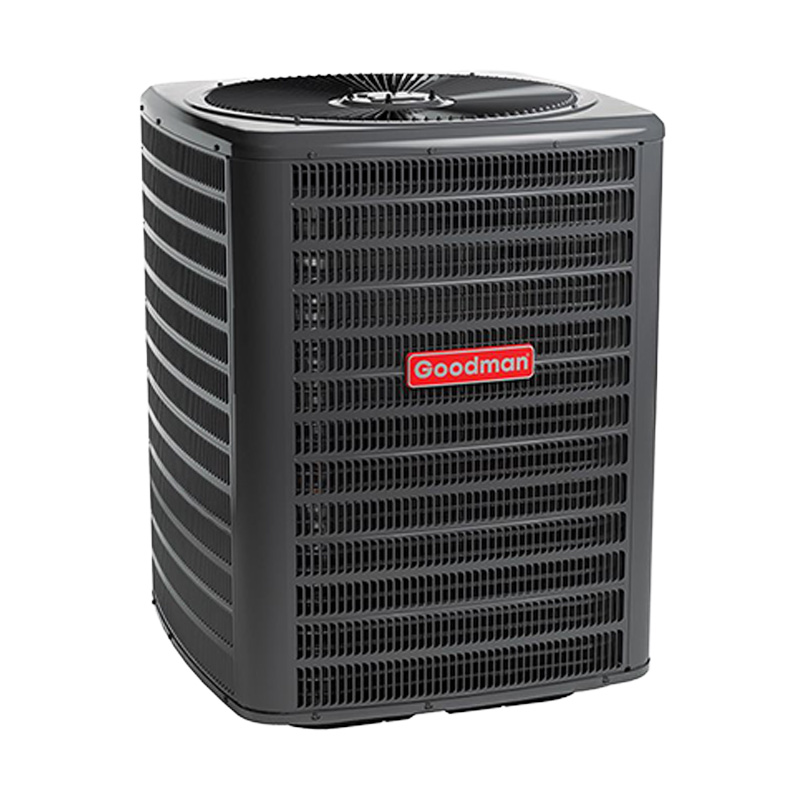
- R-32 refrigerant with lower global warming potential than outgoing R-410A systems
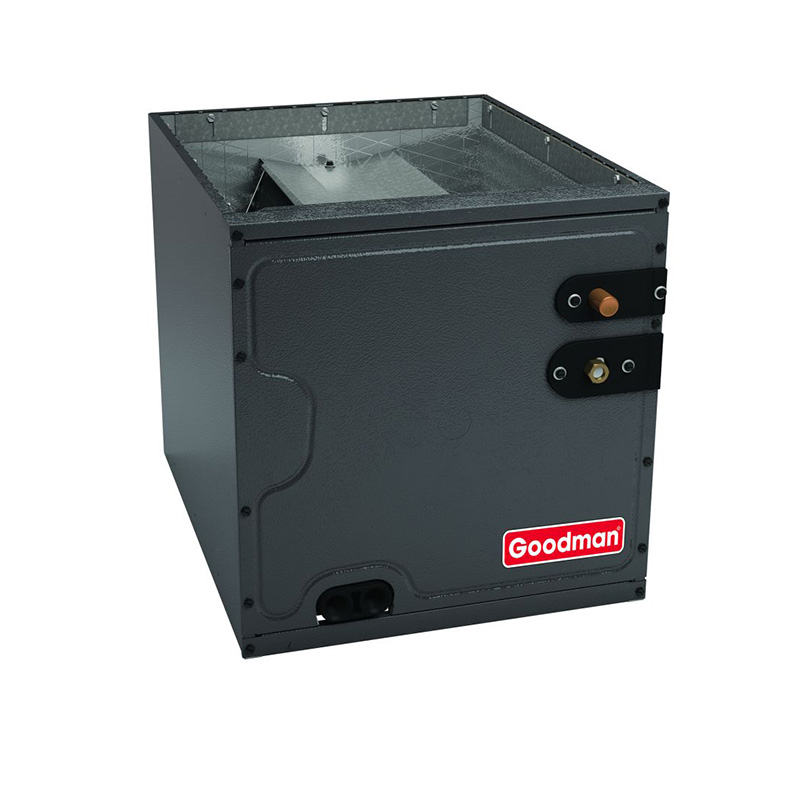
- Matched condenser, evaporator coil, and furnace sold as a pre-engineered system bundle
- Upflow air handler orientation compatible with basement and ground-level mechanical rooms
- Goodman's parts-only limited warranty covers the compressor and other major components
About this system
This Goodman bundle pairs a 5-ton R-32 condenser with a matched evaporator coil and an 80,000 BTU 80% AFUE upflow gas furnace, giving you a complete split system in a single purchase. At 14 SEER2, the air conditioner sits right at the current federal minimum efficiency threshold for most U.S. climate zones, which means operating costs are honest but not exceptional. The upflow furnace configuration is the most common residential orientation, suited to homes where the air handler sits in a basement, utility closet, or ground-floor mechanical room and delivers conditioned air upward through ductwork above it.
R-32 refrigerant is a step forward from the R-410A that dominated the market for years. It carries a lower global warming potential, is easier to recover and recycle, and requires a smaller refrigerant charge by weight to do the same job. Not every technician has R-32 certification yet, so it is worth confirming your installer is equipped before scheduling. The 80% AFUE furnace means 80 cents of every fuel dollar goes to heat, which is the minimum efficiency allowed in northern states under current DOE rules. Homeowners in cold climates who want to reduce heating bills significantly should consider whether a 96% AFUE furnace would pay back the price difference over time.
Goodman positions this as a value-oriented system for homeowners who want reliable, code-compliant equipment without paying the premium associated with Carrier, Trane, or Lennox. It suits budget-conscious buyers in moderate climates, landlords managing rental properties, or anyone replacing aging equipment and working within a tight timeline or budget. The system’s long-term performance will depend heavily on professional installation and consistent annual maintenance.
This Goodman bundle delivers a complete, code-compliant cooling and heating system at a price point that is hard to match from premium brands. Efficiency is entry-level and the brand's repair history after year 7 is a documented concern, but for buyers prioritizing upfront cost and straightforward installation this is a functional, widely-serviced option. It earns its place as a value pick, not a longevity leader.
Overall score is the average of the five ratings above.
What we like
- Typically priced 15 to 25 percent below comparable Carrier, Trane, and Lennox systems
- Complete matched system reduces compatibility guesswork and can simplify load calculations
- R-32 refrigerant future-proofs the system against tightening environmental regulations on R-410A
- Upflow configuration is the most common residential setup, meaning installer familiarity is high
- Dual-run capacitor failures, the most common documented issue, are a relatively inexpensive repair
Trade-offs
- 14 SEER2 is minimum-tier efficiency; monthly energy costs will be higher than 16 SEER2 or above systems over a long ownership period
- Compressor lifespan averages 10 to 14 years versus 15 to 20 years reported for premium-brand compressors
- Evaporator coil leaks appear in a meaningful share of owner reports, a potential mid-life repair cost
- ConsumerAffairs feedback averages around 2.5 out of 5, with repair cost complaints rising noticeably after roughly year 7
What homeowners and pros say about Goodman
Homeowners who purchase Goodman equipment most often praise the upfront cost savings, and those dealer-level Google reviews bear that out at around 3.8 out of 5 stars, where affordability is the word that comes up most consistently. The picture shifts as systems age. On ConsumerAffairs, where the audience skews toward people motivated to report problems, Goodman sits at roughly 2.5 out of 5, and the pattern in those complaints is predictable: the first several years tend to be uneventful, then repair costs begin climbing around year 7 or 8. The most commonly flagged failure point is the dual-run capacitor, which is fortunate because it is one of the cheaper HVAC repairs out there. Evaporator coil leaks are the more painful documented issue, appearing in enough owner accounts to be worth treating as a realistic possibility rather than a remote risk.
HVAC technicians generally describe Goodman as serviceable equipment that rewards careful installation and routine maintenance. The compressors in this product line are widely documented to average between 10 and 14 years of useful life, which falls short of the 15 to 20 years more commonly associated with Carrier, Trane, and Lennox compressors at comparable cooling tonnage. For a 5-ton R-32 system like this one, pros note that the A2L refrigerant requirement adds a layer of installer qualification to watch for, since not every technician has yet made the equipment investment R-32 demands. The consensus across both owner feedback and installer commentary is that Goodman is a reasonable choice for buyers who go in clear-eyed about the trade-offs: lower initial cost, adequate efficiency, and a maintenance and repair profile that rewards attention rather than neglect.
Sources: ConsumerAffairs Goodman owner reviews, AHRI Directory of Certified Product Performance, U.S. DOE appliance and equipment efficiency standards, Goodman product specification sheets.
What it costs to run
At 14 SEER2, cooling this 5-ton system for a typical 1200-hour cooling season at the U.S. average electricity rate of $0.17/kWh works out to roughly $874 per year in cooling, about $39 less per year than a minimum-efficiency 13.4 SEER2 unit of the same size. Your real cost depends on your climate and local rate.
Method: (60,000 BTU/hr ÷ 14 SEER2) × 1200 hours ÷ 1000 × $0.17/kWh. Rate source: U.S. EIA average; cooling hours: moderate-climate estimate.
How it compares
| Brand | Comparable model | SEER2 | Stage | Price position |
|---|---|---|---|---|
| Goodman | 5-Ton 14 SEER2 R-32 Bundle with 80% AFUE Upflow Furnace | 14 | Single-stage | Value pick |
| Carrier | Comfort Series (24ACC636 condenser with FV4C coil and 58SB furnace) | 14-15 | Single-stage | Typically 15 to 25 percent more than this Goodman bundle |
| Trane | XR14 or XR15 series (4TTR4060 condenser with matched coil and S8X1 furnace) | 14-15 | Single-stage | Typically 15 to 25 percent more than this Goodman bundle |
| Lennox | Merit Series (14ACX condenser with matching coil and ML196 furnace) | 14-15 | Single-stage | Typically 15 to 25 percent more than this Goodman bundle |
Competitor rows are comparable single-stage units at similar efficiency; price is relative position, not a quote.
Questions about this system
Does my installer need special certification to work with R-32 refrigerant on this system?
Yes. R-32 is an A2L refrigerant, meaning it is mildly flammable, and technicians need specific training and compatible recovery equipment to handle it safely and legally. Before booking installation, confirm your HVAC contractor is already set up for A2L refrigerants, since not all service companies have upgraded their tools and certifications yet.
Is 14 SEER2 going to cost me significantly more to run than a higher-efficiency system?
Compared to a 16 SEER2 system, a 14 SEER2 unit uses roughly 12 to 14 percent more electricity for the same cooling output. On a 5-ton system running in a warm climate, that gap can add up to a noticeable difference on summer utility bills over a decade of ownership. If your local electricity rates are high or your cooling season is long, the payback on a higher-efficiency system is worth calculating before committing.
What is the most common repair I should budget for on a Goodman system like this?
The dual-run capacitor is the most frequently reported failure point across Goodman owners. It is a relatively minor repair, typically in the 300 to 600 dollar range for a service call and part, and it can happen even on well-maintained systems. Evaporator coil leaks are the more costly documented concern and have appeared in a meaningful share of owner reviews, so it is worth factoring a coil leak into your long-term cost picture.
How does Goodman's warranty on this system compare to Carrier or Trane?
Goodman offers a parts-only limited warranty that typically requires registration within a set window after installation to reach its full term. Labor is not covered, which is consistent with most HVAC manufacturers at this price tier. Carrier and Trane offer similar parts-only structures on their base-tier equipment, though some premium lines include extended or labor-inclusive options. Read the specific warranty document for this model and register it promptly after install.
My house is 2,500 square feet. Is a 5-ton system the right size?
Five tons is on the larger end for 2,500 square feet in most climates and could be oversized depending on your insulation, window area, ceiling height, and local design temperatures. An oversized system short-cycles, which reduces dehumidification, increases wear, and can shorten equipment life. Ask your installer to perform a Manual J load calculation before deciding on tonnage, since proper sizing matters as much as brand or efficiency for long-term comfort and system durability.
Specifications
| Cooling capacity | 5 Ton |
| Efficiency | 14 SEER2 |
| Furnace output | 80000 BTU |
| Configuration | Upflow |
| Refrigerant | R-32 |