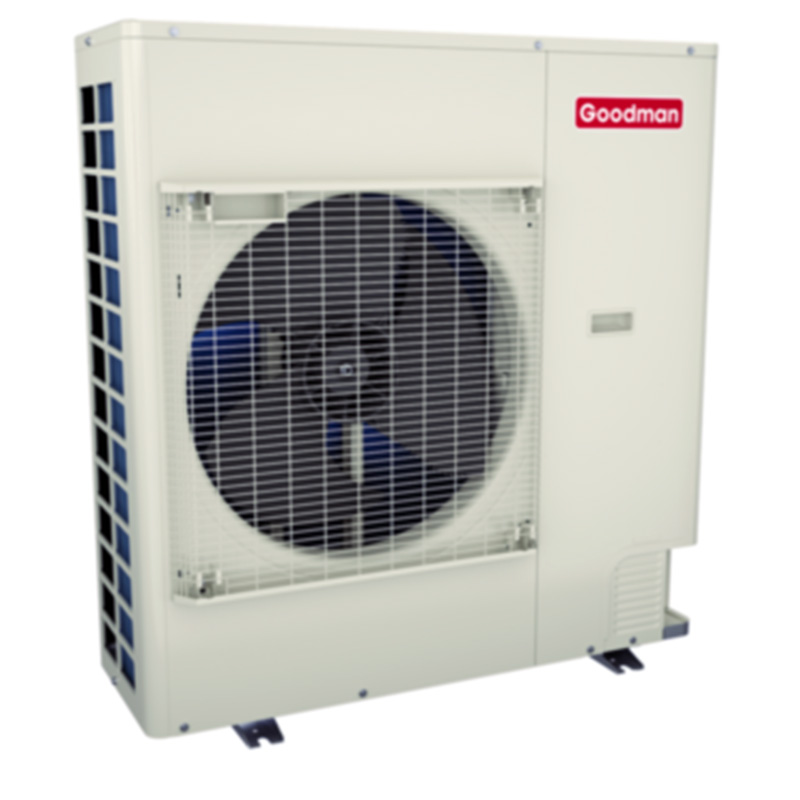
Goodman 5 Ton Up to 17.2 SEER2 Variable-Speed Inverter AC Side Discharge Condenser, R32 (GXV6SS6010)
View on AC Direct see your lowest price →Check current price on AC Direct →
Key features
- Variable-speed inverter compressor for continuous modulation and better humidity control
- 17.2 SEER2 efficiency rating, upper-middle tier for ducted split systems
- R-32 refrigerant, single-component and lower global warming potential than R-410A
- 5-ton capacity, suited for larger homes in the 2,400 to 3,000 sq ft range
- Side discharge configuration for installation flexibility in tight spaces
- 10-year parts warranty when registered within 60 days of installation
About this system
The Goodman GXV6SS6010 is a 5-ton, variable-speed inverter condensing unit rated up to 17.2 SEER2, using R-32 refrigerant and configured for side discharge. At 5 tons, it is sized for larger homes, typically in the 2,400 to 3,000 square foot range depending on climate and insulation, and the variable-speed compressor means it modulates output continuously rather than simply switching on and off. That reduces temperature swings, lowers humidity levels more effectively than single-stage equipment, and keeps energy costs closer to the rated efficiency under real-world partial-load conditions.
R-32 refrigerant is worth noting for buyers who plan to own this system for a decade or more. It has a lower global warming potential than R-410A, it is easier to recharge in the field because it is a single-component refrigerant, and it is increasingly the industry direction. The 17.2 SEER2 rating lands this unit in the upper-middle efficiency tier, meaningfully above minimum federal standards but a step below the very highest-efficiency 18 to 21 SEER2 systems from premium brands. For most large-home owners in moderately hot climates who want good efficiency without paying top-tier prices, that is a reasonable place to land.
The GXV6SS6010 delivers genuine variable-speed performance and a solid efficiency rating at a price that undercuts Carrier, Trane, and Lennox by a meaningful margin. The trade-off is a brand track record that includes documented coil leak issues and compressor lifespans that tend to run shorter than premium competitors, along with reliability that depends heavily on who installs it. Buyers who prioritize upfront cost and work with a skilled installer will find real value here; those who want the longest possible service life and minimal repair risk should look at spending more.
Overall score is the average of the five ratings above.
What we like
- Variable-speed compressor provides better comfort and humidity control than single or two-stage units
- 17.2 SEER2 is well above minimum standards and qualifies for federal tax credits
- R-32 refrigerant is more serviceable and future-friendly than R-410A
- Priced 15 to 25 percent below comparable Carrier, Trane, and Lennox equipment
- 10-year parts warranty when properly registered provides reasonable long-term coverage
Trade-offs
- Compressor lifespan averages 10 to 14 years versus 15 to 20 years for premium brands
- Evaporator coil leaks appear in a notable share of owner reviews, a documented Goodman failure mode
- Dual-run capacitor failures are the most commonly reported repair, typically occurring after year 5 to 7
- A minority of owners report refrigerant leaks within the first year, usually traceable to installation or initial charge quality
What homeowners and pros say about Goodman
On ConsumerAffairs, Goodman as a brand sits at roughly 2.5 out of 5, a score shaped by the platform’s complaint-heavy audience and by a recurring pattern of repair costs rising after roughly year 7. The specific failure modes that appear most often in those accounts are dual-run capacitor failures (a relatively low-cost fix in the 300 to 600 dollar range but an annoyance), evaporator coil leaks, and compressor issues in the 10 to 14 year window rather than the 15 to 20 years owners of premium equipment tend to see. Across Google dealer reviews, Goodman-installed systems score around 3.8 out of 5, and the most consistent praise in those reviews is the price point relative to what comparable variable-speed systems from Carrier, Trane, or Lennox would cost.
Among HVAC technicians, Goodman has a mixed but not dismissive reputation. Experienced installers generally say the equipment performs acceptably when it is properly sized, correctly charged, and installed with care. The concern they raise most often is that Goodman’s quality ceiling is lower than premium brands, meaning a perfect install on a Goodman still carries more long-term uncertainty than a premium brand with the same installation quality. For the GXV6SS6010 specifically, the variable-speed inverter and R-32 refrigerant are genuine upgrades over older Goodman platforms, but the underlying brand track record on components like coils and compressors still applies. Buyers who are cost-conscious and realistic about potentially higher maintenance costs after year 7 tend to find this equipment a reasonable compromise.
Sources: ConsumerAffairs Goodman owner reviews, AHRI Directory of Certified Product Performance, U.S. DOE appliance and equipment efficiency standards, Goodman product specification sheets.
What it costs to run
At 17.2 SEER2, cooling this 5-ton system for a typical 1200-hour cooling season at the U.S. average electricity rate of $0.17/kWh works out to roughly $712 per year in cooling, about $201 less per year than a minimum-efficiency 13.4 SEER2 unit of the same size. Your real cost depends on your climate and local rate.
Method: (60,000 BTU/hr ÷ 17.2 SEER2) × 1200 hours ÷ 1000 × $0.17/kWh. Rate source: U.S. EIA average; cooling hours: moderate-climate estimate.
How it compares
| Brand | Comparable model | SEER2 | Stage | Price position |
|---|---|---|---|---|
| Goodman | GXV6SS6010 | 17.2 | Variable-speed | Value pick |
| Carrier | Infinity 26 (24VNA6) | 17.2-18+ | Variable-speed | 20 to 25 percent higher than Goodman |
| Trane | XV18 (4TWV8) | 17.0-18+ | Variable-speed | 20 to 25 percent higher than Goodman |
| Lennox | XC21 | 17.0-18+ | Variable-speed | 20 to 30 percent higher than Goodman |
Competitor rows are comparable single-stage units at similar efficiency; price is relative position, not a quote.
Questions about this system
Does the GXV6SS6010 require a specific air handler or coil to hit the 17.2 SEER2 rating?
Yes. SEER2 ratings are system ratings, not just condenser ratings, and are measured with a matched indoor coil and air handler. You will need to confirm your indoor unit is on Goodman's matched-system certificate for this model to claim the rated efficiency. Mismatched equipment can drop real-world efficiency and may void the warranty.
Is R-32 refrigerant hard to find for service or recharge?
R-32 availability has been growing steadily as the HVAC industry transitions away from R-410A, and it is stocked by most major refrigerant distributors. Because R-32 is a single-component refrigerant rather than a blend, technicians can top off a partial charge without replacing the entire charge, which can simplify and lower the cost of leak repairs compared to blended refrigerants.
What is the real-world risk of a refrigerant leak in the first year?
A minority of Goodman owners have reported refrigerant leaks within the first year, and in most cases these trace back to installation quality, specifically improper line set connections or an inadequate initial charge rather than a defect in the unit itself. Hiring an experienced, licensed technician and confirming the system is properly commissioned after startup significantly reduces this risk.
How does the 10-year warranty actually work, and what does it not cover?
Goodman's 10-year parts warranty requires registration within 60 days of installation; without registration it defaults to a 5-year limited warranty. The warranty covers replacement parts but not labor, refrigerant, or diagnostic costs, which can be substantial. Some dealers offer extended labor warranties separately, and that is worth asking about at purchase.
What maintenance does a variable-speed inverter system like this need compared to a standard single-stage unit?
The core maintenance is the same: annual coil cleaning, filter changes, and electrical connection checks. However, variable-speed inverter systems use more complex electronics and inverter drives, so if a control board or inverter module fails, parts and labor costs are typically higher than on a simple single-stage condenser. Keeping the outdoor coil clean and ensuring proper airflow around the unit is especially important for protecting the compressor on any variable-speed system.
Specifications
| Cooling capacity | 5 Ton |
| Efficiency | 17.2 SEER2 |
| Refrigerant | R-32 |
| Model | GXV6SS6010 |