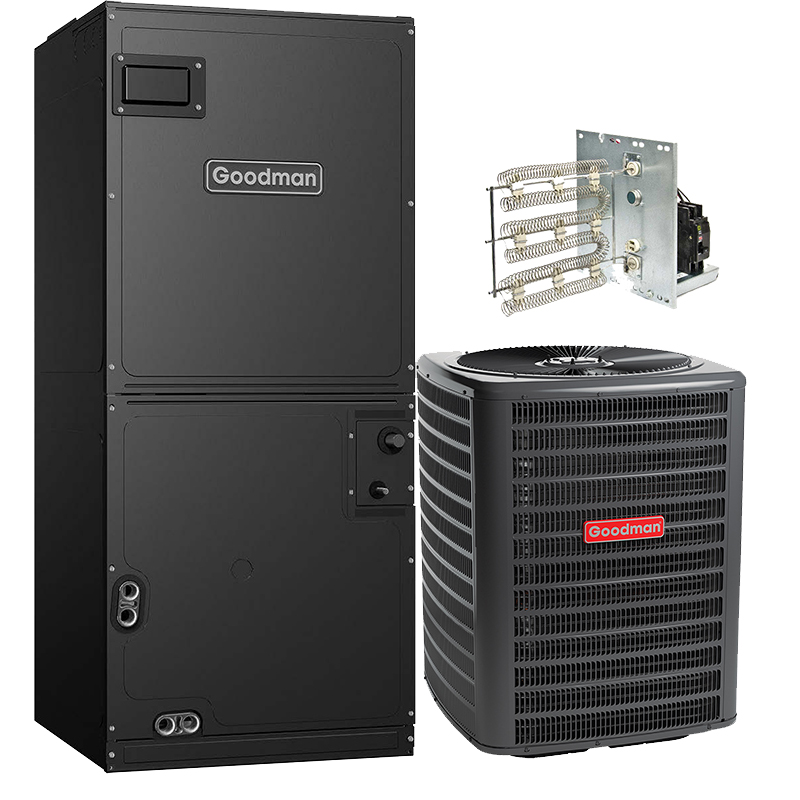
Goodman 5 Ton 15.2 SEER2 Heat Pump System w/5 Ton A/H
View on AC Direct see your lowest price →Check current price on AC Direct →
Key features
- 5-ton capacity suited to larger homes requiring substantial cooling and heating output
- 15.2 SEER2 efficiency rating meets current federal minimums with moderate energy savings
- Single-stage operation with matched air handler included for simplified system compatibility
- Heat pump configuration provides both heating and cooling from one outdoor unit
- Goodman factory-matched coil pairing supports AHRI-certified system efficiency ratings
- Priced 15 to 25 percent below comparable Trane, Lennox, and Carrier models at similar tonnage
About this system
The Goodman GSZH506010 is a 5-ton, 15.2 SEER2 single-stage heat pump system paired with a matching air handler, sized for larger homes typically in the 2,200 to 2,800 square foot range depending on climate and insulation. At 15.2 SEER2, it clears the federal minimum efficiency thresholds for most U.S. regions and sits comfortably in the entry-level tier of modern heat pump efficiency, delivering meaningful energy savings over older R-22 or low-SEER equipment without the price premium of higher-efficiency two-stage or variable-speed systems.
This system is a practical fit for budget-conscious homeowners in moderate climates who need a reliable replacement and are less concerned with squeezing every dollar out of monthly utility bills than with keeping upfront costs manageable. The 5-ton capacity makes it one of the larger residential configurations, which means sizing accuracy matters even more than usual. An oversized unit will short-cycle, increasing humidity and wear, so a proper Manual J load calculation before purchase is not optional on a unit this large. The air handler included in this package is matched to the outdoor unit, which simplifies efficiency certification and helps avoid coil compatibility issues that can arise when mixing components.
The Goodman GSZH506010 is a workable, cost-conscious choice for homeowners who need a large-format heat pump replacement and have a skilled installer lined up. It delivers baseline efficiency at a noticeably lower price than premium brands, but the long-term value equation depends heavily on installation quality and a realistic expectation that components like capacitors and evaporator coils may need attention before the unit reaches 15 years.
Overall score is the average of the five ratings above.
What we like
- Lower purchase price than Carrier, Trane, or Lennox systems at the same efficiency tier, often by 15 to 25 percent
- Factory-matched air handler simplifies installation and ensures AHRI-certified efficiency is achievable
- 15.2 SEER2 rating meets federal standards in all U.S. regions, offering a real step up over aging low-efficiency equipment
- Dual-run capacitor failures, the most commonly reported issue, are typically a fast, low-cost repair in the 300 to 600 dollar range
- Broad contractor familiarity with Goodman equipment means parts and service are widely available nationwide
Trade-offs
- Single-stage operation delivers less humidity control and comfort consistency than two-stage or variable-speed alternatives
- Compressor lifespan averages 10 to 14 years, meaningfully shorter than the 15 to 20 years seen on premium-brand compressors
- Evaporator coil leaks appear in a meaningful share of owner reports, and a minority of owners have reported refrigerant leaks within the first year
- ConsumerAffairs rating sits around 2.5 out of 5, with recurring complaints about rising repair costs after roughly year 7
What homeowners and pros say about Goodman
Homeowners who have installed Goodman equipment tend to split into two camps. Those who had experienced contractors handle the installation and stayed current on maintenance often report satisfactory service through the first several years, pointing to the lower purchase price as the main reason they chose Goodman. Those who experienced problems often trace the issues to installation quality or deferred maintenance rather than the unit itself, though that distinction offers little comfort when the repair bills arrive. On Google dealer review pages, Goodman systems carry an average around 3.8 out of 5, with affordability cited most frequently as the reason for the purchase. On ConsumerAffairs, the score drops to around 2.5 out of 5, reflecting a channel where frustrated owners are more motivated to post than satisfied ones, and where the recurring theme is repair costs climbing after roughly year 7.
HVAC technicians who work on Goodman equipment regularly describe the dual-run capacitor as the most predictable service call on these units, a failure mode that is common enough to be almost routine and inexpensive enough to be manageable when caught early. More consequential are evaporator coil leaks, which show up in a meaningful share of owner reports and can require more involved repairs. Compressor longevity is the honest long-term concern on a 5-ton Goodman: the 10 to 14 year average service life is real and falls noticeably short of what premium brands have demonstrated at this capacity. Technicians consistently emphasize that the single biggest variable in how any Goodman unit performs is the quality of the original installation, including proper refrigerant charge, airflow setup, and electrical connections. For a 5-ton system where oversizing and duct mismatch risks are amplified, that point is especially relevant.
Sources: ConsumerAffairs Goodman owner reviews, AHRI Directory of Certified Product Performance, U.S. DOE appliance and equipment efficiency standards, Goodman product specification sheets.
What it costs to run
At 15.2 SEER2, cooling this 5-ton system for a typical 1200-hour cooling season at the U.S. average electricity rate of $0.17/kWh works out to roughly $805 per year in cooling, about $108 less per year than a minimum-efficiency 13.4 SEER2 unit of the same size. Your real cost depends on your climate and local rate.
Method: (60,000 BTU/hr ÷ 15.2 SEER2) × 1200 hours ÷ 1000 × $0.17/kWh. Rate source: U.S. EIA average; cooling hours: moderate-climate estimate.
How it compares
| Brand | Comparable model | SEER2 | Stage | Price position |
|---|---|---|---|---|
| Goodman | GSZH506010 | 15.2 | Single-stage | Value pick |
| Carrier | Performance 24ACC6 Series | 15 to 16 | Single-stage | Typically 15 to 25 percent more than Goodman at comparable tonnage |
| Trane | XR15 Series | 15 to 15.6 | Single-stage | Typically 15 to 25 percent more than Goodman at comparable tonnage |
| Lennox | ML18XP1 Series | 15 to 16 | Single-stage | Typically 15 to 25 percent more than Goodman at comparable tonnage |
Competitor rows are comparable single-stage units at similar efficiency; price is relative position, not a quote.
Questions about this system
Is 5 tons the right size for my house, and what happens if it is too large?
A 5-ton unit typically serves homes in the 2,200 to 2,800 square foot range, but climate zone, insulation, window area, and duct layout all affect the correct size. If the unit is oversized for your load, it will short-cycle, meaning it runs in short bursts that fail to properly dehumidify the air, increasing indoor humidity and accelerating compressor wear. A Manual J load calculation by your installer is the only reliable way to confirm 5 tons is appropriate for your specific home.
What are the most likely repairs I should budget for over the life of this system?
Based on documented owner experience with Goodman equipment, dual-run capacitor failure is the most frequently reported issue and is generally a low-cost fix in the 300 to 600 dollar range. Evaporator coil leaks appear in a meaningful share of reviews and can be more expensive to address. A minority of owners have reported refrigerant leaks within the first year, which is typically a sign of an installation or charge problem rather than a defective component.
How does this system's compressor lifespan compare to Carrier or Trane at the same tonnage?
Goodman compressors in this class tend to average 10 to 14 years of service life, compared to 15 to 20 years commonly seen with premium-brand compressors at similar capacity. That gap is a real trade-off worth considering when comparing total cost of ownership against the lower upfront price.
Does the included air handler need any special electrical or duct work for a 5-ton system?
A 5-ton air handler requires a dedicated 240-volt circuit and duct work sized to handle the higher airflow volume that comes with large-capacity equipment. If your existing duct system was designed for a smaller unit, undersized ducts will restrict airflow, reduce efficiency, and strain the blower. Your installer should verify static pressure and duct sizing before commissioning the system.
What warranty does Goodman provide on this heat pump, and are there any conditions I should know about?
Goodman typically offers a 10-year parts limited warranty on registered equipment, which covers components including the compressor, but registration must usually be completed within a set window after installation to qualify for the full term. Labor is not covered under the manufacturer warranty, meaning service call costs after the first year are out of pocket. Confirming the registration deadline and understanding what is and is not covered with your installer before the job is complete is worth the extra step.
Specifications
| Cooling capacity | 5 Ton |
| Efficiency | 15.2 SEER2 |
| Model | GSZH506010 |