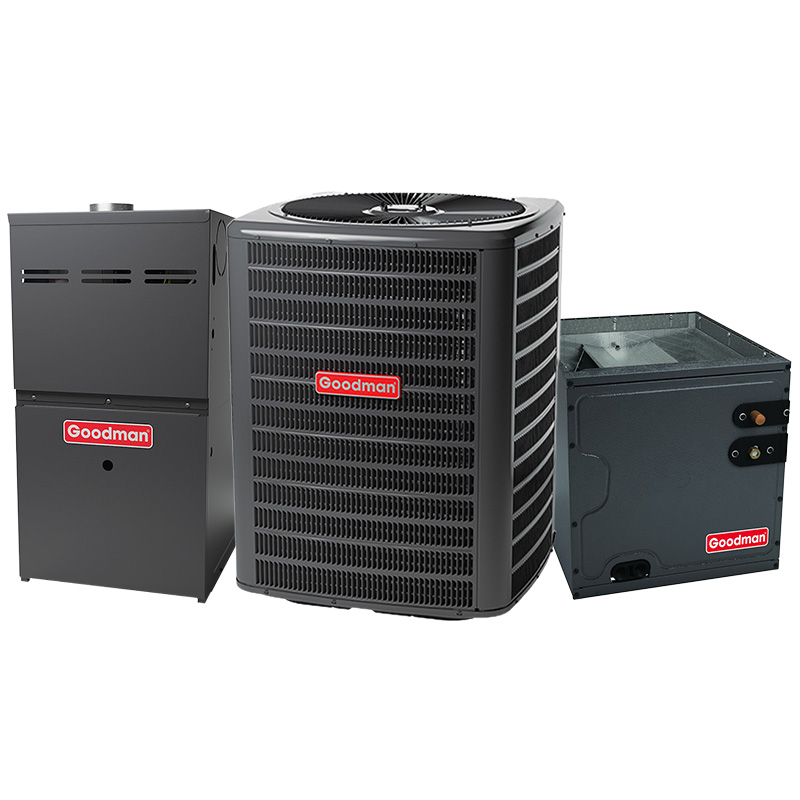
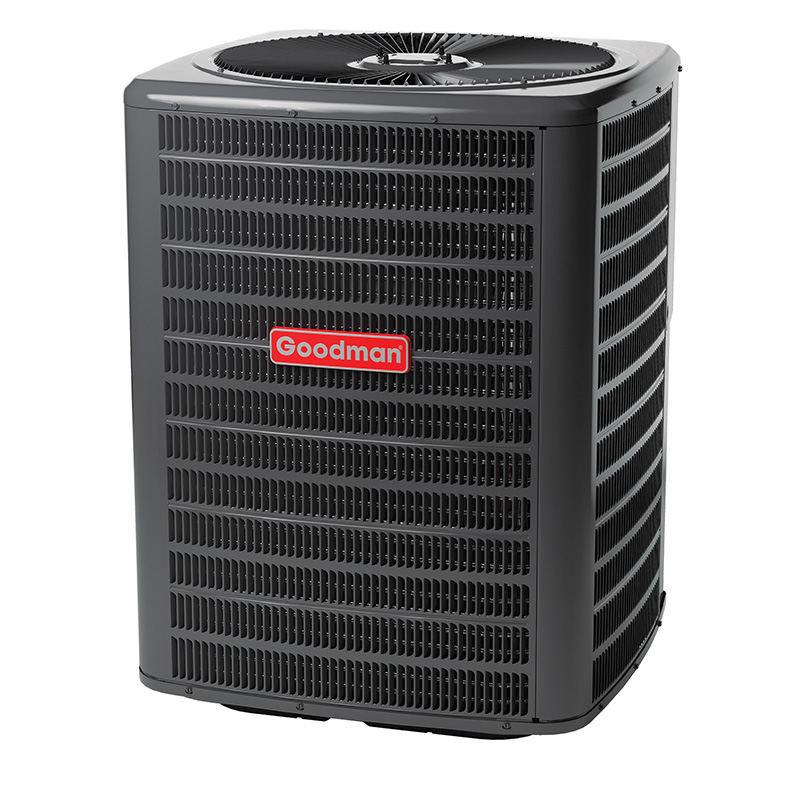
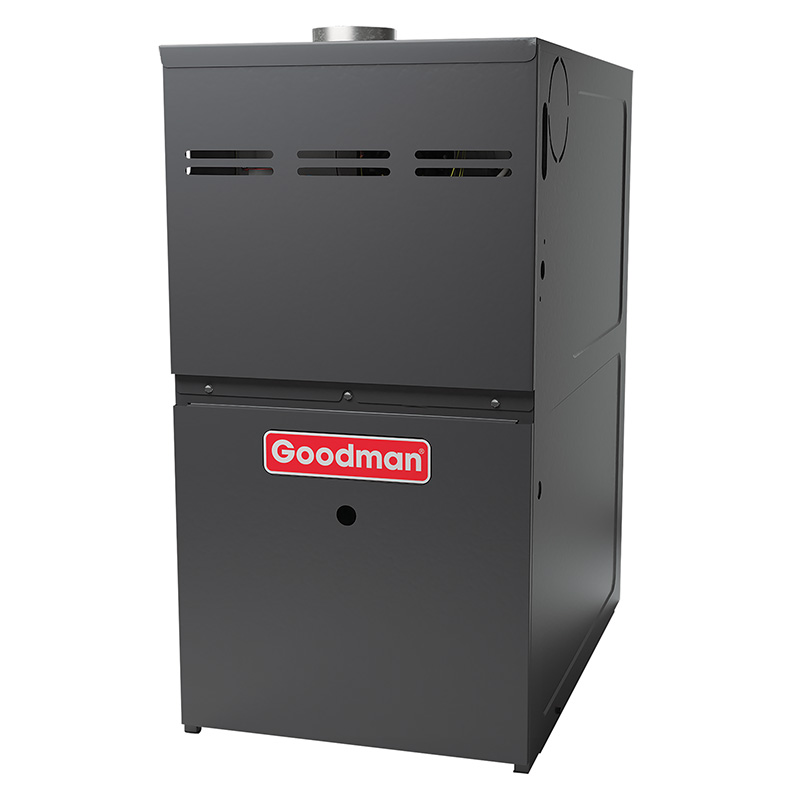
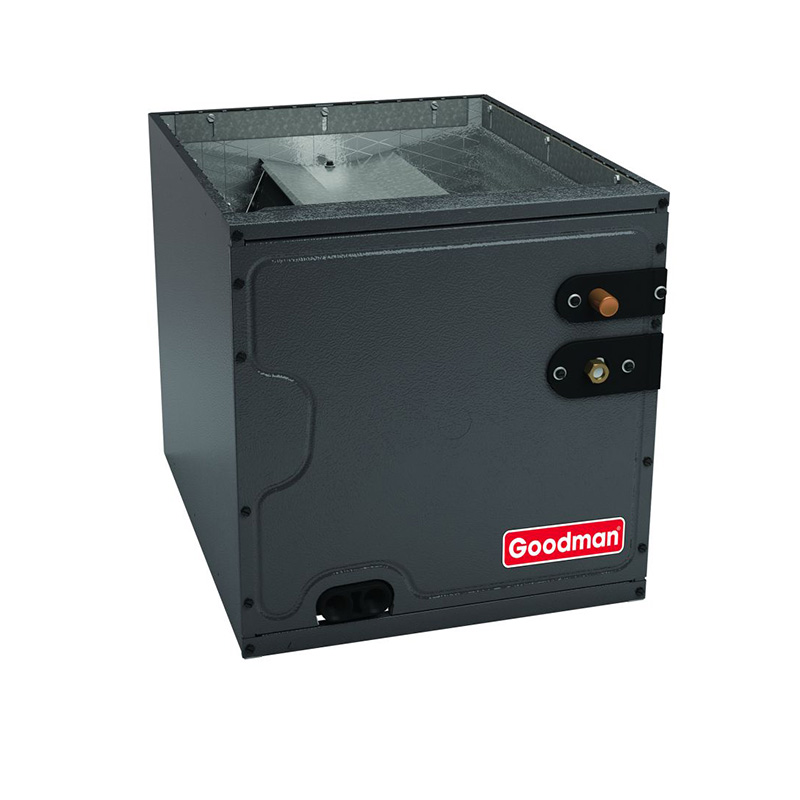
Goodman 5 Ton AC And 100000 BTU 80% AFUE Gas Furnace System | 16 SEER2 AC | Multi-Speed ECM Low NOx Furnace | Upflow | R32
View on AC Direct see your lowest price →Check current price on AC Direct →
Key features
- 5-ton cooling capacity rated at 16 SEER2
- 100,000 BTU gas furnace at 80% AFUE efficiency
- Multi-speed ECM blower motor for quieter, lower-power air handling
- R-32 refrigerant with lower global-warming potential than R-410A
- Upflow configuration for basement or closet installations with overhead ductwork
- Low NOx burner design for reduced nitrogen oxide emissions
About this system
This Goodman package pairs a 5-ton, 16 SEER2 air conditioner with a 100,000 BTU, 80% AFUE gas furnace in an upflow configuration, making it a practical choice for larger homes in the 2,500 to 3,500 square foot range that need serious cooling capacity alongside reliable winter heating. The 16 SEER2 rating sits at the entry point of current federal minimum-efficiency tiers, which means operating costs are reasonable but not class-leading. The 80% AFUE furnace means 20 cents of every heating dollar goes up the flue, so homeowners in cold climates with long heating seasons may want to weigh whether a 96% AFUE unit would recover the price difference over time.
Two specs worth noting: the system runs R-32 refrigerant, a lower global-warming-potential refrigerant that is increasingly standard and easier to service as the industry moves away from R-410A. The multi-speed ECM blower motor in the furnace improves air distribution and humidity control compared to single-speed alternatives, and it draws less electricity during blower-only operation. The upflow configuration suits homes where the air handler sits in a basement or closet with ductwork running upward, which is the most common setup in northern and mid-continental markets. As with any Goodman system, the quality of the installing contractor is a genuine variable in how this unit performs long term.
This Goodman system delivers solid entry-level efficiency at a price point that undercuts comparable Carrier, Trane, and Lennox packages by 15 to 25 percent, making it an accessible option for budget-conscious homeowners in larger homes. The ECM motor and R-32 refrigerant are genuine forward-looking features, but the 80% AFUE furnace and documented reliability concerns around capacitors, coil leaks, and compressor longevity mean buyers are trading some long-term peace of mind for upfront savings. Whether that trade-off works depends heavily on install quality and how much the homeowner values an extended parts warranty versus a premium brand's track record.
Overall score is the average of the five ratings above.
What we like
- Upfront cost is 15 to 25 percent below comparable Carrier, Trane, and Lennox systems
- Multi-speed ECM motor improves comfort and reduces blower energy use versus single-speed units
- R-32 refrigerant is lower-GWP and will face fewer supply restrictions than R-410A going forward
- Low NOx burner meets stricter regional air quality requirements, including California markets
- Goodman's parts are widely stocked, so capacitors and other common repairs are rarely a wait
Trade-offs
- 80% AFUE furnace is the least efficient tier available; homeowners in cold climates pay more to heat over the life of the system
- Compressor lifespan averages 10 to 14 years versus 15 to 20 years for premium brands, raising long-term replacement risk on a 5-ton unit where compressors are expensive
- Evaporator coil leaks appear in a meaningful share of owner reviews, which can mean refrigerant loss and costly mid-life repairs
- ConsumerAffairs feedback averages around 2.5 out of 5, with recurring complaints about repair costs climbing after year 7
What homeowners and pros say about Goodman
Homeowners who post about Goodman equipment online tend to split along a clear line: those who got a clean install from an experienced contractor report years of trouble-free operation and point to affordability as the main draw, while those who encountered problems cite the recurring issues directly. On ConsumerAffairs, Goodman scores around 2.5 out of 5, and the dominant complaint pattern is repair costs that start climbing after about year 7, with coil leaks and compressor work mentioned most often. Google dealer reviews sit higher at roughly 3.8 out of 5, where customers frequently praise the price-to-capacity ratio, though those reviews also reflect the dealer’s install and service quality as much as the equipment itself.
HVAC technicians who work on Goodman units regularly tend to call it exactly what it is: a budget brand that performs acceptably when installed well and maintained consistently. The dual-run capacitor is the single most commonly replaced part, a repair that usually runs $300 to $600 and is quick to complete because the parts are stocked everywhere. Evaporator coil leaks are the failure mode that draws more frustration, since a confirmed leak mid-ownership means refrigerant costs, labor, and sometimes a coil replacement that rivals the savings from buying Goodman in the first place. Compressor longevity averaging 10 to 14 years on a 5-ton unit is worth factoring into any ownership-cost calculation, particularly since replacing a large-capacity compressor is not an inexpensive job.
Sources: ConsumerAffairs Goodman owner reviews, AHRI Directory of Certified Product Performance, U.S. DOE appliance and equipment efficiency standards, Goodman product specification sheets.
What it costs to run
At 16 SEER2, cooling this 5-ton system for a typical 1200-hour cooling season at the U.S. average electricity rate of $0.17/kWh works out to roughly $765 per year in cooling, about $148 less per year than a minimum-efficiency 13.4 SEER2 unit of the same size. Your real cost depends on your climate and local rate.
Method: (60,000 BTU/hr ÷ 16 SEER2) × 1200 hours ÷ 1000 × $0.17/kWh. Rate source: U.S. EIA average; cooling hours: moderate-climate estimate.
How it compares
| Brand | Comparable model | SEER2 | Stage | Price position |
|---|---|---|---|---|
| Goodman | GSXH5 / GMVC8 Series | 16 | Single-stage / Multi-speed | Value pick |
| Carrier | Comfort 16 (24ACC6) with 58SC Furnace | 16 | Single-stage | Typically 15 to 25 percent more than this Goodman system |
| Trane | XR16 (4TTR6) with S8X1 Furnace | 16 | Single-stage | Typically 15 to 25 percent more than this Goodman system |
| Lennox | Merit 16 (ML16XC1) with ML180 Furnace | 16 | Single-stage | Typically 15 to 25 percent more than this Goodman system |
Competitor rows are comparable single-stage units at similar efficiency; price is relative position, not a quote.
Questions about this system
Is 5 tons the right size for my house, or can I just go bigger to be safe?
Oversizing a 5-ton unit in a home that needs 3.5 or 4 tons causes short-cycling, poor humidity removal, and accelerated wear on the compressor. You should have a Manual J load calculation done by your contractor before ordering; the square footage rule of thumb is a starting point, not a substitute for that calculation.
What does 80% AFUE actually mean for my heating bill compared to a 96% furnace?
An 80% AFUE furnace converts 80 cents of every dollar of gas into heat; a 96% unit converts 96 cents. On a $1,200 annual gas bill, that gap is roughly $192 per year. Over 10 years that adds up to around $1,900, so in cold climates the higher-efficiency option can pay back the price difference.
R-32 is new to me. Is it safe and will technicians know how to work with it?
R-32 has a lower global-warming potential than R-410A and is mildly flammable, which requires technicians to follow updated handling procedures. It is becoming mainstream, and most certified HVAC technicians are either trained or getting trained on it; availability is generally not an issue in metro areas.
What is the warranty on this system and what does it actually cover?
Goodman typically offers a 10-year parts warranty when the unit is registered within 60 days of installation, covering major components including the compressor and heat exchanger. Labor is not covered, so a service call plus the technician's time is the homeowner's expense even within the warranty window.
How worried should I be about the documented capacitor and coil leak failure modes?
Dual-run capacitor failures are common across most AC brands, not just Goodman, and a replacement typically runs $300 to $600 including labor. Evaporator coil leaks are a more significant concern because they can mean a few hundred to over a thousand dollars in refrigerant and repair costs; asking your installer about coil protection and confirming proper charge at startup are the best ways to reduce early-failure risk.
Specifications
| Cooling capacity | 5 Ton |
| Efficiency | 16 SEER2 |
| Furnace output | 100000 BTU |
| Furnace efficiency | 80% AFUE |
| Configuration | Upflow |
| Refrigerant | R-32 |