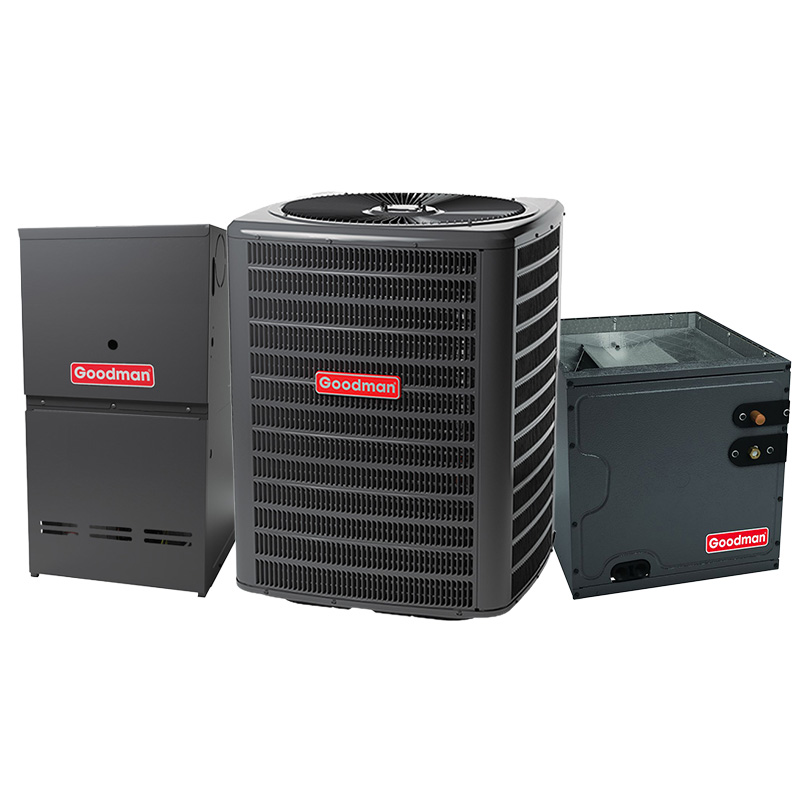
Goodman 5 Ton AC And 100000 BTU 80% AFUE Gas Furnace System | 14 SEER2 AC | Multi-Speed ECM Low NOx Furnace | Downflow | R32
View on AC Direct see your lowest price →Check current price on AC Direct →
Key features
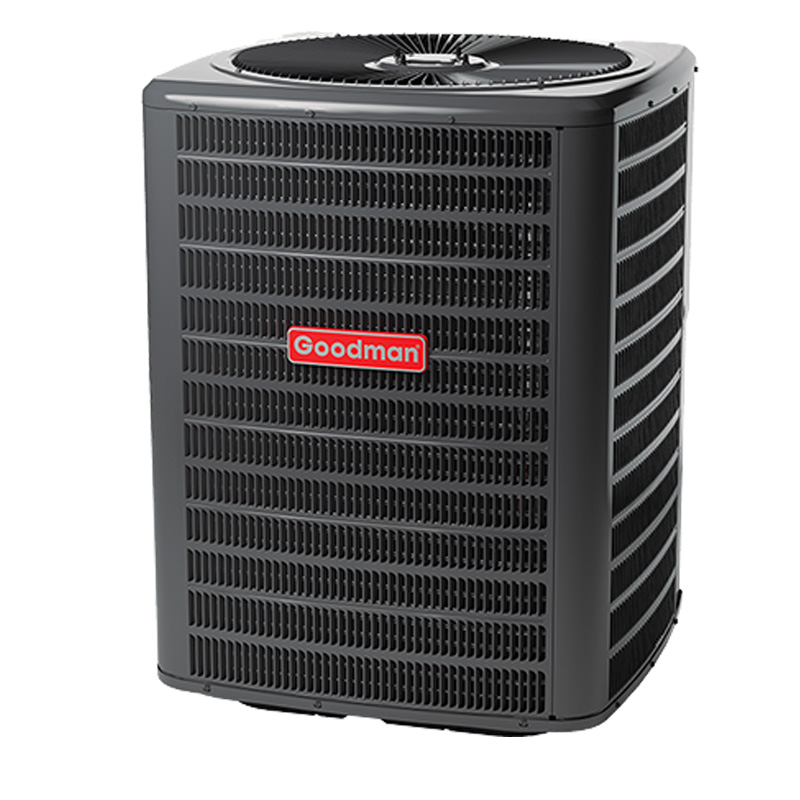
- 14 SEER2 central AC sized for approximately 2,400 to 3,000 sq ft homes
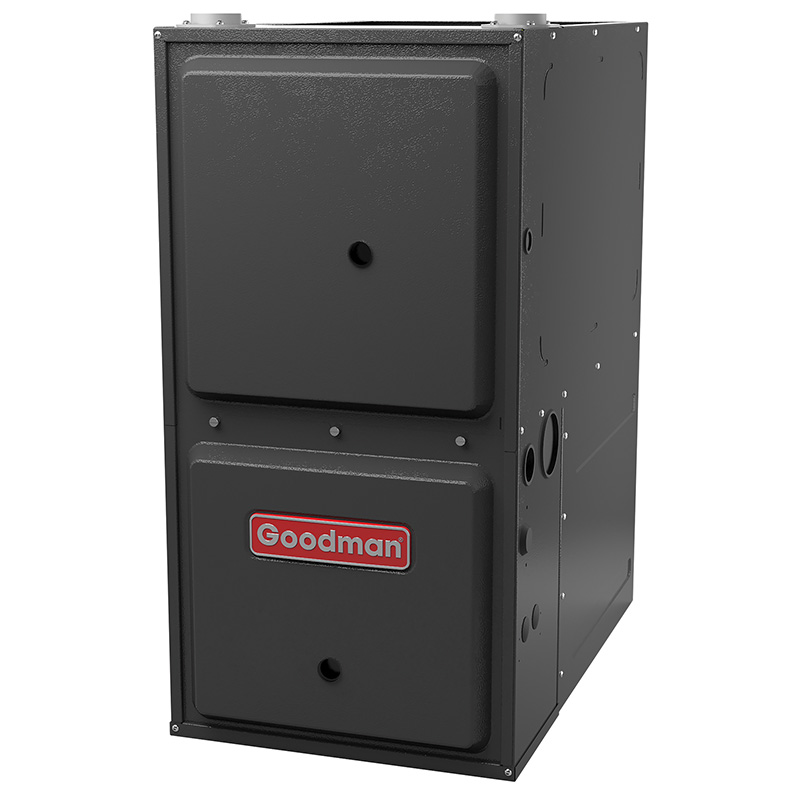
- 100,000 BTU 80% AFUE downflow gas furnace with multi-speed ECM blower
- R-32 refrigerant: lower global warming potential than R-410A
- ECM motor reduces blower electricity use versus standard PSC motors
- Downflow configuration for slab or garage installs with below-unit ductwork
- Low NOx burner design meets strict California and other regional emissions standards
About this system
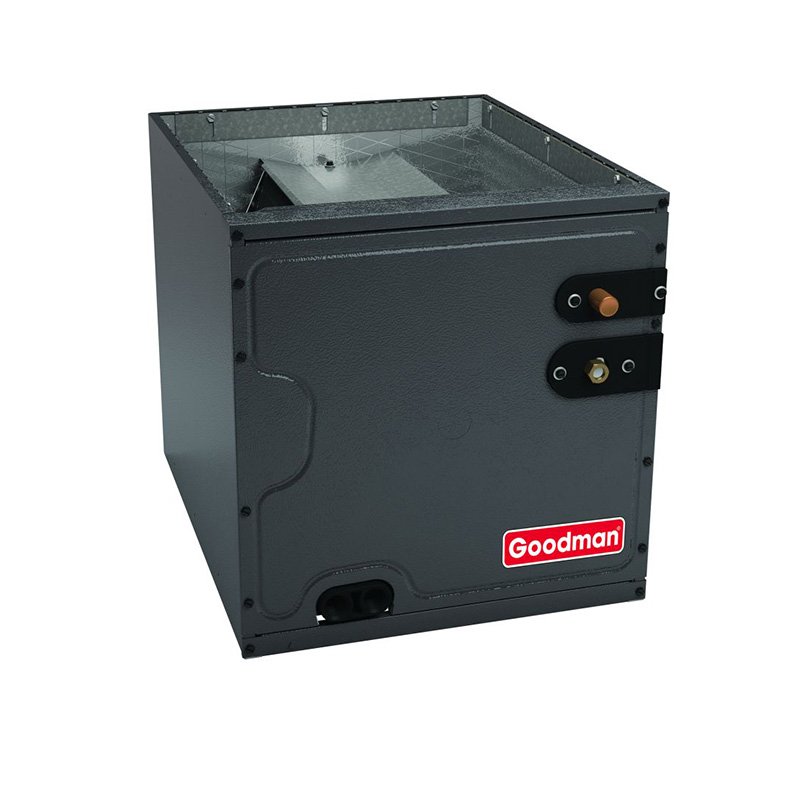
The Goodman 5-ton, 14 SEER2 split system pairs a mid-efficiency central air conditioner with a 100,000 BTU, 80% AFUE downflow gas furnace. At 5 tons, it is sized for larger homes typically in the 2,400 to 3,000 square foot range, though actual sizing should always be confirmed by a Manual J load calculation. The 14 SEER2 rating sits at the current federal minimum efficiency tier for most climate zones, which keeps the purchase price accessible without delivering the operating-cost savings of higher-tier equipment. The R-32 refrigerant charge is a forward-looking choice: R-32 has a lower global warming potential than the R-410A it replaces and is increasingly supported by service technicians nationwide.
The downflow furnace configuration is important to understand before purchasing. Downflow units discharge heated air downward, making them the correct choice for installations where ductwork runs beneath the unit, such as a closet on a slab or a garage installation with under-floor ducts. If your ductwork exits from the top or sides, this is not the right configuration. The multi-speed ECM blower motor is a meaningful spec at this price point: it ramps airflow to demand rather than running at a fixed speed, which reduces electricity consumption during fan-only and cooling cycles and improves humidity control compared to a standard PSC motor. The 80% AFUE furnace means roughly 20 cents of every heating dollar exits as exhaust, making this a reasonable but not high-efficiency heating choice, best suited to moderate heating climates or buyers where gas prices are low.
This system delivers honest, code-minimum cooling and adequate heating at a price point noticeably below Carrier, Trane, and Lennox equivalents, making it a workable choice for budget-focused buyers who understand the trade-offs. Performance and longevity are heavily dependent on installation quality and a correctly sized refrigerant charge. Buyers who can invest in a careful install and plan for possible capacitor or coil service after year seven will get reasonable value; those expecting premium-brand durability without premium-brand maintenance budgets may be disappointed.
Overall score is the average of the five ratings above.
What we like
- Purchase price runs 15 to 25 percent below comparable Trane, Lennox, and Carrier systems
- R-32 refrigerant is more environmentally responsible and increasingly serviceable
- ECM multi-speed blower improves comfort and humidity control versus fixed-speed alternatives
- Low NOx burner meets California air quality rules, broadening installation eligibility
- Downflow configuration correctly addresses installations where standard upflow units cannot be used
Trade-offs
- 14 SEER2 is the federal efficiency floor, so operating costs will be higher than 16+ SEER2 alternatives over the system's life
- 80% AFUE means significant heat loss up the flue, a real cost in colder climates with high gas prices
- Compressor lifespan averages 10 to 14 years versus 15 to 20 years for premium brands, meaning earlier replacement likelihood
- Documented failure modes include dual-run capacitor failures, evaporator coil leaks, and a minority of first-year refrigerant leaks tied to charge or install issues
What homeowners and pros say about Goodman
Homeowners who post about Goodman online fall into two fairly distinct camps. On Google dealer review pages, where ratings average around 3.8 out of 5, the most consistent praise is straightforward: the system cools the house, the price was reasonable, and the contractor made it work. Criticism in those same reviews tends to cluster around service response after installation rather than the equipment itself. On ConsumerAffairs, where Goodman scores closer to 2.5 out of 5, the tone shifts. That platform collects complaints disproportionately, and the recurring story there is of repair bills arriving after year seven or eight, often tied to dual-run capacitor failures (generally a 300 to 600 dollar fix) or evaporator coil leaks that cost more. A smaller subset of owners report refrigerant leaks within the first year, which technicians and Goodman’s own documentation suggest are usually an installation or initial charge problem rather than a manufacturing defect.
HVAC professionals tend to have a pragmatic view of Goodman. Many installers will put one in without hesitation when a customer has a hard budget ceiling, while noting that the compressor lifespan on Goodman equipment tends to run 10 to 14 years in practice, compared to 15 to 20 years they expect from Trane or Carrier compressors. The consistent message from the trade is that Goodman’s outcome is heavily install-dependent: a careful contractor who properly sizes the refrigerant charge, verifies airflow through the ECM blower, and commissions the system completely will get a functional 10-plus year run out of this equipment. A rushed install on the same unit is where the early failure stories originate. For a large 5-ton downflow system like this one, that installer quality caveat carries extra weight, since oversized or undercharged systems at this capacity can stress components quickly.
Sources: ConsumerAffairs Goodman owner reviews, AHRI Directory of Certified Product Performance, U.S. DOE appliance and equipment efficiency standards, Goodman product specification sheets.
What it costs to run
At 14 SEER2, cooling this 5-ton system for a typical 1200-hour cooling season at the U.S. average electricity rate of $0.17/kWh works out to roughly $874 per year in cooling, about $39 less per year than a minimum-efficiency 13.4 SEER2 unit of the same size. Your real cost depends on your climate and local rate.
Method: (60,000 BTU/hr ÷ 14 SEER2) × 1200 hours ÷ 1000 × $0.17/kWh. Rate source: U.S. EIA average; cooling hours: moderate-climate estimate.
How it compares
| Brand | Comparable model | SEER2 | Stage | Price position |
|---|---|---|---|---|
| Goodman | 5-Ton 14 SEER2 AC + 100K BTU 80% AFUE Downflow Furnace (this system) | 14 | Single-stage | Value pick |
| Carrier | Comfort 24ACC636 AC + 58MXA100 80% AFUE Furnace | 14-15 | Single-stage | 15 to 25 percent higher than this system |
| Trane | XR14 AC + S8X1 80% AFUE Furnace | 14-15 | Single-stage | 20 to 30 percent higher than this system |
| Lennox | Merit ML14XC1 AC + ML180 80% AFUE Furnace | 14-15 | Single-stage | 20 to 30 percent higher than this system |
Competitor rows are comparable single-stage units at similar efficiency; price is relative position, not a quote.
Questions about this system
Why does the furnace have to be downflow? Can I flip it to upflow for my installation?
No. Downflow furnaces are built with the heat exchanger, burner, and cabinet drainage oriented specifically for top-in, bottom-out airflow. Flipping the cabinet would compromise safety and void the warranty. If your ductwork exits from the top, you need an upflow or horizontal model instead.
Is R-32 refrigerant easy to find and service in my area?
R-32 availability has expanded significantly as manufacturers shift away from R-410A, and most well-stocked HVAC supply houses carry it. That said, R-32 is mildly flammable (A2L classification), which means technicians need specific recovery equipment and training. Confirm your local service providers are equipped before purchasing.
Goodman shows up on ConsumerAffairs with low scores. Should that concern me?
ConsumerAffairs scores roughly 2.5 out of 5 for Goodman, but that platform is complaint-driven by nature and overrepresents dissatisfied owners. Google dealer reviews average around 3.8 out of 5, where the most common feedback is positive on affordability. The honest picture is that Goodman builds a functional budget product where repair costs and reliability issues tend to surface after year seven, particularly around capacitors and evaporator coils.
What is the warranty on this system and are there any conditions I need to know about?
Goodman generally offers a 10-year parts warranty when the unit is registered within 60 days of installation by a licensed contractor. Failing to register typically drops coverage to five years. The warranty covers parts but not labor, which can be a significant out-of-pocket cost if a compressor or heat exchanger fails outside the labor warranty window your installer provides.
Is 5 tons the right size for my home, or should I trust the previous unit's tonnage?
Previous unit size is not a reliable guide because the original system may have been oversized, the home may have been reinsulated or had windows replaced, or the original contractor may have made an error. A Manual J load calculation by your installer is the only accurate way to confirm that 5 tons is correct for your specific house, climate zone, and duct system.
Specifications
| Cooling capacity | 5 Ton |
| Efficiency | 14 SEER2 |
| Furnace output | 100000 BTU |
| Furnace efficiency | 80% AFUE |
| Configuration | Downflow |
| Refrigerant | R-32 |