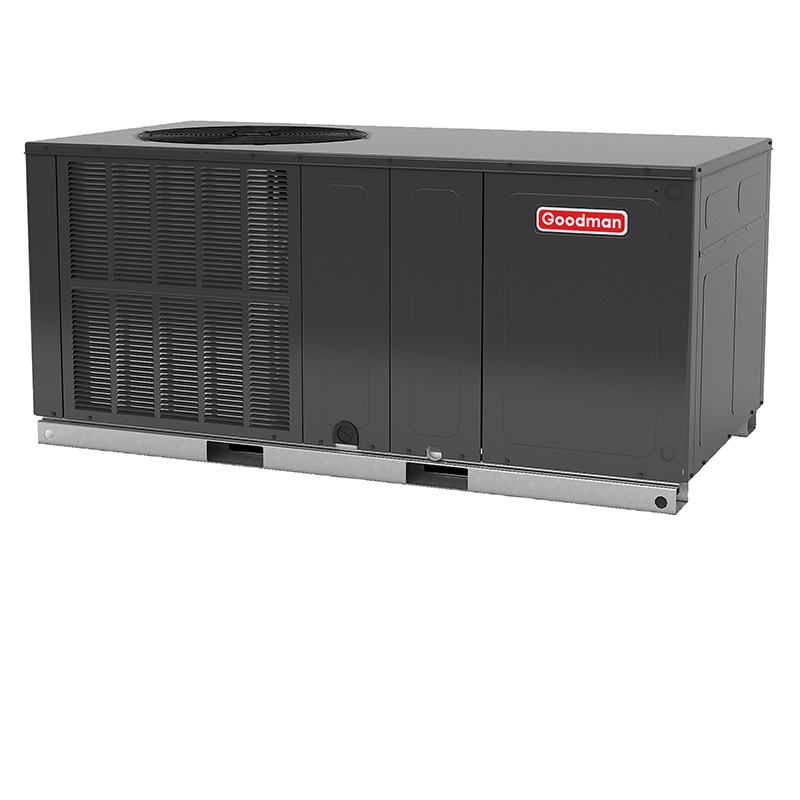
Goodman 5 Ton Package Unit Cooling Only Air Conditioning | 13.4 SEER2 | Horizontal | R32
View on AC Direct see your lowest price →Check current price on AC Direct →
Key features
- 5-ton cooling capacity suited for larger residential or light commercial spaces
- 13.4 SEER2 efficiency rating meets current federal minimum standards
- Horizontal cabinet configuration for crawlspace, rooftop, or ground-level side discharge installs
- R-32 refrigerant with lower global warming potential than legacy R-410A
- Single-stage cooling operation with straightforward on/off compressor cycling
- All-in-one package design consolidates components into one serviceable cabinet
About this system
The Goodman 5-ton cooling-only package unit is a self-contained system that houses the condenser, evaporator coil, and air handler in a single horizontal cabinet, making it the go-to choice for homes and light commercial spaces where a crawlspace or rooftop installation is the only practical option. At 5 tons, it is sized for larger spaces typically in the 2,000 to 2,800 square foot range, though actual sizing should always be confirmed with a Manual J load calculation. The horizontal discharge configuration keeps all components accessible from one location, which simplifies service calls and reduces labor time compared to split-system setups.
Running on R-32 refrigerant, this unit sits ahead of the industry curve on environmental compliance. R-32 has a lower global warming potential than the older R-410A it is replacing, and its higher energy density can contribute to slightly more efficient heat transfer. The 13.4 SEER2 rating meets current federal minimum standards for most U.S. climate regions and represents a meaningful step up from older 10 to 13 SEER equipment, but it stops well short of the 16 to 18 SEER2 territory where premium variable-speed systems operate. For buyers focused on upfront cost over long-term utility savings, that is a reasonable trade-off. For anyone running the system 10 or more hours a day in a hot climate, the efficiency gap versus higher-tier units is worth pricing out before committing.
This Goodman package unit delivers solid entry-level cooling capacity at a price point that is genuinely hard to argue with for budget-conscious buyers who need a horizontal configuration. The 13.4 SEER2 rating is adequate but not exceptional, and the system's long-term performance will depend heavily on installation quality and a willingness to budget for maintenance after year seven. It is a sensible workhorse, not a premium investment.
Overall score is the average of the five ratings above.
What we like
- Purchase price runs roughly 15 to 25 percent below comparable Carrier, Trane, and Lennox units
- R-32 refrigerant positions the unit for longer regulatory compliance as R-410A is phased out
- Horizontal all-in-one design simplifies installation where a split system is not feasible
- Single-stage operation keeps controls and service diagnostics straightforward for technicians
- Goodman's wide dealer and parts network means service availability is rarely an issue
Trade-offs
- Compressor lifespan averages 10 to 14 years, shorter than the 15 to 20 years typical of premium brands
- Dual-run capacitor failures are the most commonly reported issue and tend to appear after moderate use, even though the repair cost is relatively low
- Evaporator coil leaks show up in a meaningful share of owner reports and can be a more costly fix
- A minority of owners report refrigerant leaks in the first year, usually tied to installation quality rather than manufacturing
What homeowners and pros say about Goodman
Homeowners on forums and review platforms tend to split along two lines when discussing Goodman equipment. Those who had a skilled installer and stayed current on maintenance often report years of uneventful operation and point to the lower purchase price as a genuine win. Those who ran into trouble more quickly frequently mention repair bills that started climbing around year seven or eight, which aligns with Goodman’s ConsumerAffairs score of roughly 2.5 out of 5, a channel where complaint-driven reviews dominate and recurring themes center on post-warranty repair costs. Google dealer reviews tell a more balanced story, averaging around 3.8 out of 5 across locations, where affordability is the most consistent praise. Neither number tells the whole story, but together they suggest a brand that performs acceptably when conditions are favorable and struggles to inspire loyalty when they are not.
HVAC technicians are generally consistent in one observation: installation quality matters more with Goodman than with premium brands because there is less built-in margin for error in the components. The documented failure modes they see most often are dual-run capacitor failures, which are a quick and relatively inexpensive fix, and evaporator coil leaks, which are not. Compressor longevity averaging 10 to 14 years versus the 15 to 20 years typical of Trane or Carrier equipment is a real consideration on a 5-ton unit, where a compressor replacement is a significant cost. For a 5-ton horizontal package unit specifically, pros note that the all-in-one cabinet design does make service access more straightforward than some split configurations, which partially offsets the higher-than-average likelihood of needing service in the first place.
Sources: ConsumerAffairs Goodman owner reviews, AHRI Directory of Certified Product Performance, U.S. DOE appliance and equipment efficiency standards, Goodman product specification sheets.
What it costs to run
At 13.4 SEER2, cooling this 5-ton system for a typical 1200-hour cooling season at the U.S. average electricity rate of $0.17/kWh works out to roughly $913 per year in cooling, about $0 less per year than a minimum-efficiency 13.4 SEER2 unit of the same size. Your real cost depends on your climate and local rate.
Method: (60,000 BTU/hr ÷ 13.4 SEER2) × 1200 hours ÷ 1000 × $0.17/kWh. Rate source: U.S. EIA average; cooling hours: moderate-climate estimate.
How it compares
| Brand | Comparable model | SEER2 | Stage | Price position |
|---|---|---|---|---|
| Goodman | 5-Ton Cooling-Only Package Unit (this unit) | 13.4 | Single-stage | Value pick |
| Carrier | WeatherMaster 50XC Series | 13.4-14.0 | Single-stage | Typically 15 to 25 percent more than this Goodman |
| Trane | YCC Series Package Cooling | 13.4-14.0 | Single-stage | Typically 15 to 25 percent more than this Goodman |
| Lennox | LRP14 Series Package Unit | 14.0 | Single-stage | Typically 15 to 25 percent more than this Goodman |
Competitor rows are comparable single-stage units at similar efficiency; price is relative position, not a quote.
Questions about this system
Is 5 tons the right size for my home?
A 5-ton unit is generally appropriate for spaces in the 2,000 to 2,800 square foot range, but square footage alone is not a reliable guide. Insulation levels, window area, climate zone, and ceiling height all affect the correct load. Have an HVAC contractor run a Manual J calculation before purchasing to avoid oversizing, which causes short-cycling and humidity problems.
What does the horizontal configuration actually mean for installation?
Horizontal means the supply and return air connections run out the side of the cabinet rather than the bottom, making the unit suited for crawlspace mounting, rooftop curb applications, or ground-level side-discharge setups. It cannot be swapped into a vertical configuration, so confirm your ductwork and space requirements match before ordering.
How does R-32 refrigerant affect service and maintenance costs?
R-32 requires technicians who are certified to handle mildly flammable refrigerants, and not every HVAC company has that certification yet, though adoption is growing quickly. Parts and refrigerant availability are improving, but in some markets you may have a smaller pool of qualified service providers compared to R-410A systems for the next few years.
What are the most likely repair costs I should budget for over 10 years?
Dual-run capacitor replacements are the most commonly reported issue on Goodman equipment and typically run in the 300 to 600 dollar range including labor. Evaporator coil leaks are a more expensive repair and appear in a notable share of owner accounts. Setting aside 150 to 200 dollars annually for a maintenance contract and a small repair fund is a reasonable approach.
Does this unit qualify for any federal tax credits or utility rebates?
As of 2025, the federal 25C energy efficiency tax credit for central air conditioning generally requires a SEER2 of 16 or higher for split systems, and package unit thresholds vary by equipment class. At 13.4 SEER2, this unit is unlikely to qualify for the federal credit, but local utility rebates have different and sometimes lower thresholds, so check your utility's current program before ruling it out.
Specifications
| Cooling capacity | 5 Ton |
| Efficiency | 13.4 SEER2 |
| Configuration | Horizontal |
| Refrigerant | R-32 |