Goodman 5 Ton 100000 BTU 13.4 SEER2 Gas/Electric Package Unit Multiposition
View on AC Direct see your lowest price →Check current price on AC Direct →
Key features
- 5-ton cooling capacity with 100,000 BTU gas heating in a single outdoor cabinet
- 13.4 SEER2 efficiency rating meets current federal minimum standards
- Multiposition design supports horizontal or downflow duct connections
- Self-contained package unit eliminates the need for a separate indoor air handler
- Compatible with standard thermostat controls and most existing duct systems
- Factory-tested refrigerant charge and wiring before shipment
About this system
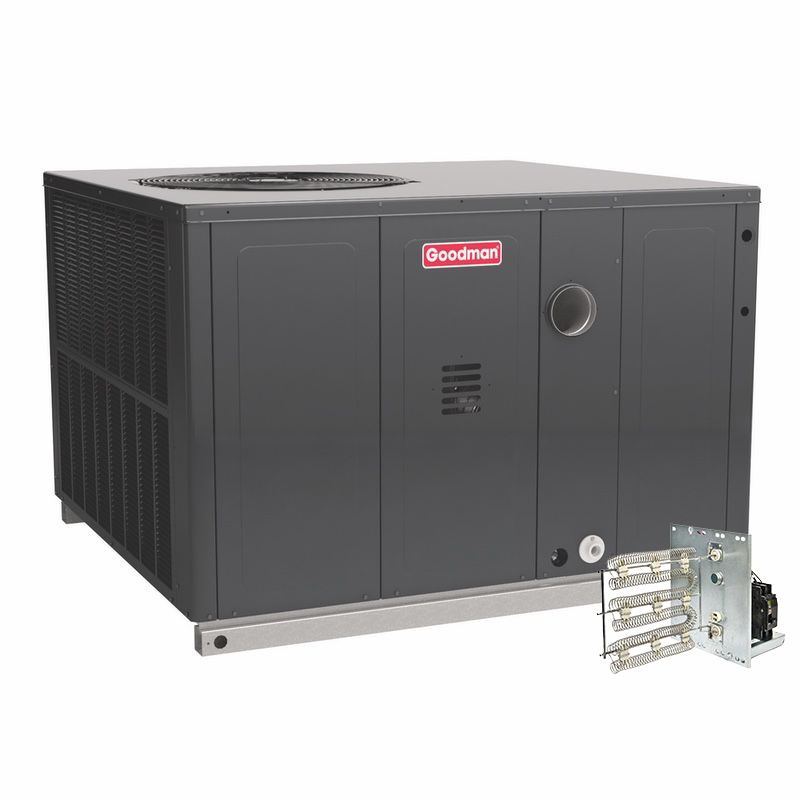
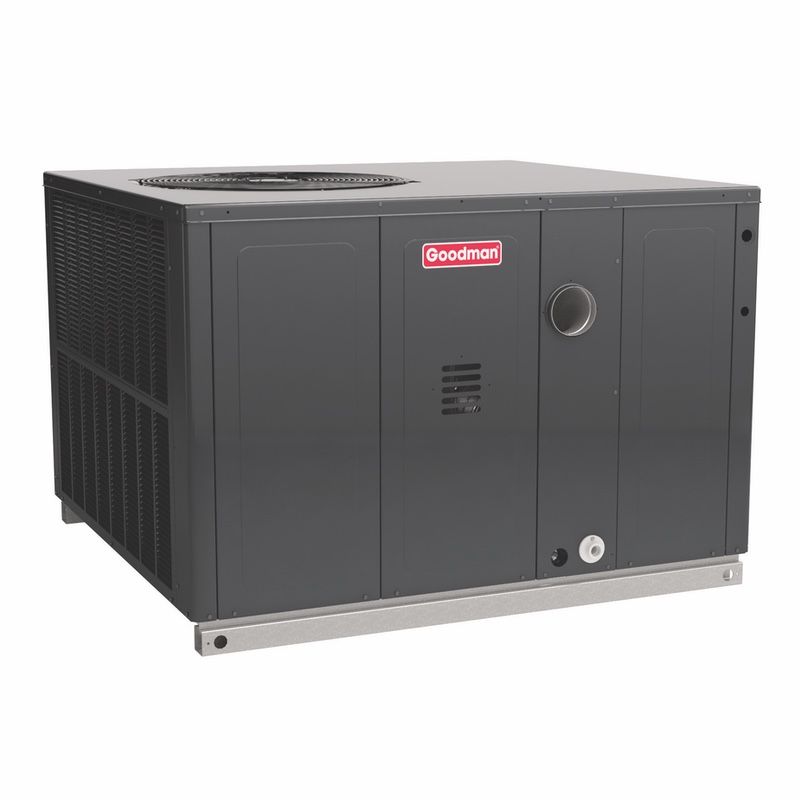
The Goodman GPGM36110041 is a 5-ton, 100,000 BTU gas/electric package unit rated at 13.4 SEER2. A package unit houses the air handler, cooling coil, and gas furnace section all in one outdoor cabinet, making it a practical choice for homes built on slabs, mobile homes, or buildings where interior mechanical space is limited. The multiposition design allows the unit to be installed in a horizontal or downflow configuration, giving contractors flexibility in how ductwork connects to the cabinet.
At 13.4 SEER2, this system meets the federal minimum efficiency standard for most U.S. regions but sits at the low end of the efficiency spectrum. Homeowners in climates with long, hot summers will see higher monthly utility costs compared to a 16 or 18 SEER2 system, though the lower purchase price can offset that difference over a shorter payback period in moderate climates. The 100,000 BTU heating section delivers substantial capacity for large homes, but accurate Manual J load calculations are essential before committing to this size. Oversizing a package unit is a common mistake that leads to short-cycling, poor humidity control, and premature wear.
The GPGM36110041 is a straightforward, no-frills package unit that delivers solid capacity at a price point meaningfully below Carrier, Trane, and Lennox equivalents. Efficiency is baseline, not impressive, and long-term costs depend heavily on how well the unit is installed and maintained. Buyers who prioritize upfront affordability over long-term efficiency or compressor longevity will find this a reasonable fit.
Overall score is the average of the five ratings above.
What we like
- Lower purchase price than comparable Carrier, Trane, or Lennox package units by roughly 15 to 25 percent
- All-in-one cabinet simplifies installation where indoor mechanical space is unavailable
- Multiposition configuration gives contractors flexibility with duct routing
- Factory refrigerant charge and wiring reduce installation variables
- Widely stocked by HVAC distributors, which supports parts availability for repairs
Trade-offs
- 13.4 SEER2 is the regulatory floor, meaning operating costs will be higher than mid- or high-efficiency alternatives over time
- Dual-run capacitors are a documented early failure point, and evaporator coil leaks appear in a meaningful share of owner reports
- Compressor lifespan averages 10 to 14 years, noticeably shorter than the 15 to 20 years reported for premium brands
- A minority of owners report refrigerant leaks within the first year, often tied to installation or factory charge issues rather than the unit itself
What homeowners and pros say about Goodman
Homeowners who have installed Goodman package units generally have one of two experiences: the unit runs without issue for years, or repair costs start climbing noticeably after the seven-year mark. That split shows up in the brand’s ratings. Goodman scores around 2.5 out of 5 on ConsumerAffairs, a channel that tends to attract frustrated owners, where the recurring complaint is unexpected repair bills in the second half of the unit’s life. Google dealer reviews paint a more balanced picture, averaging around 3.8 out of 5, with affordability consistently cited as the main reason buyers chose Goodman in the first place. For this 5-ton package unit, the most important thing owners and technicians agree on is that installation quality determines a great deal of how long the system lasts and how often it needs service.
HVAC technicians who service Goodman equipment most often flag two recurring issues: dual-run capacitor failures, which typically show up as a unit that stops cooling and cost roughly 300 to 600 dollars to fix, and evaporator coil leaks that show up in a meaningful share of owner reports. Compressor longevity is a real consideration as well. Goodman compressors average 10 to 14 years in service, compared to the 15 to 20 years more commonly reported on Trane, Lennox, and Carrier units. A smaller number of owners report refrigerant leaks within the first twelve months, which technicians generally attribute to installation errors or an improperly verified factory charge rather than the unit itself. For a large, high-demand system like this one, hiring an experienced installer who checks refrigerant charge and static pressure at startup is not optional. It is the single biggest factor in how this unit performs over its service life.
Sources: ConsumerAffairs Goodman owner reviews, AHRI Directory of Certified Product Performance, U.S. DOE appliance and equipment efficiency standards, Goodman product specification sheets.
What it costs to run
At 13.4 SEER2, cooling this 5-ton system for a typical 1200-hour cooling season at the U.S. average electricity rate of $0.17/kWh works out to roughly $913 per year in cooling, about $0 less per year than a minimum-efficiency 13.4 SEER2 unit of the same size. Your real cost depends on your climate and local rate.
Method: (60,000 BTU/hr ÷ 13.4 SEER2) × 1200 hours ÷ 1000 × $0.17/kWh. Rate source: U.S. EIA average; cooling hours: moderate-climate estimate.
How it compares
| Brand | Comparable model | SEER2 | Stage | Price position |
|---|---|---|---|---|
| Goodman | GPGM36110041 | 13.4 | Single-stage | Value pick |
| Carrier | WeatherMaster 50XC series | 14.0 | Single-stage | Typically 15 to 25 percent more than the Goodman |
| Trane | Precedent XR series | 14.0 | Single-stage | Typically 15 to 25 percent more than the Goodman |
| Lennox | Elite XC14 Packaged series | 14.0 | Single-stage | Typically 15 to 25 percent more than the Goodman |
Competitor rows are comparable single-stage units at similar efficiency; price is relative position, not a quote.
Questions about this system
Is 5 tons actually the right size for my house, or should I go smaller?
5 tons covers roughly 2,500 to 3,000 square feet depending on insulation, climate, and ceiling height, but those are rough numbers. An oversized unit short-cycles, which degrades humidity control and accelerates wear on the compressor. Ask your contractor to perform a Manual J load calculation before ordering.
What does the multiposition feature actually mean in practice?
It means the duct connections on the cabinet can be configured for either a horizontal airflow path or a downflow path, which matters when the unit is mounted on a rooftop curb versus a ground-level pad with under-cabinet ductwork. Your installer will select the appropriate configuration during setup.
How worried should I be about the early refrigerant leak reports?
A minority of Goodman owners report refrigerant leaks within the first year, and most HVAC technicians attribute these to installation errors or an improper factory charge rather than a systemic manufacturing defect. Having the installer verify the charge with gauges at startup, rather than trusting the factory charge alone, significantly reduces this risk.
What is the warranty on this unit and what does it actually cover?
Goodman typically offers a 10-year parts limited warranty when the unit is registered within a set window after installation, and a limited lifetime heat exchanger warranty. Labor is not included, which means a repair inside the warranty period still carries a service call cost. Confirm current warranty terms with your dealer at the time of purchase, as Goodman has adjusted coverage details over time.
How does the 13.4 SEER2 rating affect my electricity bills compared to a higher-efficiency option?
13.4 SEER2 meets the current federal minimum but will consume more electricity per cooling hour than a 16 or 18 SEER2 unit. The real-world savings from upgrading efficiency depend on how many hours per year the system runs, your local electricity rate, and the price difference between the two units. In a hot climate where this unit runs 1,500 or more hours per cooling season, the payback on a higher-efficiency model is typically faster.
Specifications
| Cooling capacity | 5 Ton |
| Efficiency | 13.4 SEER2 |
| Furnace output | 100000 BTU |
| Model | GPGM36110041 |