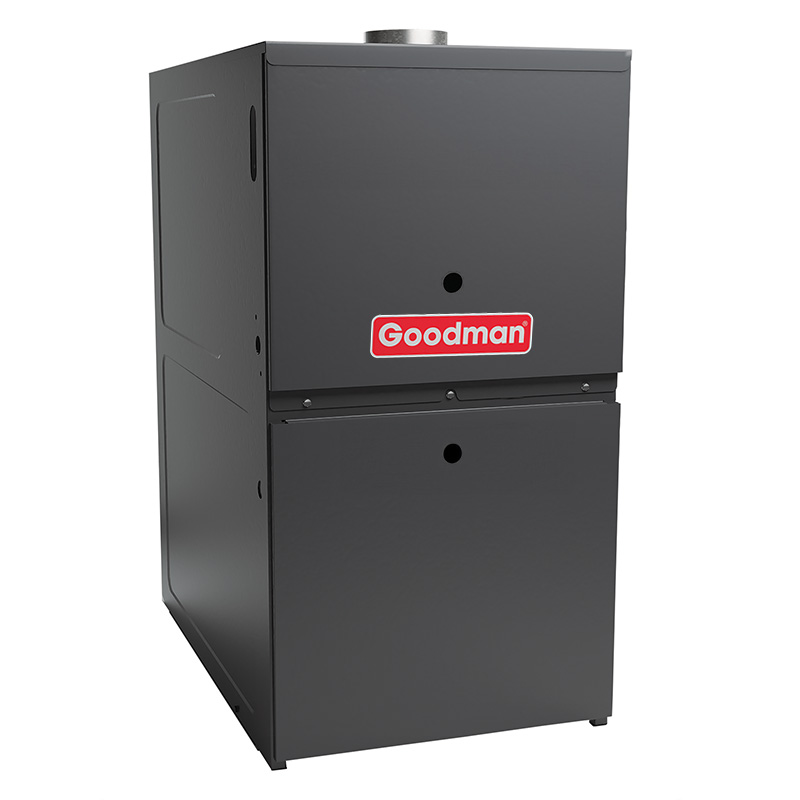
Goodman 60000 BTU 80% Efficiency Two Stage Gas Furnace | Variable-Speed ECM Downflow | Low NOx For California | R32 (GDVT800603BX)
View on AC Direct see your lowest price →Check current price on AC Direct →
Key features
- 60,000 BTU two-stage gas valve fires at reduced capacity first, full capacity only when outdoor temps demand it
- 80% AFUE efficiency rating, meaning 80 cents of every dollar in fuel becomes usable heat
- Variable-speed ECM blower motor reduces electricity use and runs quieter than single-speed motors
- Downflow configuration discharges heated air downward, suited for closet or garage installs over crawl spaces or slabs
- Low NOx certified to meet California CARB requirements for restricted air districts
- Factory-installed pressure switch, two-stage control board, and stainless-steel secondary heat exchanger included
About this system
The Goodman GDVT800603BX is a 60,000 BTU, 80% AFUE two-stage gas furnace built in a downflow configuration, meaning warm air discharges downward through the floor rather than upward through the top. That makes it the right fit for homes where the furnace sits in a closet, garage, or utility space above a crawl space or slab, and ductwork runs below the unit. The variable-speed ECM blower motor is the standout mechanical feature here: it ramps up and down in small increments to hold a steadier indoor temperature, run quieter at low demand, and move air more efficiently than a single-speed PSC motor can. Two-stage gas valve operation lets the furnace fire at a reduced capacity most of the time, reaching full output only on the coldest days, which reduces temperature swings and cuts fuel cycling losses.
The Low NOx designation on this unit meets California Air Resources Board standards, so it is one of the few configurations legal to install in California’s South Coast and Bay Area air districts where conventional furnaces are restricted. The R-32 refrigerant label in the spec sheet is almost certainly a platform or catalog artifact since this is a gas furnace without a refrigerant circuit of its own. If you are pairing it with a split-system air conditioner that uses R-32, compatibility with the air handler side matters, but the furnace itself burns natural gas or propane and does not contain refrigerant. At 60,000 BTU, this unit is sized for roughly 1,200 to 2,000 square feet depending on climate, insulation, and ceiling height, and a proper Manual J load calculation should confirm that before purchase.
The GDVT800603BX delivers a genuine step up in comfort and blower efficiency over a basic single-stage furnace, at a price that undercuts Carrier, Trane, and Lennox by a meaningful margin. The 80% AFUE tier is adequate but not exceptional, and buyers should go in knowing that long-term reliability depends heavily on who installs it and how well they set it up. For California homeowners who need Low NOx compliance and want variable-speed airflow without paying premium-brand prices, this unit earns its place.
Overall score is the average of the five ratings above.
What we like
- Two-stage firing and variable-speed ECM motor together reduce temperature swings and hot-cold cycling noticeably
- Low NOx certification opens up installation in California air districts where standard furnaces cannot be permitted
- Downflow design fills a specific installation need that not every brand covers at this price point
- Lower purchase price than comparable Carrier, Trane, or Lennox two-stage ECM models, typically by 15 to 25 percent
- ECM blower motor cuts fan electricity consumption compared to conventional PSC motors, lowering monthly operating costs
Trade-offs
- 80% AFUE leaves roughly 20% of fuel heat going up the flue; a 96% AFUE condensing furnace would cut that waste significantly in cold climates
- Goodman's repair record after year 7 shows rising costs, and dual-run capacitors are a documented early failure point even on furnace blower circuits
- Compressor and component longevity benchmarks suggest a shorter average service life than premium brands, which matters for a 60,000 BTU unit sized for a smaller home where replacement is proportionally more disruptive
- Downflow-only configuration limits future flexibility if ductwork or home layout changes, and finding a technician familiar with downflow setups in some markets takes extra effort
What homeowners and pros say about Goodman
Homeowners who have installed Goodman furnaces frequently lead with cost as the reason they chose the brand, and that sentiment tracks with Google dealer review averages sitting around 3.8 out of 5 across hundreds of reviews per location. Satisfaction tends to be high in the first few years, particularly among buyers who had a thorough installation with proper static pressure testing and a confirmed gas pressure check. The variable-speed ECM blower on this unit gets specific praise from owners who notice quieter overnight operation compared to older single-speed furnaces.
The more cautionary perspective comes from the longer ownership window. ConsumerAffairs scores for Goodman run around 2.5 out of 5, a channel that skews toward people with complaints, and the recurring pattern in those reviews is repair costs that start accumulating around year 7 or 8. Dual-run capacitors are the most frequently cited failure, typically a 300 to 600 dollar repair that is fast and low-stakes when caught early but frustrating when it happens repeatedly. Technicians who work on Goodman equipment regularly note that the brand is not inherently fragile, but it has less margin for installation shortcuts than premium brands do. For a downflow configuration like this one, where venting and drain routing require extra care, that installer-dependency point matters more than usual.
Sources: ConsumerAffairs Goodman owner reviews, AHRI Directory of Certified Product Performance, U.S. DOE appliance and equipment efficiency standards, Goodman product specification sheets.
How it compares
| Brand | Comparable model | SEER2 | Stage | Price position |
|---|---|---|---|---|
| Goodman | GDVT800603BX | N/A (gas furnace) | Two-stage | Value pick |
| Carrier | Performance 59TP6 (80% AFUE two-stage ECM) | N/A (gas furnace) | Two-stage | Roughly 20 to 30 percent higher than Goodman |
| Trane | S9X2 (80% AFUE two-stage variable-speed) | N/A (gas furnace) | Two-stage | Roughly 20 to 30 percent higher than Goodman |
| Lennox | Merit ML196V (80% AFUE two-stage ECM) | N/A (gas furnace) | Two-stage | Roughly 25 to 35 percent higher than Goodman |
Competitor rows are comparable single-stage units at similar efficiency; price is relative position, not a quote.
Questions about this system
Why does this furnace spec list R-32 refrigerant when it is a gas furnace?
The R-32 notation appears to be a platform or catalog tag related to the matched split-system air conditioner this unit is often sold alongside, not the furnace itself. A gas furnace has no refrigerant circuit. If you are pairing this with an R-32 air conditioner, confirm coil and refrigerant compatibility on the AC side separately.
Is a downflow furnace harder to find service for than an upflow unit?
Most licensed HVAC technicians are comfortable with downflow furnaces, but they are less common than upflow configurations, so it is worth confirming your installer has recent downflow experience. Flue venting angles and drain routing differ from upflow setups, and incorrect installation is the leading cause of early problems with any Goodman unit.
Will this furnace pass a California permit inspection in a restricted air district?
Yes, the Low NOx certification on the GDVT800603BX is specifically designed to meet California CARB standards for the South Coast and Bay Area air districts. Always verify the current NOx limit and permit requirements with your local air quality management district before installation, as rules can change.
How long should I realistically expect this furnace to last?
With proper installation and annual maintenance, 15 to 20 years is achievable, but Goodman's documented track record shows repair costs climbing after roughly year 7. Budgeting for a capacitor or control board replacement in that window is realistic. Premium brands have shown longer average component lifespans, so expectations should be set accordingly.
Is 80% AFUE efficient enough, or should I upgrade to a 96% condensing furnace?
In mild California climates where the heating season is short, 80% AFUE is often cost-effective because the payback period on a more expensive 96% unit stretches out. In colder California regions like the mountains or high desert, the higher efficiency unit pays back faster. Running your local energy costs through an AFUE savings calculator with your actual annual heating hours will give you a clearer answer for your specific address.
Specifications
| Furnace output | 60000 BTU |
| Configuration | Downflow |
| Refrigerant | R-32 |
| Model | GDVT800603BX |